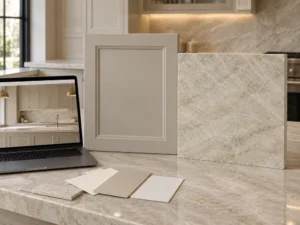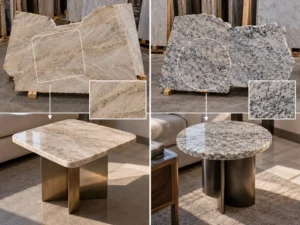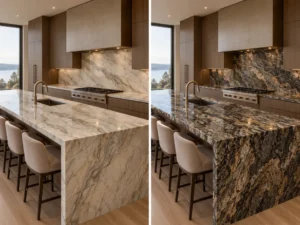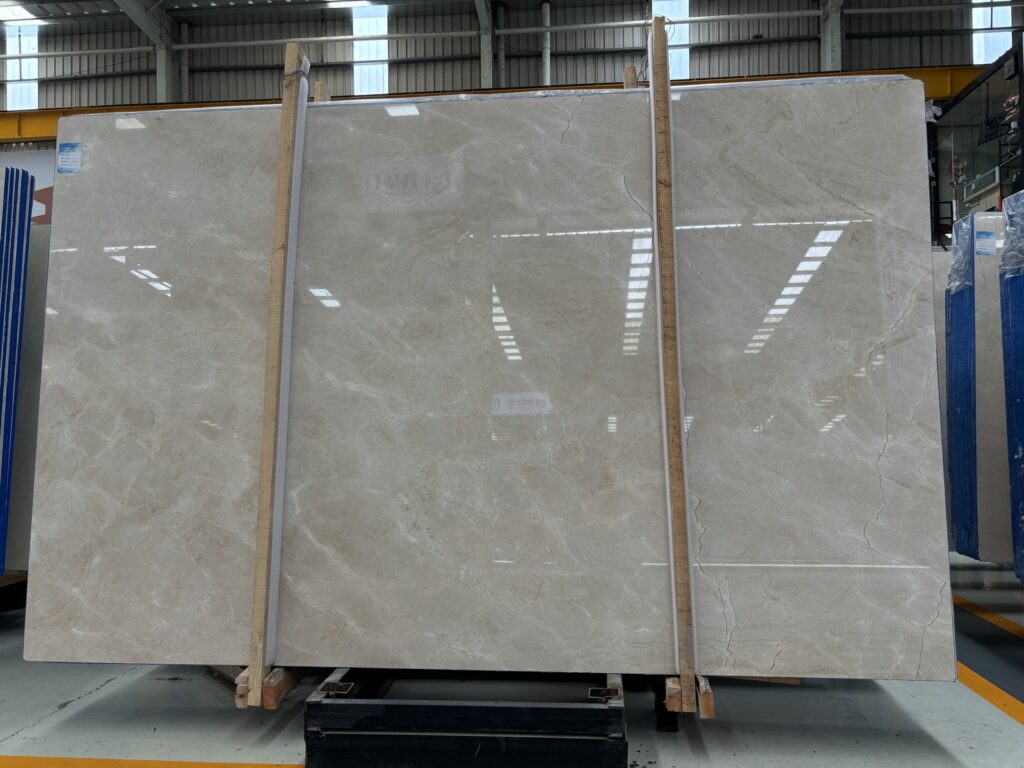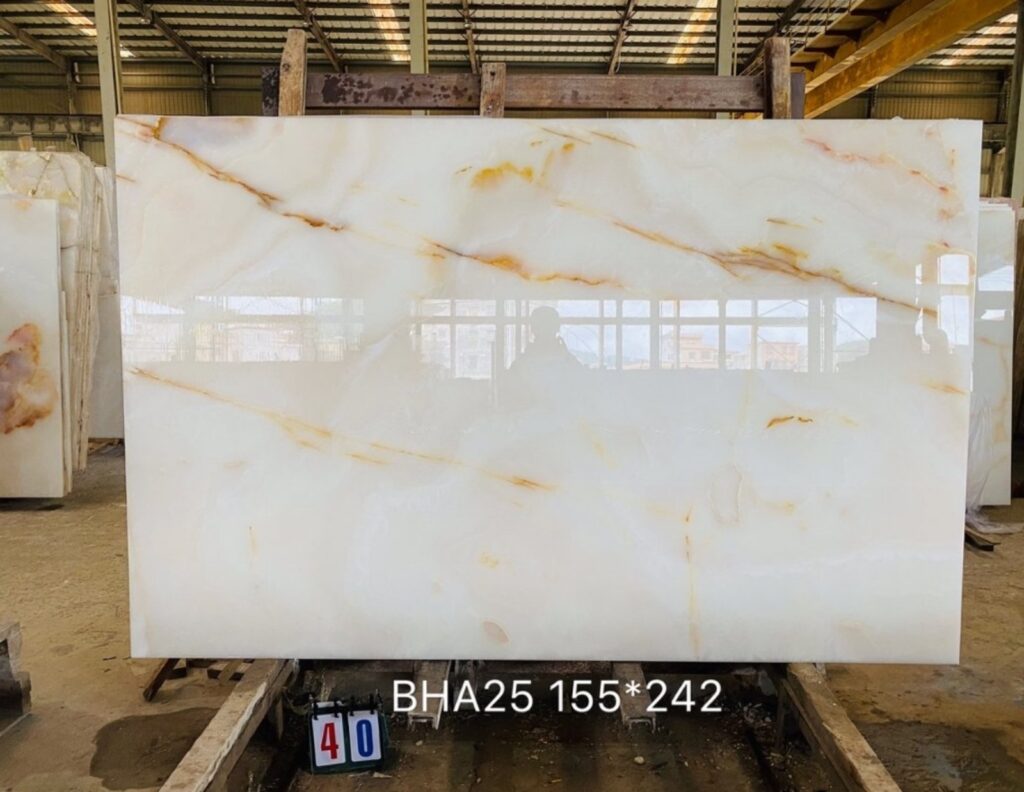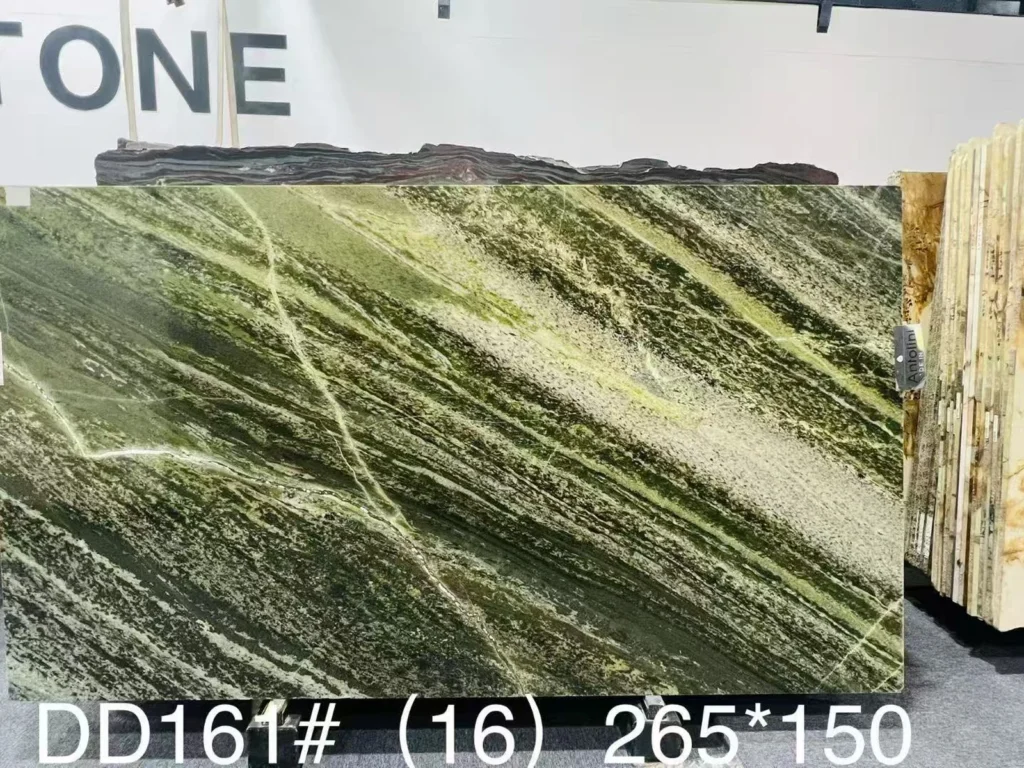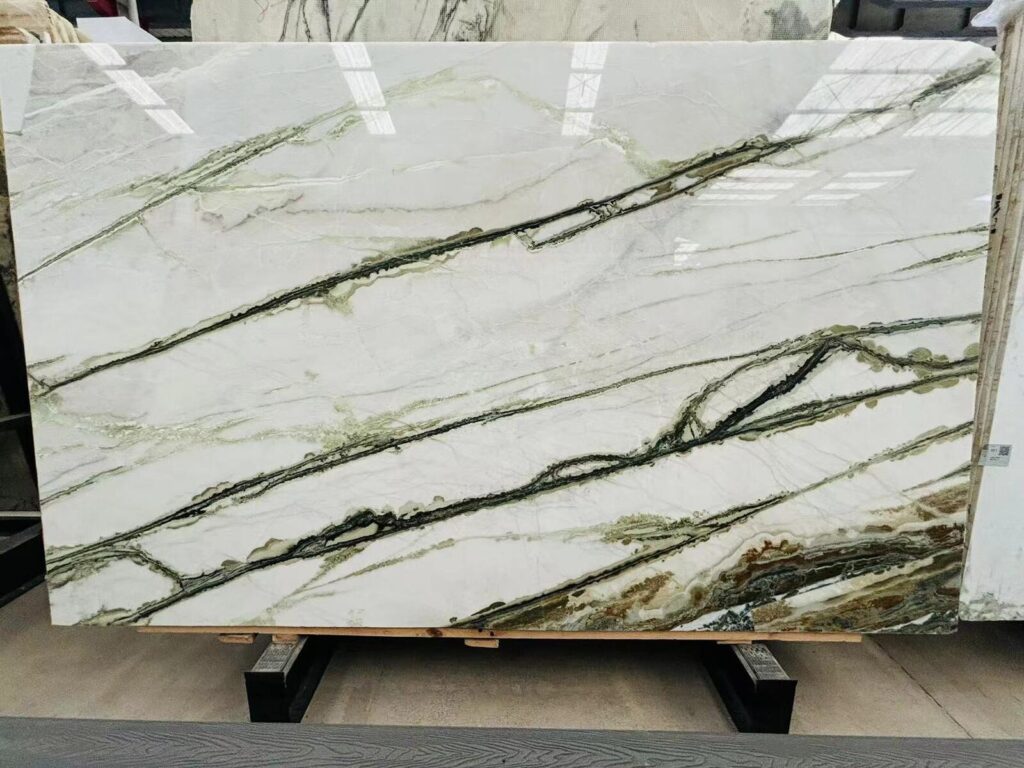

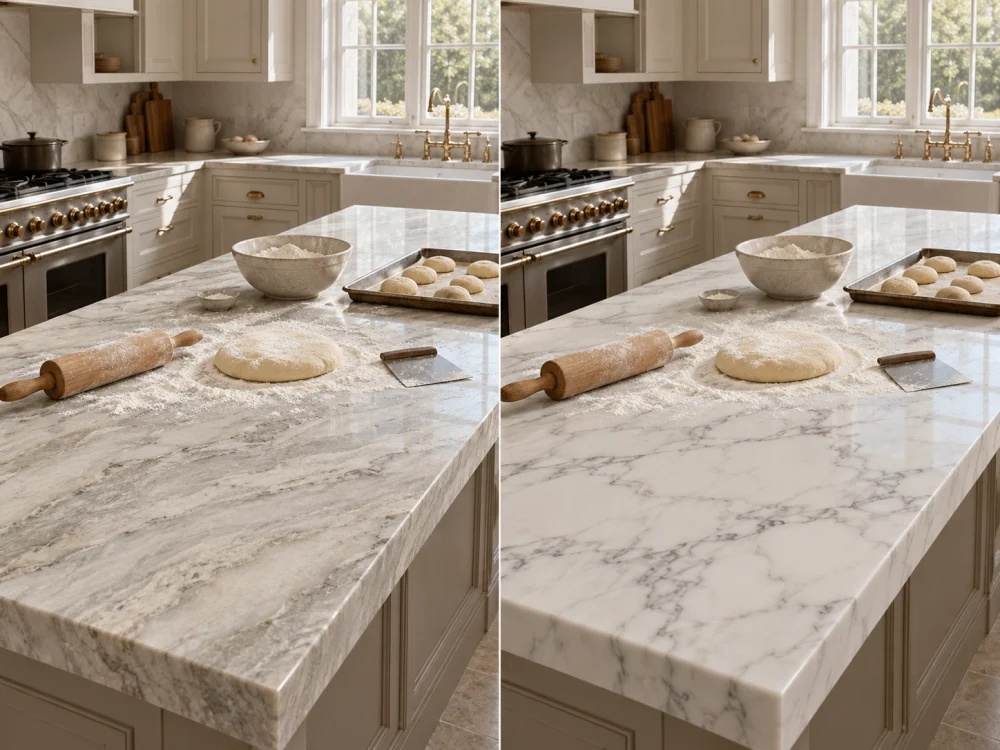
Quick SummaryNatural Quartzite vs Marble for a Frequently Used Baking Counter should be decided around the real baking workflow rather than appearance alone. A baking surface may encounter flour, butter, oils, citrus, vinegar, fruit fillings, dough scrapers, repeated wiping, cool ingredients, warm cookware, and frequent close-range use. Marble is a calcite-based natural stone and can etch when exposed to common kitchen acids, while true Natural Quartzite is a siliceous stone and is generally less susceptible to the same acid reaction. Neither material should be described as stain-proof, scratch-proof, heat-proof, or maintenance-free. Compare the actual slabs and finish, decide how much visible patina the user accepts, and plan the main rolling area, seams, edges, cleaning method, and nearby kitchen interfaces before fabrication.
A baking counter is not simply another decorative kitchen surface.
Someone who bakes occasionally may use a small section of the island for rolling pastry a few times each year. A serious home baker may work on the same counter several times a week, spreading flour across a large area, rolling dough, portioning butter, preparing fruit fillings, moving trays, scraping the worktop clean, and washing the surface repeatedly.
Those are very different use conditions.
That is why Natural Quartzite vs Marble for a Frequently Used Baking Counter should not be answered only by saying that Marble is traditional for pastry or that Quartzite is a harder natural stone.
The useful decision is more specific:
Which actual stone and finish best fit the baker’s working habits, cleaning routine, tolerance for visible patina, and the geometry of the planned baking zone?
Both Natural Quartzite and Marble are natural stones. Both vary from slab to slab. Both require project-specific review for finish, fabrication, sealing where appropriate, edges, seams, and ongoing care.
But the way they respond to some common baking ingredients can be materially different.
A frequently used baking counter should be specified from the activities that actually happen on it.
Start by identifying the dominant tasks.
Pastry, bread, pasta, cookies, laminated dough, and similar work can require a broad uninterrupted surface.
The user may repeatedly spread flour, roll dough in several directions, portion ingredients, and use a bench scraper to lift or divide the dough.
For this activity, usable worktop area and seam position may matter as much as the stone category.
Baking also brings fats and strongly colored ingredients onto the countertop.
Butter, oils, chocolate, berries, fruit fillings, spices, and similar ingredients can create different cleaning challenges.
Neither Natural Quartzite nor Marble should automatically be treated as stain-proof.
Absorption depends on the actual material, finish, exposure time, surface treatment, and care routine.
This is where the Natural Quartzite vs Marble comparison becomes particularly important.
Lemon juice, citrus fillings, vinegar, some fruits, wine, and other acidic kitchen ingredients can contact a baking counter during preparation.
True Marble is primarily calcite-based. Acids react with calcite and can alter the surface finish, creating an etch that may appear as a dull or lighter-looking area.
Natural Quartzite is a siliceous stone. The Natural Stone Institute notes that siliceous stones are generally resistant to most common kitchen acids, although acidic cleaners are still not recommended and the actual material should always be correctly identified.
This is one practical reason why the frequency of acidic ingredient use should be discussed before choosing the baking surface.
The related Taj Mahal Quartzite vs Crema Marfil Marble comparison explores this distinction in a warm-kitchen context, including the difference between staining and acid etching.
Start with the Workflow
Rolling Dough → Flour and Fat Exposure → Acidic Ingredients → Repeated Cleaning → Trays / Tools → Edge and Seam Contact → Long-Term Appearance. The best material decision should fit this complete routine.
These two problems are often confused in countertop discussions.
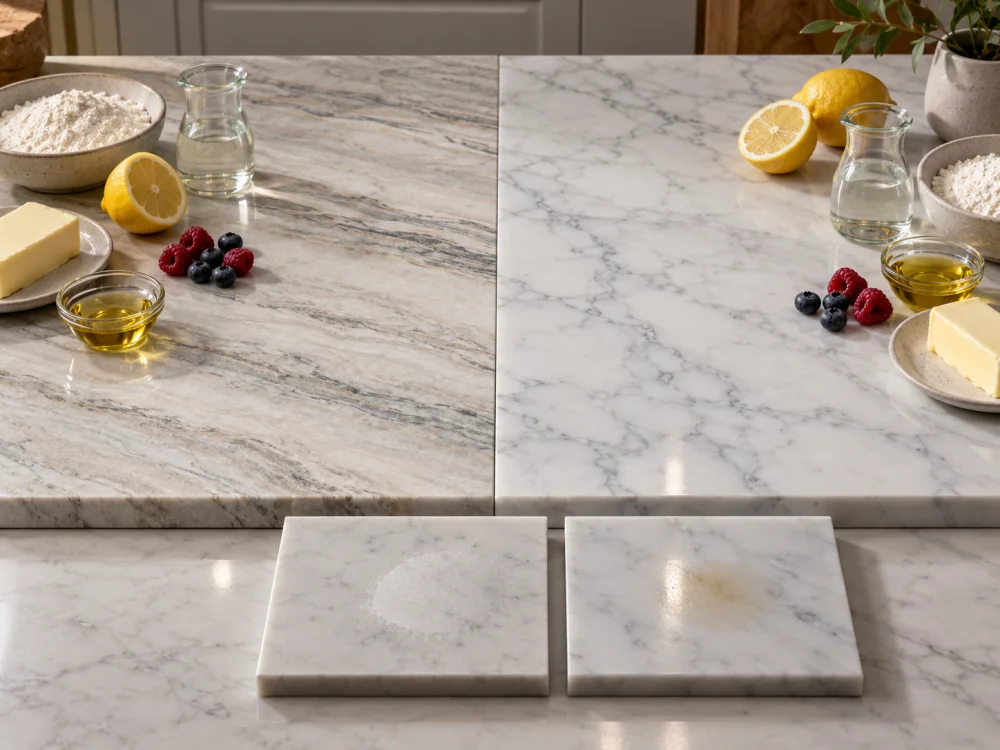
A stain occurs when a substance penetrates or otherwise leaves discoloration in the material.
Oil, strongly colored food, wine, and other substances may contribute to staining depending on the actual stone, finish, protection system, exposure duration, and cleaning response.
An appropriate impregnating sealer may be recommended for some natural-stone countertops to help reduce absorption.
However, sealing does not make a surface completely stain-proof.
Etching is different.
With calcite-based Marble, an acidic substance can chemically react with the surface.
The resulting area may lose polish or appear duller than the surrounding stone.
This is not simply a stain sitting inside the stone.
The Natural Stone Institute specifically identifies lemon, vinegar, and other acids as substances that can etch calcareous stone such as Marble.
This distinction is especially important for a baking counter.
A sealer may help manage absorption-related staining where appropriate, but it does not prevent the chemical reaction between acid and calcite.
Therefore, a sealed Marble worktop should not be described as immune to lemon juice, vinegar, or similar acidic ingredients.
A user who regularly prepares lemon curd, fruit fillings, sourdough recipes involving acidic ingredients, or other acid-containing foods should understand this before approving a polished Marble counter.
Some owners accept the gradual etching, small marks, and changes in sheen of Marble as part of a working kitchen’s natural patina.
Others expect the countertop to maintain a more uniform finish.
Neither expectation is inherently correct.
The project should establish the expectation before material selection.
| Condition | Natural Quartzite Review | Marble Review |
| Common food acids | True quartzite is generally less susceptible to common kitchen acid etching; actual material identity still matters | Calcite-based Marble can visibly etch from acidic substances |
| Oil / colored ingredients | Evaluate actual porosity, finish, sealing and spill response | Evaluate actual porosity, finish, sealing and spill response |
| Sealer | May help reduce absorption where appropriate; does not make stone stain-proof | May help reduce absorption; does not prevent acid etching |
| Long-term visual change | Review actual stone, finish, care and use conditions | Decide whether visible etching and patina are acceptable |
The material name does not finish the specification.
Surface finish affects appearance, reflection, tactile character, and the way normal use marks are perceived.

A polished Natural Quartzite surface can emphasize mineral depth, tonal movement, and the visual character of the selected slab.
In a bright kitchen, the surface may also reflect windows, pendant lights, and surrounding cabinetry more strongly.
A honed finish produces a lower-sheen appearance and may create a softer working surface visually.
It should not automatically be assumed to require less care or to hide every mark.
The actual slab and finish sample should be reviewed under the intended kitchen lighting.
The Polished vs Honed Quartzite for Kitchen Countertops guide compares how the two finishes affect reflection, color depth, pattern visibility, and overall kitchen character.
Polished Marble creates a crisp reflective surface and can make natural veining appear more defined.
However, acid etching is particularly noticeable on a polished finish because an etched area interrupts the surrounding sheen.
A honed Marble surface has a lower sheen.
Some owners choose it because they prefer a softer aesthetic or are more comfortable with a working patina.
Honing does not remove Marble’s acid sensitivity. It changes how the surface looks and may influence how certain marks are perceived.
Finish Approval Question
Do not ask only, “Polished or honed?” Ask, “How should this finish look after repeated flour, wiping, acidic food contact, normal kitchen use, and the level of patina the owner is willing to accept?”
For frequent baking, the countertop layout can matter more than a small difference in sample appearance.
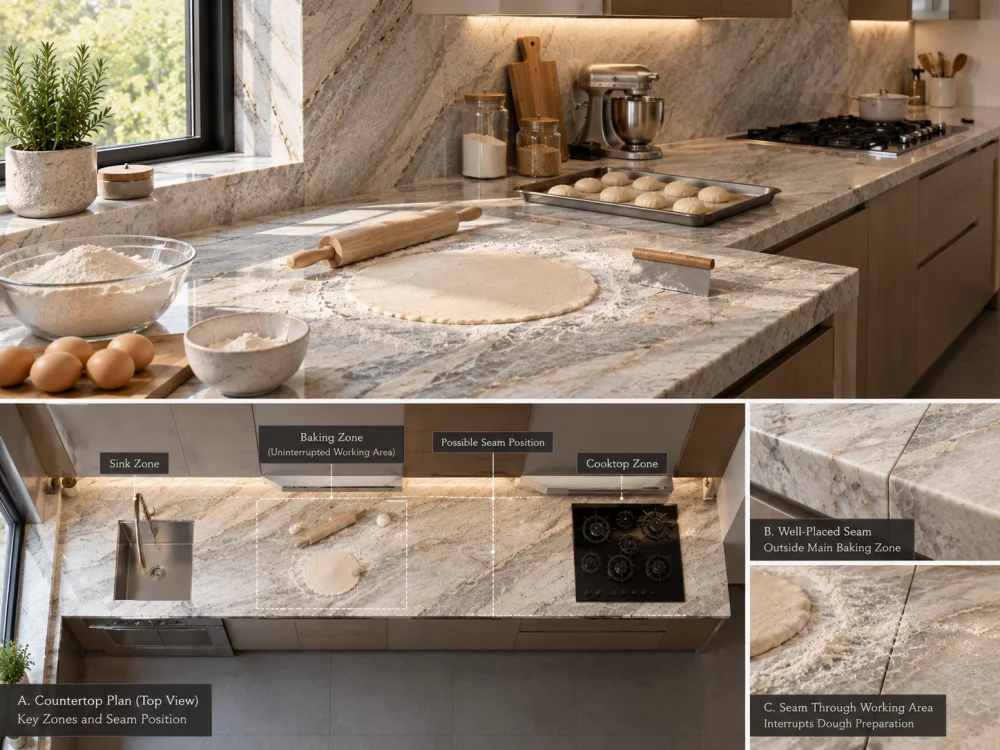
Pastry and dough preparation often benefits from an uninterrupted working zone.
Where practical, avoid placing an unnecessary seam directly through the center of the primary rolling area.
This is not because a properly fabricated seam automatically makes baking impossible.
It is because the user may repeatedly roll dough, move scrapers, wipe flour, and work across that zone at close range.
The design should decide whether a seam in that location is acceptable.
A baking station does not always need to sit beside the sink or cooktop.
In some kitchens, a dedicated island end or perimeter run provides a calmer work zone.
Separating the main pastry area from water splashes, cooking oils, or heavily used sink functions can also affect the daily workflow.
This is a kitchen-planning decision rather than a universal stone requirement.
The user should have enough usable depth for the intended dough size, rolling direction, mixing bowls, trays, and tools.
Do not optimize the slab layout only for visual veins while ignoring the way the counter will actually be used.
With Natural Quartzite or Marble, a large baking counter may expose a substantial portion of one slab.
Use the actual finished-piece outline to evaluate the natural movement before cutting.
A beautiful vein may become a focal feature, or the designer may prefer a quieter stone area for a visually calm working surface.
A frequently used baking station may be cleaned several times during one baking session.
Flour is wiped away. Butter and dough residue are removed. Fruit or chocolate spills may need immediate attention. The surface is cleaned again after trays and utensils are moved away.
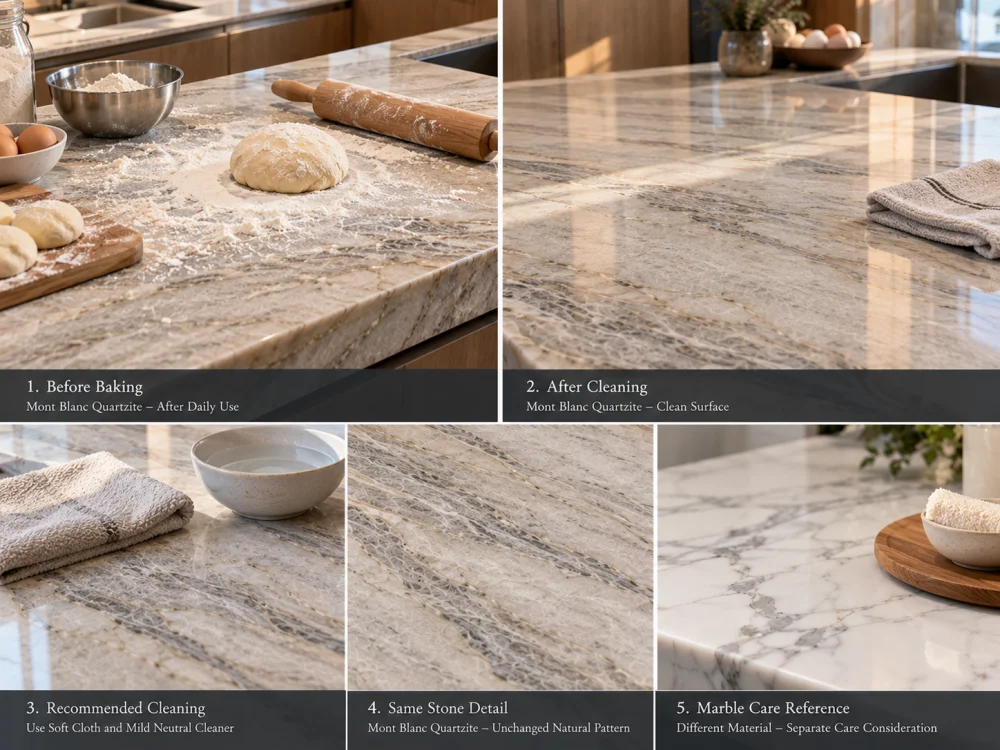
The Natural Stone Institute recommends neutral cleaners, stone soap, or mild liquid dishwashing detergent with warm water for routine natural-stone care.
Acidic cleaning products should not be used casually on natural stone.
This is particularly important for Marble because acidic products can etch calcite-based surfaces.
Even with siliceous stone such as Natural Quartzite, aggressive acidic or abrasive cleaners are not recommended as a general routine.
The project should consider what the actual user intends to keep beside the counter.
If vinegar-based sprays, strong descaling products, abrasive powders, or other aggressive cleaners are part of the current household routine, the care plan should be reviewed before the stone is approved.
Quartzite’s generally greater resistance to common food acids should not be interpreted as permission to leave food, oils, pigments, or cleaning chemicals on the surface indefinitely.
Routine spills should be removed promptly using a method suitable for the actual stone and finish.
The Ultimate Natural Quartzite Maintenance Guide provides a broader framework for matching cleaning and maintenance methods to the installed material, finish, use area, and approved care products.
Marble has a long association with pastry preparation, and many bakers appreciate the feel of working dough on a smooth stone surface.
However, the project should avoid turning that tradition into an unsupported claim that Marble is automatically a refrigerated or permanently colder work surface.
Surface temperature depends on the room, surrounding materials, thermal conditions, and how the counter is used.
If dough temperature and tactile feel are important to the baker, compare actual representative surfaces in the intended kitchen environment rather than relying on a marketing statement.
A sample mock-up can help the user judge finish, tactile feel, and working preference.
A frequently used baking counter may receive hot sheet pans, Dutch ovens, cake tins, or other cookware near the work zone.
The Natural Stone Institute recommends using trivets or mats even though many natural stones can tolerate heat.
This is a sensible project rule for both Natural Quartzite and Marble because it reduces unnecessary thermal and surface risk and avoids treating the countertop as the primary hot-pan support.
Do not sell either natural stone as “heat-proof.”
For frequent use, the most important benefits may be the combination of:
A baking counter is repeatedly contacted by rolling pins, bowls, trays, dough cutters, scrapers, and other tools.
This does not mean every tool will damage the stone. It means the specification should acknowledge real use instead of treating the surface as display-only.
If a baker regularly uses a scraper directly against the countertop, discuss the intended tool and working method.
A plastic or other surface-compatible scraper may create a different interaction from a sharp metal edge.
The project should avoid making a universal scratch-resistance promise for every stone and finish.
The front edge may be contacted repeatedly as dough is rolled near the user.
Choose a profile that suits the design and fabrication requirements while remaining comfortable for the intended working style.
If the baking counter forms an island end or projecting workstation, exposed corners should be coordinated with the kitchen circulation and approved fabrication detail.
Do not select a corner treatment from appearance alone if the project has handling, installation, or support requirements that still need technical review.
This article is ultimately about a frequently used surface.
A physical review should therefore simulate some of the way the counter will actually be experienced.
Use identified Natural Quartzite and Marble samples in the proposed finish.
Where possible, connect each sample to the current slab or slab group being considered.
Place a small amount of dry flour on the samples, then clean them using the intended approved routine.
The point is not to conduct a laboratory abrasion test.
It is to see how the finish, color, and surface texture read during an ordinary baking task.
If acid sensitivity is important to the user, use established stone information or a controlled sample test authorized for that purpose rather than experimenting on production slabs.
Do not perform an acid test on material that has already been approved for fabrication unless the test area and procedure have been explicitly agreed.
For Marble in particular, show the owner what etching means before the worktop is ordered.
An owner who is comfortable with a working patina can make a very different decision from someone who expects a highly uniform polished surface after years of frequent baking.
A sample can confirm a material and finish direction.
It does not automatically approve every slab, every seam, the entire fabrication layout, or every future maintenance condition.
The original project brief correctly emphasizes that physical references should remain identified and that approval should stay limited to the evidence actually reviewed.
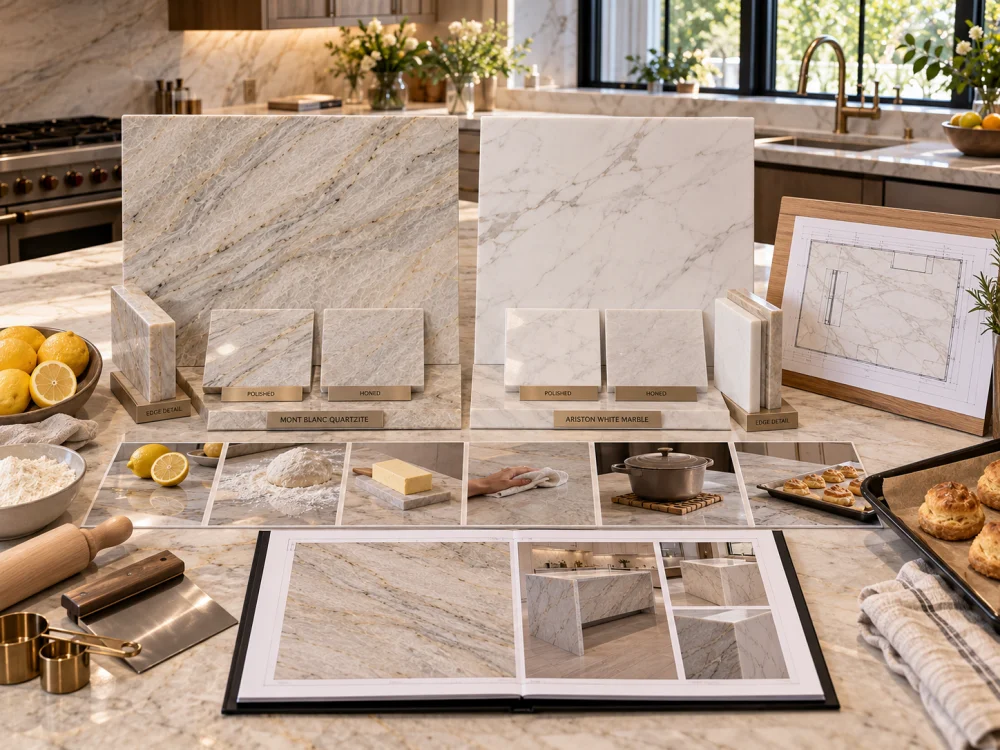
For a frequently used baking counter, Natural Quartzite may be the preferred direction when the owner wants natural geological character while reducing the level of acid-etching sensitivity associated with calcite-based Marble.
Marble may remain the preferred material when the owner values its specific appearance, tactile character, traditional pastry association, and is comfortable managing acidic ingredients carefully and accepting or maintaining the resulting surface patina.
Neither material should be presented as maintenance-free.
| Baking-Counter Priority | Natural Quartzite Review | Marble Review |
| Frequent acidic ingredients | True quartzite is generally less susceptible to common kitchen acid etching; confirm actual material | Expect calcite-based Marble to be vulnerable to acid etching |
| Visible working patina | Set expectations according to actual slab, finish, tools and care | Decide whether etching and changing sheen are acceptable |
| Finish | Approve polished or honed on the actual stone | Approve polished or honed with acid-sensitivity expectations understood |
| Stain management | Review porosity, sealing where appropriate and cleaning | Review porosity, sealing where appropriate and cleaning separately from etching |
| Hot trays | Use trivets or mats | Use trivets or mats |
| Final approval | Actual slab + finish + baking-zone layout + care expectations | Actual slab + finish + patina expectations + baking-zone layout + care plan |
The decision becomes much easier when the owner answers one practical question:
Do I want a surface that I will actively protect from visible acid etching, or do I want to reduce that particular concern while still accepting the normal care requirements of natural stone?
There is no universal winner. Natural Quartzite is generally less susceptible to common kitchen acid etching than calcite-based Marble, which can be important when baking involves citrus, vinegar, fruit, or other acidic ingredients. Marble may still be selected for its specific appearance, feel, and traditional pastry use when the owner understands and accepts its care and patina characteristics.
Many bakers value a smooth stone work surface and the tactile experience of preparing pastry on Marble. However, the countertop is not a refrigerated surface, and its temperature depends on the surrounding environment. If working temperature is important, evaluate the actual surface under the intended kitchen conditions rather than relying only on tradition.
No. An appropriate impregnating sealer may help reduce absorption-related staining, but it does not make calcite-based Marble immune to chemical etching from acidic substances such as lemon juice or vinegar.
Neither material should be described as stain-proof. Actual staining risk depends on the specific stone, finish, porosity, surface treatment, substance, exposure time, and cleaning response. Where appropriate, discuss sealing and care requirements for the actual selected slab.
Not universally. Honed and polished finishes create different visual and tactile experiences. Honing does not remove Marble’s acid sensitivity, although etching may be perceived differently on a lower-sheen finish. Review actual finish samples and decide what long-term appearance the owner accepts.
Do not treat either material as a universal hot-pan surface. The Natural Stone Institute recommends using trivets or mats for hot items even though many natural stones can tolerate heat. This also protects the finish and reduces unnecessary thermal risk.
Send Josh the proposed Natural Quartzite material, current kitchen plan, baking-counter dimensions, expected work zone, quantities, requested finish, edge profile, nearby sink or cooktop information, preferred seam locations, cabinet and flooring references where relevant, and delivery destination. Also identify whether frequent acidic ingredients, heavy pastry preparation, or a specific long-term patina expectation affects the material decision.
Project Approval SummaryA frequently used baking counter should be selected around actual working habits rather than appearance alone. Compare the proposed Natural Quartzite and Marble in the intended finish, understand the difference between staining and acid etching, decide whether visible Marble patina is acceptable, plan an uninterrupted rolling zone and practical seam position, use an approved cleaning routine, and protect the counter from unnecessary hot-tray and tool impacts. Approve the actual slabs and finished baking-zone layout before fabrication.
For project-based Natural Quartzite baking counters and kitchen worktops, HRST STONE can coordinate available full-slab photographs, slab references, finish samples, CAD/shop drawings, cutting layouts, seam positions, sink and cooktop openings, edge profiles, visual QC, packing, and export documentation according to the confirmed stone scope. Send Josh the baking-counter dimensions, intended workflow, finish, quantities, kitchen drawings, visual priorities, and delivery destination for review.