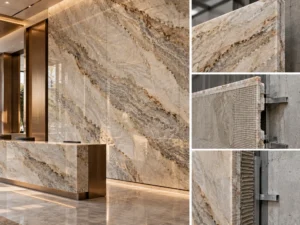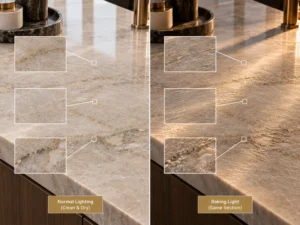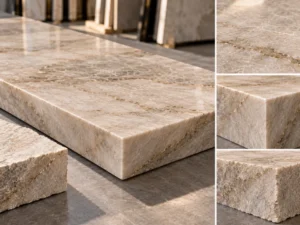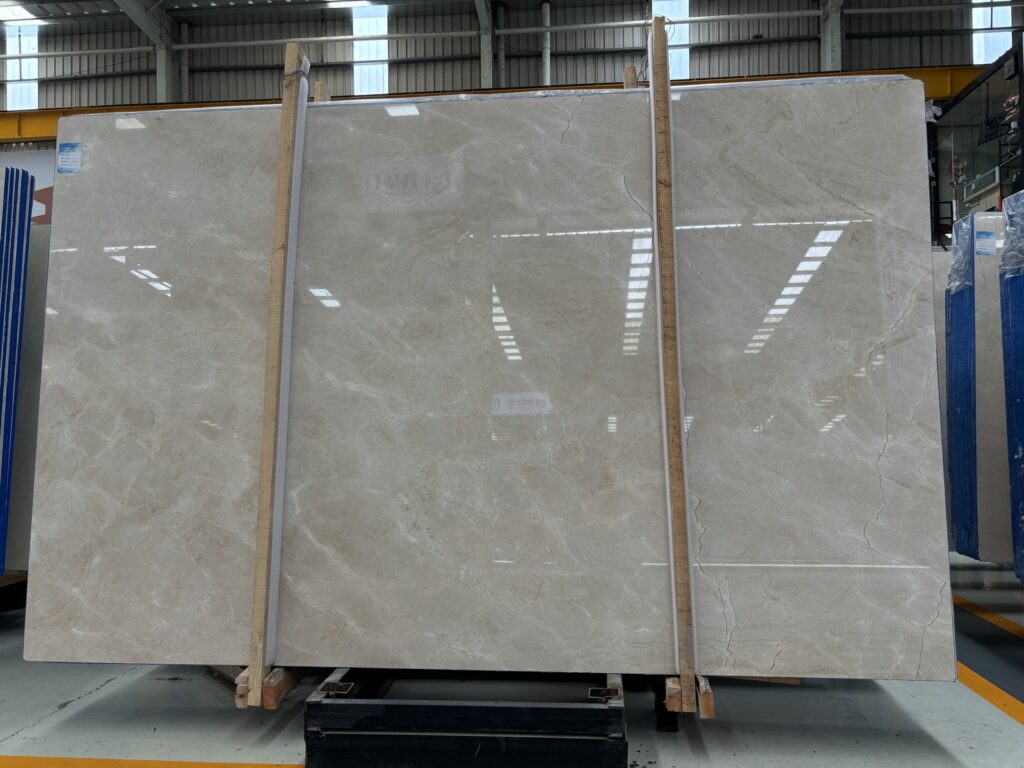

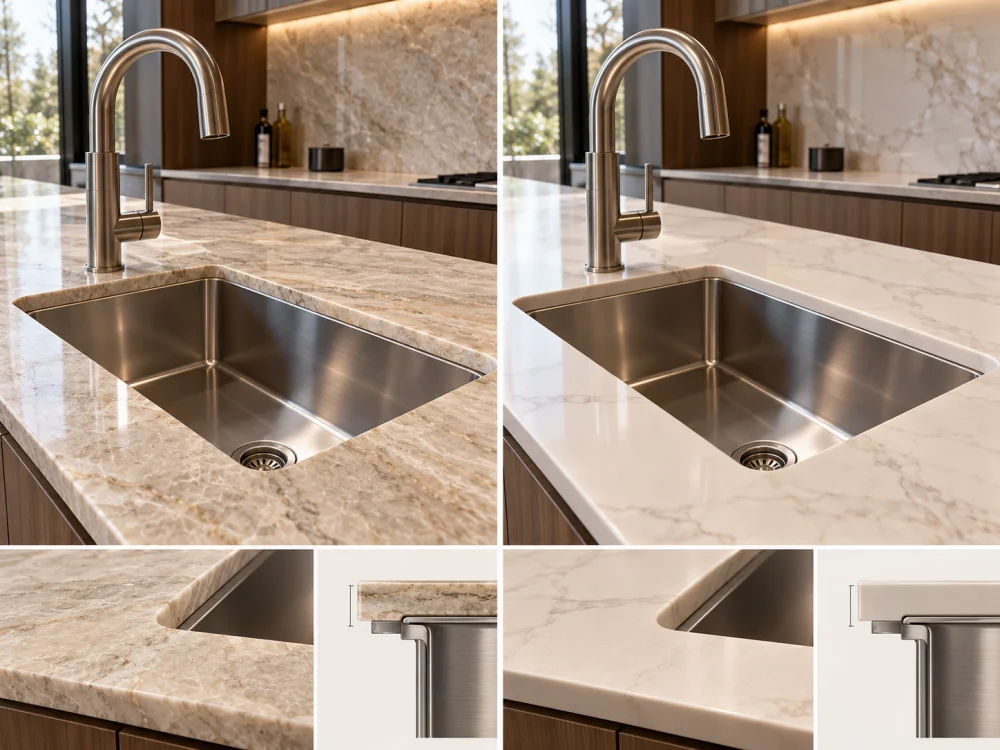
Quick SummaryNatural quartzite vs. engineered quartz for an undermount sink detail should be compared through the actual sink interface rather than a general material ranking. Confirm the exact sink model, current manufacturer information, mounting type, cutout basis, intended reveal, visible cut-edge finish, faucet and accessory holes, surrounding countertop geometry, and required support before releasing the opening for fabrication. Natural quartzite requires review of the actual slab and natural features around the cutout, while Engineered Quartz should be checked against the current fabrication and installation requirements for the exact selected product. A material sample, edge sample, sink template, and cutting release are different approvals.
An undermount sink looks simple after installation.
The bowl sits below the worktop. The countertop edge forms the visible perimeter of the opening. Water and food debris can move directly from the worktop toward the sink without a raised rim interrupting the surface.
But from a fabrication perspective, the detail concentrates several decisions into one of the most heavily cut areas of the countertop.
Natural quartzite vs. engineered quartz for an undermount sink detail should therefore not be reduced to the question, “Which material is stronger around a sink?”
The better questions are:
What exact sink is being installed? What shape must the stone opening take? Which part of the sink rim will be visible? How will the cut edge be finished? What stone or manufactured-surface material remains in front of and behind the opening? Where are the faucet holes, nearby seams, and slab features? How is the sink supported independently within the cabinet assembly?
These questions should be answered before an irreversible opening is cut.
The phrase “undermount sink” describes a mounting concept, not a complete fabrication specification.
Two sinks with similar overall dimensions can have different bowl shapes, flange widths, corner geometry, mounting details, and manufacturer templates.
The countertop opening should therefore be connected to the exact product being installed.
The external dimensions of the sink are not automatically the dimensions of the countertop opening.
The opening depends on the approved sink information, intended reveal, bowl geometry, mounting method, and fabrication detail.
A project note such as “800 mm undermount sink” is therefore incomplete as a cutting instruction.
The current drawing or fabrication record should identify the exact sink manufacturer and model, the document or template being used, and the person or project party authorized to approve that information for cutting.
Some projects can proceed from a verified manufacturer template or controlled CAD information.
Other projects may require the actual physical sink to be available before the final cut, particularly where documentation is incomplete, model variation is suspected, or a critical fit condition needs physical verification.
There is no single rule for every sink and every factory.
The important point is that the fabrication basis should be agreed before cutting.
For owner-supplied fixtures, the related Quartzite Orders with Owner-Supplied Sinks: Avoiding Missing Specifications guide explains why model number, current documentation, cutout template, mounting condition, reveal, faucet holes, and actual sink availability should be treated as one controlled specification package.
An undermount sink exposes the relationship between the finished stone opening and the top edge of the sink bowl.
This relationship is often described using three general reveal conditions.
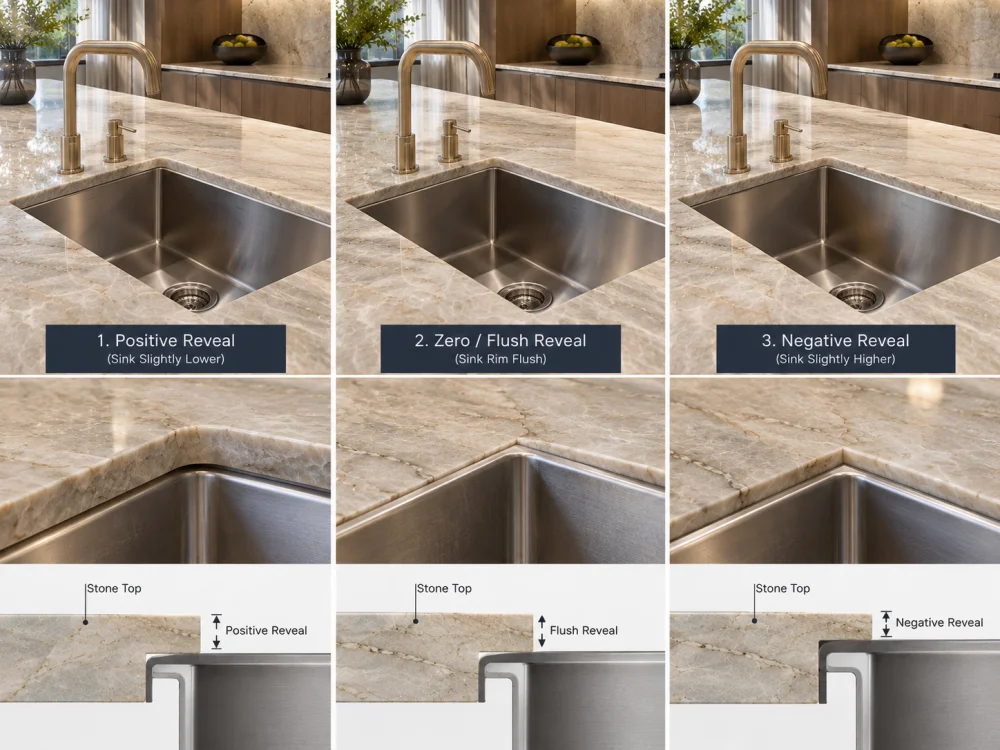
Part of the sink rim or flange remains visible inside the finished stone opening.
The exact amount and suitability depend on the sink, design intent, fabrication basis, hygiene and cleaning considerations, and manufacturer or project requirements.
The finished countertop opening is intended to align closely with the inside line of the sink bowl.
This can create a visually direct transition, but the project should recognize that sink-manufacturing tolerances, template accuracy, fabrication accuracy, and installation position all influence the final relationship.
The finished worktop edge projects inward beyond the bowl edge so that part of the sink flange is concealed below the countertop.
Again, this is a design and fabrication decision rather than a universal best practice.
The appropriate reveal should be confirmed for the exact sink and countertop system.
| Reveal Condition | What the Reviewer Sees | What Must Be Confirmed |
| Positive reveal | Some sink rim remains visible | Actual sink geometry, approved reveal and finished-edge relationship |
| Zero / flush reveal | Stone edge aligns closely with bowl opening | Template basis, sink tolerance, fabrication and installation coordination |
| Negative reveal | Stone projects inward over the bowl edge | Approved overlap, cleaning access, sink geometry and project detail |
The material comparison should take place after the intended reveal condition is understood.
A face sample alone cannot approve this interface.
Sink-Detail Rule
Exact Sink → Approved Opening Basis → Reveal → Visible Cut Edge → Surrounding Countertop Geometry → Support / Installation Interface → Cutting Release.
Both materials can be used in fabricated countertop systems, but they should not be treated as interchangeable.
Natural Quartzite contains slab-specific geological features.
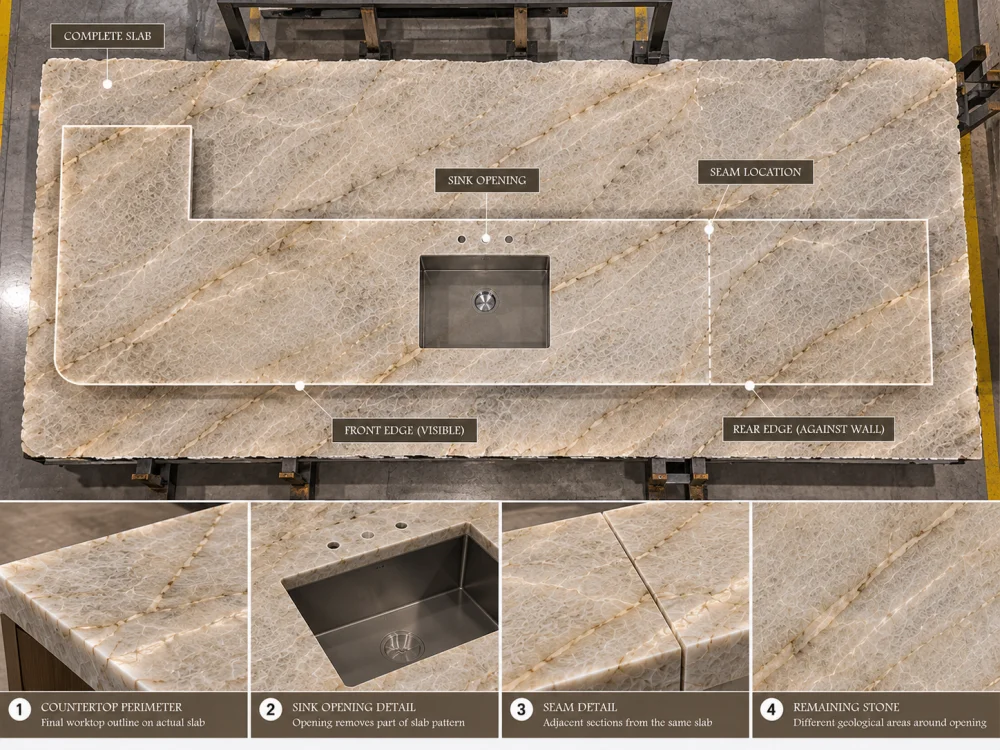
When the sink opening is overlaid onto the selected slab, the project should review not only the material removed by the cutout but also the stone that remains around it.
Relevant areas include:
A visually dramatic slab area may look attractive before layout, but the sink opening may remove its strongest feature or leave an important geological transition in a narrow remaining section.
This is why the actual cutout should be overlaid onto the slab layout before fabrication where the stone character or surrounding geometry is important.
Engineered Quartz should be reviewed using the fabrication and installation information applicable to the exact selected product.
Different manufacturers and product systems may specify different requirements for cutout geometry, inside corners, edge treatment, reinforcement, joint location, support, and sink installation.
Do not take a detail from one Engineered Quartz brand and automatically apply it to another product.
Likewise, do not transfer a Natural Quartzite shop method to Engineered Quartz without confirming that the selected product and fabricator support that method.
Neither “Quartzite” nor “Engineered Quartz” tells the buyer what radius to cut at every sink corner, how much stone must remain around every opening, or how the sink should be supported.
Those decisions depend on the actual material, countertop geometry, sink, fabrication system, product requirements, cabinet arrangement, and installation scope.
An undermount sink opening creates an internal cutout with several corner conditions and relatively narrow stone areas around it.
It is tempting to treat the opening simply as one rounded rectangle.
A better review considers the complete countertop component.
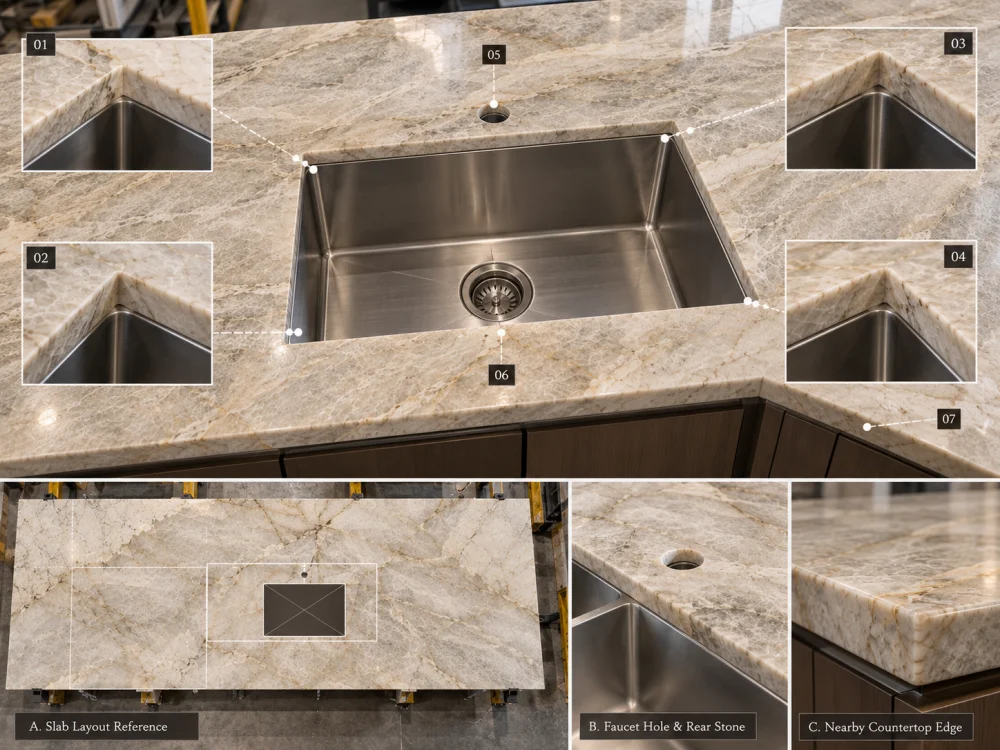
The two front corners sit close to the front stone section and finished countertop edge.
Review them together with the actual front geometry, edge profile, slab position, and any nearby natural features.
The rear corners may sit near faucet holes, accessory holes, backsplash interfaces, windows, or other countertop features.
Do not approve them independently of the rear stone geometry.
The sink opening leaves material in front of and behind the bowl.
The width and geometry of these areas depend on the actual countertop depth, sink position, sink size, wall relationship, faucet location, and other project conditions.
A universal minimum value should not be invented for every Natural Quartzite or Engineered Quartz countertop.
The responsible fabricator should evaluate the actual component.
A seam near a large cutout introduces another interface.
Review the relationship between the sink opening, remaining material, seam location, support, handling, and installation sequence before fabrication.
The related Quartzite Sink Cutouts: Why Corner Details Need Fabricator Approval guide explains why the four corners, front and rear remaining stone, faucet holes, nearby seams, and actual slab position should be reviewed as one countertop system rather than as isolated details.
A top-mounted sink can conceal much of the stone opening beneath the sink rim.
An undermount sink does the opposite.
The fabricated cut edge becomes visible every time the user looks into the bowl.
This makes edge quality an important part of both material selection and fabrication approval.
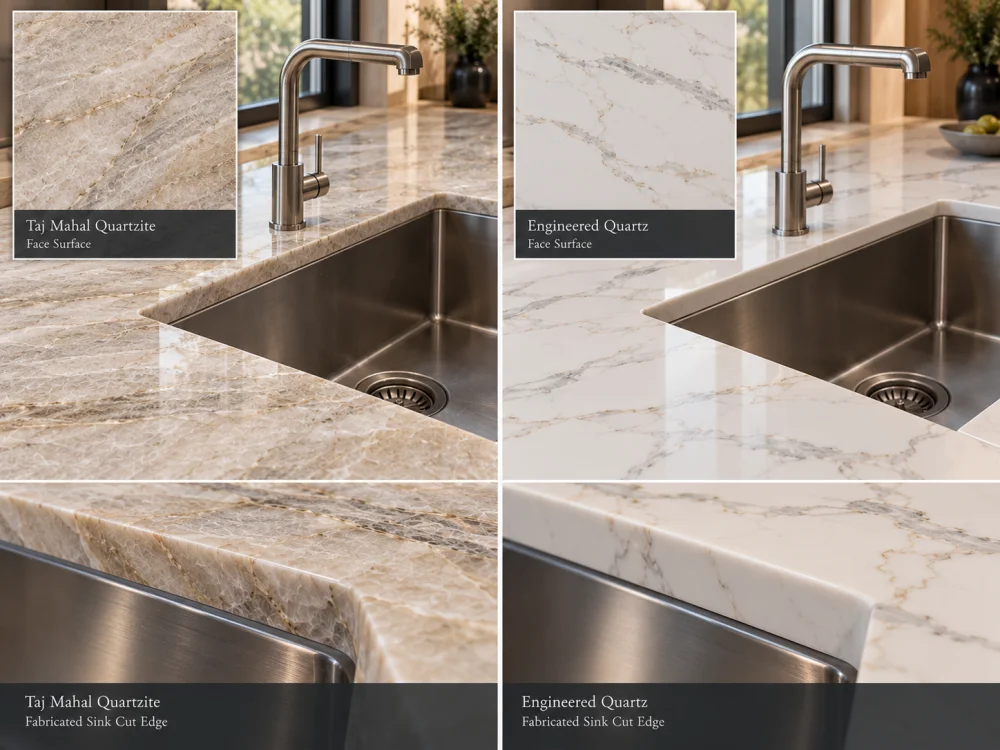
A worked Natural Quartzite edge exposes the actual geological material through the slab thickness.
The appearance may differ from the broad polished top face because minerals, crystal structures, veins, and color transitions are being viewed through another plane.
If the sink opening crosses a prominent mineral feature, the cut edge may show that feature directly.
Where visual appearance matters, an actual worked sample can provide more useful evidence than a flat face sample.
The appearance of the fabricated edge depends on the selected Engineered Quartz product and its construction.
Review the actual product rather than assuming that the edge will look exactly like the printed or finished top face.
Manufacturer and fabricator instructions should guide the appropriate edge preparation.
The internal opening may require an eased, rounded, bevelled, or otherwise fabricated edge condition according to the approved material and fabrication method.
Do not prescribe one universal edge radius in a procurement article.
Instead, identify the required visual result and make sure the responsible fabricator confirms the actual machining detail.
The undermount opening is rarely the only hole near the sink.
A kitchen may include:
Each opening changes the amount and distribution of countertop material around the sink.
Show the accessory holes individually on the current drawing.
Confirm the relevant diameter, center location, relationship to the sink, cabinet space, and any equipment below the countertop through the responsible project information.
If the faucet position changes after the sink opening has been approved, review the affected geometry again.
For Natural Quartzite, overlay faucet and accessory holes onto the actual slab layout where relevant.
A small drilled opening can still intersect a prominent fissure-like mineral line or complex natural transition.
The project should review the actual position rather than assuming that a small hole is automatically insignificant.
The sink must not be treated as though its weight and service loads are resolved merely because it is attached below the countertop.
The project should identify the sink-support method and the party responsible for it.
Depending on the selected system, support may involve cabinet-mounted rails, brackets, frames, clips, manufacturer-approved hardware, or another engineered installation method.
The correct solution depends on the sink, cabinet, countertop product, and project design.
Do not assume that adhesive alone, the stone edge alone, or a generic bracket detail is suitable for every undermount sink.
| Scope | Typical Question |
| Stone fabrication | What opening, edge, holes, and countertop geometry will be fabricated? |
| Sink support | How will the sink be structurally supported within the cabinet assembly? |
| Sink installation | Who positions, fixes, seals, and confirms the sink installation? |
| Plumbing | Who connects the drain, water supply, disposal, and related services? |
A quotation that includes a fabricated sink cutout does not automatically mean all four scopes are included.
Once the sink geometry is controlled, the material comparison becomes much more meaningful.
Evaluate the actual Natural Quartzite slab or selected Engineered Quartz product for the desired color, movement, finish, and kitchen composition.
The sink opening exposes a substantial amount of fabricated edge.
Review its appearance from normal standing height and from close working distance.
Inside corner geometry affects both fabrication and visual character.
The design should follow the approved project detail rather than being chosen from a marketing photograph.
Look at how the material behaves visually in the rear sink zone, especially when the design contains strong natural veins or large manufactured graphics.
The sink is one detail within a larger countertop.
A Natural Quartzite slab may offer a stronger overall island composition even if its sink zone requires careful slab positioning.
An Engineered Quartz product may offer another visual strategy based on the selected manufactured design.
The material decision should consider the complete worktop rather than ranking the materials only from a small cutout sample.
This is the most important procurement control in the project.
Several approvals may happen at different times.
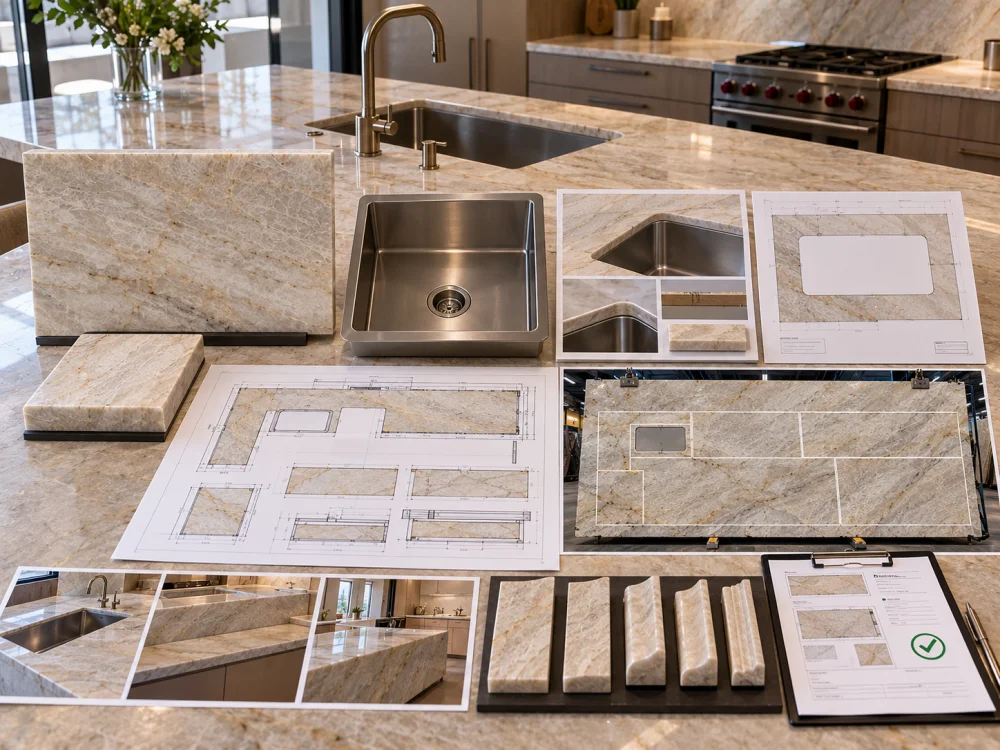
This confirms that the stated Natural Quartzite reference or Engineered Quartz product and finish are acceptable for the defined visual purpose.
It does not automatically approve the sink opening.
This confirms the exact sink reference, intended mounting condition, reveal, and other defined project inputs.
It does not necessarily mean the final countertop cutting layout has been released.
This confirms a defined visible-edge appearance.
It does not prove the structural suitability of every opening geometry or slab position.
This is the irreversible fabrication decision.
Before release, the project should connect the current sink information, drawing revision, opening geometry, reveal, accessory holes, actual Natural Quartzite slab position or Engineered Quartz product requirements, surrounding countertop geometry, applicable support interfaces, and authorized approval.
Final Cutout Release GateExact sink manufacturer and model confirmed.
Current sink document / template identified.
Mounting type and reveal confirmed.
Visible cut-edge requirement defined.
Faucet and accessory holes coordinated.
Current countertop drawing identified.
Actual Natural Quartzite slab layout or Engineered Quartz product requirements reviewed.
Nearby seams, edges, openings, and remaining countertop geometry reviewed.
Sink-support responsibility identified.
Authorized project party has released the current information for cutting.
The original project draft correctly emphasizes that approval should remain limited to the decision actually reviewed rather than becoming an undocumented blanket approval of all future fabrication.
There is no universal winner. The decision depends on the actual Natural Quartzite slab or exact Engineered Quartz product, sink geometry, visible edge requirements, countertop layout, support arrangement, fabrication guidance, and design priorities.
Positive, zero or flush, and negative reveals are all project-specific conditions. The appropriate choice depends on the actual sink, manufacturer information, design intent, fabrication method, cleaning considerations, and installation coordination. Do not apply one reveal automatically to every sink.
Not automatically. Overall sink dimensions describe the sink body or flange, while the stone opening is defined by the approved sink interface, template, reveal, and project information.
No universal radius should be specified for every Natural Quartzite countertop. The responsible fabricator should review the actual sink, opening geometry, material, surrounding stone, slab position, machining approach, support, and installation conditions.
Not necessarily. Some projects can proceed from verified manufacturer documentation or an accepted CAD/template basis. Other projects may require physical sink verification. The accepted fabrication basis should be recorded before the opening is released for cutting.
Not automatically. Stone fabrication, sink supply, mounting hardware, structural support, sink installation, sealing, cabinet work, plumbing, and final connections should be identified separately unless they are expressly included in the agreed scope.
Send Josh the Natural Quartzite material reference, current countertop drawing, finished dimensions, exact sink manufacturer and model, current manufacturer documentation, cutout template where available, mounting type, intended reveal, faucet and accessory-hole information, surface finish, visible-edge requirements, quantities, actual sink availability, and delivery destination.
Project Approval SummaryAn undermount-sink detail should be approved as a complete interface rather than as a generic hole in a countertop. Confirm the actual sink, reveal, opening basis, visible cut edge, corners, faucet holes, surrounding countertop geometry, support responsibilities, and current fabrication drawing. For Natural Quartzite, connect the sink position to the actual slab and surrounding geological features. For Engineered Quartz, follow the current requirements applicable to the exact selected product. Keep material approval separate from irreversible cutting release.
For fabricated Natural Quartzite countertops, HRST STONE can coordinate available slab references, CAD/shop drawings, actual slab layouts, sink and cooktop cutouts, visible-edge details, piece identification, fabrication review, visual QC records, export packing, and related documentation according to the confirmed project scope. Send Josh the exact sink information and current countertop drawings before the opening is released for production.