
Quick Summary
Quartzite vein direction symbols are drawing marks used to communicate the intended visual orientation of natural stone pieces. An arrow can indicate dominant vein movement or piece orientation, but its meaning must be defined by the project drawing legend. For reliable fabrication, vein-direction symbols should be coordinated with piece IDs, visible faces, seams, actual slab layouts, and written approvals rather than used as standalone instructions.
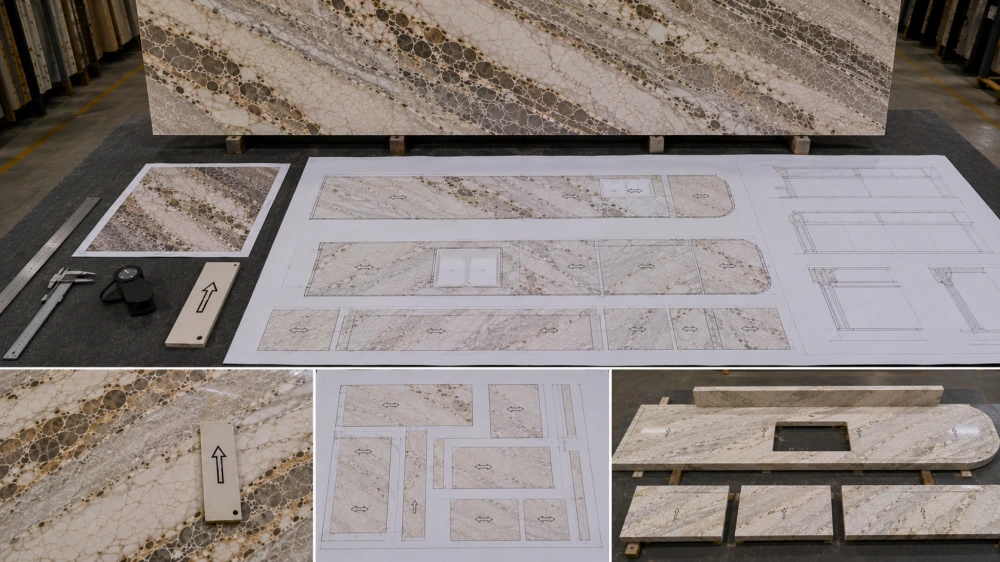
Quartzite shop drawings do more than define dimensions. For projects where the natural movement of the stone is visually important, they also help communicate how each fabricated piece should be oriented and how adjacent pieces are intended to relate to one another.
This is where quartzite vein direction symbols become useful. A simple arrow may appear straightforward, but an undefined arrow can create significant ambiguity. Does it show the dominant vein direction? The installation orientation? The direction in which pieces should be positioned on a slab? Or the intended visual flow across several fabricated pieces?
For designers, fabricators, contractors, importers, and project procurement teams, the safest approach is to treat vein-direction notation as part of a larger stone-layout control system. The symbol should work together with the drawing legend, piece identification, visible-face information, seam positions, actual slab photographs, cutting layouts, and approval records.
A quartzite vein-direction symbol is typically an arrow, directional line, or project-specific drawing mark used to indicate the intended visual movement or orientation of a natural quartzite piece.
There is no single quartzite vein-direction symbol that should automatically be assumed to have the same meaning on every project. Architects, designers, stone contractors, and fabricators may use different notation systems. The drawing legend should therefore define exactly what the arrow or directional mark represents.
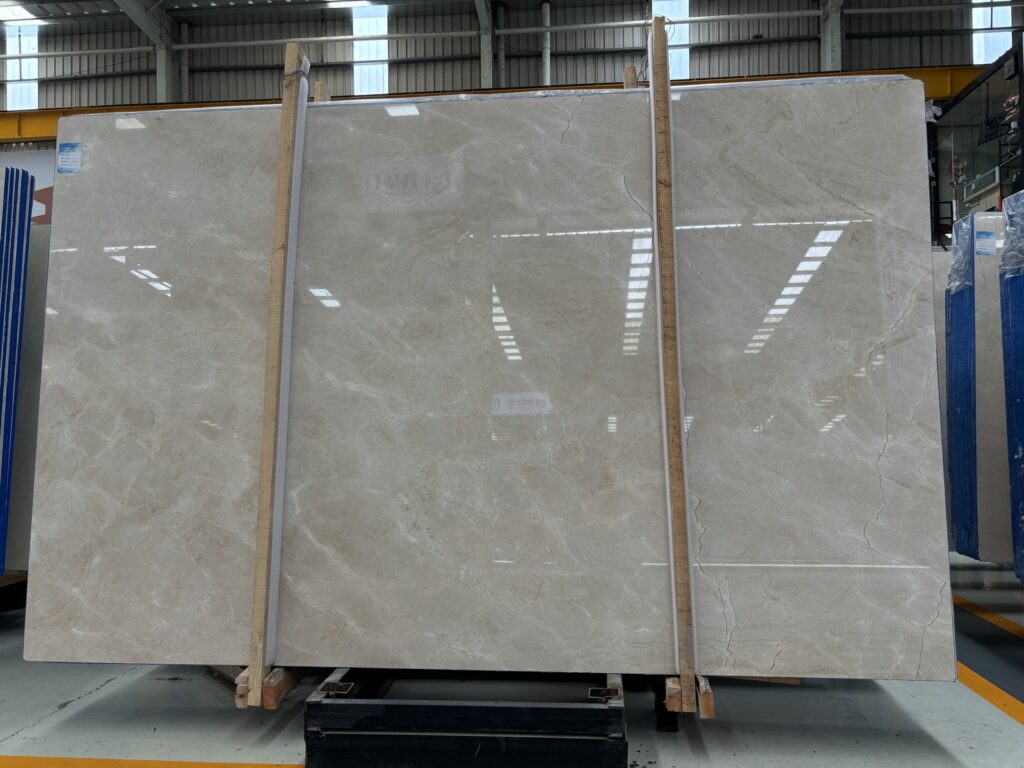
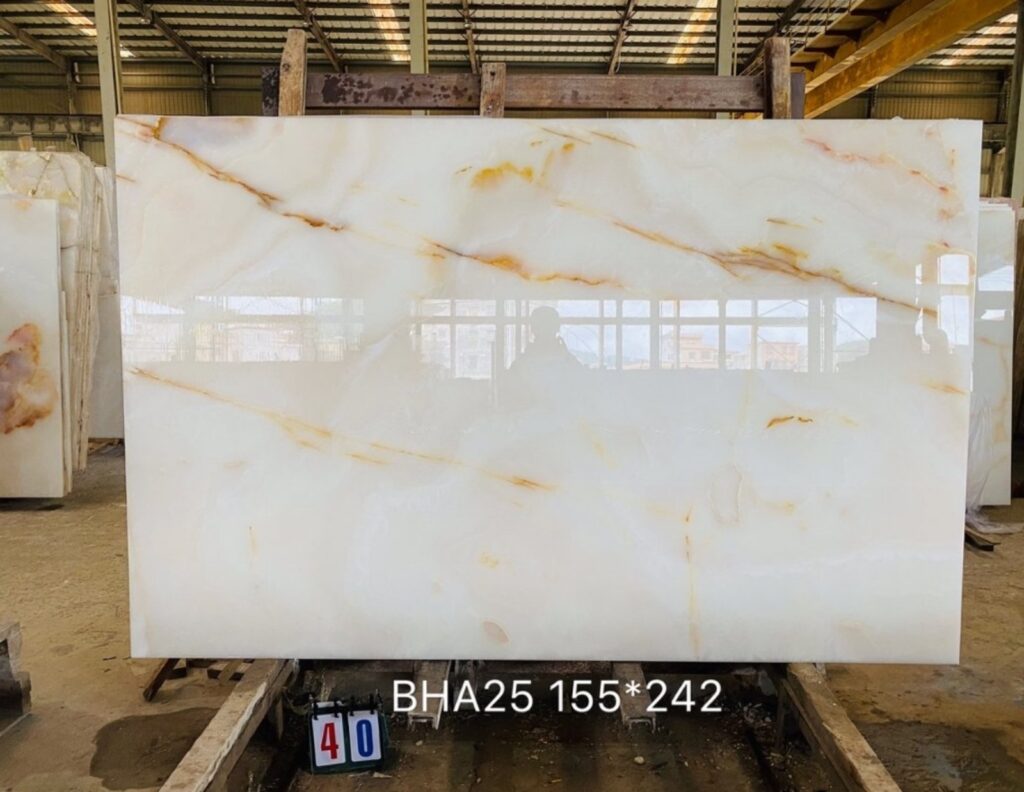
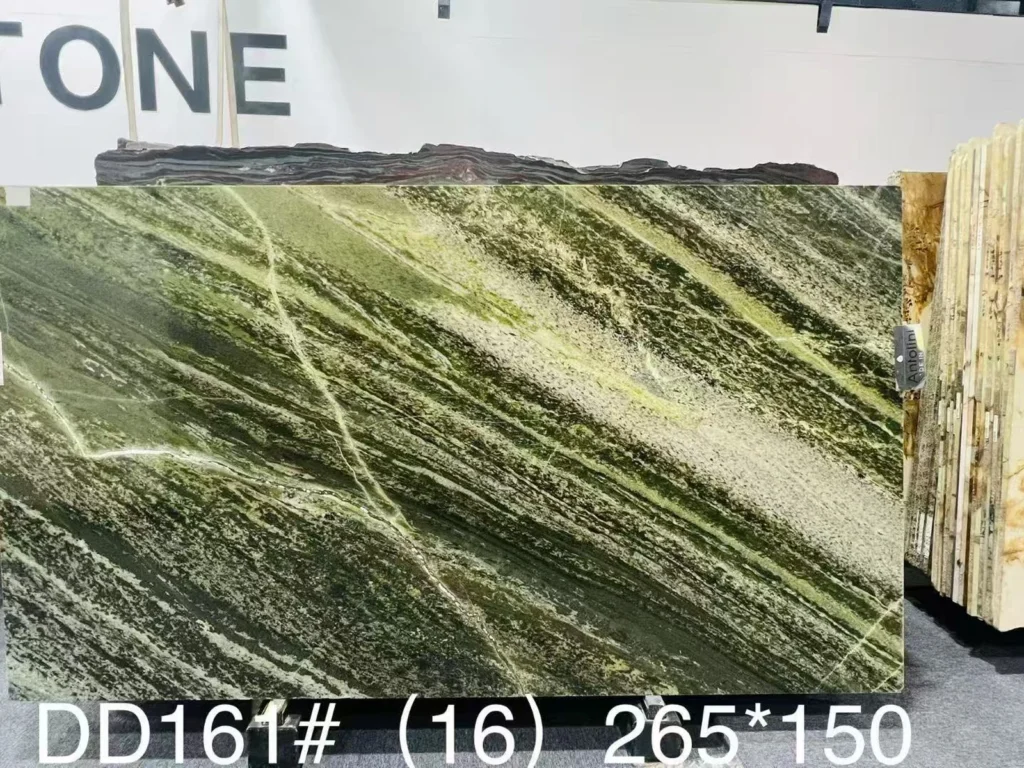
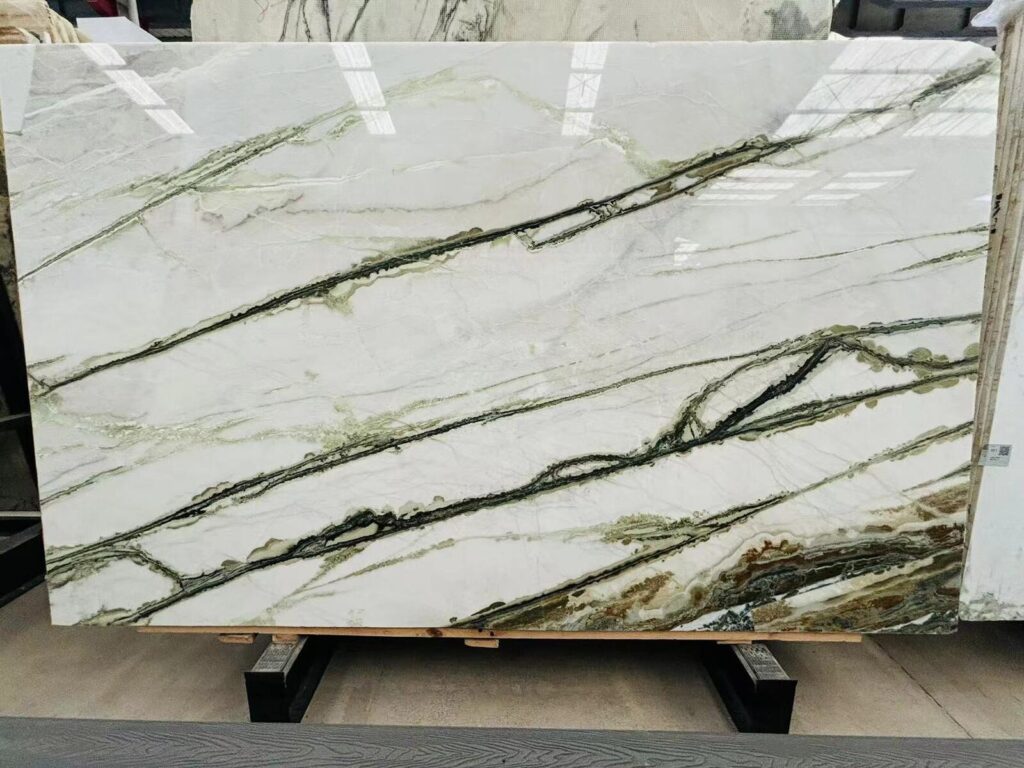
This distinction matters because Natural Quartzite is a naturally variable material. Veins, mineral bands, crystalline zones, color transitions, fissure-like structures, and other geological features may change across a slab and between consecutive slabs.
An arrow communicates direction. It does not by itself guarantee that two quartzite pieces will visually connect after cutting and installation.
Depending on the project drawing standard, a vein-direction arrow may communicate one or more of the following:
The drawing should make clear which meaning applies. A fabricator should not have to infer the intended orientation from an isolated arrow.
Drawing conventions vary between companies, so the following examples should be treated as common project practices rather than universal industry symbols.
| Drawing Mark | Typical Meaning | What Should Be Confirmed |
| Single directional arrow → | Intended dominant vein or visual movement | Confirm the arrow meaning in the drawing legend |
| Double-ended directional line ↔ | Directional axis without necessarily defining a start and end | Confirm whether the piece may be rotated or reversed |
| Piece ID + arrow | Orientation of one specific fabricated piece | Match the piece ID to the cutting and slab-layout drawings |
| Adjacent arrows | Intended visual relationship between neighboring pieces | Check seam position and actual slab pattern before approval |
| Match-line notation | Relationship across a joint, corner, or return | Confirm whether the intent is continuation, bookmatch, slip match, or another layout condition |
No universal quartzite vein-direction symbol should be assumed across every fabricator, architect, or stone project. The project legend and approved shop drawings govern the meaning of each mark.

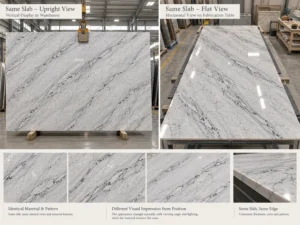
Vein direction and slab orientation are closely related, but they are not exactly the same instruction.
Vein direction describes the intended visual movement of the stone. Slab orientation describes how the physical slab or fabricated piece is positioned relative to the drawing, cutting layout, or final installation.
For example, a quartzite slab may contain a broad diagonal mineral movement from lower left to upper right. A designer may want that movement to travel along the length of a kitchen island. The slab may therefore need to be rotated during layout so the selected fabricated piece produces the intended visual direction.
This is why shop drawings should not rely on vein arrows alone. They should be reviewed together with actual slab images and cutting layouts whenever the pattern is visually important.
Before drawing a direction arrow, establish which surface will actually be visible after installation. This is particularly important for wall panels, waterfall ends, mitered returns, backsplashes, stair elements, and multi-face stone features.
An arrow shown on the wrong face can communicate the opposite orientation from what the designer intended.
Every important fabricated component should have a unique piece reference such as A1, A2, B1, or another project-specific code.
The same ID should appear consistently in the shop drawing, slab layout, cutting plan, production record, and packing identification where practical.
Add an arrow or directional mark to the visible face of the piece. The legend should define what the arrow means, for example:
Arrow = intended dominant visual movement of quartzite.
A simple legend note reduces the risk that one team interprets the arrow as stone movement while another interprets it as installation direction.
A vein-direction arrow does not explain what happens at a seam. If multiple pieces meet, show the seam or joint position clearly and review how the natural pattern behaves at that location.
For visually important work, seam approval should consider both fabrication practicality and the actual stone movement.
Once actual slabs are selected, the piece IDs and vein-direction intentions should be transferred into the slab-layout review.
The relationship should be easy to trace:
Approved Slab → Cutting Position → Piece ID → Vein Direction → Seam Relationship → Installed Location.
This creates a much stronger fabrication control than an arrow shown only on an architectural elevation.
Vein-direction decisions should be tied to a specific drawing or slab-layout revision. If the material selection or cutting layout changes later, the orientation decision should be reviewed again rather than assumed to remain valid.

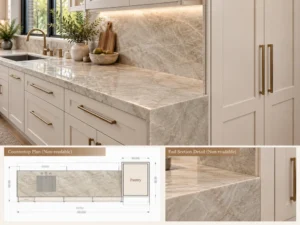
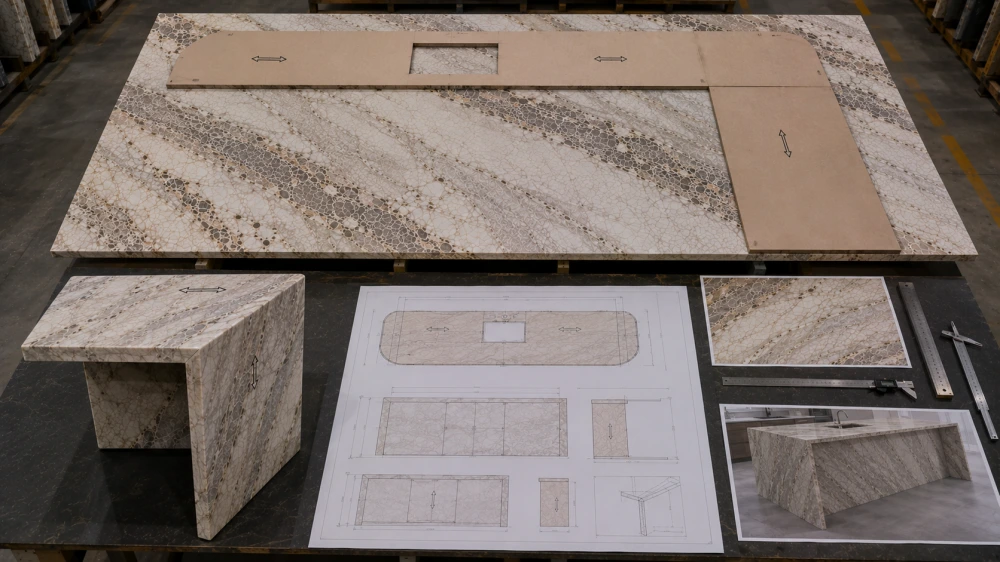
Long kitchen islands often benefit from deliberate vein orientation because the countertop is viewed as one large visual plane. Designers may choose to run the dominant movement along the length of the island or create a more directional cross-island composition depending on the selected slab.
The drawing should show the top piece ID, visible orientation, cut-outs, seam locations where applicable, and any relationship to waterfall panels.
Waterfall islands require additional coordination because a horizontal countertop transitions into a vertical end panel.
A direction arrow on each piece can communicate intended orientation, but arrows alone cannot guarantee a convincing continuation. The actual slab layout must show where the top and waterfall pieces are cut relative to one another.
For a mitered waterfall, the review typically considers:
Backsplashes are often positioned close to the countertop, which makes differences in orientation easy to notice. Where the design expects visual continuity, the backsplash layout should be reviewed together with the countertop rather than as an unrelated piece.
Large wall installations may contain many numbered panels. Vein-direction arrows can help keep the intended visual movement consistent, but panel sequence, joint locations, elevation references, and slab selection are equally important.
For feature walls, a full elevation or dry-layout review may provide more useful visual control than individual arrows alone.
Vanity tops, side splashes, aprons, and returns often involve smaller pieces, but visible orientation still matters when the quartzite has a strong directional structure.
Piece identification is particularly useful because small components can otherwise be accidentally rotated during cutting, finishing, packing, or installation.
Vein direction, bookmatching, and slip matching are related concepts, but they control different parts of the stone layout.
Vein-direction symbols indicate the intended orientation or visual movement of individual pieces.
Bookmatching generally refers to arranging sequential slab faces so the patterns mirror one another across a joint or centerline.
Slip matching generally keeps consecutive slabs or pieces facing in a similar orientation rather than creating a mirrored relationship.
Therefore, an arrow cannot replace a bookmatch or slip-match instruction. A project may require both.
For example, a feature wall could specify a bookmatched center composition while also using directional arrows and piece IDs to prevent individual panels from being rotated during fabrication.
Consider a quartzite kitchen island consisting of one long countertop and one full-height waterfall panel.
The shop drawing identifies:
The designer wants the dominant quartzite movement to travel along the island before visually transitioning down the waterfall end.
On the shop drawing, A1 and A2 each receive a direction arrow. However, this is only the first layer of control.
During slab layout, the fabricator must determine whether the selected slab has sufficient usable area to position both components close enough to the relevant mineral movement while still allowing for cutting, miter fabrication, edge allowances, defects, and other project constraints.
The final approval sequence becomes:
Slab Selection → A1 Cutting Position → A2 Cutting Position → Vein Direction → Miter Relationship → Installed View.
This illustrates an important principle: vein-direction symbols describe intent, while the actual slab layout determines whether that intent can realistically be achieved.
No. A vein-direction arrow controls intended orientation, but it does not guarantee visual continuity between fabricated quartzite pieces.
Continuity depends on several additional factors:
For critical visual areas, actual slab-layout approval is more reliable than relying on directional symbols alone.
| Common Mistake | Why It Creates Risk | Better Control |
| Using arrows without a legend | Different teams may interpret the arrow differently | Define the arrow meaning in every relevant drawing package |
| Showing direction without piece IDs | Orientation can become disconnected from the cutting plan | Use traceable IDs for important fabricated pieces |
| Approving direction before actual slab selection | The selected material may not support the conceptual layout | Reconfirm the layout against current slab images |
| Ignoring seam positions | Correct direction does not guarantee an acceptable joint | Review seam location and pattern relationship together |
| Using a small sample as the layout reference | A small sample cannot represent the full slab movement | Use current full-slab photographs for visual planning |
| Relying on verbal approval | The approved scope may become unclear later | Record the approved drawing or slab-layout revision in writing |
Before fabrication release, buyers and project teams can use the following checklist to confirm that direction symbols are supported by enough project information.
| Review Item | Check Before Release |
| Drawing revision | Confirm that all teams are reviewing the same current revision |
| Arrow legend | Define exactly what the direction arrow represents |
| Piece IDs | Ensure important fabricated pieces can be traced between drawings and slab layouts |
| Visible faces | Confirm which stone surfaces will remain visible after installation |
| Actual slab review | Review current slab photographs rather than relying only on samples or trade names |
| Slab layout | Confirm the cutting position and orientation of visually important pieces |
| Seams and joints | Review the visual relationship at visible connections |
| Bookmatch / slip match | Define separately where a specific matching method is required |
| Fabrication constraints | Check cut-outs, miter allowances, edge work, yield, and structural requirements |
| Written approval | Record exactly which layout or drawing revision has been accepted |
For international stone projects, clear documentation is especially important because designers, buyers, fabricators, installers, and suppliers may be working in different locations and time zones.
A useful approval message should identify:
A message such as “looks good” may be visually positive but does not clearly establish whether the material, slab layout, seam position, vein orientation, or fabrication drawing has actually been approved.
For production control, the approval should be specific enough that another project team member can understand what was accepted without reconstructing the entire message history.

An arrow usually indicates the intended visual or vein direction of a quartzite piece, but its exact meaning should be defined in the project drawing legend. It may represent dominant stone movement, piece orientation, or another project-specific direction.
No universal quartzite vein-direction symbol should be assumed for every project. Arrows are common, but architects, fabricators, and stone contractors may use different conventions. The shop-drawing legend should define the symbol used on the project.
Not necessarily. It is most useful on pieces where orientation materially affects the finished appearance, such as countertops, waterfall panels, backsplashes, feature-wall panels, large vanity elements, and visible returns.
The countertop and waterfall panel should have separate piece IDs and orientation marks, then be reviewed together on the actual slab layout. The miter position and cutting locations should also be checked because arrows alone cannot guarantee vein continuity.
Vein direction describes how a stone piece is oriented. Bookmatching describes the mirrored visual relationship between adjacent slab faces. A project may use vein-direction arrows and a separate bookmatch instruction at the same time.
No. Pattern continuity depends on the natural slab, cutting position, slab sequence, seams, fabrication allowances, and available usable stone area. The arrow communicates intent, while the slab layout determines whether the intended relationship can actually be achieved.
The approval path depends on the project contract and responsibilities. For visually important work, the final slab layout is typically reviewed by the relevant buyer, designer, architect, project manager, or other authorized project representative before fabrication release.
Final Note
Quartzite vein-direction symbols are most effective when they form part of a complete drawing and slab-layout review process. Define the symbol, identify each important piece, confirm the visible face, review current slabs, coordinate seams and matching requirements, and record the approved revision before fabrication. For project-specific quartzite fabrication support, HRST STONE can review material requirements, slab images, dimensions, drawings, finish, fabrication details, and delivery information as part of the quotation and production coordination process.