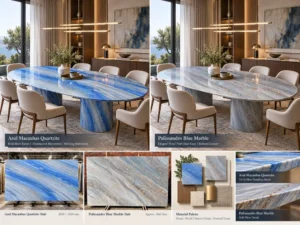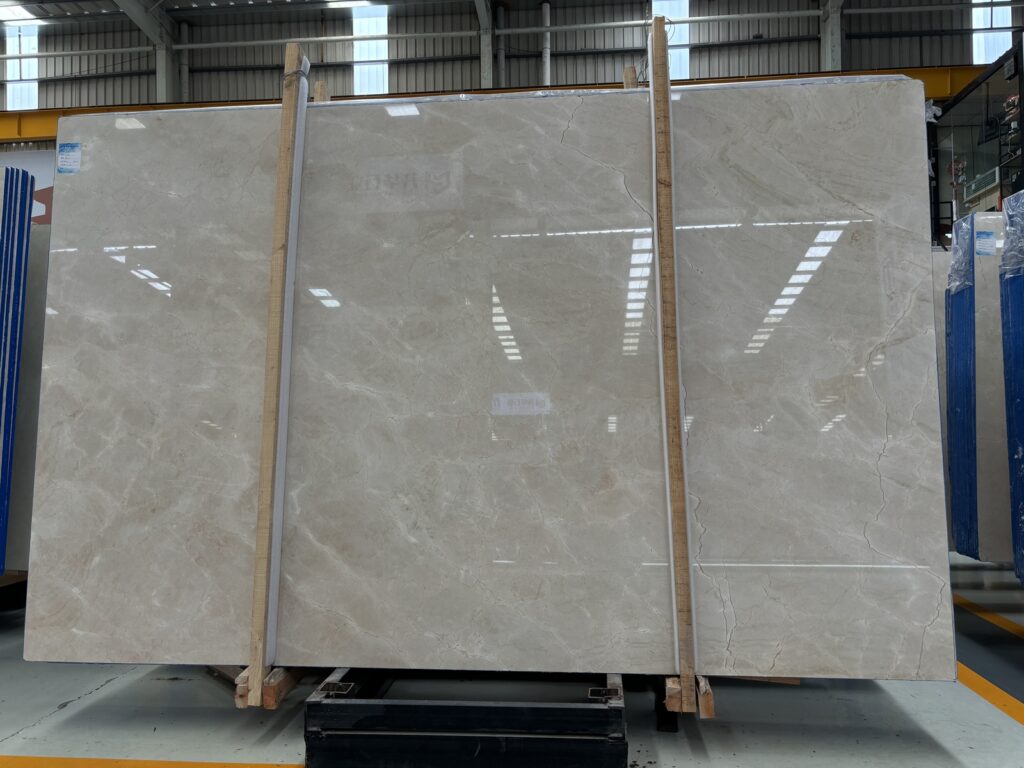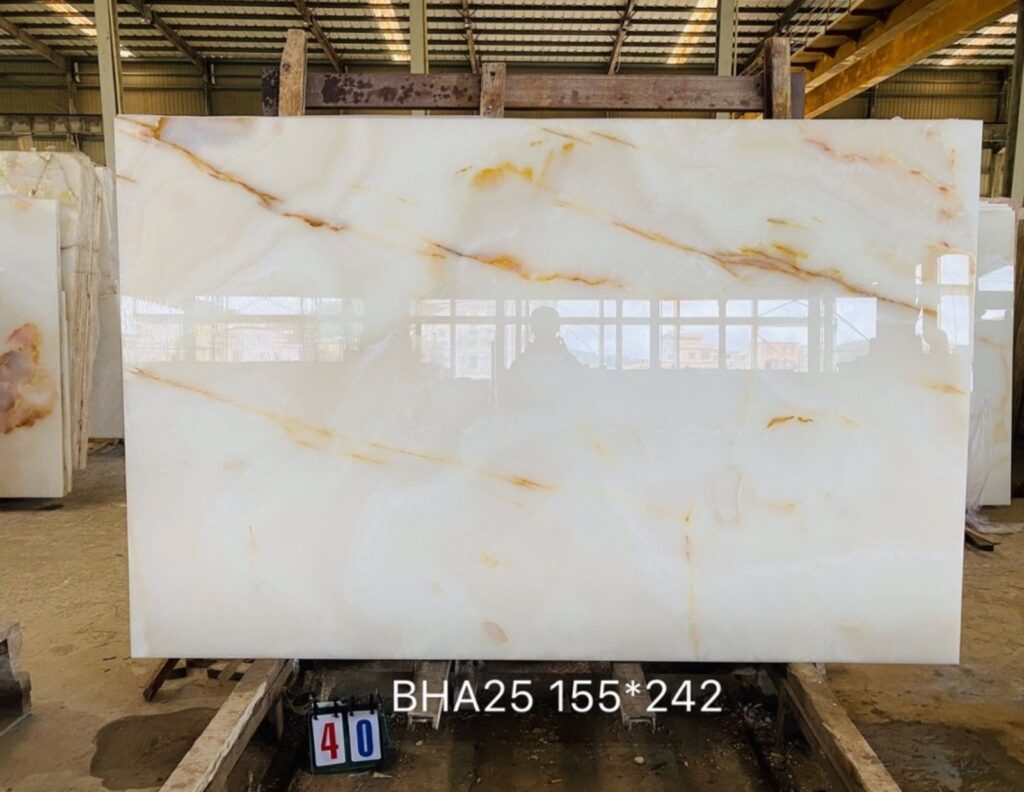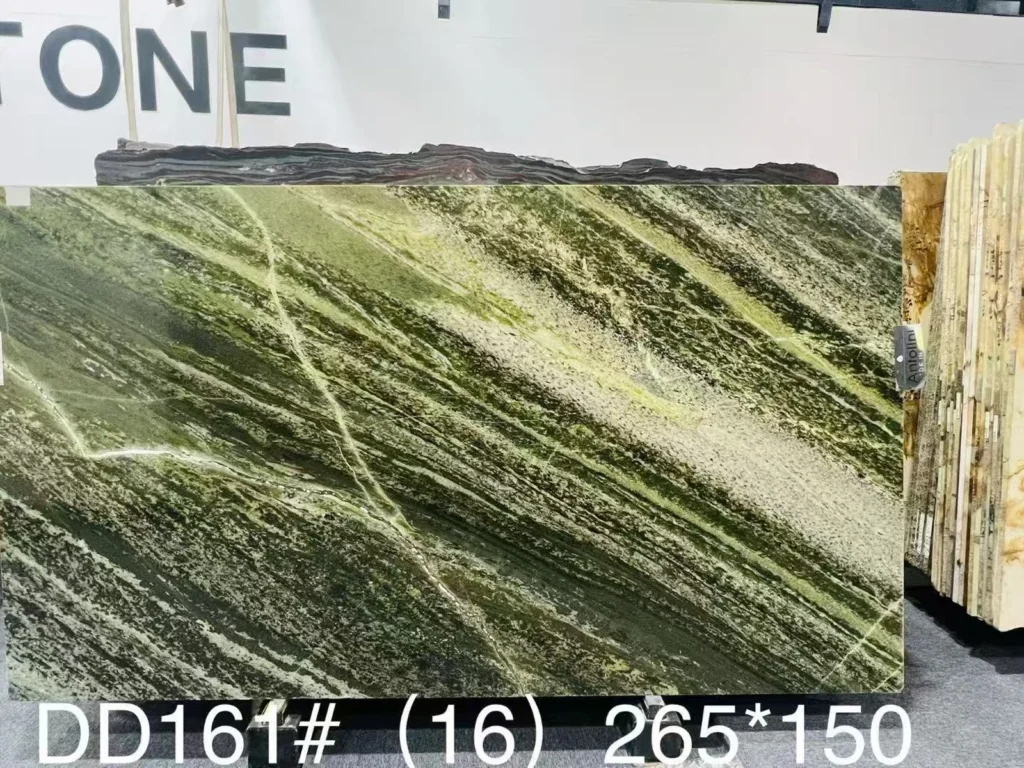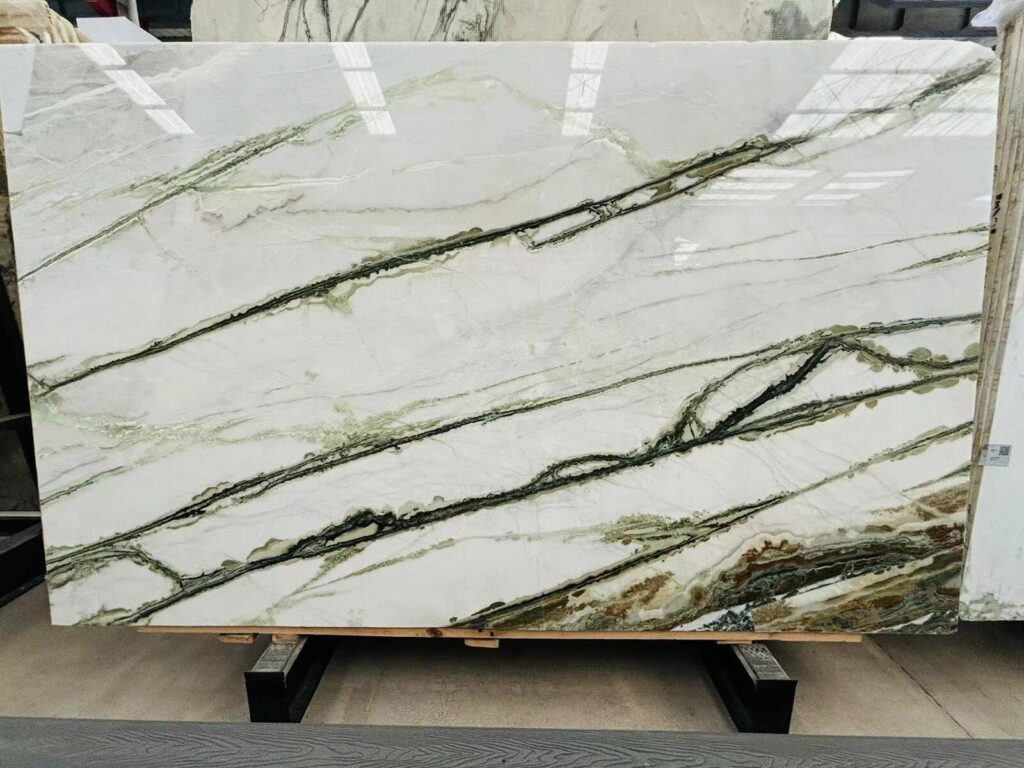

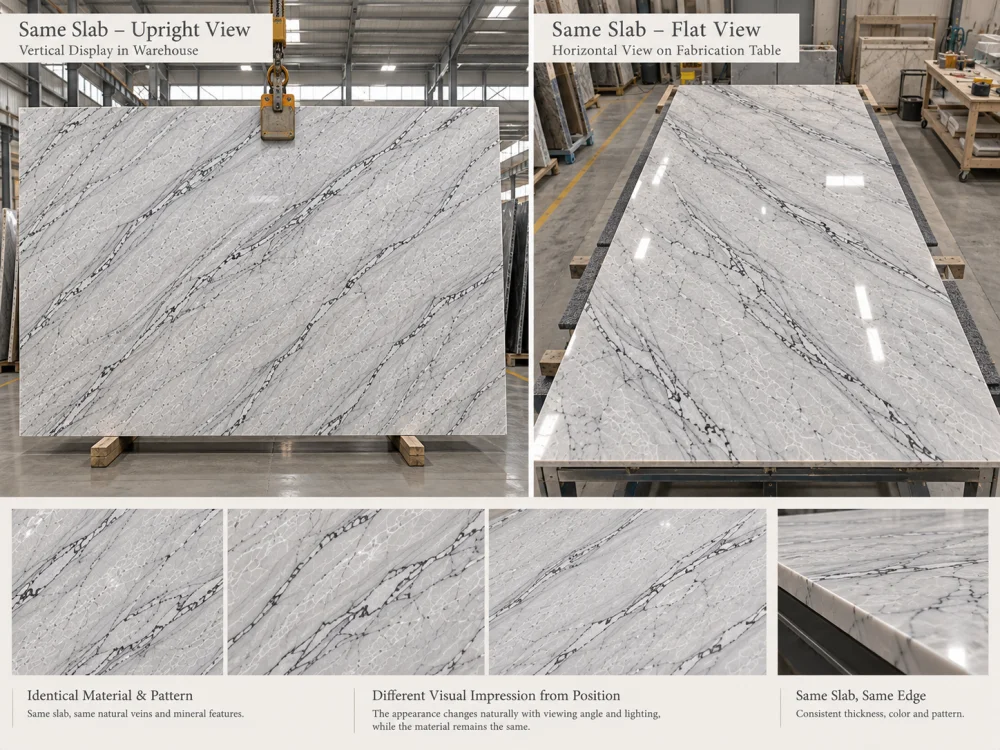
Quick SummaryNatural Quartzite can appear different when viewed upright in a slab warehouse and flat on a fabrication table. The stone itself has not necessarily changed. Light direction, surface reflections, viewing angle, distance, and the viewer’s relationship to the natural pattern have changed. Upright presentation helps buyers read the complete slab as a vertical composition; flat presentation can help them imagine horizontal applications and inspect particular areas from above. Neither position alone predicts every finished application. Compare the same identified slab under documented conditions and use the intended project surface to decide which view matters most.
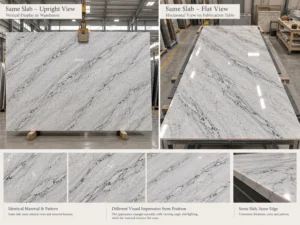
A buyer stands in front of a large Natural Quartzite slab displayed almost vertically in a stone warehouse. The movement looks dramatic, the crystalline areas are easy to distinguish, and the entire composition reads like an architectural feature wall.
Later, the same slab is positioned horizontally for a fabrication review. The surface now reflects overhead lights, the viewer approaches it from a different angle, and certain mineral features appear more prominent while others seem less important.
Has the stone changed?
Not necessarily. The apparent difference may result from the viewing conditions rather than a change in the material.
Understanding Quartzite slabs upright vs flat is particularly useful when a slab is selected in a showroom but will eventually become a kitchen island, countertop, dining table, wall panel, or reception surface.
A slab’s presentation position determines how the viewer encounters its surface.
When displayed upright, the slab often faces a person standing several steps away. The viewer can take in its complete height and width with a relatively direct view of the surface.
When the same slab is laid flat, the viewer may stand beside it and look down from an oblique angle. Parts of the slab are closer to the eyes than others, and overhead lighting may reflect across the surface differently.
These differences affect perception even when the stone’s finish, dimensions, and geological pattern remain unchanged.
| Viewing Factor | Upright Presentation | Flat Presentation |
| Typical viewer position | Standing in front of the slab | Standing beside or above the slab |
| Overall pattern | Often easier to read as one vertical composition | May be viewed as a horizontal surface or from an oblique perspective |
| Lighting | Vertical face interacts with the showroom’s light directions | Overhead fixtures and windows may create different reflections |
| Useful application context | Feature walls, wall panels, vertical furniture faces | Countertops, islands, tables, horizontal components |
| Main limitation | Does not automatically predict a horizontal finished surface | Does not automatically predict a vertical installation |
This is a difference in presentation, not a ranking of inspection accuracy. Either view can be useful when it answers a defined question.
Light is one of the strongest reasons the same polished Quartzite slab may appear different in two positions.
When a slab is upright, overhead fixtures may illuminate its face at an angle. The viewer may see a broad, relatively uninterrupted section of the stone, depending on the warehouse arrangement.
When the slab is flat, the same fixtures may produce visible reflections across the horizontal surface. These reflections can emphasize certain areas, obscure parts of the mineral pattern, or change the apparent contrast between light and dark geological features.
A polished surface may reflect windows, ceiling lights, nearby slabs, or surrounding colors. Honed and textured finishes may distribute reflections differently, although the actual appearance depends on the surface and lighting conditions.
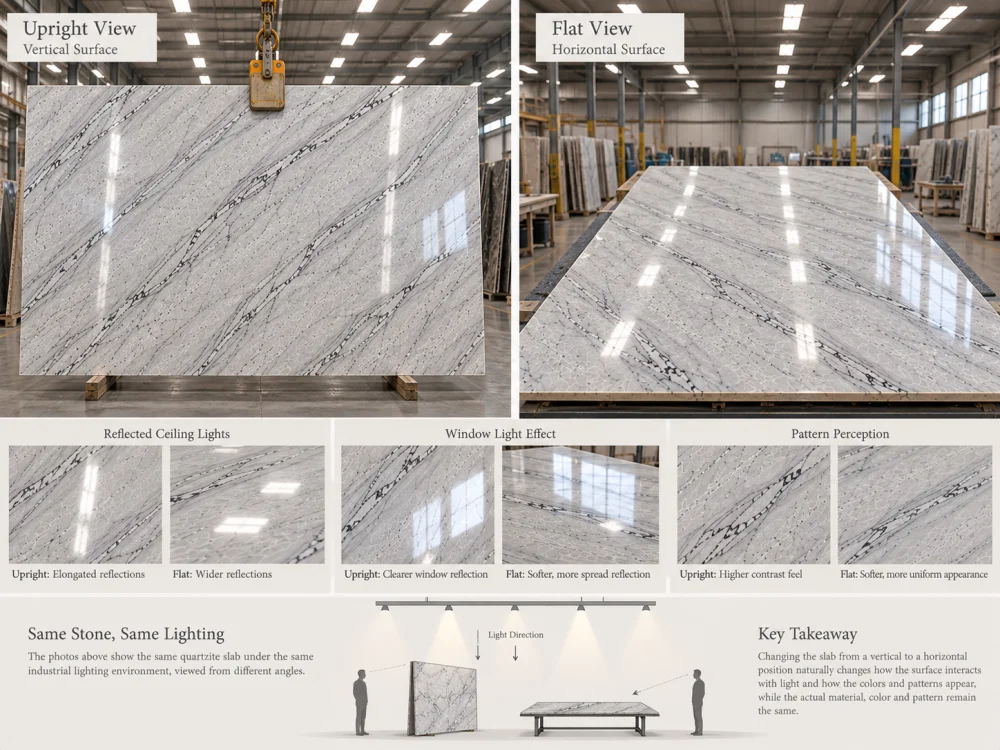
Imagine a pale Quartzite slab with soft grey movement. Under one viewing condition, its background appears calm and relatively uniform. Under another, reflected ceiling fixtures create bright patches that compete with the natural pattern.
The bright patches are not necessarily lighter mineral areas. They may be reflected light.
Likewise, a darker-looking region may result partly from the surrounding illumination or the angle from which the viewer sees the surface.
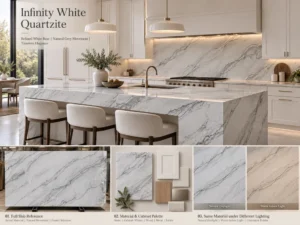
For color-sensitive decisions, compare the stone under controlled, representative lighting and use physical references when appropriate. A showroom photograph alone cannot establish a precise finished-room color match.
Light travelling at a shallow angle across a surface can make reflections and local visual changes more noticeable. That can be useful for observing an area that deserves closer attention.
However, a reflected line that appears curved or interrupted does not, by itself, establish a flatness defect. A dimensional flatness concern requires an appropriate measurement method and a project-specific reference.
The useful distinction is simple: visual observation identifies what to investigate; technical measurement determines a measurable condition.
Natural Quartzite often contains geological features at several scales. Some slabs have broad bands or crystalline fields; others have smaller veins, irregular mineral concentrations, or strong contrasts between adjacent zones.
When viewing an upright slab from several steps away, the eye tends to organize these details into a larger composition.
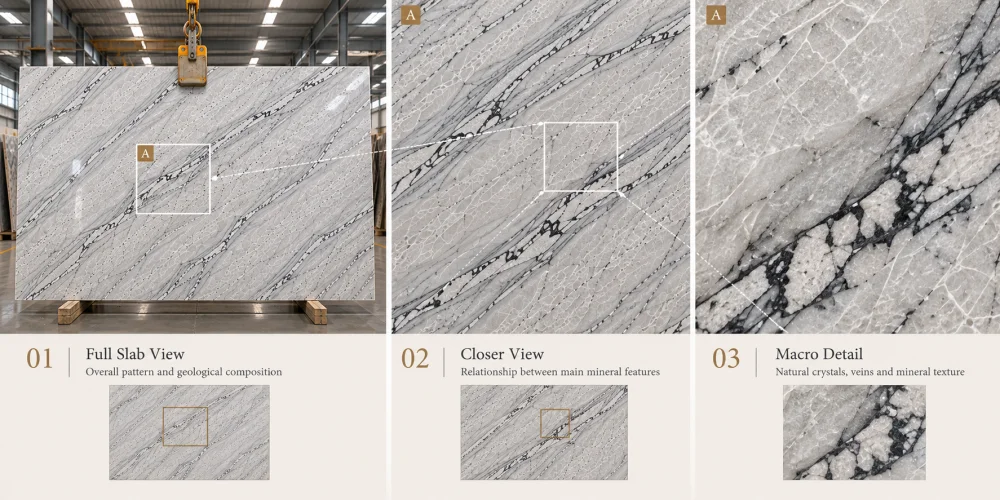
Move closer, and the individual veins, mineral boundaries, crystals, and localized variations become more prominent.
A flat slab introduces another viewing relationship. Someone standing beside a large board may be close to one end while the far end is viewed at a greater distance and a different perspective angle.
This can make the near portion visually dominant, even when the overall pattern is more balanced from a direct overhead view.
Whole-Slab Distance: Step far enough away to see the complete board. Use this view to understand the overall movement, dominant mineral areas, and general composition.
Working Distance: Move closer to examine the portions likely to become important finished surfaces. For a kitchen island, this may include the planned countertop crop and waterfall areas.
Detail Distance: Inspect a specific feature, finish, or local area that needs clarification. Keep the detail connected to its position on the full slab.
No single distance should be treated as sufficient for every decision.
Viewing Scale Rule
Whole Slab → Finished-Surface Area → Local Detail. Review all three scales when the project decision depends on both overall movement and particular natural features.
The finished use of the stone should guide the presentation review. A slab selected for a wall does not need to be evaluated in exactly the same way as one selected for a horizontal dining table.
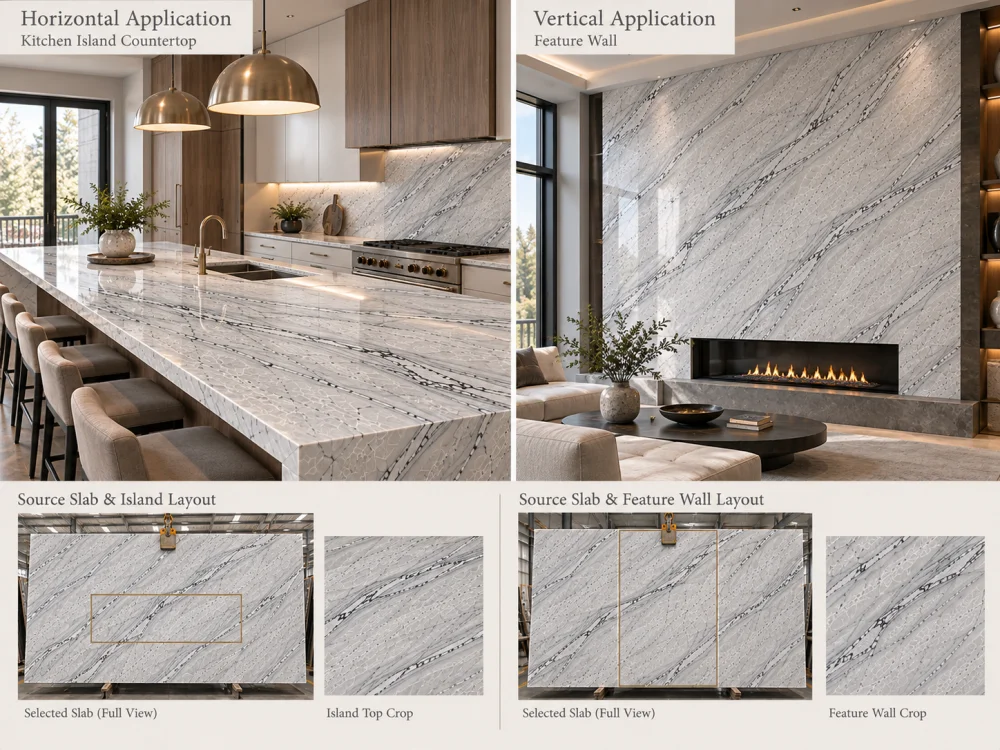
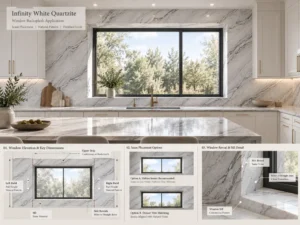
For a vertical feature wall, an upright slab presentation can provide a useful first impression of how the material reads as a large vertical composition.
However, the finished wall may be viewed from a greater distance, illuminated by different fixtures, or divided into several panels. The showroom view is therefore a reference, not a complete installation simulation.
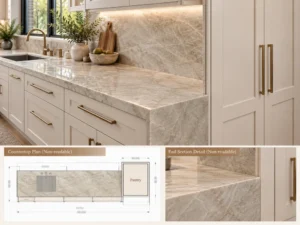
For a kitchen island, the horizontal appearance becomes more important. A flat presentation may help reviewers consider how broad mineral features occupy a top surface.
Yet a person using the kitchen rarely views the entire countertop from directly overhead. Standing-height views and realistic room perspectives remain useful.
Where an island includes waterfall ends, the project contains both horizontal and vertical faces. Neither upright nor flat presentation alone describes the complete finished composition.
For a large table, the stone is experienced mainly from seated and standing positions around its perimeter.
A flat review can help the team examine the proposed tabletop crop, but it should be supplemented by an appropriate perspective view that considers the table’s actual dimensions and viewing height.
Bathroom vanities may combine a horizontal top with a vertical backsplash or front apron. The same stone can be experienced differently across these surfaces because their orientations and light exposure differ.
In these projects, it is more useful to identify the main finished planes than to declare one warehouse presentation universally preferable.
When a project requires both views, the comparison should preserve the identity of the stone and distinguish presentation effects from changes in the material itself.
Begin with the same identified slab and confirm which face and finish are being examined. If the slab cannot be safely moved or repositioned, use existing documented views or suitable controlled references rather than attempting an unnecessary handling operation.

Record the complete visible slab, its identification, presentation angle, approximate viewing distance, and lighting conditions.
Observe the overall direction of movement, relative size of mineral areas, and the way the pattern reads from the front.
Where a properly supported horizontal review is available, examine the same visible face and identify the changes in perspective, reflection, and visual emphasis.
Do not assume the lighting is identical merely because the review takes place in the same building. Rotating the slab changes how its surface faces the available light.
Connect the observations to the project drawing. If the stone will become a countertop, focus on the proposed horizontal finished area. If it will become a wall, evaluate the intended vertical composition.
For mixed-plane work, review each principal finished face separately and then consider the complete assembly.
This process is a comparison of visual evidence, not an instruction to repeatedly move large stone slabs. Slab handling must be carried out only by appropriately equipped personnel using suitable supports and established safety procedures.
Remote buyers may receive one photograph of a slab upright in a warehouse and another of the same slab lying flat on a fabrication table.
It is tempting to compare the photographs as though they were controlled images of the same scene. In practice, several variables may have changed simultaneously.
The camera may have moved closer. A wide-angle lens may exaggerate perspective. The slab may face a different light source. Automatic exposure or white balance may alter the apparent brightness or tone.
Even a correctly identified slab can therefore appear different across two photographs.
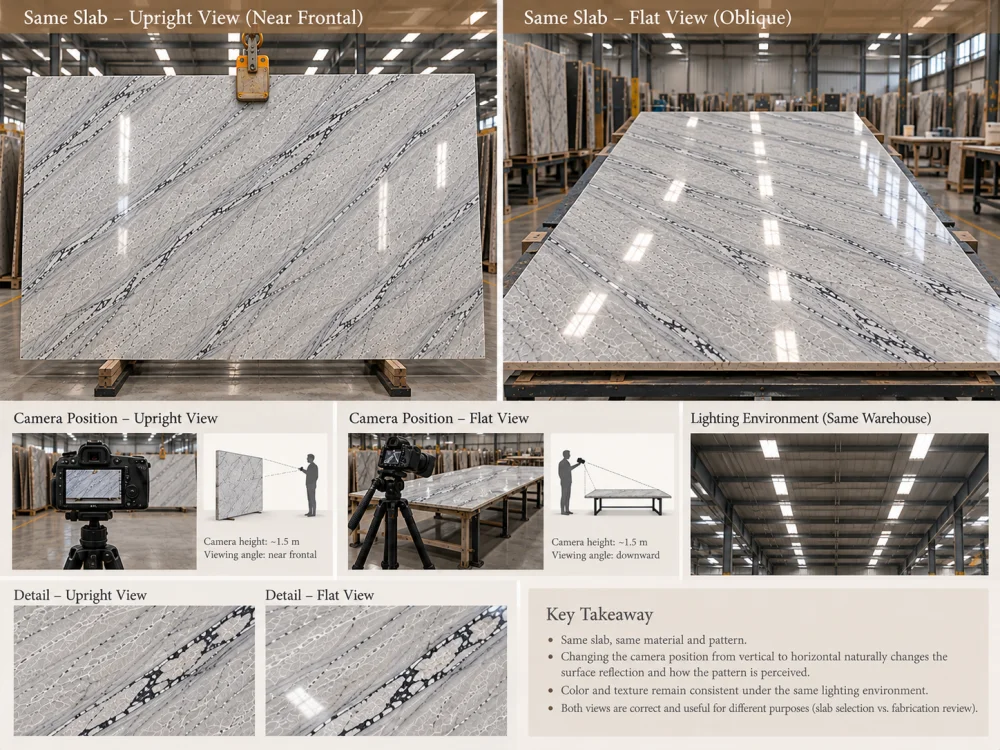
Before concluding that the material has changed, check whether the images show the same board, the same finished face, and the same surface finish.
Then ask for the available lighting and viewing information. If the difference matters to a material decision, request a targeted clarification rather than treating one photograph as automatically more truthful.
The related Quartzite slab showroom selection guide explains how complete slab photographs, board identification, and targeted details can support a more useful material review.
A change in appearance between upright and flat presentation does not automatically indicate a defect. Equally, a visually attractive slab display does not establish that every technical requirement has been met.
Consider three different observations.
Observation A: The natural veins appear more prominent when the slab is upright. This may be a matter of viewing distance, pattern scale, or perspective.
Observation B: The polished surface shows a strong reflected line when the slab is flat. This may be a reflection effect that warrants further review if it raises a specific concern.
Observation C: A local area appears different under another lighting condition. The team may need to examine whether the difference belongs to the stone itself, the surface finish, or the viewing environment.
None of these observations alone establishes a measurable defect, a petrographic classification, or a fabrication acceptance result.
Natural Quartzite should also be distinguished from engineered quartz. A commercial material name does not replace confirmation of the actual product being offered.
If a project raises a dimensional or material-condition question, record the relevant slab area and request the appropriate technical review. Keep that question separate from the aesthetic comparison of upright and flat views.
A useful slab-viewing record does not need to become a long production checklist. It should simply preserve the conditions needed to understand the visual decision.
If several people are reviewing the material, their comments should remain connected to the same slab evidence. The Quartzite slab selection with multiple decision makers guide explains how to distinguish visual preferences from technical and approval decisions.
The key point is that an upright display and a flat display are two different ways of observing the same natural material. A meaningful decision uses the view that answers the project’s question and recognizes what that view cannot prove.
The surface interacts differently with lighting, reflections, viewing distance, and perspective. The natural stone pattern may be unchanged even though certain features become more or less prominent.
Not universally. Upright viewing can help with the overall vertical composition, while flat viewing may be useful for horizontal applications. The better review is the one that matches the decision being made.
A properly supported flat review can be helpful where available, but it is not always necessary or practical. The project can also use actual slab photographs, a proposed cutting layout, and realistic finished-island views to evaluate the horizontal composition.
Changing presentation position does not by itself change the stone’s intrinsic color. It can change perceived appearance because the surface faces the light and viewer differently. Surface reflections and photographic settings may contribute further differences.
No. A photograph can document visual observations, but it cannot replace a defined dimensional measurement where flatness must be verified against a project requirement.
Confirm the slab identity, visible face, finish, presentation position, lighting, and camera conditions. Request complete slab views and targeted details that answer the actual project question.
Record the material and board reference, the viewing positions considered, important lighting and distance conditions, the intended application, the specific visual decision, and any issues requiring further review.
Review Natural Quartzite for Its Intended ApplicationFor an international Quartzite project, HRST STONE can help coordinate available full-slab photographs, identified material references, proposed stone layouts, relevant CAD/shop drawing information, and visual inspection records according to the confirmed scope. Send Josh the material name, project application, required dimensions, quantities, surface finish, and delivery destination to discuss the next review steps.
Copyright © HRST STONE / XIAMEN HRST STONE CO., LTD. All rights reserved.