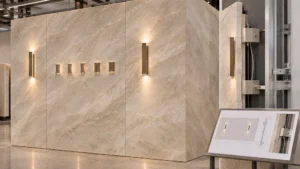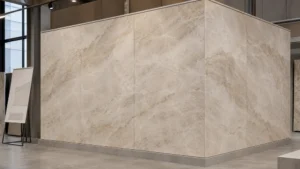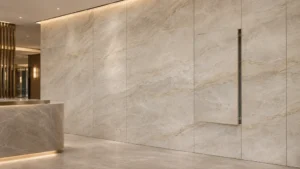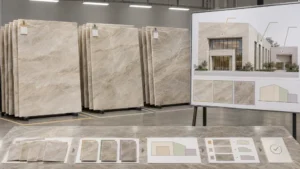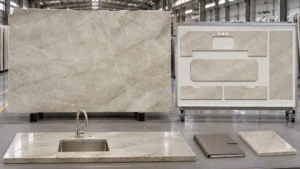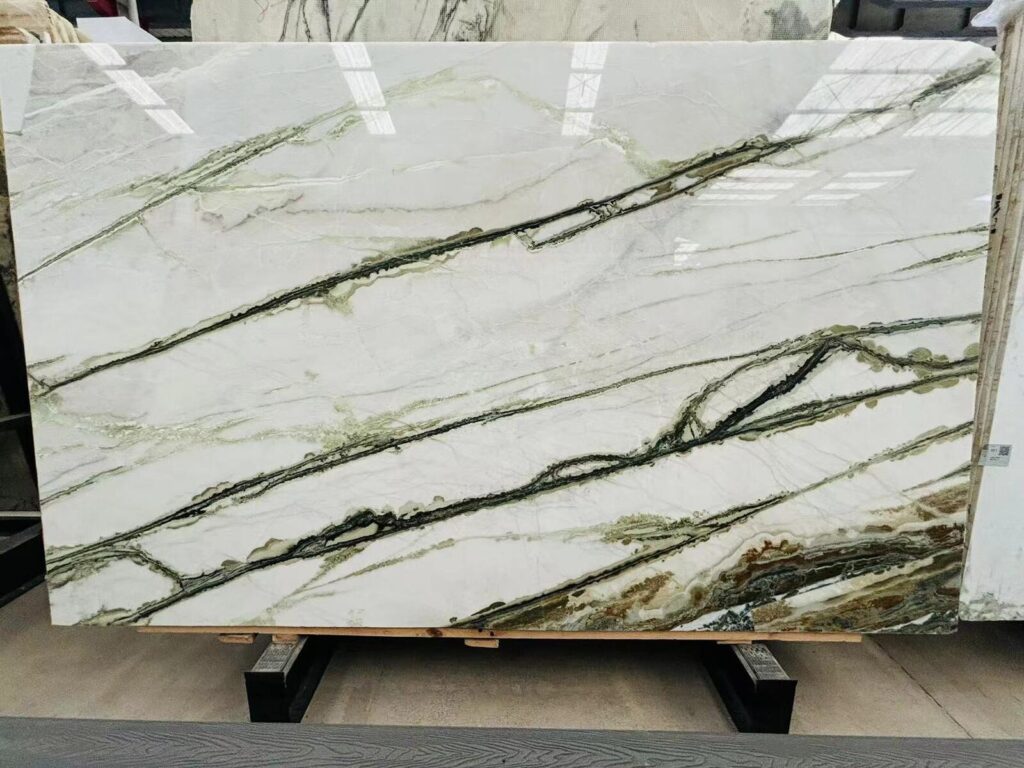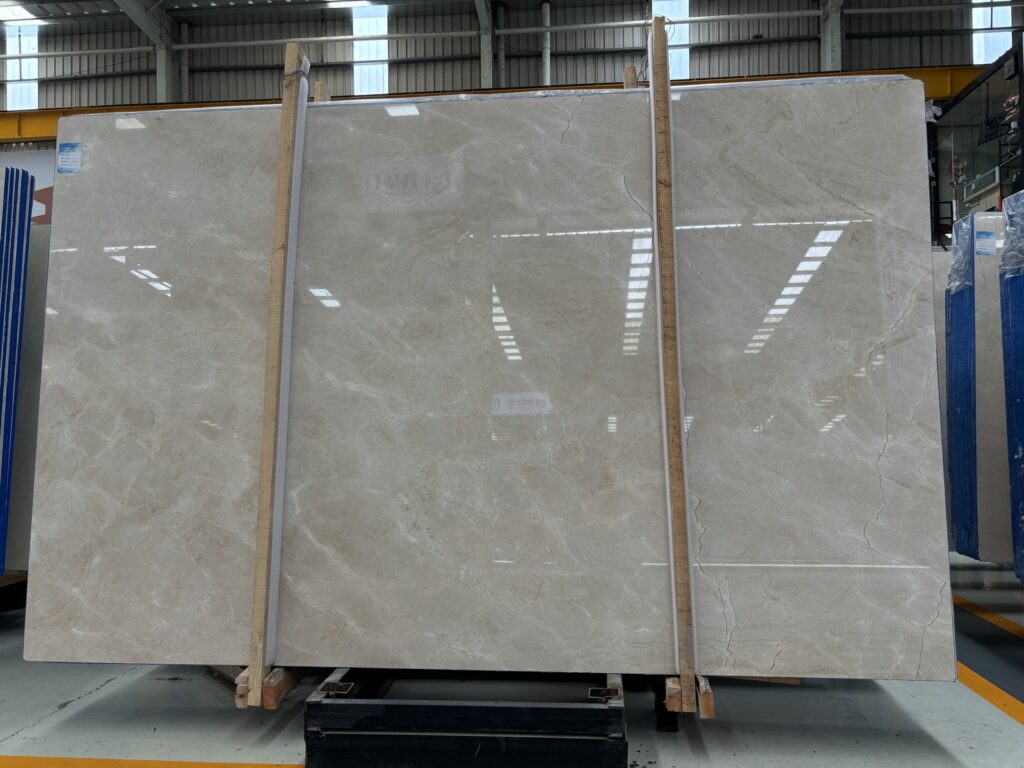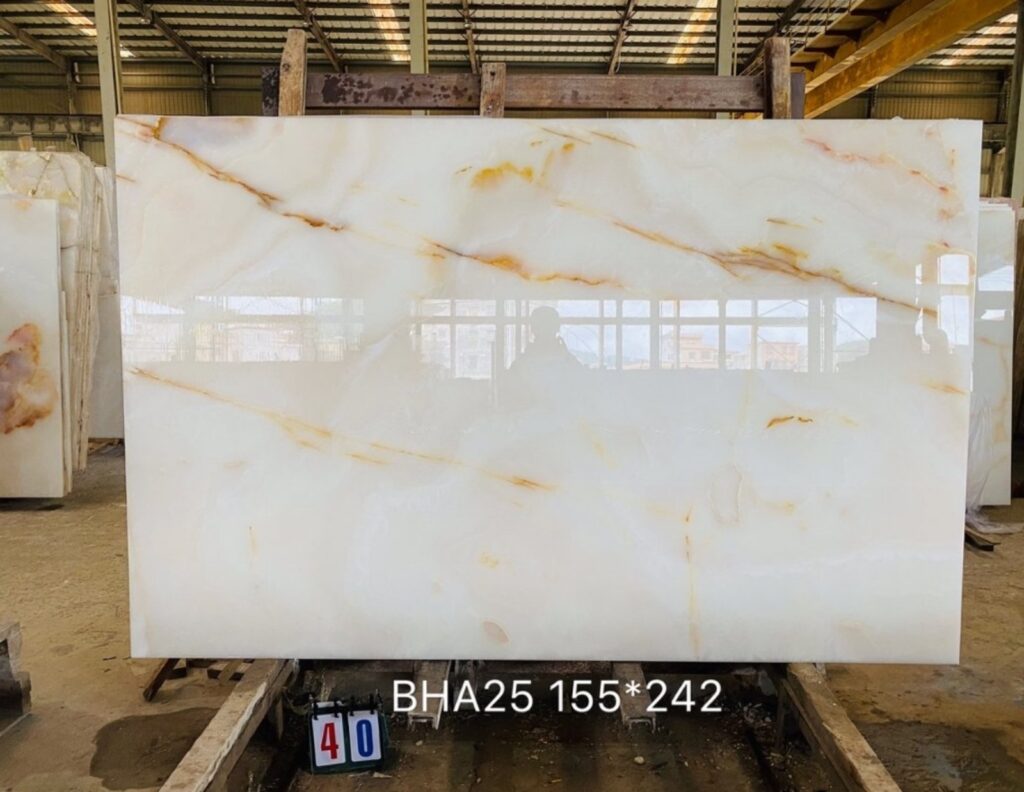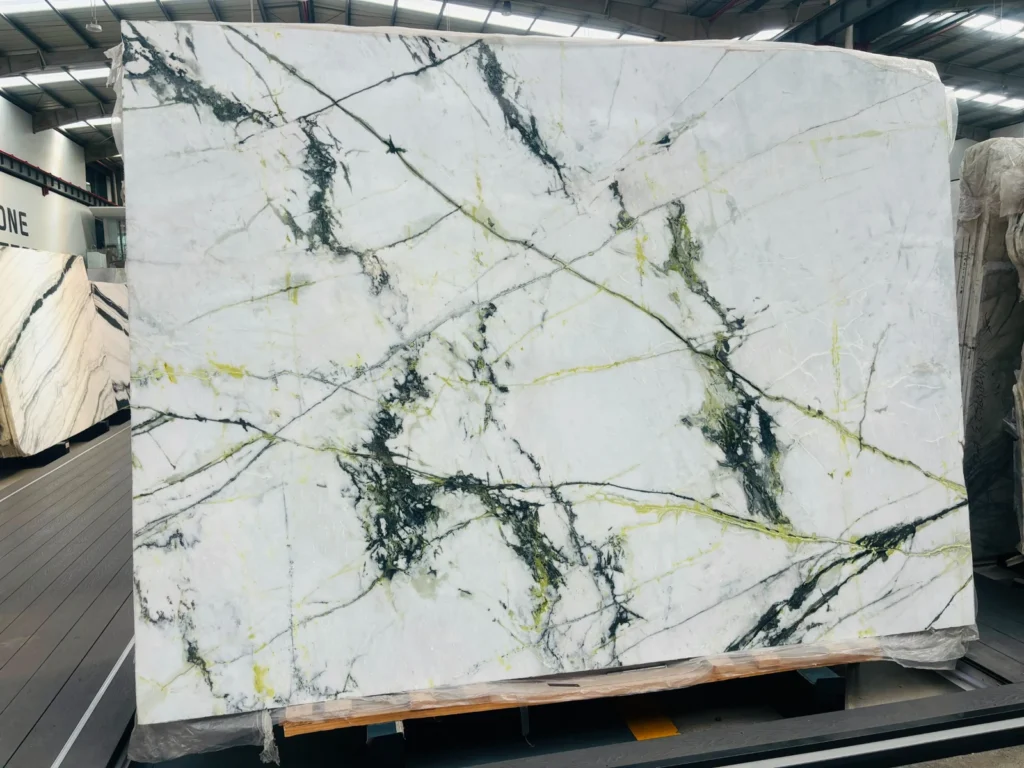

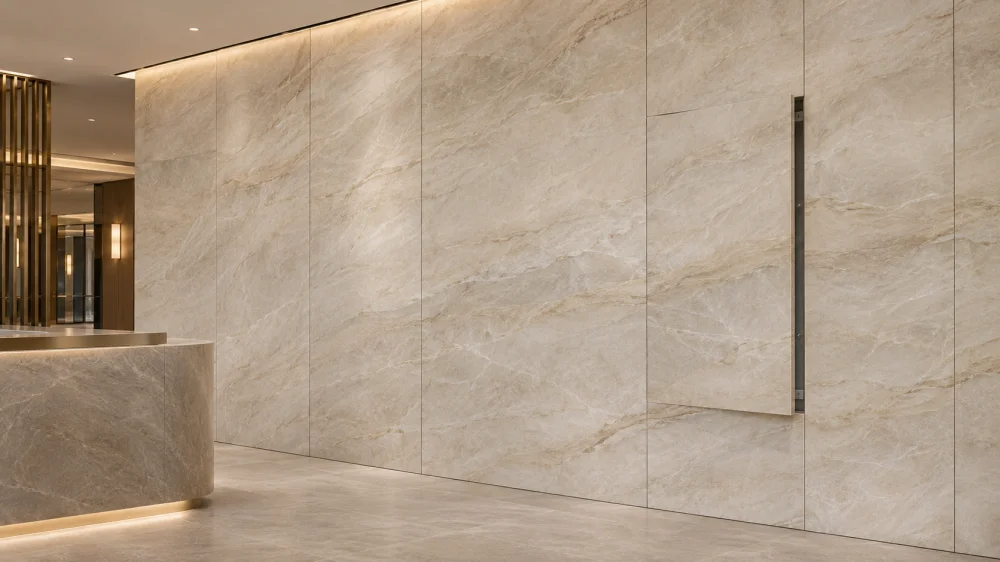
A Quartzite facade access hatch should be designed as a removable part of the complete stone assembly, not as an opening cut into the wall after the stone layout is finished. Coordinate the service opening, hatch boundary, stone pattern, joint or reveal, backing, attachment method, panel weight, removal direction and maintenance clearance before fabrication. The final approval should prove that the identified stone piece can be removed and reinstalled without damaging adjacent panels or losing the intended facade composition.
Access-Hatch Design BriefService Need: What equipment, valve, electrical item or other condition requires future access?
Stone Boundary: Which visible Quartzite panel becomes removable?
Opening Logic: Is the perimeter concealed, expressed as a reveal or coordinated with the normal stone-joint grid?
Removal: In which direction can the panel move before it clears the surrounding stone?
Reinstallation: How does the piece return to the same orientation, joint relationship and finished plane?
A Quartzite facade access hatch is a service opening integrated into a stone-clad vertical surface in which an identified Quartzite panel, or stone-faced assembly, can be intentionally removed or opened to reach equipment or building services behind the finished face.
The word facade can describe different project conditions.
An interior reception wall, lift lobby or decorative feature wall may have very different technical requirements from an exterior building envelope.
For an exterior facade, the access-hatch design may also affect structural support, drainage, water management, air and weather layers, thermal interfaces, wind loading and code requirements. Those issues should be resolved by the responsible facade and structural design team rather than inferred from a decorative stone detail.
The stone supplier or fabricator should understand the required interface, but the stone panel cannot independently define the complete building-envelope system.
Start with the reason the opening exists.
A hatch may provide access to:
The responsible design team should establish the required service opening and maintenance envelope before the Quartzite panelization is frozen.
Otherwise the stone layout can create a visually attractive panel that is too small to reach the equipment behind it.
The reverse problem also occurs.
A large generic access opening may be drawn first, and the stone subcontractor is later asked to conceal it inside a carefully composed natural-stone elevation.
A stronger sequence is:
Service Item → Required Access Envelope → Stone Joint Grid → Removable Panel → Attachment / Removal Strategy → Slab Allocation
Serviceability FirstThe access hatch exists so future work can occur behind the stone.
If the finished Quartzite looks perfect but the maintenance team cannot reach the equipment without breaking adjacent panels, the access design has failed its primary function.
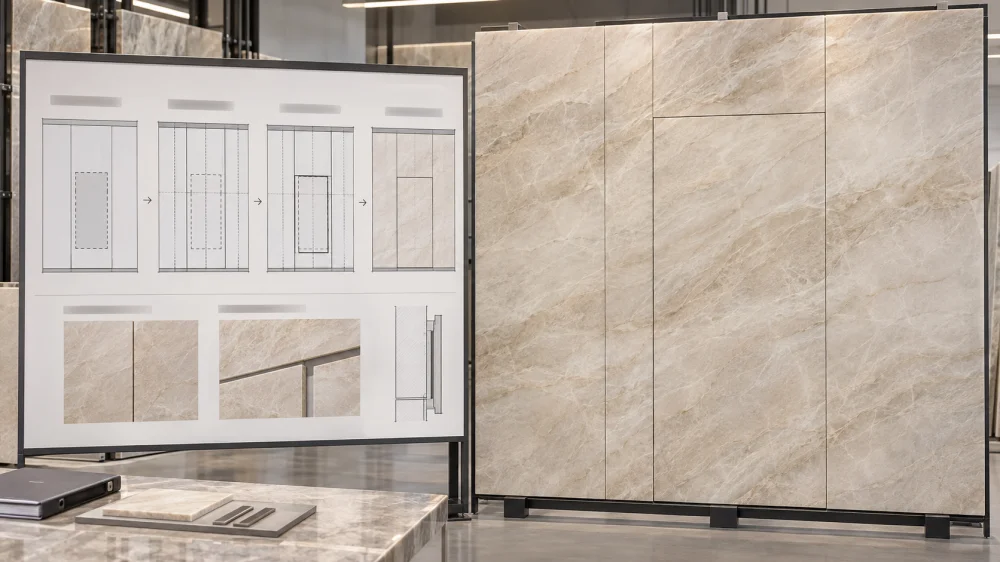
The hatch boundary should respond to both the service opening and the visible stone composition.
Possible strategies include:
A hatch should not be made unnecessarily obvious simply because it is removable.
But the design should also avoid creating a false promise of a completely jointless stone surface if a real serviceable perimeter is required.
| Joint Strategy | Design Advantage | What Must Be Controlled |
| Normal Panel Joint | Hatch blends into the existing panel grid | Panel dimensions and service opening must align |
| Shadow Reveal | Makes the removable boundary intentional | Reveal consistency, backing visibility and edge finish |
| Very Tight Visual Joint | Can reduce visual interruption | Required movement and removal clearance must still exist |
| Expressed Frame / Trim | Clear serviceable architectural element | Stone-to-frame interface and finish coordination |
The access hatch is still part of the visible stone elevation.
It should therefore enter the slab layout before cutting.
The project can review:
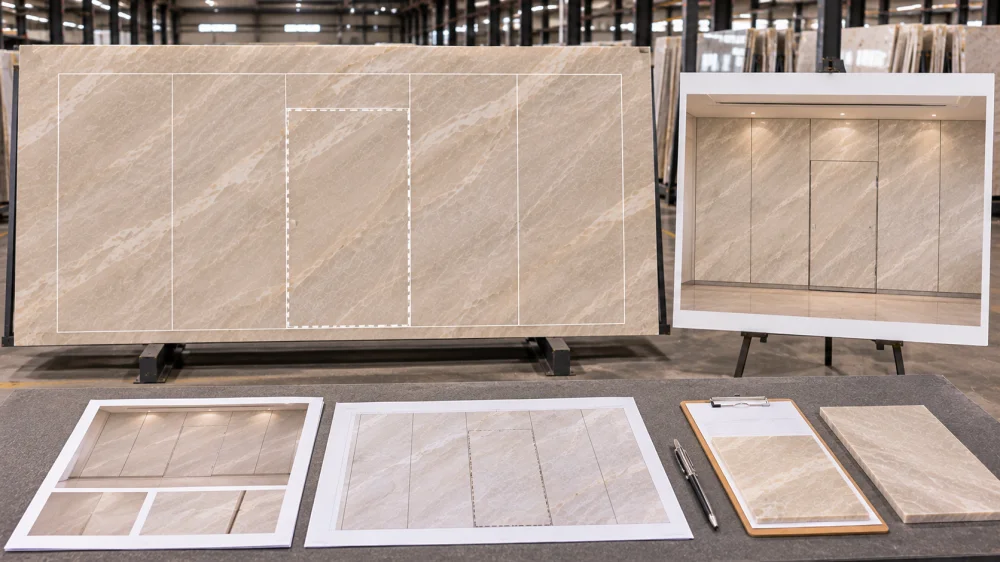
A Taj Mahal Quartzite hatch located inside a quiet wall composition may need relatively calm material.
A Patagonia Quartzite feature wall may instead use the hatch as part of a larger crystalline panel sequence.
The objective is not to promise perfect continuation through every joint.
It is to prevent the access panel from looking like an unrelated replacement piece.
A useful control chain is:
Board Number → Cutting Position → Hatch Piece ID → Visible Face → Adjacent Piece IDs → Final Elevation
Where directional movement matters, use the same face and orientation references already used for the rest of the facade.
The site’s annotated-photo fabrication guide recommends stable piece IDs and clearly defined visible zones so visual instructions remain connected to the actual fabrication documents rather than existing only as comments on photographs.
This is where many visually resolved access panels become impractical.
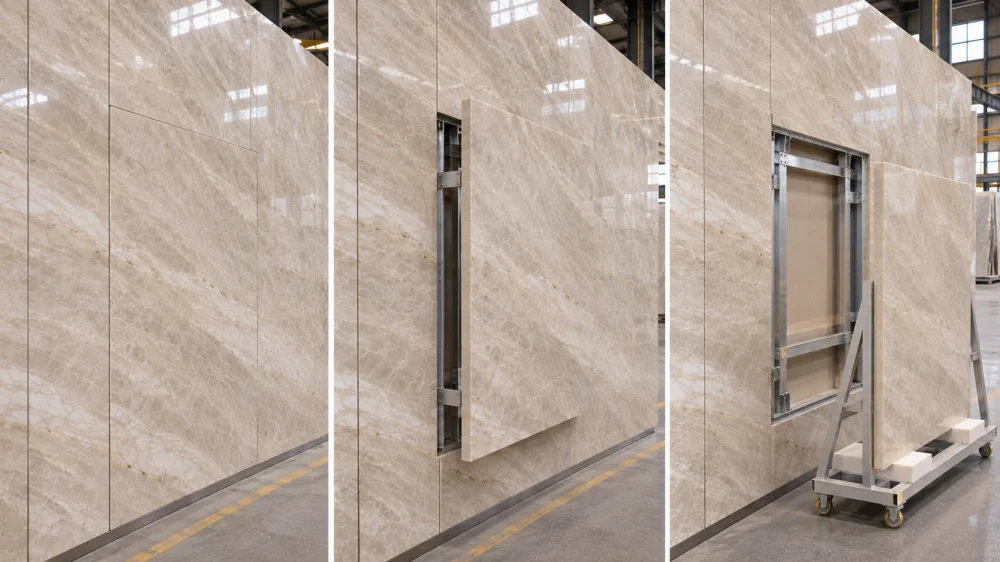
A removable stone piece needs space to move.
Depending on the proposed mechanism, it may need to:
The exact mechanism should be developed by the responsible system designer and fabricator.
The important stone-coordination question is:
What physical envelope does the panel occupy while it is being removed?
Check nearby:
The Removal-Envelope TestDo not approve only the panel in its closed position.
Show the hatch at the critical stages of removal:
Closed → Released → Initial Movement → Clear of Adjacent Stone → Service Position
The visible stone is only the outer layer.
The removable assembly may also involve:
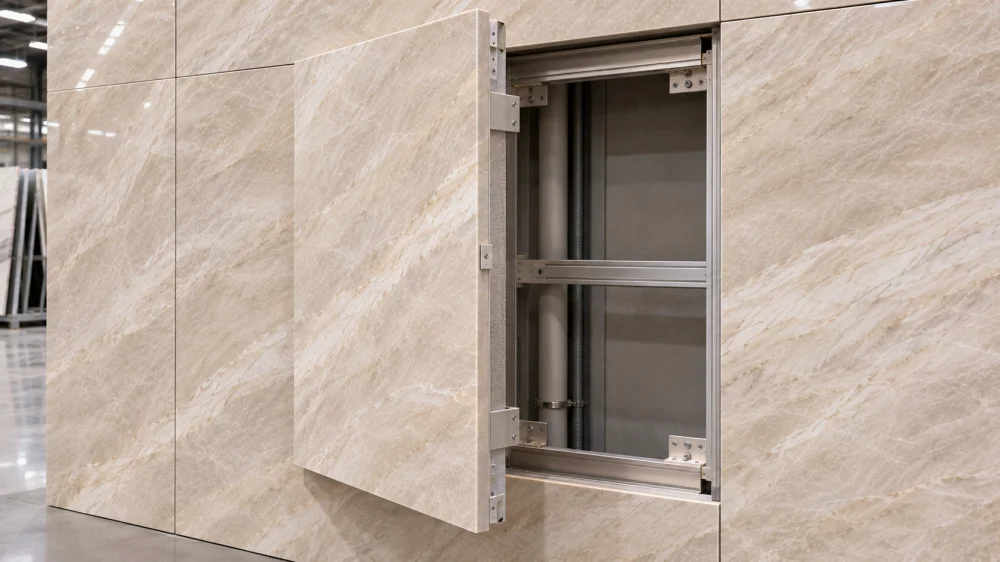
The Natural Stone Institute’s current 2024 Dimension Stone Design Manual Chapter 14 addresses vertical stone installation systems including mechanically anchored, adhesively attached and preassembled panelized systems. A removable hatch should be coordinated with whichever project-specific vertical-stone system is actually being designed rather than treated as an isolated loose panel.
Do not infer a universal fixing method from this article.
The support and anchorage need to be designed for the actual stone, assembly, orientation, loads and applicable project requirements.
Yes, but weight should not be reduced to one generic maximum number.
A larger or thicker Quartzite access panel can affect:
A panel that can technically be fabricated may still be an inconvenient service hatch if every future inspection requires specialist lifting equipment.
That does not automatically mean the panel should be made smaller.
A smaller hatch may no longer provide sufficient service access or may disrupt the facade composition.
The design team therefore needs to balance:
Stone Geometry ↔ Access Requirement ↔ Handling Strategy ↔ Visible Joint Pattern
A normal facade panel may be installed and then remain largely undisturbed.
An access panel is different.
Its edges can become active interfaces during repeated removal and reinstallation.
Potential coordination issues include:
The project should therefore review the hatch perimeter as an operational edge—not merely as another decorative stone joint.
If maintenance requires a screwdriver, suction device, release tool, concealed latch or another access method, define where that interaction occurs.
The service team should not have to discover on site that the easiest way to open the hatch is to pry directly against a finished Quartzite edge.
The installed visible face does not need a permanent large label.
The project records do need a stable identity.
For example:
Wall Panel W-12 — Removable Access Hatch AH-01
That same reference can appear in:
A useful traceability chain is:
Source Slab → Cutting Position → AH-01 → Factory Test → Crate → Wall Location → Maintenance Record
The site’s Quartzite Factory-to-Site Handover Document Index uses the same stable-piece principle: a physical component should remain identifiable from fabrication and QC through packing, site receipt and final installation.
This topic deserves more than a normal finish sample.
The most useful mock-up is a functional assembly.
It does not necessarily need to reproduce the entire facade.
It should reproduce the conditions that could make the hatch fail.
| Test Stage | What to Observe |
| Closed Position | Finished plane, joint rhythm, pattern relationship and edge alignment |
| Release | How the locking / attachment condition is accessed without damaging stone |
| Initial Movement | Clearance from adjacent stone, reveals and architectural elements |
| Removal | Handling support and access to the service opening |
| Reinstallation | Orientation, alignment, attachment and return to the correct finished plane |
| Repeat Check | Whether the joint and stone edges remain acceptable after the service cycle |
Functional Mock-Up RuleA closed photograph proves how the hatch looks while nobody is using it.
An access hatch should also prove how it behaves when somebody actually needs access.
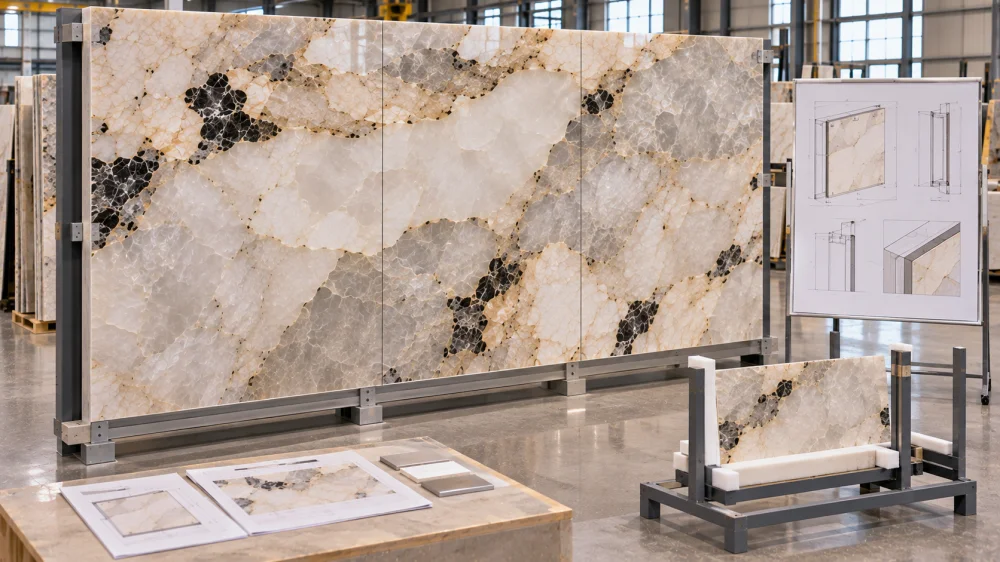
The hatch should not leave the factory with only a general surface QC photograph.
Where relevant, the project can verify:
If hardware is supplied separately from the stone, the handover package should identify which system or site party controls it.
Do not allow:
“Stone supplied by Factory A”
and
“Hatch frame installed by Contractor B”
to become two unrelated scopes without one coordinated interface drawing.
Natural stone orientation matters.
A rectangular hatch may physically fit after being rotated 180 degrees while the Quartzite movement becomes visibly wrong.
For directional or visually complex stone, the project record should identify:
These references can remain concealed on the back or in project documents rather than being visible on the finished facade.
The objective is simple:
the maintenance team should not need to remember how the stone looked before they removed it.
This is where an access hatch differs strongly from an ordinary fixed wall panel.
The project is not complete when the stone looks correct on installation day.
Someone may need to open it years later.
A useful handover record can contain:
Access Hatch ID: AH-01
Stone Piece ID: W-12
Location: current elevation / room reference
Service Purpose: what lies behind the panel
Opening Direction / Removal Sequence: current approved procedure
Required Tool / Handling Method: where applicable
Temporary Support Requirement: where applicable
Stone Orientation: top / visible face / adjacent panels
Hardware / Frame Responsibility: responsible project source
As-Built Drawing: current reference
Factory Test Record: reference where performed
Installed Photographs: closed and service condition where useful
Known Restrictions: any maintenance limitation
The site’s Quartzite Project Completion Records recommends preserving final drawings, piece IDs, orientation, visible edges and installed-location evidence so a later team can reconstruct the physical stone condition without relying on memory.
Not every Quartzite access hatch belongs to the same technical system.
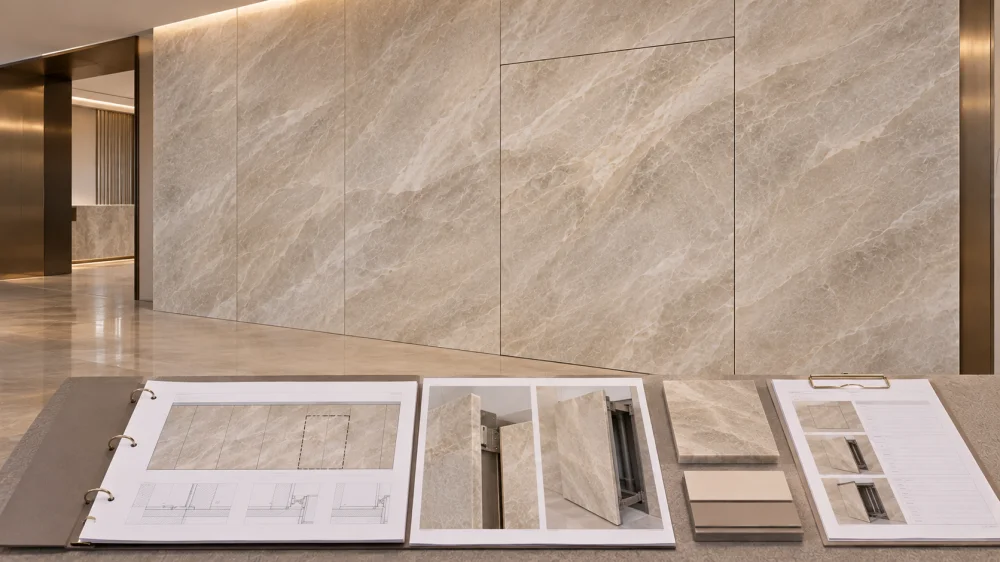
An interior decorative wall may primarily require coordination of:
An exterior facade can introduce additional responsibilities involving:
The Natural Stone Institute’s 2024 Dimension Stone Design Manual Chapter 14 distinguishes exterior and interior vertical installation systems and covers multiple support and anchorage approaches.
That makes one boundary especially important:
the Quartzite fabricator can coordinate the stone component, but the complete exterior access-hatch system requires the appropriate project-specific facade design.
Yes, a project can incorporate removable stone panels, but the stone should be coordinated with a suitable backing, attachment, service opening and handling strategy. The design should define how the panel is released, supported, removed and reinstalled without assuming that a normal fixed stone panel can simply be pulled off the wall.
Often that can improve visual integration, but it is not always possible. The hatch also has to provide the required service opening and removal clearance. The project should coordinate the service envelope and stone panelization rather than forcing one to follow the other after fabrication.
Do not promise an invisible serviceable perimeter before the actual system has been designed and tested. The hatch may use normal panel joints, controlled narrow joints, a shadow reveal, trim or another intentional detail depending on the attachment and removal strategy.
Allocate the access panel from the actual slab layout together with the surrounding pieces. Record its board number, cutting position, visible face, orientation and adjacent piece IDs so the panel remains part of the complete facade composition.
A closed mock-up proves only the finished appearance. A functional test can also reveal whether the panel clears adjacent stone, whether the edges are protected during removal, whether the service opening is usable and whether the panel returns to the correct alignment after reinstallation.
Yes for controlled project work. A stable ID can connect the physical stone to the shop drawing, slab layout, factory QC, packing list, installation location and maintenance instructions. It also reduces the risk of reinstalling the panel in the wrong orientation.
No. An exterior building-envelope condition can introduce structural, drainage, air, water, thermal, weather and code responsibilities in addition to the stone-panel requirements. Those conditions should be resolved by the responsible facade and structural design team for the actual project.
Send the current elevation and sections, service-opening requirement, hatch dimensions, surrounding panel layout, selected Quartzite or slab references, finish, joint or reveal intent, current backing or frame information from the responsible designer, removal direction, site access requirements and any required functional mock-up. Identify whether the condition is an interior feature wall or part of an exterior facade system.
Serviceability Release GateA removable Quartzite panel is not complete when it looks indistinguishable from the surrounding facade.
It is complete when the design team can also identify it, release it, support it, remove it, access the service zone, reinstall it in the correct orientation and restore the intended joint relationship without damaging the surrounding stone.
Buyer Next Step: Before cutting the access panel, ask for one controlled detail showing the closed position, attachment / backing interface, removal direction, service opening and final piece ID.