Quartzite Slab Selection with Multiple Decision Makers: How to Control Approval
Post navigation
Quick Summary
A Quartzite slab selection can involve an owner, designer, architect, procurement team, fabricator and installer without becoming confusing—if each person’s review role is defined. Keep the exact slab IDs, current photographs, drawing revision, visual priorities, technical questions and commercial status in one controlled record. Most importantly, distinguish comments from decisions and identify who has authority to give the final slab approval and production release.
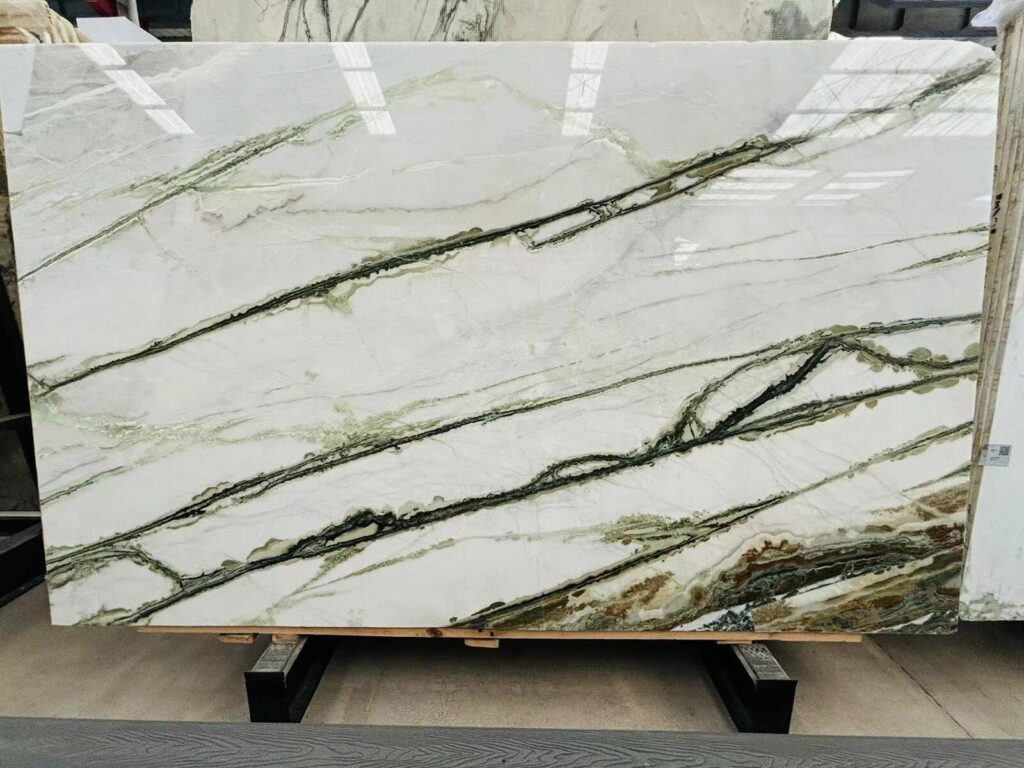
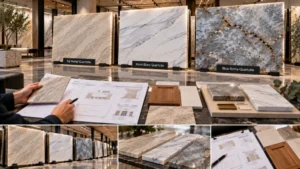
blue-roma-quartzite-multiple-review-roles
A designer prefers Slabs A and B.
The homeowner likes B and C.
The fabricator says Slab C creates a difficult cutting layout.
The procurement manager asks whether all three are still available.
Meanwhile, someone writes in the project chat:
“Looks good. Let’s use these.”
Has the Natural Quartzite actually been approved?
On a project with several decision makers, the main risk is often not disagreement itself. The risk is failing to distinguish observation, preference, technical review, commercial confirmation and final approval.
The Quartzite Decision Room
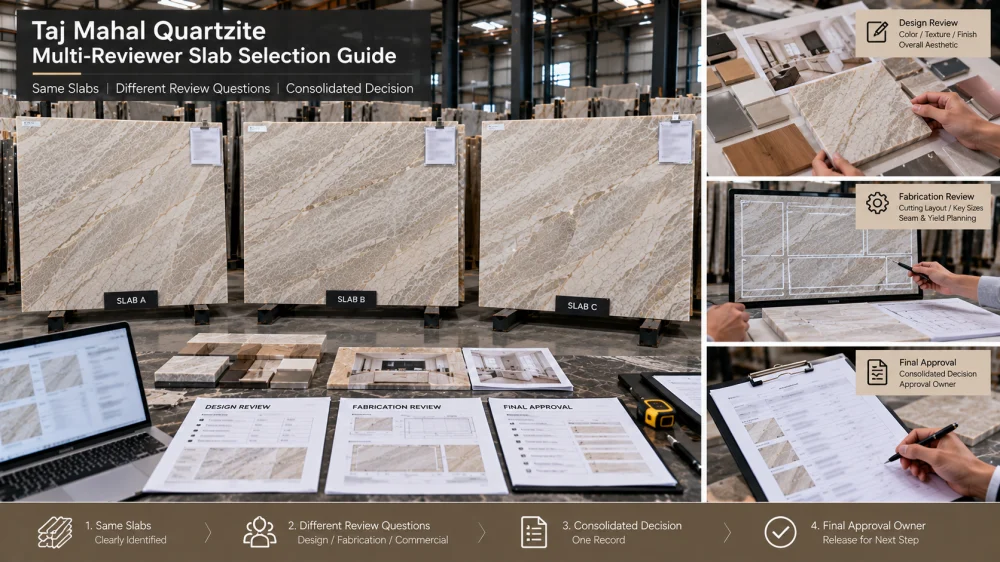
Different project participants may be looking at the same slabs but answering completely different questions.
OWNER / CLIENT
Does the overall appearance support the intended space and personal preference?
DESIGNER / ARCHITECT
Do tone, movement, scale and visible relationships support the design intent?
FABRICATOR
Can the required components be positioned within the actual usable areas of the selected slabs?
PROCUREMENT
Are the identified boards, quantity, commercial scope and project timing aligned?
INSTALLER / SITE TEAM
Are relevant interfaces, piece relationships and site-dependent information coordinated?
FINAL APPROVAL OWNER
Has the required project review been completed, and can the selection move to the next defined stage?
These roles may be combined or assigned differently on a particular project.
The important point is not the job title. It is knowing what each reviewer is authorized to decide.
One Slab Set, Five Different Types of Feedback
Suppose a project team is reviewing three Blue Roma Quartzite slabs for a large kitchen island and waterfall ends.
The comments might look like this:
Comment
What It Actually Represents
“I prefer the movement in Slab B.”
Visual preference
“Keep the darker area away from the center of the island.”
Design / layout instruction requiring translation into the slab layout
“Slab C cannot accommodate the proposed island position without changing the layout.”
Fabrication / usable-area review
“Please reserve B and C.”
Material reservation instruction, subject to the agreed commercial process
“Approved for cutting according to Layout R04.”
Production-release instruction when issued by the authorized party under the project process
All five statements are useful.
They are not interchangeable.
Comments Are Not Votes
A multi-reviewer slab selection should not normally be managed by counting how many people prefer each slab.
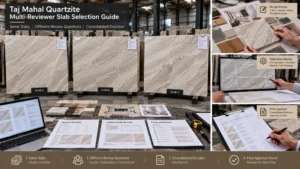
mont-blanc-quartzite-shared-slab-review-evidence
Three visual preferences do not automatically override a fabrication constraint.
A fabricator’s layout comment does not automatically determine the client’s aesthetic preference.
A procurement confirmation does not automatically approve the visible composition.
The more useful approach is:
Classify the comment before resolving the comment.
Site / Interface — field dimensions, adjacent work, installation relationships
Approval — authorization to move to the next defined stage
Start Every Review with the Same Physical Slabs
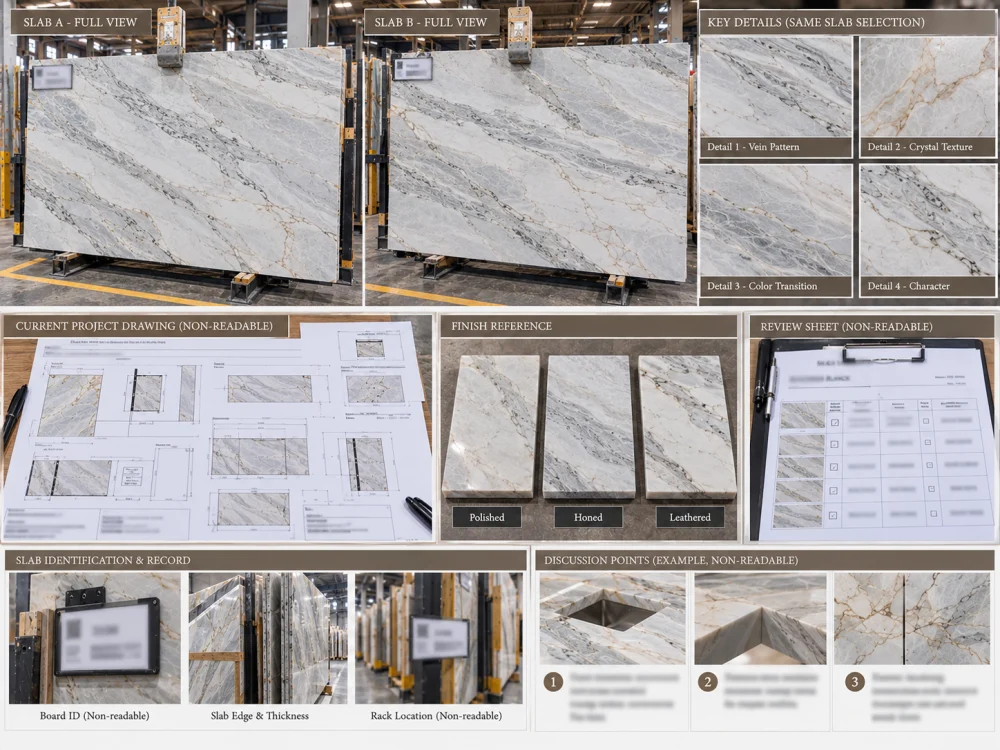
Before asking several people for opinions, make sure they are reviewing the same material evidence.
A controlled Quartzite slab selection should identify the actual boards rather than relying only on a commercial stone name.
For example:
Blue Roma Quartzite
Board BR-118
Board BR-119
Board BR-120
Each reviewer should be able to connect comments to the relevant slab reference and current photographs.
This becomes particularly important if several bundles or visually different slabs of the same material are available.
For slab-specific projects, the reservation stage should preserve both the material name and physical board numbers. HRST’s guide to Quartzite slab reservation forms explains why board identity, reservation status and substitution control should remain explicit instead of relying only on the commercial stone name. :chatgpt-content-reference{index=”2″}
Give Reviewers a Shared View, Not Different Screenshots
Multi-person approval becomes unreliable when each person reviews a different image.
The resulting opinions may sound contradictory even though the reviewers are not actually looking at the same evidence.
A better review package can include:
Master Slab View → Board ID → Supporting Details → Current Drawing / Layout → Specific Review Question
The full-slab image provides context. Detail images explain particular features. Neither should lose its relationship to the board being reviewed.
Ask Each Person a Different Question
Sending the same message—“Please review and approve”—to six people creates vague responses.
Instead, direct the question according to the person’s role.
TO THE DESIGNER
Are the overall movement, tone and proposed focal areas consistent with the intended design?
TO THE FABRICATOR
Can the current finished-piece geometry be positioned within the usable areas of these exact slabs?
TO PROCUREMENT
Are these board numbers and quantities aligned with the current commercial scope and reservation status?
TO THE SITE / INSTALLATION TEAM
Are the required site dimensions and relevant interfaces sufficiently confirmed for the current review stage?
TO THE FINAL APPROVAL OWNER
After the required reviews are complete, is this identified slab selection approved for the stated next stage?
What Happens When Two Decision Makers Disagree?
Do not solve the disagreement first by asking who has the stronger opinion.
First identify whether the comments actually conflict.
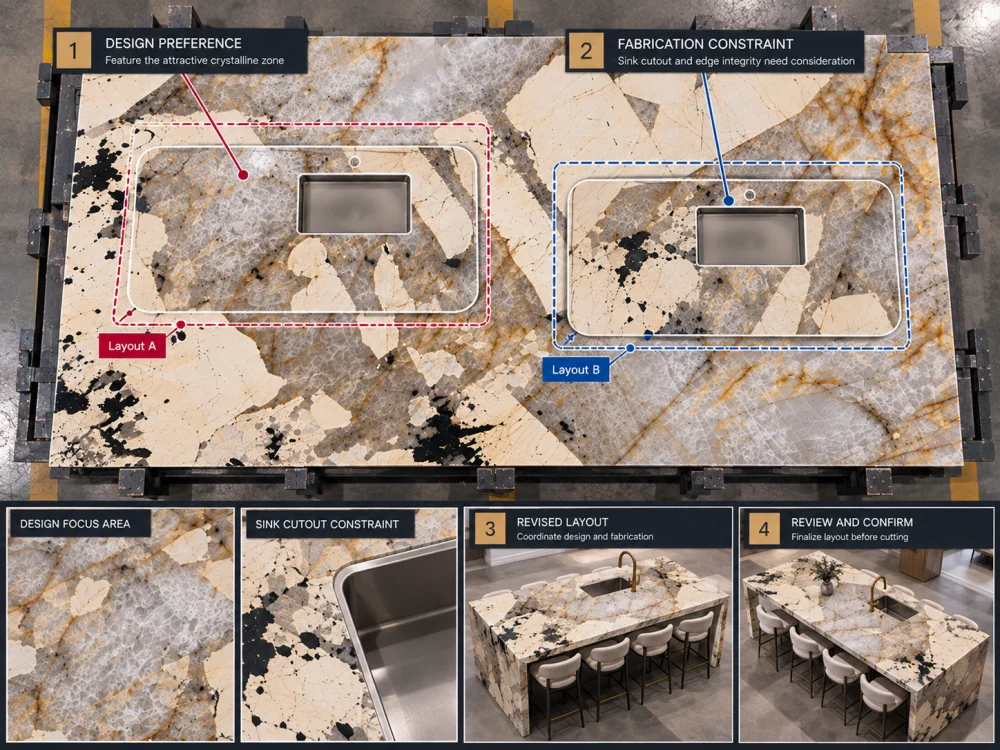
EXAMPLE — DESIGNER VS FABRICATOR
Designer: “Use this crystalline area in the center of the island.”
Fabricator: “The proposed position conflicts with the current sink cutout and usable slab geometry.”
Actual issue: This is not necessarily a disagreement about whether the slab is acceptable. It is a layout coordination problem.
Next action: Return the preferred visual area to the actual cutting layout and develop a revised position for review.
Another example:
EXAMPLE — OWNER VS DESIGNER
Owner: “I prefer Slab A.”
Designer: “Slab B works better with the other selected boards.”
Actual issue: Two visual priorities need to be reconciled.
Next action: Compare A and B in the context of the complete proposed slab set and intended visible areas, then route the decision to the agreed approval owner.
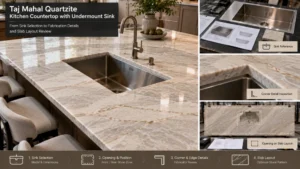
Separate Slab Approval from Layout Approval
This distinction becomes especially important when several people are involved.
mont-blanc-quartzite-shared-slab-review-evidence
A buyer may approve the selected slab itself while still requesting changes to where particular areas appear in the finished work.
For example:
Slab Selection Approved
“Yes, Boards TM-231 and TM-232 are acceptable for this project.”
Layout Still Pending
“Please move the darker mineral area away from the main island seating zone and return a revised layout.”
These statements are compatible.
The project does not need to reopen the entire material selection simply because the cutting composition still requires adjustment.
The Approval Matrix
For a project with multiple decision makers, a small matrix can prevent a large amount of confusion.
Decision
Reviewer
Status
Evidence / Reference
Overall slab appearance
Owner / Designer as defined by project
Pending / Accepted / Revise
Board IDs + master slab images
Usable layout
Fabrication review
Pending / Feasible / Revise
Current layout revision
Finish reference
Named project reviewer
Pending / Accepted
Sample ID / finish record
Commercial confirmation
Procurement / buyer
Open / Confirmed
Current quotation / order record
Production release
Authorized approval owner
Hold / Released
Approved drawing / layout revision
This is not intended to prescribe who must hold each role.
It makes the project’s own decision structure visible.
“Looks Good” Is Usually an Incomplete Approval Record
Short messages are useful during fast-moving projects, but they can become ambiguous later.
Compare:
AMBIGUOUS
“Looks good. Approved.”
CONTROLLED
“Blue Roma Quartzite Boards BR-118, BR-119 and BR-120 accepted for the stated project material selection. Visual layout for the island and waterfall pieces remains subject to Layout R04 review. No cutting release from this comment.”
The second record answers three questions:
What was reviewed? What was approved? What is still pending?
Use One Comment Trail
When several people review Natural Quartzite, feedback can become scattered across:
Email → WhatsApp → marked-up photograph → video call → drawing PDF → another email.
The project does not necessarily need one communication platform, but it does need one current decision record.
A useful comment entry can contain:
Reviewer → Date → Board / Piece → Drawing Revision → Comment Type → Comment → Required Action → Status
This allows the team to preserve discussion without treating every historical comment as a current instruction.
Visual Approval Works Better in Context
A slab that looks attractive by itself may need to work beside several other slabs.
For multi-slab installations, reviewers may need to evaluate:
overall tone relationship;
movement across adjacent pieces;
focal mineral areas;
major seams;
waterfall transitions;
panel sequence; and
areas that will be especially visible after installation.
Once pieces are fabricated, a controlled dry-lay record can give several reviewers a shared whole-set view rather than forcing them to reconstruct the composition from isolated close-ups. HRST’s guidance on Quartzite dry-lay photography emphasizes a master whole-set view, stable piece IDs, current drawing revision and clearly scoped approval comments.
What If Someone Changes Their Decision?
A revised opinion is manageable if the project can identify where it occurs in the approval sequence.
For example:
Before Reservation
A preference change may simply return the project to slab comparison.
After Reservation
Check whether the requested replacement changes board numbers, quantity, reservation status or layout.
After Layout Approval
Identify which approved visual or fabrication relationship is being changed.
After Production Release
Stop treating the request as an informal slab-selection comment. Determine what work has already occurred and what project-controlled change process is required.
The later the change occurs, the more important it becomes to identify the affected material, drawing, fabricated pieces and commercial consequences before proceeding.
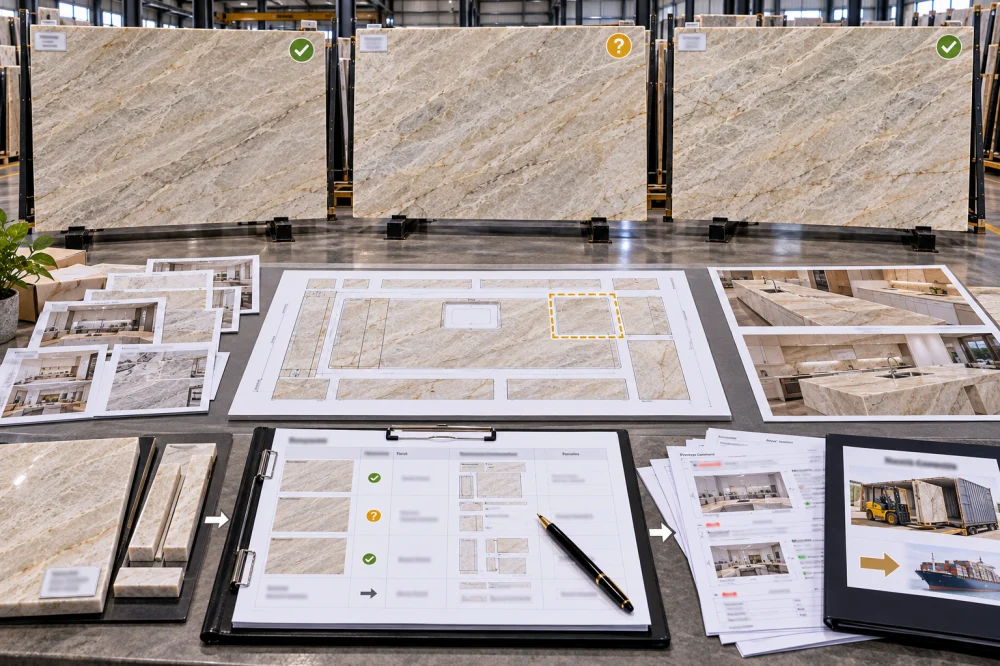
A Five-Line Approval Record Can Be Enough
The final record does not need to be a long meeting report.
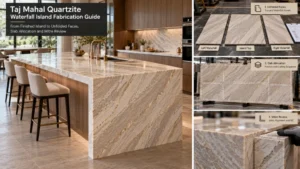
taj-mahal-quartzite-final-slab-approval-record
MATERIAL
Taj Mahal Quartzite — Boards TM-231 / TM-232 / TM-233
REVIEW BASIS
Current slab photographs + Layout R04
APPROVED
Slab selection and stated visible-area priorities
STILL OPEN
Revised island positioning and final waterfall relationship
NEXT AUTHORIZED ACTION
Return revised layout for final production-release review
The objective is not more paperwork.
It is making the current decision understandable to someone who was not present in the original conversation.
FAQ
1. Who should approve a Natural Quartzite slab selection when several people are involved?
The project should define its own approval authority. Owners, designers, architects, procurement teams and fabricators may review different aspects of the same material, but the record should identify who has authority to approve the slab selection and who can authorize the next project stage.
2. Does every reviewer need to approve the same thing?
No. A designer may review appearance, a fabricator may review usable layout, procurement may confirm commercial scope, and another authorized party may issue final approval. Defining each review question reduces conflicting or duplicated decisions.
3. Can a WhatsApp message saying “looks good” count as slab approval?
Its meaning depends on the agreed project process, but the phrase alone is ambiguous. A stronger record identifies the exact slabs, what aspect was accepted, what remains pending, and whether the comment authorizes reservation, layout approval or production release.
4. What should happen if the designer and fabricator disagree about a Quartzite slab?
First determine whether they are answering the same question. A designer may prefer a particular visual area while the fabricator identifies a cutting constraint. The next step may be a revised slab layout rather than rejecting the material outright.
5. Is approving the Quartzite slab the same as approving the cutting layout?
Not necessarily. The physical slabs can be accepted while the placement of finished pieces, seams, focal areas, cutouts or waterfall relationships remains under review. Keep slab approval and layout approval identifiable as separate decisions where the project requires both.
6. What happens if a decision maker changes the selection after slabs are reserved?
Identify which board numbers, reservation records, layouts, quantities and approvals are affected. The project should review the change against its current status rather than silently replacing an earlier approved slab reference.
7. What should I send HRST STONE for a multi-reviewer Quartzite slab selection?
Send Josh the material name, current slab or board references, project drawings, dimensions, quantities, finish, visible-area priorities, reviewer roles, current comments, unresolved questions, approval owner and delivery destination.
For Multi-Reviewer Quartzite Projects
HRST STONE can organize current slab photographs, board references, CAD/shop drawings, cutting layouts, finish references, fabrication records, dry-lay photographs and QC documentation around the confirmed project scope. Send Josh the current material references, drawings, reviewer roles and unresolved decisions so the next stone-related review can be presented against one controlled project record.
Hi, I am the author of this article. I have been working in the field of Natural Stone for more than 15 years. If you need customized Natural Stone services, please feel free to contact me.