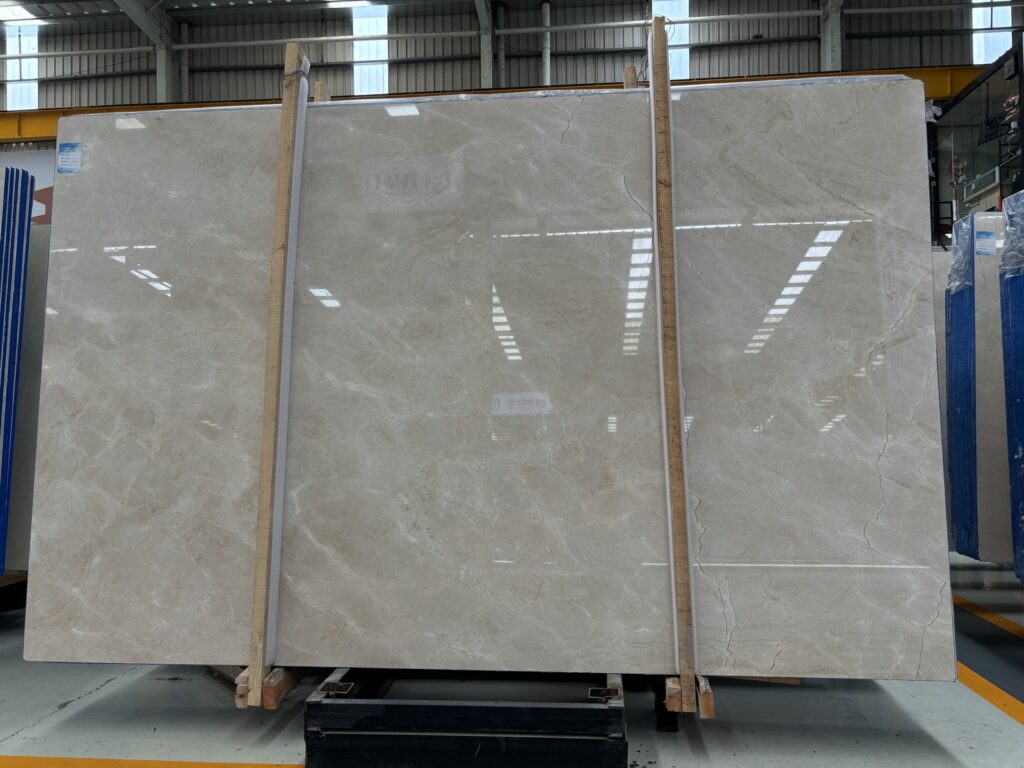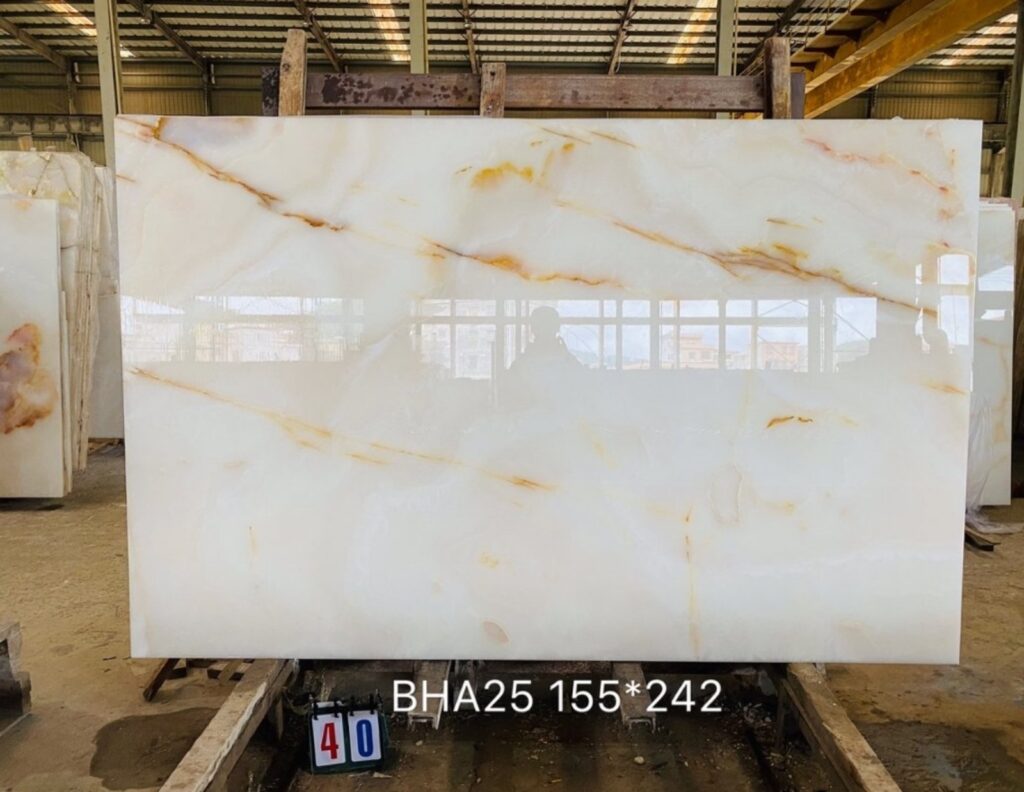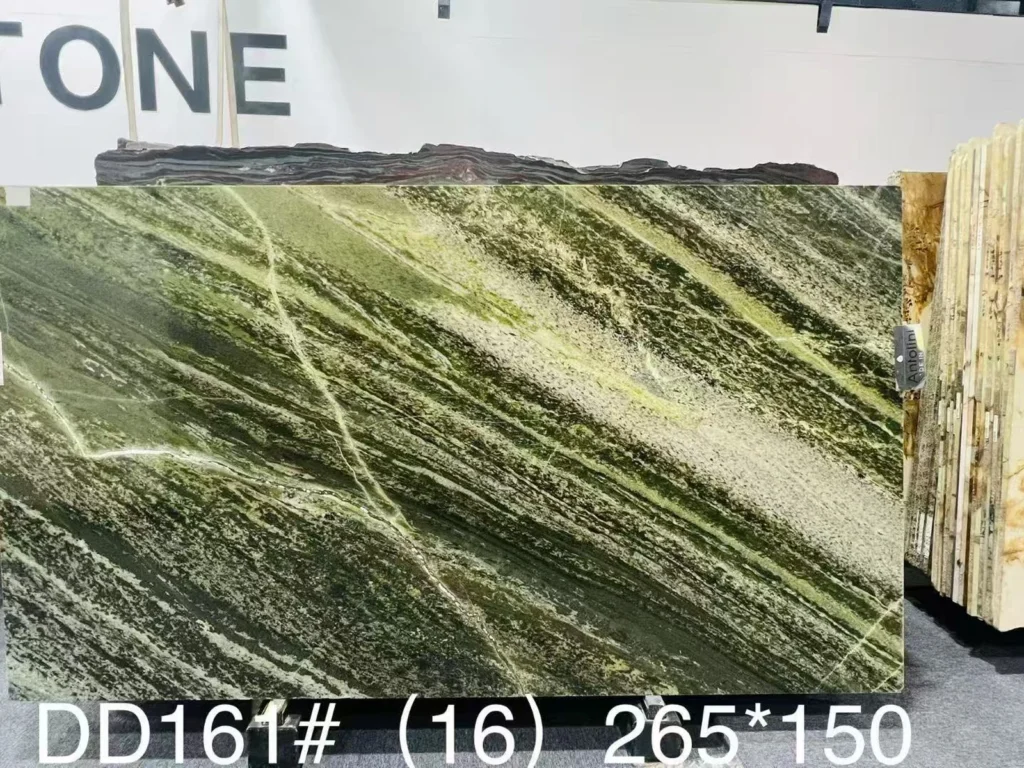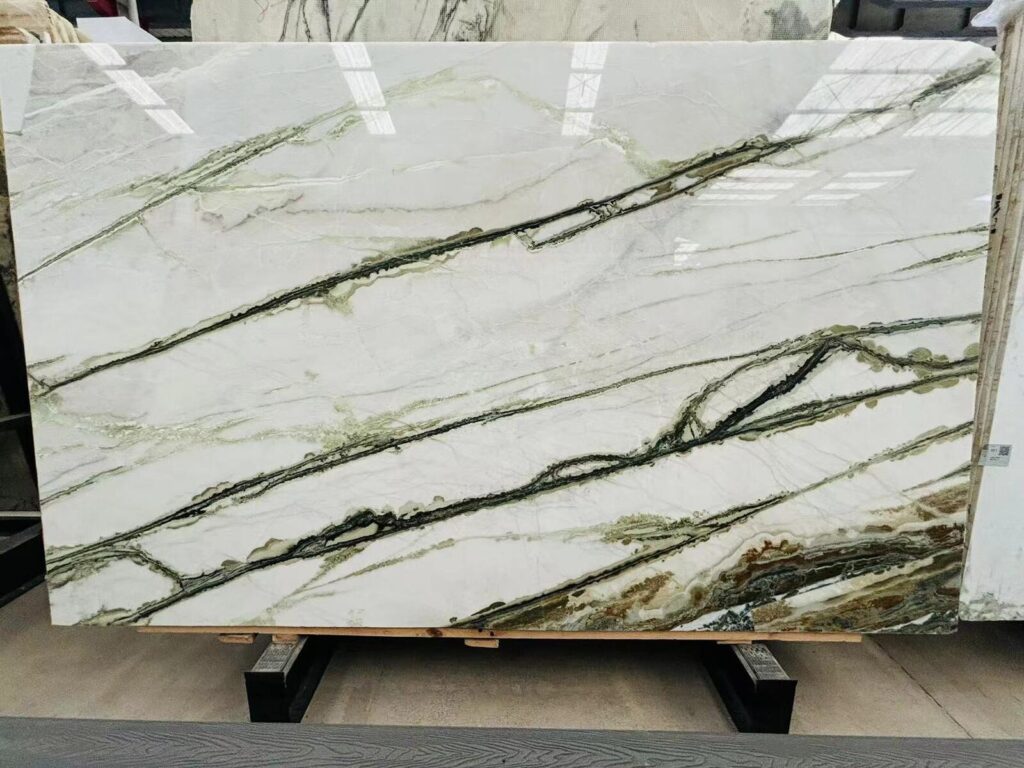

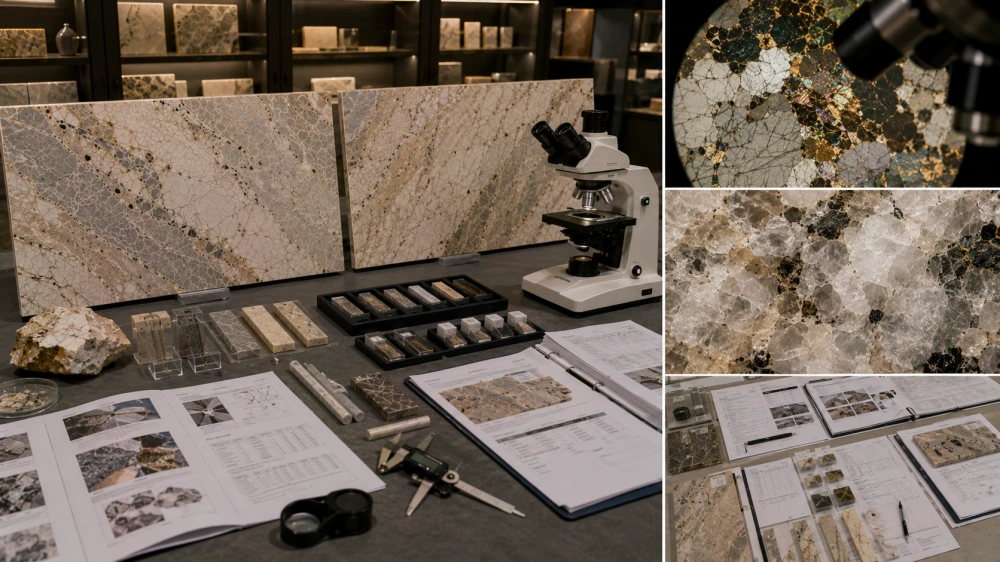
A petrographic report can help a Natural Quartzite buyer understand what a submitted stone sample is made of and how its minerals and texture are organized. Depending on the laboratory method and report scope, petrographic examination may describe mineral composition, rock classification, grain relationships, fabric, accessory minerals, alteration, fractures, or other microscopic features. However, a petrographic report describes the tested sample; it does not automatically prove the performance, appearance, or consistency of every slab sold under the same commercial name. Buyers should read petrography together with sample identity, slab review, project specifications, and any separate physical or mechanical tests required for the intended application.
Natural Quartzite is often purchased under a commercial stone name, but a trade name alone does not provide a complete geological description of the material.
For buyers, architects, fabricators, contractors, and project procurement teams, a petrographic report for Natural Quartzite can provide another level of material information by examining a representative submitted sample at the mineral and textural level.
This can be particularly useful when the buyer wants to understand questions such as:
However, petrography also has important limits. A thin section taken from one submitted sample cannot automatically represent every slab, every quarry zone, every production batch, or every stone sold under the same commercial name.
The most useful approach is therefore:
Identify the Sample → Read the Petrographic Description → Understand the Mineralogy and Fabric → Recognize the Report Limits → Compare with Other Project Evidence → Make the Procurement Decision.
A petrographic report is a laboratory description of a rock sample based on its mineral composition, texture, fabric, and other observable geological characteristics.
Depending on the laboratory procedure and scope, the examination may include macroscopic observations together with microscopic examination of a prepared thin section.
A thin section is a very thin slice of the stone prepared so that minerals and their relationships can be examined using a petrographic microscope.
The resulting report may help describe:
The exact information depends on the laboratory, testing method, sample quality, and requested scope.
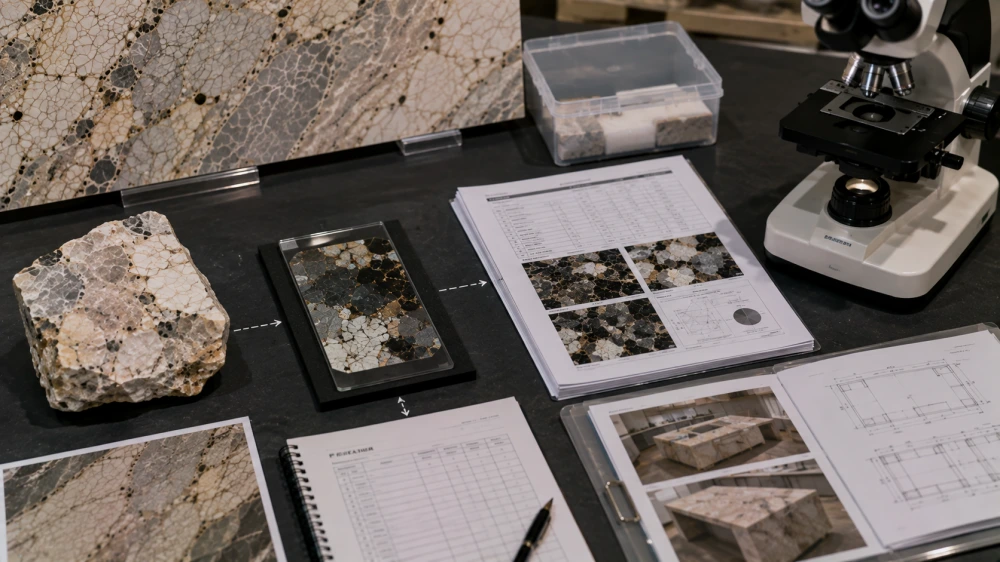
Commercial stone terminology and geological terminology do not always answer the same question.
A commercial name helps identify and market a stone in the natural-stone supply chain. A petrographic examination instead looks at the actual submitted rock sample.
For a buyer, this distinction matters because stones with similar visual appearances can have different mineralogical compositions and geological fabrics.
Petrography can therefore provide evidence that complements:
It should normally be treated as one part of the material-evaluation package rather than as a standalone purchasing certificate.
| Report Area | What It May Describe | Why It Matters to a Buyer |
| Mineral Composition | Quartz and other minerals observed in the sample | Helps the buyer understand what the tested stone is actually composed of |
| Rock Classification | Geological description or classification based on observed features | Provides information beyond the commercial trade name |
| Texture | Grain size, grain relationships, interlocking structure, or other microscopic texture | Helps explain the internal geological structure of the sample |
| Fabric | Orientation, foliation, banding, or directional mineral arrangement where present | Can provide context for directional geological features visible in the stone |
| Accessory Minerals | Minor minerals in addition to the dominant mineral assemblage | May help explain color, mineral spots, bands, or other natural features |
| Alteration | Altered mineral zones or secondary mineral products where observed | Provides additional geological context that may justify further project-specific review |
| Fractures | Natural fractures or microfractures present in the examined section | Can identify features in the tested sample that may warrant correlation with slab and fabrication review |
One of the most useful parts of a petrographic report is the mineralogical description.
Natural Quartzite is associated with a quartz-rich geological composition, but buyers should avoid turning this general statement into an assumption about an untested slab.
A petrographic examination can identify the minerals observed in the submitted sample and may provide information about their relative abundance, depending on the analytical method.
In addition to quartz, the report may identify accessory or secondary minerals.
These can contribute to:
The important buyer question is not simply:
“Does this report mention quartz?”
A better question is:
“What mineral assemblage does the report describe, and how does the laboratory characterize the tested rock?”
A commercial stone name and a petrographic rock classification serve different purposes.
The commercial name is used in the stone market to identify a product. It may reflect appearance, origin, historical naming, or established trade practice.
The petrographic description is based on the sample examined by the laboratory.
This means a buyer should not assume that every product marketed with the word “quartzite” has automatically been petrographically verified as the same geological rock type.
Likewise, a petrographic result for one sample should not automatically be applied to unrelated materials carrying a similar commercial name.
For procurement, keep both identities in the record:
Commercial Material Name + Sample Identification + Petrographic Classification
This creates a clearer evidence trail than relying on the trade name alone.
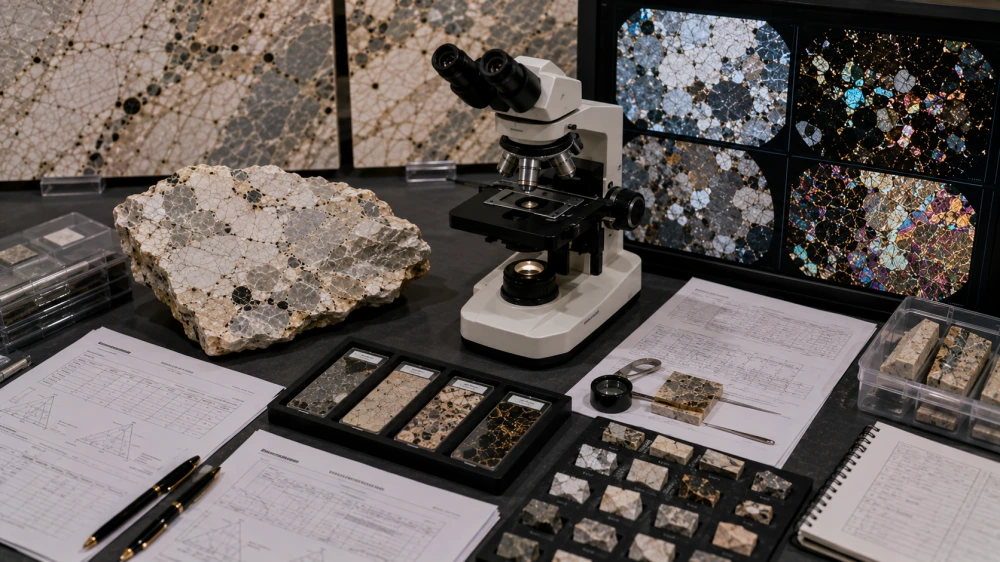
Petrographic examination can reveal how mineral grains relate to one another at microscopic scale.
The report may describe features such as:
For a buyer, these observations provide a more detailed geological picture than a polished slab photograph alone.
However, microscopic texture should not be converted into an unsupported performance guarantee. If the project requires specific strength, absorption, abrasion, or other physical-property values, those questions should be addressed with the appropriate separate tests and project criteria.
Yes, depending on the sample, analytical method, and report scope, petrographic examination can identify minerals other than quartz.
Accessory minerals may be visually minor but geologically informative.
They can help explain why a Natural Quartzite slab contains:
Not every visible feature can be identified confidently from a photograph. If mineral identity matters to the project, laboratory analysis is more useful than visual guessing.
A petrographic examination may document fractures or microfractures observed in the tested section.
This information can be useful, but it must be interpreted carefully.
A microscopic fracture in one small sample does not automatically describe the fracture distribution of an entire slab. Conversely, a thin section without a particular fracture does not prove that the full slab contains none.
For fabricated projects, the petrographic observation should therefore be correlated with:
Petrography can identify microscopic evidence. The fabrication plan determines how the actual slab is used.
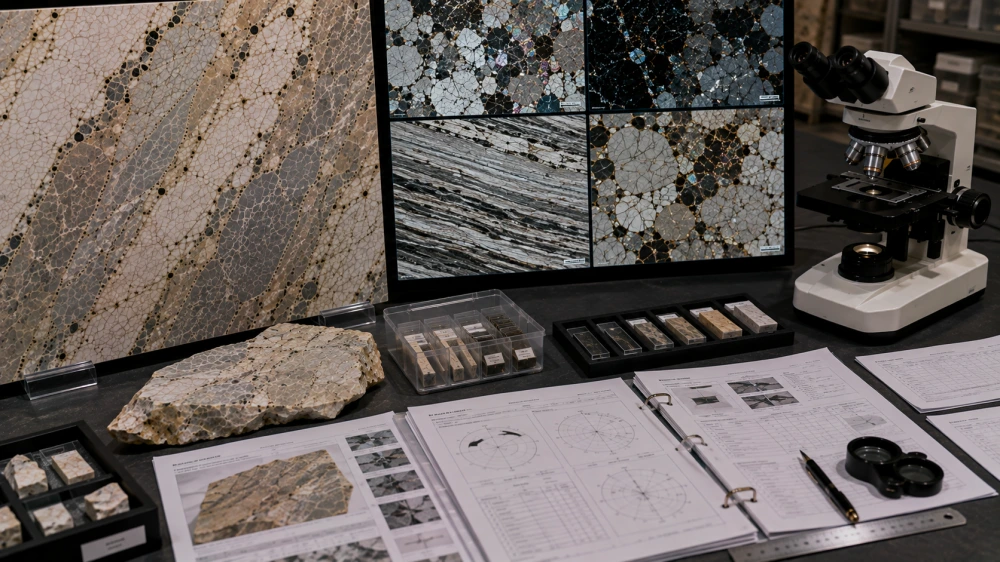
A petrographic report can identify mineral composition that may be relevant to discussions about acid-sensitive minerals, but buyers should be careful not to turn a mineralogical description into an automatic field-performance prediction.
If a stone contains minerals that are potentially relevant to acid response, that information can help the project team decide whether additional testing is appropriate.
For countertop or hospitality applications where exposure to acidic substances is a concern, a project-specific test on a representative sample can provide more directly relevant information than relying only on the commercial stone name.
The useful distinction is:
Petrography identifies and describes minerals; a specific performance test evaluates a specific performance question.
No. A petrographic report should not be treated as a complete performance certificate for every property of the stone.
Petrography describes mineralogical and textural characteristics of the tested sample. Other questions may require different test methods.
| Buyer Question | Can Petrography Help? | May Separate Testing Be Needed? |
| What minerals are present? | Yes, this is a core petrographic question | Additional analytical methods may be used where more specific identification is required |
| How is the rock classified? | Yes, depending on report scope | Not necessarily for basic petrographic classification |
| What is the water absorption? | Not established by petrographic description alone | Yes |
| What is the flexural strength? | Not established by petrographic description alone | Yes |
| What is the abrasion resistance? | Not established by petrographic description alone | Yes, when relevant to the project |
| Will every slab have the same mineral distribution? | No | Actual slab and lot review remains important |
The value of a petrographic report depends heavily on knowing what was actually tested.
Before relying on a report, the buyer should check whether the sample identity can be connected to the material being offered.
Useful records may include:
If the chain between the laboratory sample and the offered material is unclear, the buyer should avoid assuming that the report automatically represents the slabs under consideration.
No. Petrographic results should be interpreted within the scope of the sample that was tested.
Natural stone can vary because of geological changes within the deposit and differences between extraction zones, blocks, slabs, and batches.
A petrographic report can provide valuable evidence about a submitted sample, but it does not prove that every future slab will have identical:
This is why petrographic evidence and current slab review serve different purposes.
Petrography helps explain the tested rock. Slab review confirms the actual material being purchased.
Buyers sometimes treat all laboratory documents as though they answer the same questions. They do not.
| Document Type | Main Question | Typical Buyer Use |
| Petrographic Report | What is the tested rock made of and how is it structured? | Mineralogy, texture, geological description, and material verification context |
| Water Absorption Test | How much water does the tested specimen absorb under the specified method? | Project performance review where absorption is relevant |
| Density / Specific Gravity Test | What are the measured density-related properties? | Material characterization and project engineering input |
| Flexural Strength Test | How does the tested specimen respond under the specified bending test? | Engineering and application-specific evaluation |
| Abrasion Test | How does the tested material respond to the specified abrasion method? | Flooring and wear-related evaluation where applicable |
A strong technical submittal may therefore contain several documents, each answering a different question.
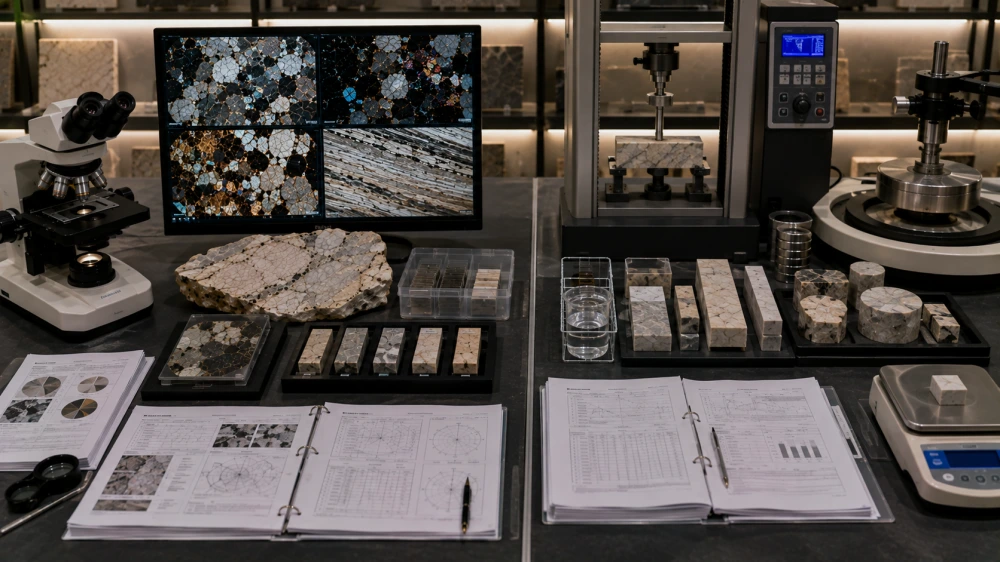
A buyer does not need to become a geologist to use a petrographic report effectively. A structured review is usually more useful than focusing on isolated technical words.
Check what material was submitted, when it was tested, and whether it can reasonably be linked to the stone currently offered.
Identify how the laboratory describes or classifies the sample rather than relying only on the commercial stone name.
Look at the minerals identified and their reported relationships or proportions where provided.
Note grain size, recrystallization, orientation, foliation, banding, fractures, or other reported structural features.
These may help explain visible geological variation or identify questions that deserve further review.
Check whether the laboratory defines the scope of the examination, sample limitations, or other qualifications.
Do not ask petrography to answer a question it was not designed to answer. If the project needs physical performance values, use the appropriate additional test data.
Not every residential slab purchase requires a petrographic report. The value depends on the project and the uncertainty being addressed.
A buyer may consider requesting or reviewing petrographic analysis when:
The request should have a defined purpose. Testing without a clear question can produce a technical document that the project team does not know how to use.
| Common Mistake | Why It Is a Problem | Better Approach |
| Assuming the trade name proves geology | Commercial naming and geological classification serve different purposes | Read the actual petrographic description |
| Applying one report to every slab | Natural stone can vary between blocks and batches | Confirm sample identity and current material |
| Using petrography as a strength test | Mineralogical description does not provide every engineering property | Use appropriate physical or mechanical testing |
| Ignoring accessory minerals | Minor minerals may be relevant to understanding natural variation | Review the full mineralogical description |
| Ignoring sample traceability | The buyer may not know whether the report relates to the offered material | Record sample, report, supplier, and material references |
| Skipping actual slab review | Microscopic analysis cannot approve the visual layout of the purchased slabs | Combine laboratory evidence with current slab selection |
Before using a petrographic report in a Natural Quartzite purchasing decision, check:
A petrographic report can describe the mineral composition, rock classification, texture, fabric, accessory minerals, fractures, alteration, and other geological features observed in the tested sample. The exact information depends on the laboratory method and report scope.
A petrographic examination can provide a geological description and classification of the submitted sample based on its observed mineralogy and texture. Buyers should read the laboratory’s actual conclusion rather than assuming that a commercial trade name alone establishes geological classification.
It may provide mineral proportions or an estimate of mineral abundance depending on the analytical method and scope. Buyers should use the values and terminology stated in the actual laboratory report rather than assuming that every petrographic examination provides the same quantitative data.
Petrography can identify minerals that may be relevant to acid sensitivity, but it should not automatically be treated as a direct etch-performance test. If acid response matters to the application, representative project-specific testing may be appropriate.
No. A petrographic report describes the sample examined. Natural stone may vary between quarry zones, blocks, slabs, and batches, so the report should not automatically be applied to every future slab without considering sample identity and material variation.
No. Petrography primarily describes mineralogy, texture, fabric, and geological characteristics. Properties such as water absorption, flexural strength, or abrasion resistance require appropriate separate test methods when those values are needed.
Yes. Petrography and slab inspection answer different questions. Petrography describes the tested sample at mineral and textural level, while slab inspection confirms the actual color, movement, natural features, dimensions, usable areas, and visual suitability of the material being purchased.
It can be useful when geological classification matters, the commercial stone name creates uncertainty, a project requires technical submittals, a consultant requests mineralogical verification, or the buyer needs additional evidence beyond visual slab review. The testing request should be tied to a defined project question.
A petrographic report is most valuable when it is used for the question it can actually answer: what the tested Natural Quartzite sample is made of and how its minerals and geological fabric are organized. It should not be stretched into a guarantee for every slab or every performance property. For procurement, connect the report to a clearly identified sample, review the laboratory’s mineralogical and classification findings, understand the stated limitations, compare the findings with the actual slabs being offered, and request separate physical or mechanical testing when the project specification requires it.