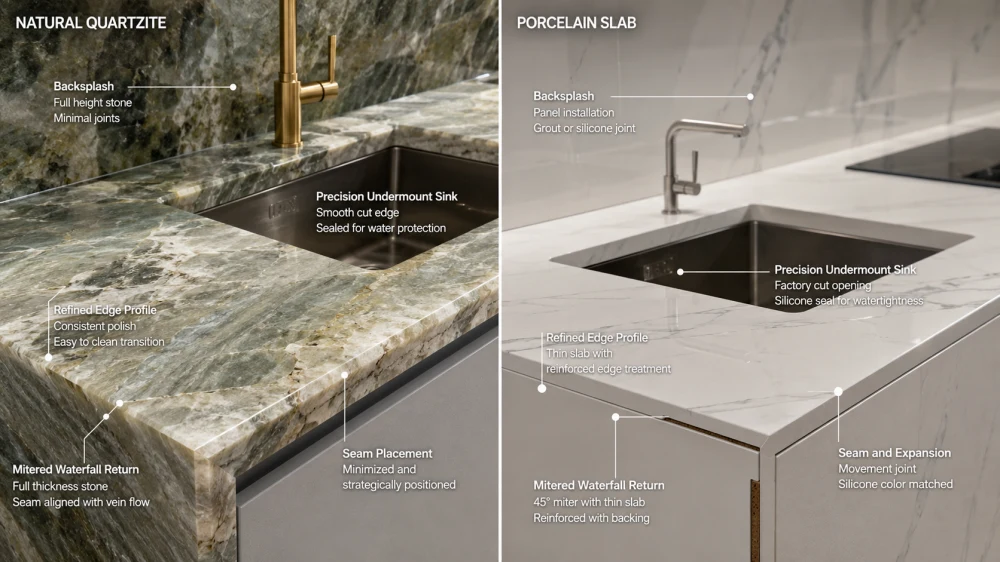
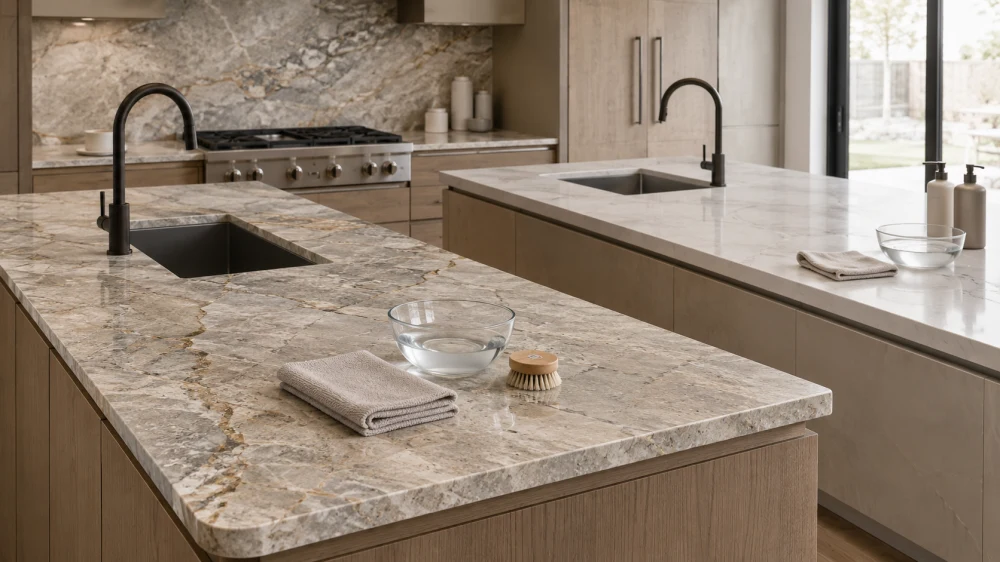
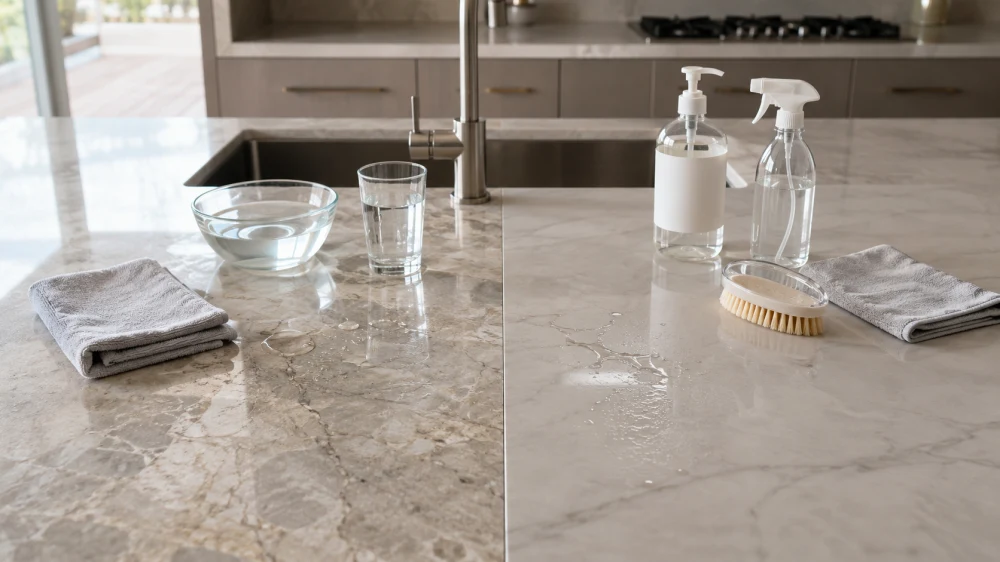
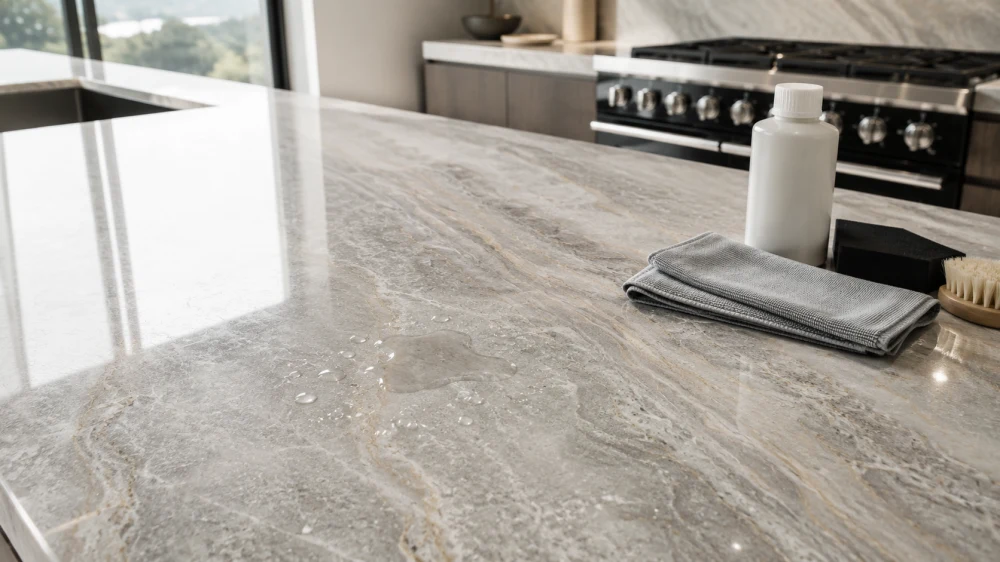
Maintenance Comparison: Is Quartzite Easier Than Porcelain Slab?
Post navigation
Quick Summary
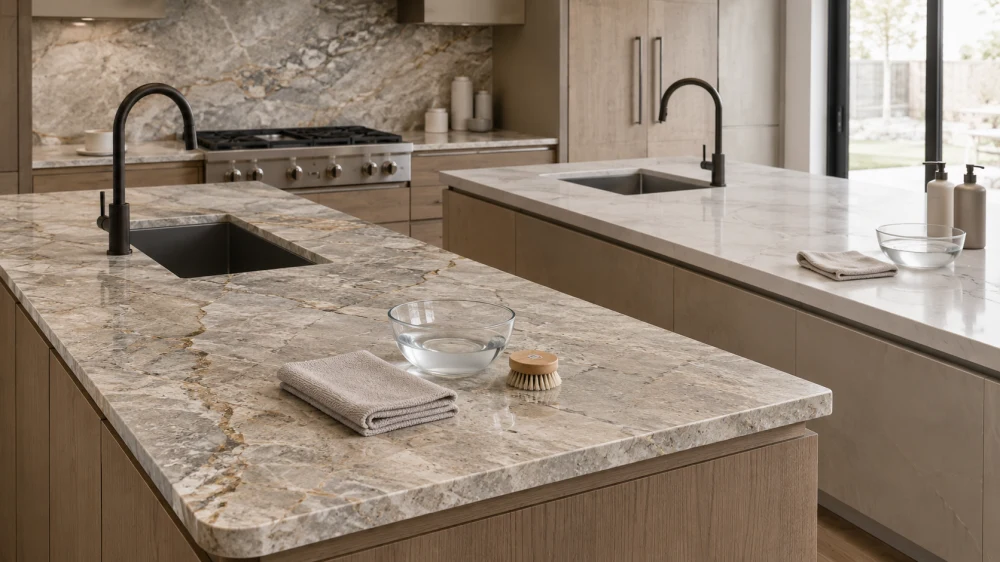
Natural Quartzite and porcelain slabs can both suit serious countertop and interior projects, but they are not the same material and should not be bought through the same checklist. Natural Quartzite is a natural metamorphic stone with slab-to-slab variation. Porcelain slab is a manufactured surface. For maintenance comparison between Natural Quartzite and porcelain slab, international buyers should compare the project brief, visual approval process, fabrication method, maintenance expectations, and delivery requirements before naming a preferred material.
Maintenance is often treated as a short cleaning question, but for a commercial or residential project it begins much earlier. The material, finish, slab or product approval, fabrication details, and handover instructions all influence how comfortably a surface can be cared for over time. This buyer guide compares Natural Quartzite and porcelain slab maintenance without confusing a natural stone with a manufactured surface.
For an importer, fabricator, architect, contractor, or procurement team, the practical question is not which material is universally better. The useful question is which material can be specified, approved, fabricated, installed, and maintained with the least avoidable risk for this particular project. A durable decision starts with a clear written scope, representative material review, and agreement on the details that affect the finished work.
quartzite-vs-porcelain-slab-maintenance
Start With the Material Difference
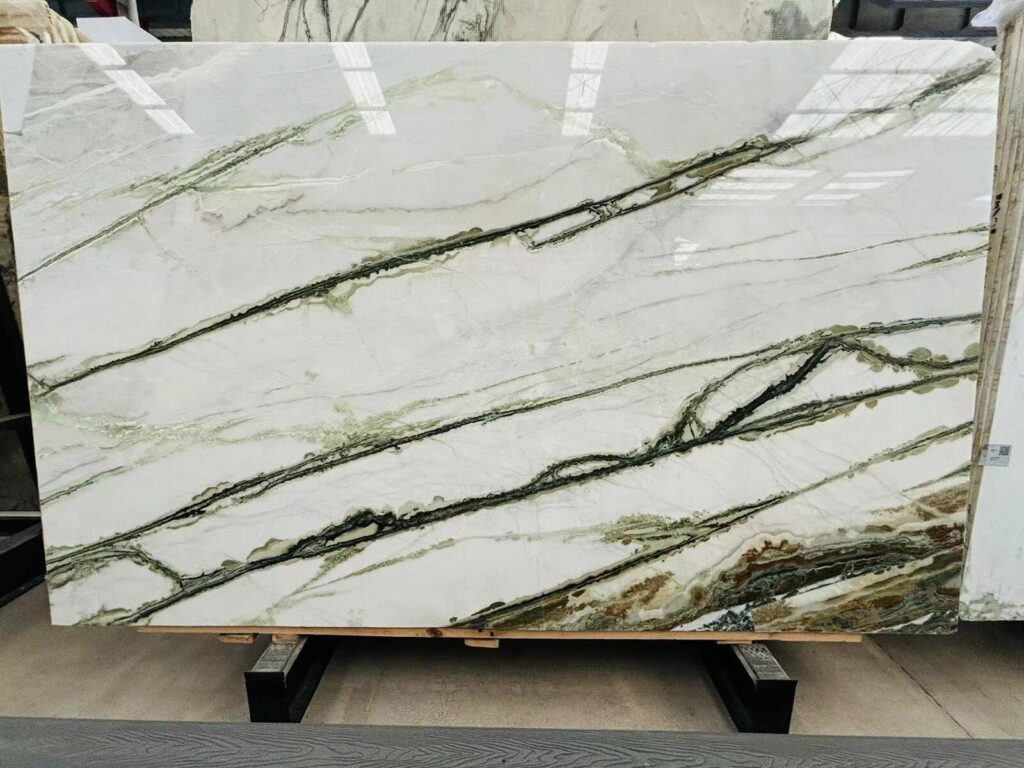
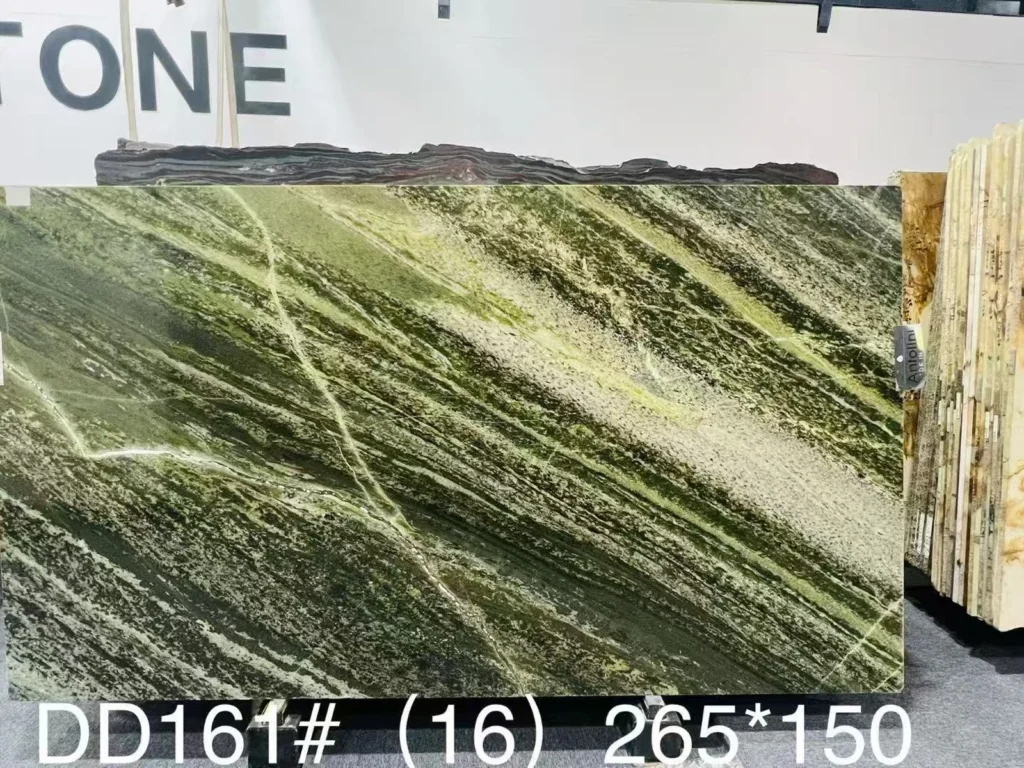
Natural Quartzite is a natural stone, so its color movement, veining, mineral features, and local texture can vary within and between slabs. Those characteristics can be a design advantage when the project values a one-of-a-kind natural surface. They also mean that approval should be based on the actual slabs or clear current images, not only a commercial name or a small sample. Porcelain slab is manufactured and is therefore evaluated through its own product range, finish options, and fabrication instructions.
Neither material should be described with a blanket performance promise. A buyer should ask for the intended application, thickness, edge profile, support conditions, finish, and care expectations to be considered together. For Natural Quartzite, the fabricator should review the particular slab structure and visual direction before cutting. For porcelain slab, the fabricator should follow the product-specific handling and fabrication guidance. This distinction keeps a comparison honest and useful.
How Daily Care Expectations Differ
Natural Quartzite care should be discussed in relation to the actual stone and finish selected for the project. A mild routine, prompt attention to spills, and appropriate surface-care guidance are sensible planning points, but they are not a substitute for reviewing the material before fabrication. Porcelain slab care should be discussed according to the chosen product and finish. Buyers should ask the installer or fabricator to provide a simple, material-specific care note rather than relying on a generic online checklist.
A sound specification separates what is a design preference from what is a control point. Design preferences include tone, vein direction, bookmatching, edge appearance, and the relationship between the slab and surrounding finishes. Control points include layout approval, cut-out locations, support, movement allowances, junction details, packaging, and arrival inspection. When these items are left until late in the project, the material comparison becomes less important than the preventable coordination problem.
quartzite-porcelain-daily-cleaning-care
Use a Buyer-Controlled Approval Process
For Natural Quartzite, confirm the approved material against current slabs and record the selected faces, visible areas, and intended vein flow. Ask the fabricator to show the layout before irreversible cuts, especially where there are long runs, returns, islands, wall panels, or bookmatched compositions. Natural features should be reviewed in context so the team agrees on what is visually acceptable rather than treating every mineral mark as an unexpected defect.
For porcelain slab, request the relevant finish, batch or range information available from the chosen product line, and the fabricator’s proposed cutting and edge treatment method. The project team should make sure that the selected design, joint strategy, substrate, and handling approach are compatible. In both cases, written approvals are more reliable than assumptions made from a marketing image, an unrelated installation, or an incomplete sample.
Decision area
Natural Quartzite buyer control
Porcelain slab buyer control
Visual approval
Review current slabs, faces, and vein direction.
Confirm the selected range, finish, and visual expectation.
Fabrication planning
Approve layout around natural movement and key features.
Confirm the fabricator’s product-appropriate cutting and edge plan.
Project handover
Provide care guidance suited to the approved stone and finish.
Provide care guidance suited to the selected porcelain product and finish.
Protection, Sealing, and Cleaning Decisions
A buyer should not assume that all natural stones require the same treatment or that all porcelain products have the same care limits. Discuss the intended room, use pattern, finish, and exposure with the fabricator. The aim is to identify the appropriate cleaning routine, suitable protection approach if any is recommended for the selected stone, and a clear response procedure for spills or marks. Keeping that advice tied to the approved surface helps the owner avoid unsuitable products and improvised maintenance.
Maintenance planning is also a communication task. The owner, facility team, and installer should know which cleaners, pads, and repair decisions are appropriate for the actual surface. Avoid giving unqualified universal advice such as assuming every natural stone reacts the same way or assuming every manufactured slab uses identical fabrication details. A short care note supplied at handover is valuable because it connects day-to-day practice with the material and finish that were actually installed.
natural-quartzite-sealing-surface-care
Coordinate Fabrication and Installation Early
Material selection cannot be separated from fabrication. The edge profile, sink or appliance cut-outs, unsupported spans, joints, wall fixing, and access route can all influence the final result. Natural Quartzite work benefits from a layout discussion that respects the slab’s natural movement and the design’s focal zones. Porcelain slab work benefits from a fabrication discussion that follows the selected product’s technical requirements. Both benefit from accurate site measurements and a shared shop-drawing review.
International buyers should also define who approves substitutions, who signs off on visible faces, and how changes will be documented. A purchase order that only repeats a trade name is rarely enough for a detailed stone project. It is better to record the material type, finish, nominal dimensions, tolerance expectations where applicable, quantity basis, layout responsibility, packing expectation, destination, and inspection timing. These are practical controls, not extra decoration around a purchase.
quartzite-porcelain-sink-edge-joint-maintenance
Plan Delivery and Receiving Checks
Export planning should preserve the approved material identity from selection to packing. For Natural Quartzite, confirm that the selected slabs and visible faces can be traced through the agreed layout process. For any fragile or large-format material, clarify how pieces will be protected, labeled for the project, and checked when they arrive. The receiving team should inspect before cutting or installation, document any issue promptly, and keep photographs tied to the packing and piece identification where possible.
Do not treat delivery as the end of procurement. A project needs a handover between procurement, fabricator, installer, and owner. The handover should include the approved scope, drawings, care guidance, and a clear path for questions about handling. This approach reduces confusion when different parties are in different countries or work on separate stages of the project.
quartzite-vs-porcelain-slab-maintenance
How to Make a Maintenance Comparison Useful
The best maintenance comparison is project-specific. A hospitality counter, a private kitchen island, a vanity, and a large wall panel do not create the same day-to-day demands. Buyers should compare expected use, cleaning responsibility, finish, visible edges, and the availability of trained service support. This makes Natural Quartzite and porcelain slab options easier to evaluate on their own terms, without claiming that one material eliminates the need for reasonable care.
When comparing options, use the same brief for both materials. List the room, expected traffic, exposure, design intent, desired continuity, edge treatment, cleaning practice, service access, and approval path. Then ask each potential supplier or fabricator to respond to that brief instead of inviting generic claims. A comparable response makes it easier to see what has been confirmed, what needs a mock-up, and what should remain subject to final slab or product review.
A Practical Decision Matrix
Question for the project team
Why it matters
Action before order
Is a unique natural slab appearance central to the design?
Natural variation must be intentionally selected and placed.
Request current slab approval and layout review.
Are fabrication details fully resolved?
Edges, cut-outs, supports, and joints affect both materials.
Approve shop drawings and the fabricator’s method.
Who will receive and maintain the surface?
Handover avoids incorrect routine care and late disputes.
Issue material-specific care and receiving guidance.
The decision should be signed off by the people responsible for design, fabrication, and operations, not made by one stakeholder in isolation. A designer may prioritize visual expression, a fabricator may focus on workable details, and a procurement team may need predictable approvals and delivery coordination. Natural Quartzite is often selected because its natural character is part of the design. Porcelain slab may be selected where its manufactured aesthetic and product system align with the brief. The right outcome is a controlled match, not a slogan.
Questions Buyers Should Resolve Before Final Selection
Before placing an order, ask whether the material is being selected for a countertop, island, vanity, wall, fireplace surround, reception desk, or another use. Confirm the intended finish, the required visual continuity, the number of slabs or pieces needed, the need for bookmatching, the exact edge and cut-out details, and the handover destination. These inputs are more valuable than a vague request for the best material because they turn a comparison into an actionable sourcing brief.
HRST STONE / XIAMEN HRST STONE CO., LTD. approaches Natural Quartzite projects through material review, fabrication coordination, and buyer communication. We do not replace project-specific engineering, site verification, or product-specific instructions with general blog advice. For a serious inquiry, the more complete the information supplied at the beginning, the more useful the discussion can be.
Frequently Asked Questions
1. Is Natural Quartzite easier to maintain than porcelain slab?
Neither material should be given a universal maintenance ranking. Natural Quartzite is a natural stone and should be cared for according to the approved slab and finish. Porcelain slab is a manufactured surface and should be cared for according to the selected product guidance. Compare the actual application, finish, fabrication, and owner care plan before deciding.
2. Does every Natural Quartzite surface need the same cleaning routine?
No. Cleaning guidance should relate to the selected stone, finish, use area, and project handover advice. Buyers should request a simple care note from the responsible fabricator or supplier and avoid assuming that one routine applies to every natural stone surface.
3. Should maintenance be discussed before fabrication?
Yes. The finish, edge details, joints, use pattern, and access for routine care should be understood before fabrication. Early discussion helps the project team select a surface and detail package that can be maintained as intended after installation.
4. What should be included in a surface-care handover?
A useful handover identifies the installed material and finish, routine cleaning approach, products or practices to avoid where relevant, spill-response expectations, and the contact path for project-specific questions. It should match the actual approved scope rather than a generic brochure.
5. Can HRST STONE review a Quartzite maintenance brief?
Yes. Contact Josh with the Natural Quartzite material name, dimensions, quantity, drawings, finish, intended use, and delivery destination. HRST STONE can discuss material review, layout, fabrication coordination, and the information needed for a clear buyer handover.
Final Note
Choose a material after aligning the desired appearance with a realistic care plan, then record the final care instructions at project handover. Contact Josh at HRST STONE with the material name, dimensions, quantity, drawings, finish, and delivery destination. That information lets the team discuss Natural Quartzite selection, layout, fabrication coordination, and export planning in terms that match the project.
Copyright (c) HRST STONE / XIAMEN HRST STONE CO., LTD.
Hi, I am the author of this article. I have been working in the field of Natural Stone for more than 15 years. If you need customized Natural Stone services, please feel free to contact me.