

Quick Summary
A quartzite trade name and a geological name are not necessarily the same thing. The trade name identifies the stone commercially, while the geological description classifies the rock according to its mineralogy, texture, and geological characteristics. For most Natural Quartzite specifications, buyers should record the commercial material name together with supplier, approved slab or sample reference, finish, thickness, and project scope. If geological identity is important to the specification, add the verified petrographic classification or laboratory report reference rather than replacing the commercial name with an unsupported geological assumption.
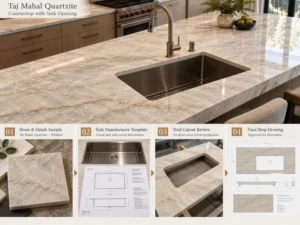
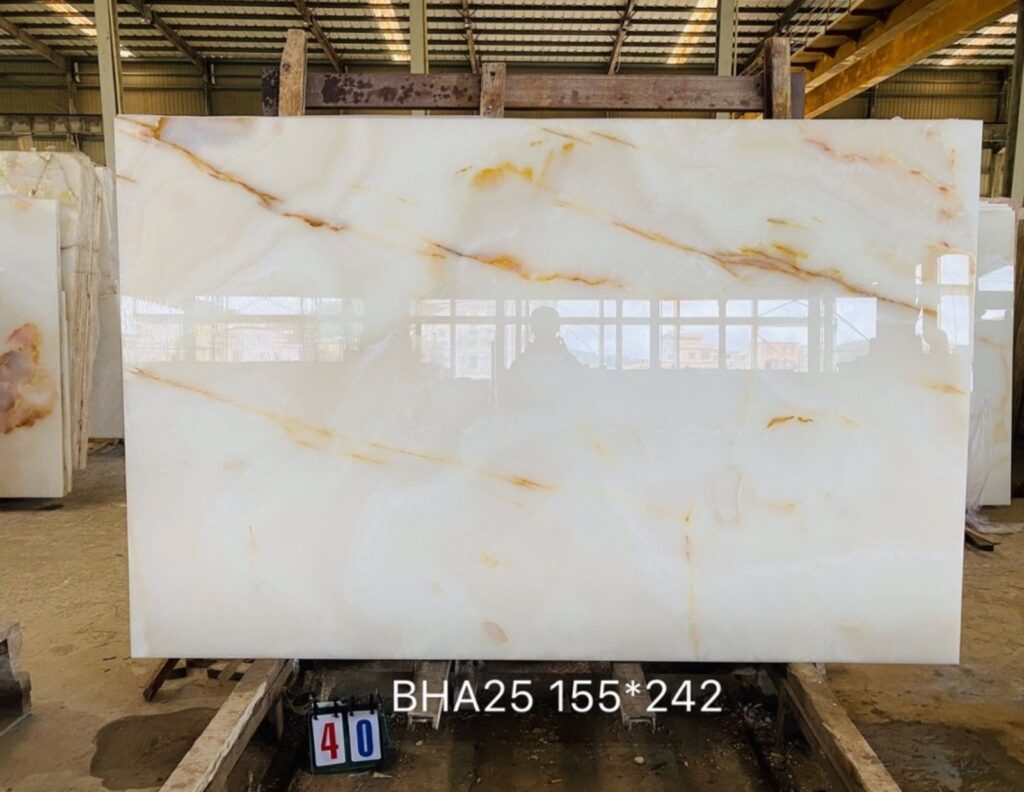
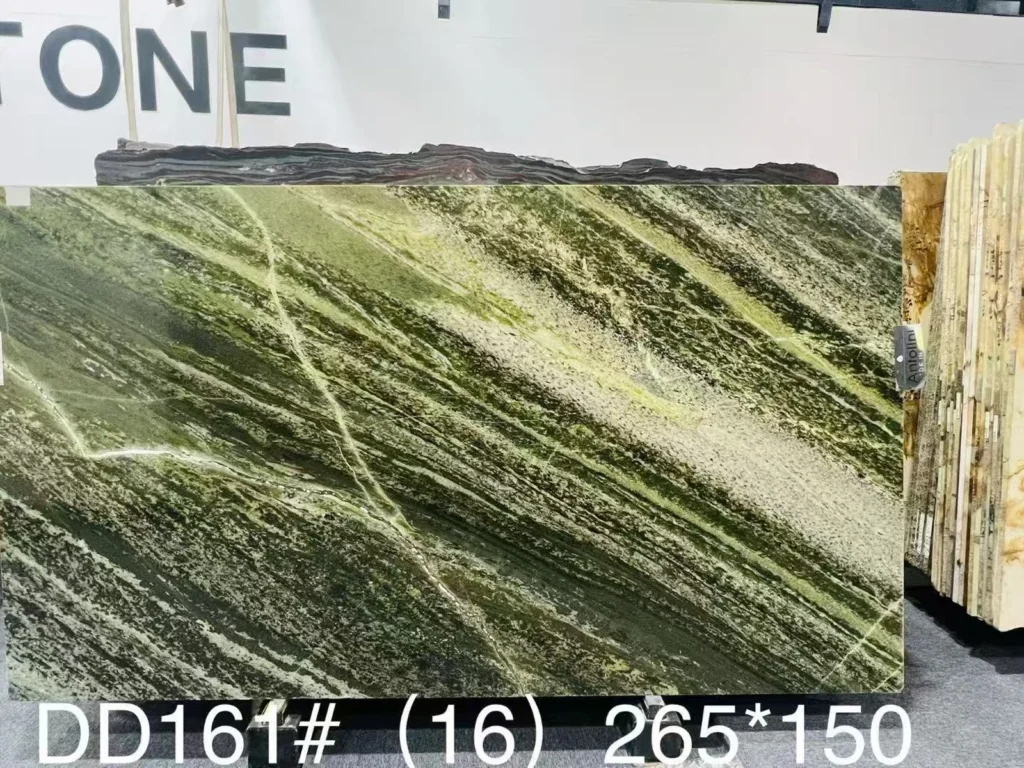
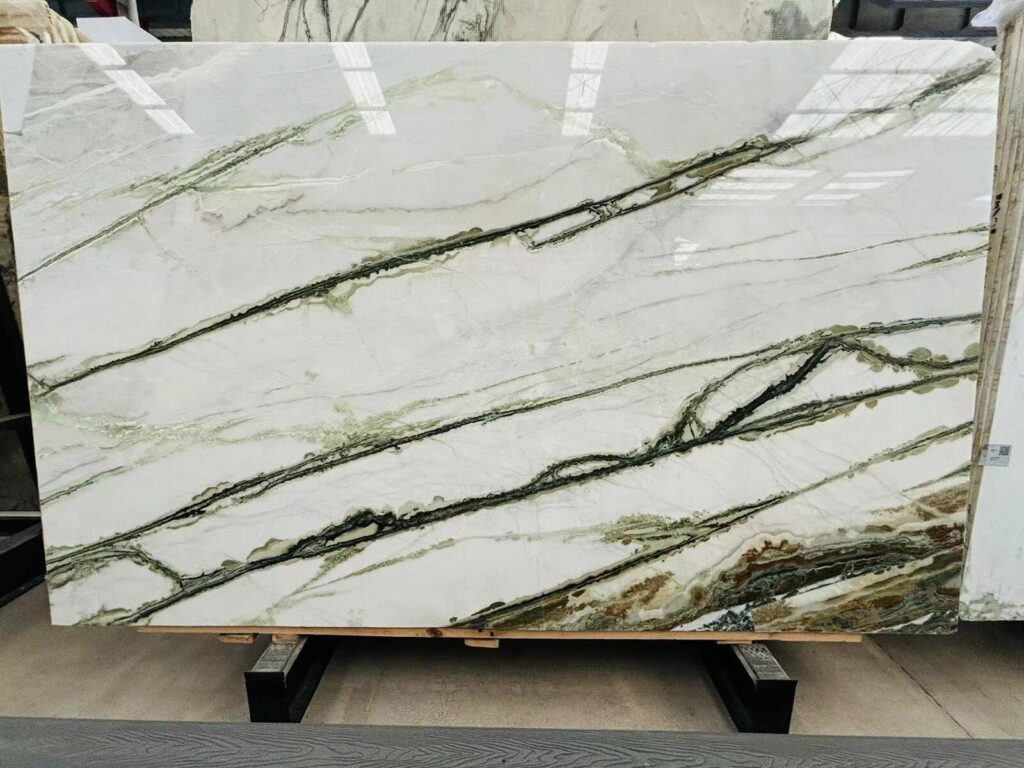
A Natural Quartzite project may begin with a familiar commercial name such as Taj Mahal Quartzite, Cristallo Quartzite, Blue Roma Quartzite, or another market-recognized material.
That name is useful for communication between the buyer, supplier, designer, and fabricator. But does the commercial name automatically tell an architect what the rock is geologically?
Not necessarily.
The natural-stone industry uses commercial categories to organize materials for selection, fabrication, and sale. Geological classification answers a different question: what type of rock is the examined material based on mineral composition, texture, origin, and geological structure?
For specifications, the practical solution is usually not to choose one naming system and discard the other.
Instead, keep the identities separate:
Commercial Material Name → Actual Slab / Sample Reference → Geological Classification Where Verified → Project Specification.
A trade name identifies a Natural Quartzite in the commercial stone market. A geological name describes the rock according to scientific classification.
These naming systems serve different purposes.
| Item | Trade / Commercial Name | Geological Name |
| Primary Purpose | Identify and sell a material in the stone market | Scientifically classify the rock |
| Basis | Market convention, appearance, locality, supplier usage, or established commercial identity | Mineralogy, texture, fabric, geological origin, and other diagnostic features |
| Typical User | Buyer, supplier, designer, fabricator, distributor | Geologist, petrographer, laboratory, technical consultant |
| Can It Identify the Product? | Yes, commercially | Yes, geologically when properly determined |
| Does It Prove Physical Performance? | No | No; separate physical testing may still be required |
The important procurement principle is:
A commercial name is not automatically a geological diagnosis, and a geological classification does not replace the commercial identity needed to purchase the correct slabs.

The natural-stone trade needs a practical vocabulary for buying, selling, designing, fabricating, and specifying stone.
Scientific geology has a much more detailed classification system.
As a result, commercial stone categories simplify a large number of geological rock types into a smaller set of market-recognized material groups.
This is why a stone can have:
Those descriptions can coexist without being interchangeable.
In geological use, quartzite generally refers to a very quartz-rich rock in which the original quartz-rich material has become strongly indurated and, in many quartzites, recrystallized into a tightly bonded structure.
However, the commercial dimension-stone market uses classification systems designed for building-stone selection and performance groups, not simply academic rock nomenclature.
For example, ASTM C616/C616M covers quartz-based dimension stone and recognizes categories including sandstone, quartzitic sandstone, and quartzite for that standard’s classification framework.
This matters because a buyer should avoid assuming that every material marketed using a quartz-related trade description has exactly the same geological classification or properties.
The project should use verified information when geological classification is important.
No. The commercial name alone should not be treated as geological proof.
A trade name tells the project team which commercial stone is being discussed. Geological verification requires evidence appropriate to that question.
If classification is important, the evidence may include a petrographic examination or another qualified geological assessment of an identified sample.
The distinction can be summarized as:
Trade Name = Commercial Identity
Petrographic Classification = Geological Evidence
This does not mean commercial names are unreliable or should be removed. They remain essential for identifying slabs in the supply chain.
The problem occurs only when a commercial label is used to claim a geological fact that has not been independently established.
For most commercial and architectural projects, a Natural Quartzite specification should identify the actual material being purchased rather than rely on a geological term alone.
A practical specification record may include:
| Specification Field | Recommended Information | Why It Matters |
| Commercial Material Name | Name used to purchase and identify the Natural Quartzite | Connects the specification to the stone supply chain |
| Material Type | Natural stone / Natural Quartzite as applicable to the verified project record | Avoids confusion with Engineered Quartz |
| Supplier | Approved or proposed supplier | Improves material traceability |
| Slab / Sample Reference | Approved slab photographs, lot reference, control sample, or other current material reference | Connects the name to the actual selected material |
| Thickness | Project-required stone thickness | Defines an important fabrication and procurement input |
| Finish | Polished, honed, leathered, or other approved finish | Controls the required finished surface |
| Application | Countertop, wall, flooring, vanity, facade, or other project element | Connects technical requirements to actual use |
| Geological Classification | Add when verified and when relevant to the specification | Separates geological evidence from commercial naming |
| Petrographic Report Reference | Laboratory, report number, date, and sample reference where applicable | Makes geological verification traceable |
| Physical Test References | Applicable project-required test data | Keeps performance evidence separate from naming |
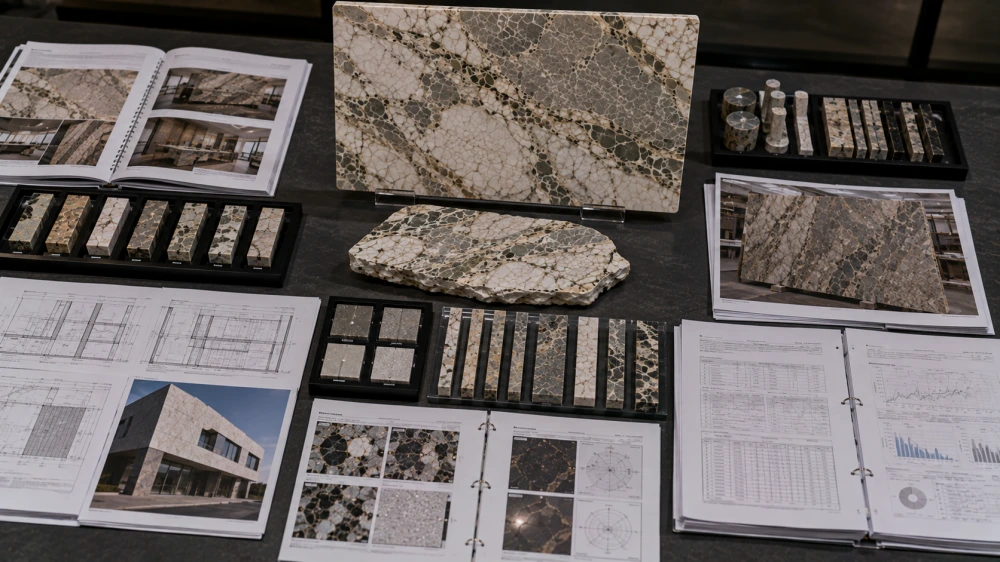
In most Natural Quartzite procurement specifications, the commercial trade name should remain because it identifies the material being purchased. If geological classification is important, add it as a separate verified field rather than silently replacing the trade name.
For example, the project record can follow this structure:
Commercial Name: [Approved Natural Quartzite Trade Name]
Supplier: [Approved Supplier]
Approved Material Reference: [Slab / Lot / Sample Reference]
Finish: [Specified Finish]
Thickness: [Specified Thickness]
Geological Classification: [Classification if independently verified]
Petrographic Reference: [Report Reference if applicable]
This structure gives the buyer both commercial clarity and technical traceability.
Imagine that an architect removes the commercial stone name and writes only a general geological term such as “quartzite.”
That may still leave the supplier with hundreds of visually different materials that could potentially fall within the stated category.
The project has lost critical purchasing information.
A commercial name helps identify:
Geological classification provides technical context, but it cannot substitute for these procurement functions.
The geological description becomes important when a project needs more than market identification.
It can help answer questions such as:
This makes geological information particularly useful for:
One of the most important specification mistakes is treating these three categories as though they prove the same thing.
They do not.
| Information | Main Question Answered | Does It Replace the Others? |
| Trade Name | Which commercial stone are we buying? | No |
| Petrographic / Geological Classification | What type of rock is the tested sample? | No |
| Physical Test Data | How did the tested specimens perform under a defined test method? | No |
| Slab Approval | Do the actual slabs meet the visual and layout requirements? | No |
The strongest Natural Quartzite specification therefore does not ask one document to do four different jobs.
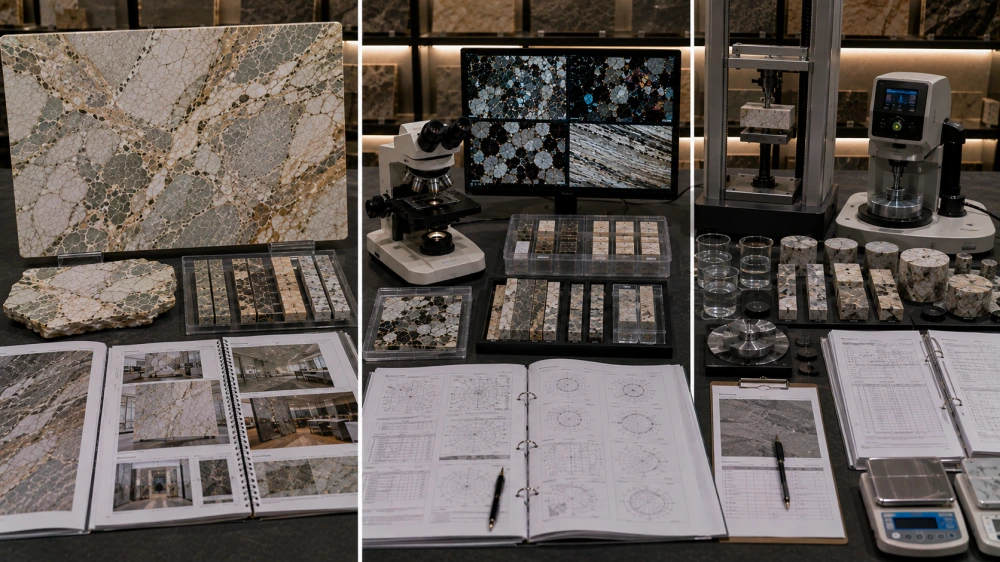
A petrographic report can help when the project needs evidence about the geological identity of a submitted stone sample.
Petrographic examination can investigate characteristics such as:
The report should remain connected to the sample that was actually examined.
A petrographic result from one specimen should not automatically be presented as proof that every slab from every block or future batch has identical mineral proportions, appearance, or microstructure.
No. Geological classification and physical performance are different questions.
A geological description can tell the project team what kind of rock was examined. It does not by itself provide every physical property required for design or installation.
Depending on the application, separate test information may be relevant for characteristics such as:
ASTM C616/C616M, for example, addresses physical requirements for quartz-based dimension stone, including several physical-property categories. Geological naming should therefore not be used as a substitute for required test values.
The reverse is also true.
A stone can have a set of measured physical properties, but those values alone do not necessarily provide the same mineralogical and textural information as petrographic examination.
Use the right evidence for the right question:
Need product identity? → Commercial name and slab reference.
Need geological identity? → Petrographic or qualified geological evidence.
Need physical-property values? → Appropriate physical testing.
Need visual approval? → Actual slab review and layout approval.
The specification should also avoid shortening “Natural Quartzite” to an ambiguous use of the word “quartz” where that could create confusion.
Natural Quartzite is a natural stone.
Engineered Quartz is a manufactured surface product.
The names sound similar, but the materials, manufacturing origins, slab characteristics, variation patterns, fabrication considerations, and specification routes are different.
For procurement documents, drawings, RFQs, and purchase orders, write the intended material category clearly.
Rather than writing only:
“Provide quartzite.”
a more controlled specification can identify the purchasing and approval basis.
For example:
Material: Natural Quartzite
Commercial Name: Approved trade name
Supplier: Approved supplier
Approved Reference: Current slab / sample / lot reference
Thickness: Project specification
Finish: Project specification
Visual Approval: Actual slabs subject to approved review procedure
Geological Classification: Record separately where verified or required
Technical Test Data: Submit where required by project specification
This avoids both extremes:
Usually, no.
If petrographic testing gives a more precise geological classification, retain that technical description in the project record while keeping the commercial name needed for procurement.
The project may therefore record both:
Commercial Identity + Verified Geological Identity
This is much clearer than allowing one term to overwrite the other.
Yes, commercial naming practices can vary across suppliers and markets.
A buyer should therefore avoid assuming that two similar names automatically mean identical material or that two different names automatically mean different geology.
For an international quotation comparison, confirm:
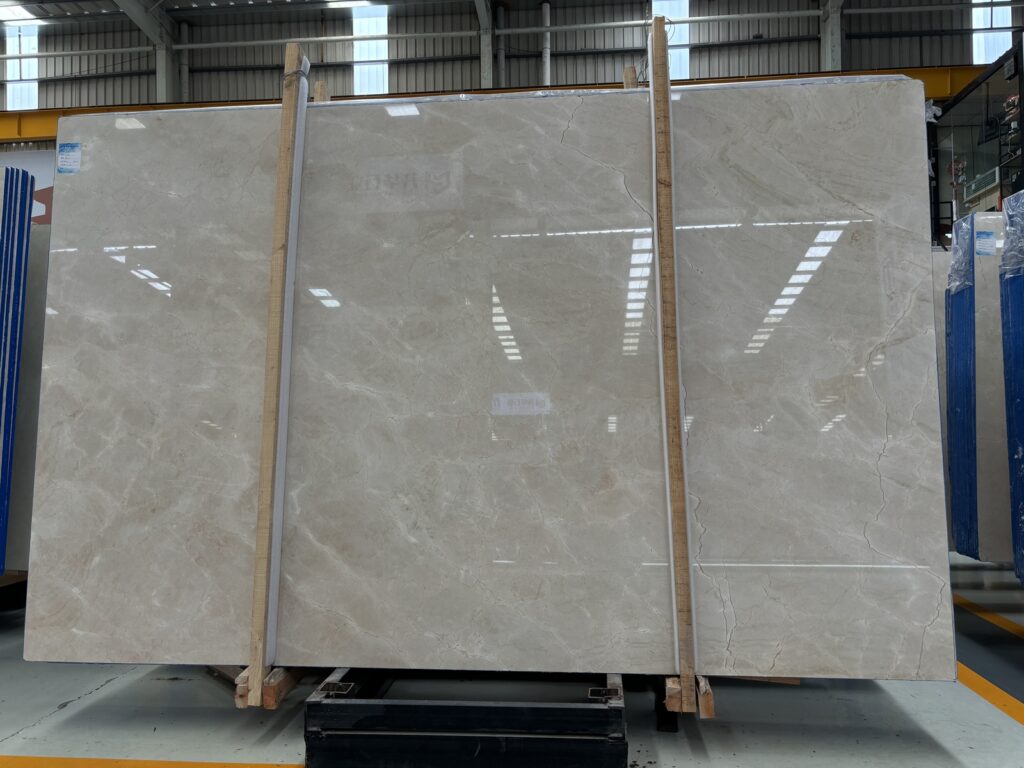
Ultimately, the purchase is for actual stone slabs, not for the material name alone.
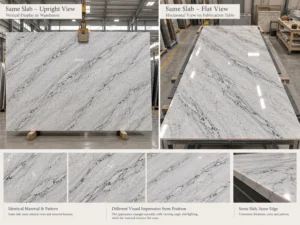
Yes. Natural Quartzite is a natural geological material and can show meaningful variation between blocks and slabs.
Even when the commercial name remains constant, buyers may encounter differences in:
That is another reason the specification should contain an actual slab approval mechanism rather than relying on the trade name as a visual guarantee.
The actual approved slab or agreed material-control reference should control project appearance more directly than the generic trade name.
A trade name establishes which commercial material family is intended.
Actual slab review establishes what the buyer is approving.
For visually sensitive Natural Quartzite projects, the review may include:
Geological terminology cannot replace this visual-control step.

Consider a hypothetical luxury kitchen using a commercially selected Natural Quartzite.
The designer originally writes:
“Kitchen countertop: quartzite, polished.”
This is too broad for controlled international procurement.
A stronger project record might become:
| Field | Example Record |
| Material Category | Natural Quartzite |
| Commercial Name | Selected market trade name |
| Material Reference | Current approved slab set / supplier reference |
| Thickness | 20mm |
| Finish | Polished |
| Visual Control | Actual slab approval plus cutting-layout review |
| Geological Classification | Record only if verified or required |
| Petrographic Report | Attach report reference if required by project |
| Performance Tests | Provide applicable project-required test data separately |
The trade name still identifies the product, but it is no longer being asked to prove geology, slab appearance, or performance by itself.
| Common Mistake | Why It Creates Risk | Better Practice |
| Using only “quartzite” | Does not identify the intended commercial material | Add trade name and material reference |
| Treating a trade name as geological proof | Commercial naming is not the same as petrographic classification | Use verified geological evidence when needed |
| Replacing the trade name with only a geological name | Can make the intended stone difficult to identify commercially | Record commercial and geological identity separately |
| Assuming geological classification proves performance | Strength, absorption, and other properties require appropriate evidence | Reference applicable physical test data separately |
| Using one small sample as visual approval | Natural slab variation may be much larger than the sample shows | Review actual slabs for visually sensitive work |
| Writing “quartz” for Natural Quartzite | Can create confusion with Engineered Quartz | Write the full intended material category |
Before issuing a Natural Quartzite specification or purchase order, confirm:
A quartzite trade name is the commercial identity used to buy, sell, and specify a stone product. A geological name classifies the rock according to mineralogy, texture, geological origin, and other scientific characteristics. The two naming systems serve different purposes and are not automatically interchangeable.
It can identify the intended commercial material, but a stronger specification also records relevant supplier, slab or sample reference, thickness, finish, application, and approval requirements. A trade name alone should not be treated as proof of geological classification or physical performance.
Usually not. The commercial name remains useful for procurement and slab identification. If geological classification is important, add the verified geological description or petrographic report reference as a separate field.
When geological classification is important, qualified petrographic examination of an identified sample can provide mineralogical, textural, and classification information. The result should remain connected to the specific sample examined.
No. Geological classification does not replace physical-property testing. Water absorption, density, strength, abrasion resistance, and other required performance values should be supported by appropriate test methods when relevant to the project.
Yes. Commercial naming can vary across suppliers and markets. Buyers should compare actual slab photographs, material references, dimensions, appearance, finish, and technical documentation rather than assuming that similar or different names alone establish material equivalence.
No. Natural Quartzite is natural stone, while Engineered Quartz is a manufactured surface material. Procurement documents should state the intended material category clearly so that the two are not confused.
Record the commercial material name and supplier reference, then connect them to actual slab approval, thickness, finish, application, drawings, and layout requirements. Add geological classification and laboratory test references separately when the project requires them.
Final Note
Quartzite trade names and geological names should not compete for one line in the specification. They answer different questions. Use the commercial name to identify the stone being purchased, connect that name to the actual slabs or approved sample, and add a verified geological classification when the project requires it. Keep physical test data and visual slab approval as separate evidence. This gives the buyer a specification that is commercially usable, technically traceable, and less dependent on assumptions created by material naming alone.