Quartzite Cost Guide for Kitchen Countertops: Material, Fabrication, and Installation
Post navigation
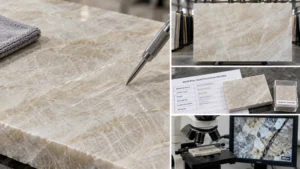
A premium kitchen scene representing quartzite countertop budgeting, material value, and project-level decision making.
Quick Summary
Quick Summary:Quartzite cost guide for kitchen countertops is not only about slab price. The total budget usually depends on three major layers: material selection, fabrication complexity, and installation conditions. Buyers who understand how quartzite countertop cost is built can compare quotes more accurately, avoid hidden cost surprises, and make better sourcing decisions for premium kitchen projects.
Quartzite is often chosen for kitchen countertops because it combines natural stone beauty with strong visual value and premium project appeal. But once buyers move from inspiration into budgeting, the same question appears almost every time: why do quartzite countertop quotes vary so much?
That confusion is understandable. Two kitchens may look similar at first, yet the final countertop price can be very different. One quote may reflect a straightforward slab layout with simple edge work and standard installation. Another may include a more expensive slab, tighter material yield, waterfall panels, more cutouts, reinforced sections, or a more difficult installation environment. In other words, quartzite cost is not a single number. It is a layered project calculation.
This is why a useful quartzite cost guide for kitchen countertops should do more than provide a generic price range. Buyers need to understand what they are actually paying for, what cost drivers matter most, and why some quotes that seem cheaper at the slab stage end up more expensive at the project stage. A realistic budgeting process should separate material cost, fabrication cost, and installation cost, then evaluate how each one changes according to the kitchen design.
For homeowners, designers, fabricators, and B2B buyers, this kind of cost breakdown is critical. It supports better planning, more rational supplier comparison, and fewer surprises once drawings, slab selection, and project execution begin.
Why Quartzite Countertop Pricing Often Feels Unclear
Quartzite pricing feels unclear because many buyers only see the final quote, not the logic behind it. A supplier or fabricator may provide one total number, but that number often includes very different cost elements combined together. Without a breakdown, buyers may assume the slab itself is responsible for most of the cost. In reality, the finished countertop price often depends just as much on fabrication and installation as on the raw material.
Another reason pricing feels inconsistent is that quartzite is a natural material. Slabs differ in color, pattern, country of origin, rarity, visual movement, and commercial demand. A soft beige, broadly market-friendly slab may price very differently from a more exotic or dramatic quartzite, even when the kitchen size is similar. That difference becomes even larger when buyers request bookmatching, waterfall edges, or specific visual continuity across islands and backsplashes.
Finally, countertop quotes are shaped by local conditions. Labor rates, jobsite access, installation difficulty, regional market pricing, and whether the work is domestic or international all affect the final number. This is why buyers should not compare quartzite quotes based only on headline totals. A valid comparison requires understanding what each quote actually covers.
What Drives Quartzite Countertop Cost?
In most projects, quartzite countertop cost comes from three main categories: the slab itself, the fabrication process, and the installation process. These three parts are connected, but they should still be reviewed separately.
Material cost covers the quartzite slab or slabs used for the project. This includes the stone selection, slab size, quality level, and visual characteristics. A more premium slab usually raises the base cost immediately.
Fabrication cost covers the work required to turn the slab into a finished countertop system. This includes measuring, templating, cutting, finishing, edging, polishing or honing, sink and cooktop cutouts, seam preparation, reinforcement, backsplash pieces, waterfall fabrication, and dry-lay planning where needed.
Installation cost covers transportation to site, handling, lifting, fitting, seam setting, leveling, final placement, and site-specific labor conditions. This part can change substantially depending on whether the kitchen is easy to access or whether the project requires stairs, tight corners, elevator coordination, large islands, or extra manpower.
Once buyers understand these three categories, quartzite pricing becomes much easier to read and compare.
Material Cost: What Affects Quartzite Slab Price?
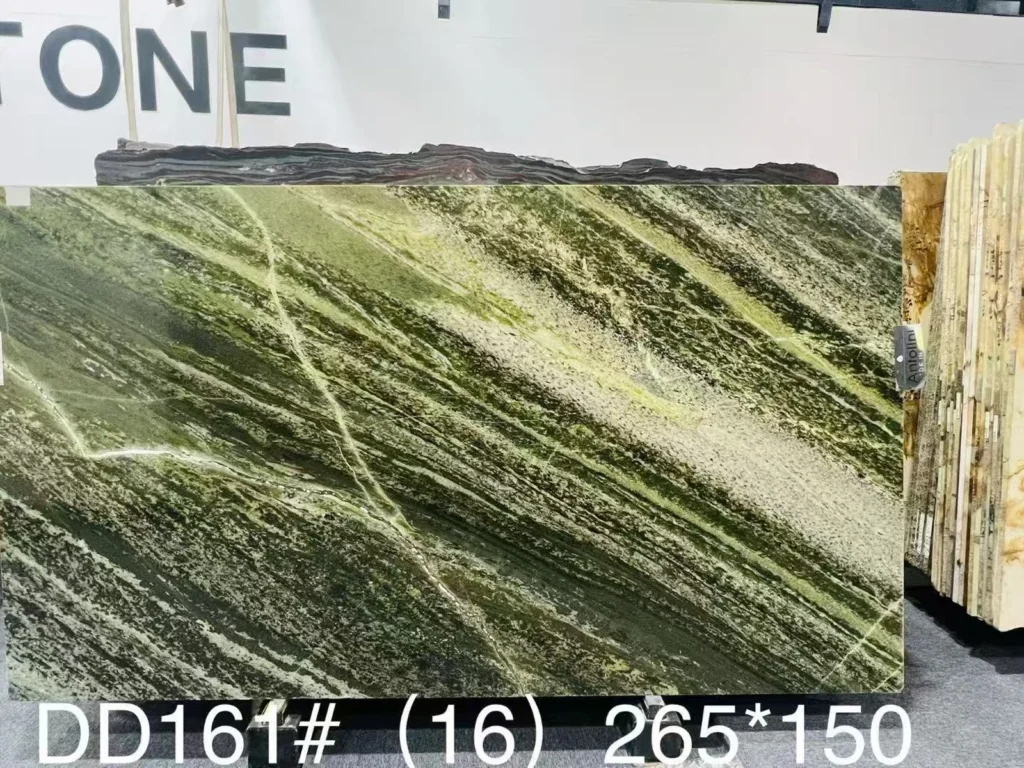
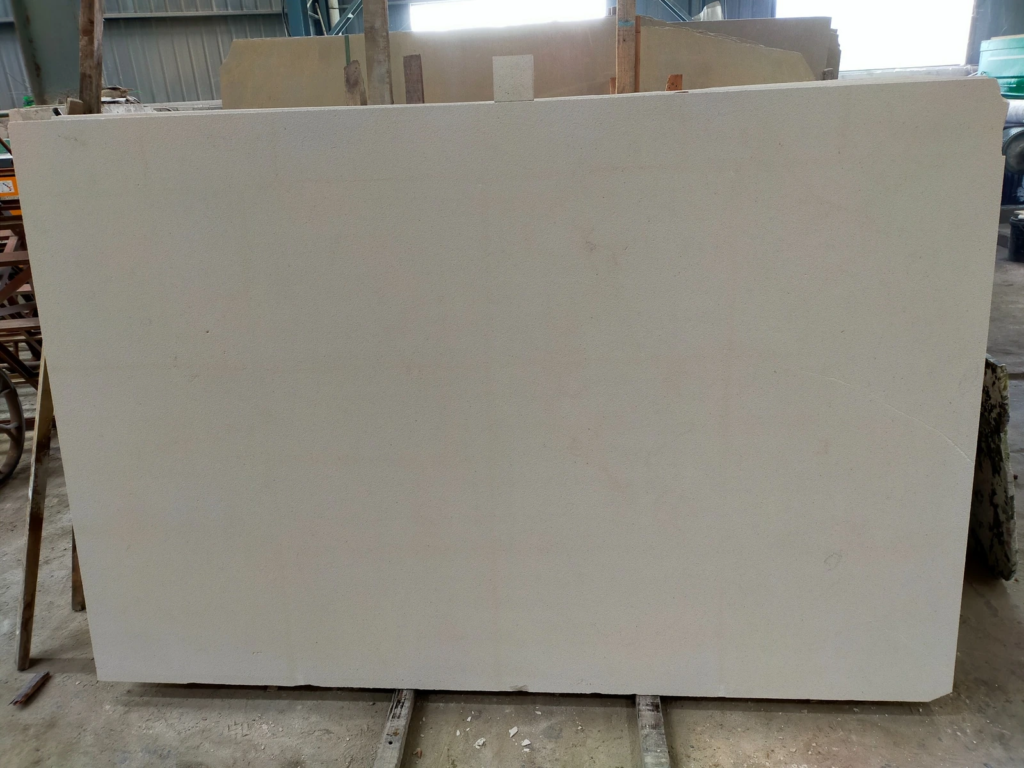
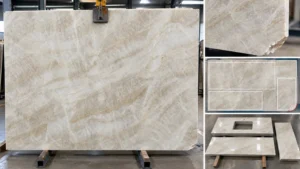
A full slab view illustrating how quartzite material selection affects countertop cost and project value.
Color, Pattern, and Commercial Demand
One of the biggest drivers of quartzite slab cost is visual demand. Some quartzites are commercially popular because they fit a wide range of kitchens. Warm beige, cream, and soft white slabs often perform well in the market because they work with many cabinet styles and feel broadly premium. Other quartzites may command higher prices because they are more dramatic, more limited, or more difficult to source consistently.
Buyers should also remember that strong market demand can raise pricing even when the material is not the rarest geologically. In countertop projects, price often follows market desirability as much as stone classification.
Origin and Supply Conditions
Origin can influence cost through quarry access, export conditions, supply stability, freight distance, and processing chain complexity. Some quartzites are easier to source in standard commercial batches. Others are more dependent on limited quarry output or more fragmented supply, which increases price and complicates repeat sourcing.
For larger projects, origin also matters because it affects consistency. If a kitchen requires multiple slabs with compatible tone and movement, the cost may rise simply because matching inventory is harder to secure.
Slab Size and Usable Yield
Quartzite cost is not only about the slab price itself. It is also about how efficiently the slab can be used. A kitchen layout that fits well within one slab often performs better economically than a layout that forces buyers into a second slab with significant leftover waste. This is especially important for islands, waterfall ends, and full-height backsplashes.
In real projects, some slabs look reasonably priced until layout planning reveals poor material yield. The slab then becomes expensive not because of price per square foot alone, but because the project consumes more stone than expected.
Thickness and Surface Finish
Thickness can influence both material and fabrication cost. A thicker slab may cost more as raw material and may also increase handling and installation complexity later. Finish matters as well. A standard polished finish may be simpler in some supply chains, while honed or specialty finishes can change processing cost depending on the stone and production workflow.
For buyers comparing quotes, this means slab thickness and finish should always be confirmed before assuming one offer is cheaper than another.
Fabrication Cost: Where the Price Can Rise Quickly
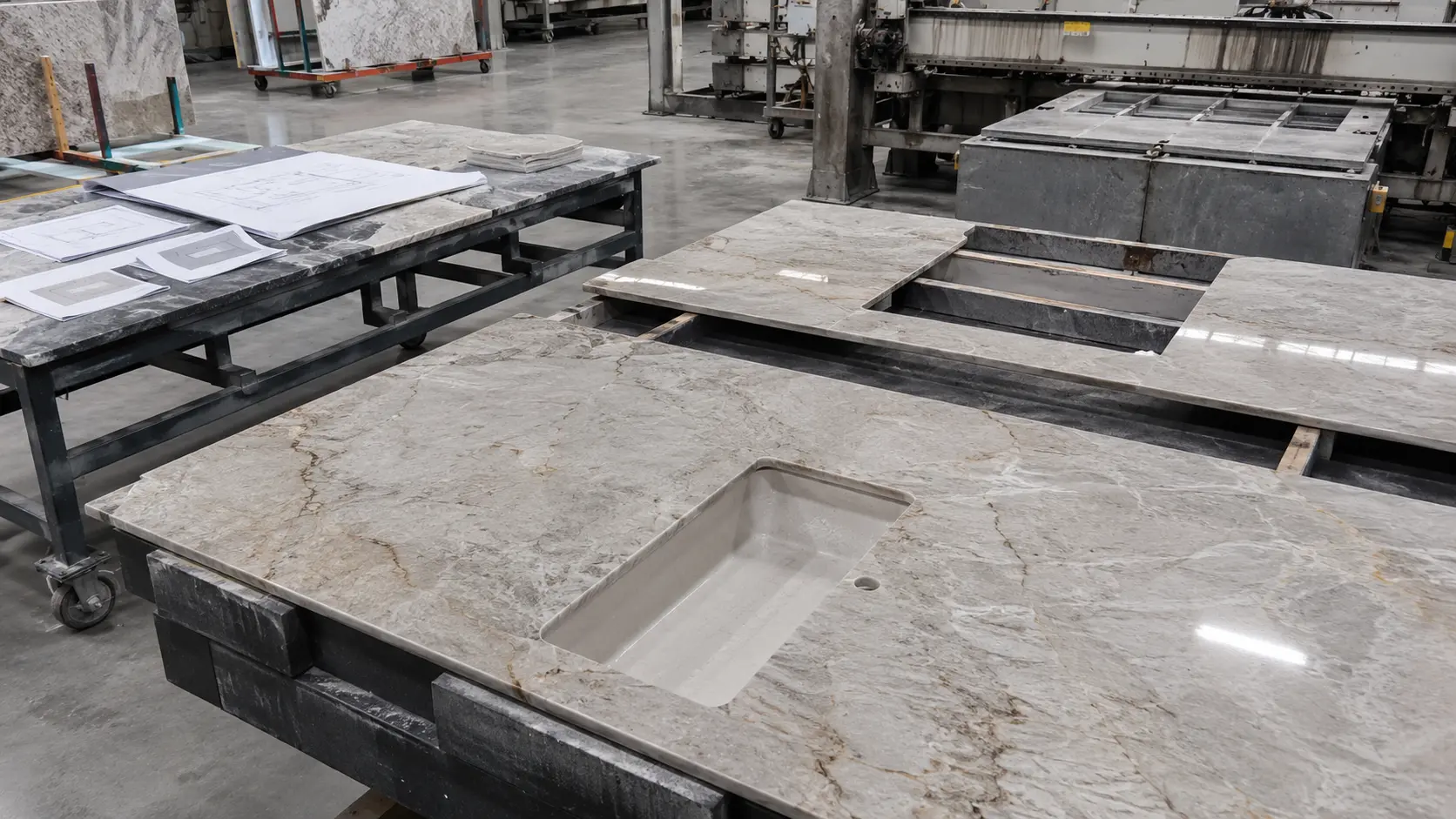
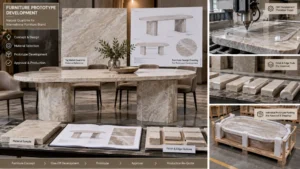
Quartzite countertop fabrication scene showing layout planning, cutout work, and project-level processing details.
Edge Profiles and Detail Work
Basic eased edges and simple straight details usually cost less than more decorative or labor-intensive edge profiles. The more shaping, finishing, or profile consistency the fabricator must produce, the more fabrication time increases. This matters especially in kitchens with long visible runs or prominent island edges.
Sink and Cooktop Cutouts
Every sink cutout, faucet hole, cooktop opening, and corner treatment adds labor and risk. These openings are not just simple cuts. They require careful processing and, in some cases, reinforcement planning. Complex sink configurations or custom accessory openings can raise fabrication cost faster than many buyers expect.
Waterfall Panels and Full-Height Features
Waterfall edges are one of the most common price accelerators in high-end kitchens. They increase material consumption, demand more precise layout matching, and require more fabrication and installation care. The same applies to full-height backsplashes, wrapped returns, and visually continuous stone features. These details are beautiful, but buyers should understand that they are not only material upgrades. They are also labor upgrades.
Seams, Reinforcement, and Structural Planning
Seam location matters both visually and technically. A straightforward layout with one well-placed seam may be cost-efficient. A design requiring more complex seam management, extra reinforcement, fragile cut zones, or structural protection around unsupported areas will usually cost more. Even when the finished kitchen looks simple, hidden fabrication planning can represent a substantial part of the quote.
Dry-Lay, Layout Planning, and Slab Matching
Higher-level quartzite projects often involve more planning before cutting begins. Buyers may want vein direction control, island-centered pattern placement, or matching movement across different sections. This kind of fabrication planning is one reason two quotes for the same kitchen size can look very different. One quote may reflect basic commercial cutting. Another may reflect a much more design-sensitive production process.
Installation Cost: Why the Final Stage Can Change the Budget
Quartzite project logistics and installation handling showing how delivery and site conditions affect total countertop cost.
Site Access and Handling Difficulty
Installation cost often depends on how difficult the jobsite is. Ground-floor access with short carrying distance is very different from installation in a high-rise, a narrow townhouse, or a home with complicated entry conditions. Large quartzite pieces are heavy and require careful movement, especially if the project includes oversized islands or waterfall panels.
Local Labor Conditions
Labor pricing varies by market. The same quartzite countertop installation may cost significantly more in one city than in another because of wage differences, crew availability, liability expectations, or regional construction norms. This is why buyers should be cautious when comparing fabrication-inclusive quotes from different regions without considering local labor structure.
Template Accuracy and On-Site Adjustments
Good installation depends on accurate site preparation and templating. If cabinetry is not level, walls are not straight, or other trades create last-minute changes, installation becomes more complicated. In some cases, the countertop itself is not the issue. The site condition is the issue. That can increase time, risk, and cost.
Transportation, Packaging, and Coordination
For some projects, especially long-distance or export-oriented ones, packaging and logistics become meaningful cost factors. Quartzite is a premium natural stone, and safe handling matters. Reinforced crating, additional protection, delivery coordination, and jobsite scheduling may all affect total cost even before installation begins.
Quartzite Countertop Cost Breakdown Table
Cost Component
What It Includes
What Usually Increases Cost
Buyer Note
Material
Quartzite slab supply
Premium color, rare pattern, larger slab need, poor yield
Do not compare slab price without reviewing layout efficiency
What Usually Makes Quartzite Countertop Quotes Higher?
Cost Driver
Why It Raises Price
Practical Buying Impact
Exotic or high-demand slab
Higher material value and limited sourcing flexibility
Base quote rises early
Poor slab yield
Requires more slab area than expected
Total stone consumption increases
Waterfall edges
More material, more layout precision, more labor
Aesthetic upgrade with strong cost effect
Multiple cutouts
Extra processing, detail work, and risk control
Fabrication cost rises quickly
Custom edge profile
More shaping and finishing time
Long visible runs become more expensive
Complex installation site
More crew, more time, more handling difficulty
Final installed price increases even if slab price stays unchanged
Why Two Quartzite Quotes Can Be Very Different
Two quartzite quotes can differ for several reasons even when they appear to cover the same kitchen. One supplier may price a more commercial slab category, while another is quoting a more premium or visually selective material. One fabricator may assume standard edge work and simple seam planning, while another is including enhanced layout matching, reinforced cutouts, or more refined finishing standards.
Quotes also differ because some are more complete than others. One proposal may include installation, site delivery, sink cutouts, backsplash pieces, and edge finishing. Another may leave those items outside the headline total. This is why experienced buyers do not ask only, “Which quote is lower?” They ask, “Which quote is actually more complete and more comparable?”
In quartzite sourcing, a low headline number is not always a lower real project cost. Sometimes it only reflects missing scope.
Hidden Cost Factors Buyers Commonly Miss
One of the most commonly missed cost factors is material waste. Buyers often focus on square footage, but countertop fabrication does not work like tile purchasing. Slab geometry, seam placement, and island proportions can all affect how efficiently the stone is used.
Another hidden factor is finish coordination. A kitchen using a more specialized finish, additional edge detailing, or coordinated backsplash treatment may cost more than expected simply because the project demands more controlled workmanship.
Buyers also underestimate the cost effect of schedule pressure. Rush production, accelerated installation windows, or multi-trade coordination often create indirect cost increases. These may not always appear as a separate line item, but they influence the quote.
Finally, many buyers do not account for the value of professional layout planning. Good planning can reduce waste, protect visual continuity, and prevent expensive rework. In premium quartzite projects, planning quality is part of cost efficiency, not a luxury extra.
How to Compare Quartzite Countertop Quotes Correctly
The best way to compare quotes is to break them into the same three layers: material, fabrication, and installation. Buyers should confirm slab type, finish, thickness, slab quantity, edge profile, number of cutouts, backsplash scope, waterfall scope, installation conditions, and whether delivery or handling is included.
It is also important to ask whether the quote is based on actual slab selection or on a provisional material assumption. If one supplier is pricing from generic category assumptions and another is pricing from real available slabs, the quotes are not directly comparable.
When possible, buyers should ask for a project-based explanation rather than only a total. This makes it easier to understand whether the price difference comes from better material, more accurate scope, or more demanding execution quality.
For buyers still evaluating broader material direction, it can help to review more information about quartzite kitchen countertops before moving into final budgeting. If the project is already at quotation stage, the next step is usually a countertop material inquiry with drawings, dimensions, slab preference, and finish expectations clearly stated.
Buyer Checklist Before Accepting a Quartzite Countertop Quote
Before approving a quote, buyers should confirm the exact slab direction, thickness, finish, number of slabs assumed, seam strategy, edge profile, sink and cooktop cutouts, backsplash scope, waterfall scope, installation scope, delivery terms, and whether packaging or protection is included where relevant. They should also confirm whether the quote reflects actual project drawings or only an estimated layout.
A good quote should not only tell the buyer how much the project costs. It should also show enough structure that the buyer understands why it costs that amount.
Final Recommendation
The most useful way to read quartzite pricing is to stop thinking in terms of slab cost alone. A real kitchen countertop budget is built from material quality, fabrication complexity, and installation reality together. Buyers who understand this usually make better decisions, compare suppliers more accurately, and avoid the false economy of incomplete quotes.
In many projects, the smartest choice is not the cheapest slab or the lowest total. It is the quote that balances the right quartzite, the right layout, and the right execution for the kitchen as a whole.
Final Note / Practical Takeaway
For buyers, quartzite countertop pricing should always be understood as a full project equation, not a simple material number. The slab matters, but the fabrication method, layout efficiency, and installation conditions often determine whether the final budget stays reasonable or rises unexpectedly.
The best way to control cost is not to chase the lowest quote blindly. It is to understand what the quote includes, where the major cost drivers sit, and whether the kitchen design is using quartzite efficiently.
When buyers compare material, fabrication, and installation on the same basis, they usually make stronger decisions and achieve better value from a premium natural stone investment.
FAQ
1. What is usually included in quartzite countertop cost?
Quartzite countertop cost usually includes three main parts: the slab material, the fabrication work, and the installation work. Depending on the supplier or fabricator, the quote may also include edge finishing, cutouts, backsplash pieces, delivery, packaging, or site coordination, so buyers should always check scope carefully.
2. Why can two quartzite countertop quotes be so different?
Two quartzite quotes can differ because of slab quality, slab yield, finish, thickness, edge details, number of cutouts, waterfall features, installation difficulty, and whether the quote includes complete project scope. A lower quote is not always cheaper in real terms if important items are missing.
3. Does fabrication cost matter as much as slab price?
Yes. In many kitchen projects, fabrication cost matters almost as much as slab price because details such as edge profiles, sink cutouts, reinforcement, waterfall panels, and seam planning can significantly raise the final project total. Buyers should never judge value by slab price alone.
4. What usually increases quartzite installation cost?
Installation cost usually increases when the jobsite is difficult to access, the countertop pieces are oversized, the kitchen requires more labor for lifting and fitting, or the site conditions are not ready for straightforward installation. Local labor pricing and transportation distance can also affect this part of the budget.
5. How should I compare quartzite countertop quotes correctly?
You should compare quartzite quotes by separating material, fabrication, and installation scope, then confirming slab type, thickness, finish, edge profile, cutouts, backsplash, waterfall details, delivery, and installation conditions. The most accurate comparison is based on matching project scope, not only the final headline number.
Hi, I am the author of this article. I have been working in the field of Natural Stone for more than 15 years. If you need customized Natural Stone services, please feel free to contact me.