Quartzite Change Orders: Recording a New Drawing After Slabs Are Reserved
Post navigation
Quick Summary
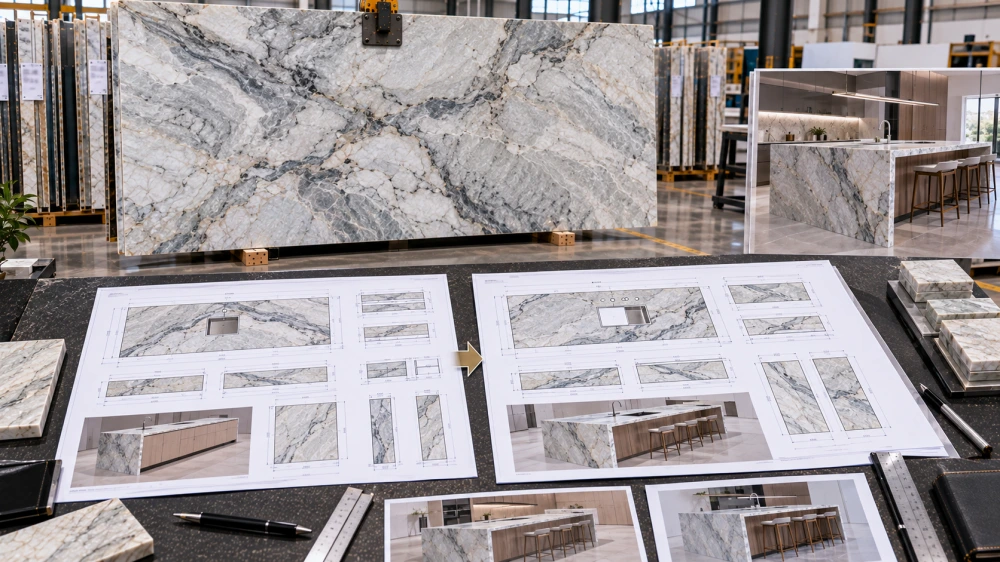
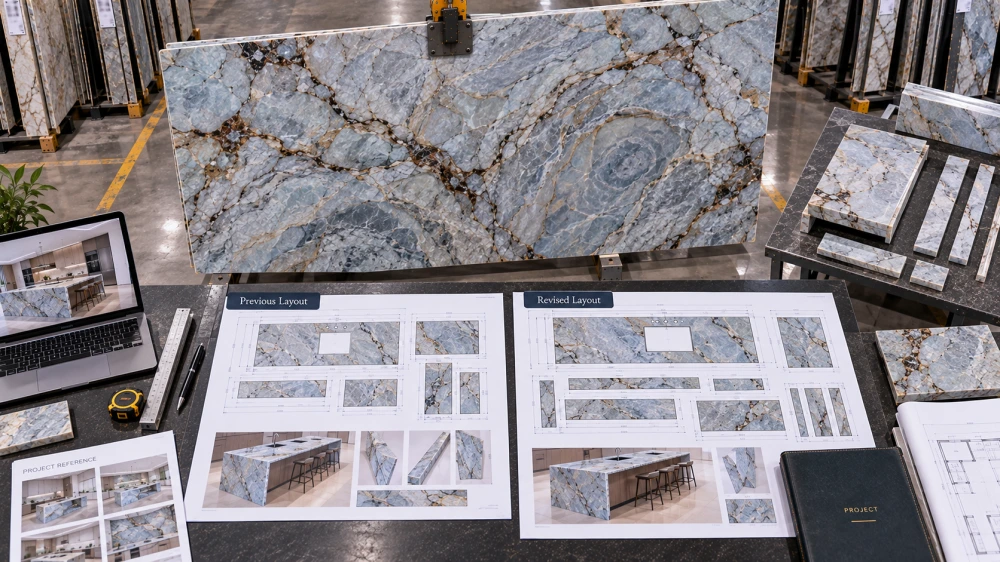
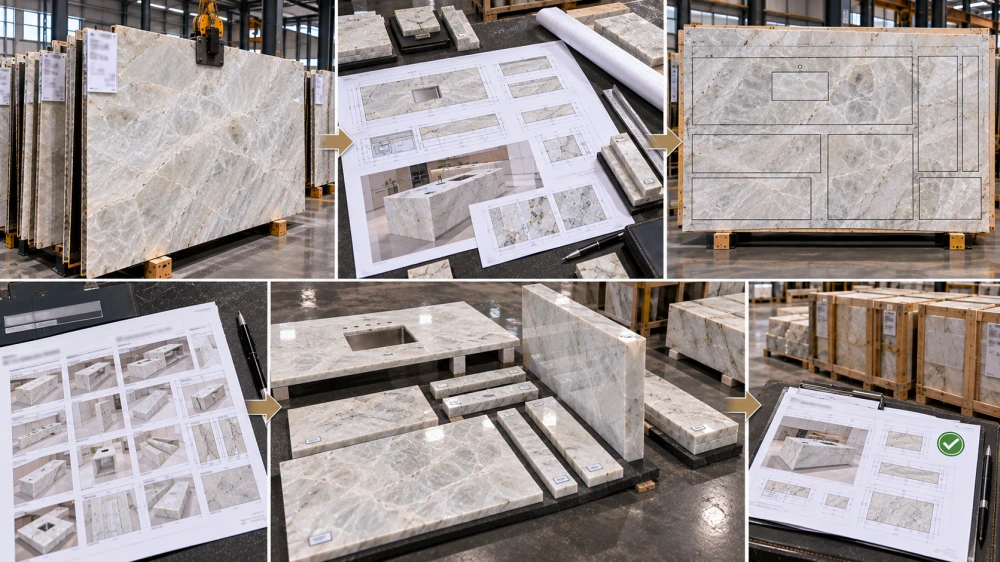
A Quartzite change order issued after slabs are reserved should not simply replace the old drawing and continue production. Record the new drawing revision, identify exactly what changed, confirm which reserved slabs and finished pieces are affected, recheck layout and usable yield where necessary, reopen visual approvals that no longer match the new geometry, and identify any quotation, fabrication, packing, or programme impact before issuing the next production release.
A quartzite change order becomes especially important when Natural Quartzite slabs have already been selected and reserved.
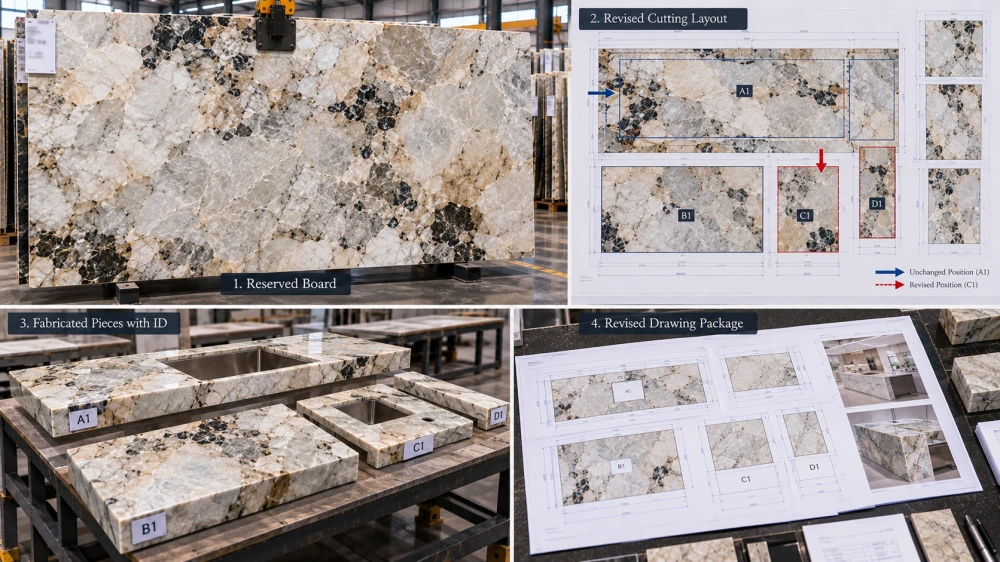
At that point, the project is no longer discussing a generic stone. It may already be connected to specific board numbers, actual slab photographs, a proposed cutting layout, piece references, visual priorities, and an earlier quotation.
Then a new drawing arrives.
The island becomes longer. A sink moves. A waterfall is added. A backsplash height changes. A vanity becomes two pieces instead of one. A wall elevation gains another panel.
The correct response is not simply:
“Use the new drawing.”
The project must determine what the new drawing changes in the existing stone record.
Start the Quartzite Change Order With One Controlled Change Header
CHANGE RECORD HEADER
Project: [Project reference]
Material: [Natural Quartzite name]
Reserved Slabs: [Board numbers / slab references]
Previous Drawing: [Drawing + revision]
New Drawing: [Drawing + revision]
Revision Date: [Date]
Change Issued By: [Responsible project party]
Current Production Status: [Reserved / Layout Review / Released / Fabrication / QC / Packing]
This header prevents the new drawing from becoming an isolated attachment with no connection to the material already reserved for the job.
Reservation Does Not Mean the Slabs Have Been Released for Cutting
A slab reservation and a fabrication release answer two different questions.
Reservation: Which identifiable physical slabs are being held for the project?
Production release: Which approved drawing, layout, dimensions, orientation, seams, and fabrication instructions authorize the factory to proceed?
This distinction matters because slabs are often selected before every shop-drawing detail is finalized.
Our Quartzite slab reservation guide separates the process into slab selection, reservation, layout review, and final production release. A change after reservation therefore does not automatically cancel the material, but it may require the project to revisit whether those same slabs still work for the revised scope.
Use a Before-and-After Delta Instead of “Revised as Drawing”
A strong quartzite change order should explain the difference between the previous and revised scope without making the supplier reconstruct two full drawing packages line by line.
Item
Previous
Revised
Review Needed
Island Length
Previous drawing dimension
New drawing dimension
Layout + slab yield
Sink Position
Previous location
Moved
Cutout + narrow stone zones
Waterfall
Not included
Added
Extra piece + miter + visual relationship
Backsplash
100 mm
Full height
Additional material + layout
The purpose of the delta is not to calculate the answer immediately. It is to show exactly which project decisions have been reopened.
Our Quartzite cutting-plan guide explains why slab identity should continue into finished-piece references rather than disappearing once fabrication planning begins.
Reset Visual Approval Only Where the Change Affects It
A revised drawing does not always require the entire material selection process to restart.
Instead, ask:
Does this change alter something that was previously approved visually?
Dimension increases but visual layout remains unchanged
Recheck fit and yield first.
Seam position moves
Recheck the stone relationship at the new seam.
Waterfall added
Reopen orientation, miter relationship, and adjacent slab allocation.
Piece orientation changes
Recheck vein or mineral direction.
Additional piece uses another slab
Review the new slab against the already reserved sequence.
The Quartzite vein-direction shop-drawing guide recommends tying orientation decisions to an identified drawing or slab-layout revision. If the drawing or layout changes, the previous direction decision should be reviewed rather than silently inherited.
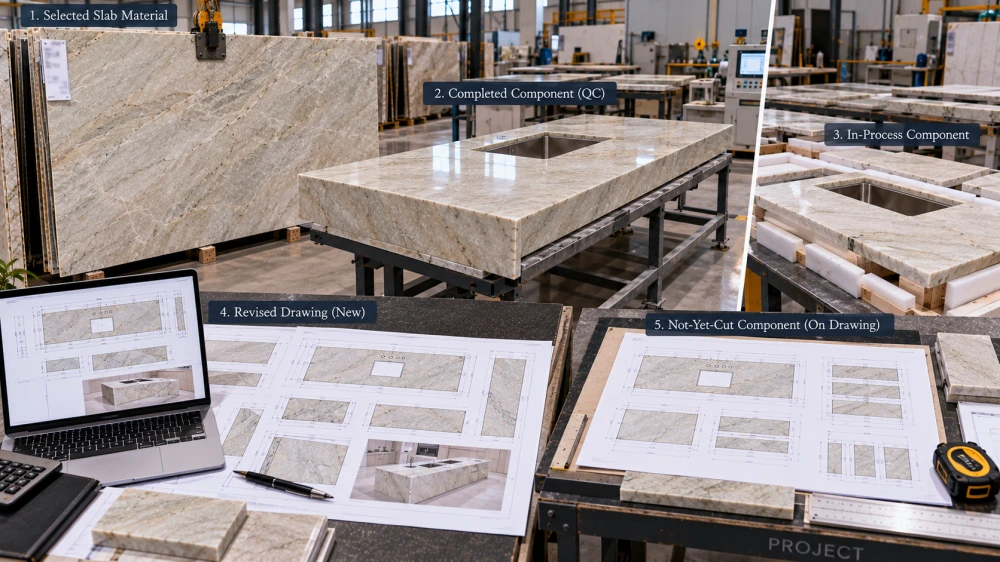
The Timing of the Change Order Matters
The same drawing revision can have very different consequences depending on when it arrives.
STAGE 1
Slabs Reserved, No Layout Approved
Update the drawing basis and check whether reserved material still fits the revised requirement.
STAGE 2
Layout Approved, Cutting Not Started
Reopen affected layout decisions and issue a revised cutting release.
STAGE 3
Cutting or Fabrication Has Started
Identify completed, in-process, and unaffected pieces before assessing rework or replacement requirements.
STAGE 4
Finished Pieces Have Passed QC
The revision may create replacement pieces rather than a simple drawing correction.
STAGE 5
Packing Has Started
Also review package references, crate allocation, packing list, freight data, and receiving sequence where affected.
A quartzite change order should identify exactly which components are:
unchanged;
changed but not yet fabricated;
already fabricated and still usable;
already fabricated but potentially affected;
newly added; or
cancelled.
This prevents one drawing revision from unnecessarily reopening every component in a large project.
Use an Affected-Piece Register
Piece ID
Change Status
Production Status
Next Review
K-01
Dimension revised
Not cut
New layout
K-02
No change
Fabricated
Retain existing record
K-03
New piece
Not started
Material allocation + quote
Recheck Cutouts, Edges, Miters, and Returns
A drawing revision can appear small on paper but create a different fabrication condition.
Examples include:
sink moving closer to an edge;
cooktop becoming wider;
backsplash becoming full height;
straight edge becoming a built-up edge;
waterfall being added to an island;
return being added around a column;
seam moving through a different visual area; or
one large component becoming two pieces.
Each change should be checked against the actual stone geometry, rather than assuming the previous fabrication assumptions remain suitable.
Separate the Commercial Change From the Technical Change
A drawing revision may create both.
TECHNICAL / PRODUCTION REVIEWDoes the reserved material still work?
Does the slab layout change?
Are cutouts or seams affected?
Which pieces require new fabrication information?
COMMERCIAL REVIEWDoes material quantity change?
Does fabrication scope change?
Does packing change?
Does the quotation require revision?
The change record should identify these questions first. The supplier can then confirm any project-specific price or lead-time impact rather than the article or buyer assuming one in advance.
What Happens If the Reserved Slabs Are No Longer Enough?
This is one of the most important outcomes a revised layout can reveal.
The project may need to consider:
adding another slab;
changing seam positions;
changing piece allocation;
reducing a secondary visual priority;
using an available reserve slab;
reviewing another slab from the same bundle; or
requesting a new slab selection.
A newly introduced slab should not automatically be treated as visually equivalent simply because it carries the same Quartzite trade name.
Where the project depends on a specific multi-slab composition, review the additional board against the already reserved set before production release.
Approval Reset Map
Do not ask everyone to “reapprove the project.” Ask each reviewer to confirm only the decision affected by the change.
Material Review → Are the reserved slabs still the correct material set?
Layout Review → Does the revised geometry still fit the intended slab allocation?
Visual Review → Did seam, direction, waterfall, or focal-area relationships change?
Fabrication Review → Are the new cutouts, edges, miters, or pieces understood?
Commercial Review → Does the revised scope require a new quotation or logistics basis?
Issue a Controlled Quartzite Change Order Record
The final record does not need to be complicated.
It should identify:
change-order number;
date;
previous drawing revision;
new drawing revision;
reserved slab board numbers;
affected piece IDs;
before-and-after changes;
layout impact;
visual review status;
fabrication status;
commercial status;
open items;
responsible reviewer; and
next release condition.
Do Not Delete the Old Drawing From the Project History
Superseded drawings should no longer control production, but they should remain identifiable in the project record.
The team may later need to understand:
which slabs were originally reserved;
why a slab layout changed;
why an extra piece was fabricated;
why a quotation was revised;
which approval applied before the change; or
which components were already completed.
A controlled history is more useful than simply replacing “Revision 03” with “Revision 04” in the same folder and losing the sequence of decisions.
Release Gate Before the Next Irreversible Step
Before revised production proceeds, confirm:
quartzite-change-order-revised-production-release
□ New drawing revision identified
□ Previous revision marked superseded for production
□ Reserved slab board numbers confirmed
□ Affected pieces identified
□ Revised slab layout checked where required
□ Usable yield rechecked
□ Cutouts, edges, seams and miters updated
□ Visual approval reopened where necessary
□ Commercial impact confirmed or listed as pending
□ Production status of existing pieces recorded
□ New release decision recorded
FAQ
1. Does a new drawing automatically cancel a Quartzite slab reservation?
No. A slab reservation and a drawing revision are different project records. The revised drawing should be checked against the reserved board numbers to determine whether the same slabs and quantity still suit the new scope.
2. When does a Quartzite change order require a new slab layout?
A new layout should be considered when the revision changes finished dimensions, piece quantities, seams, cutouts, orientation, waterfalls, returns, visible faces, or any other condition that affects where pieces are positioned on the reserved slabs.
3. Do previously approved Quartzite slab photos need to be approved again?
Not necessarily. If the physical slabs remain the same, the material selection itself may still stand. However, any visual approval tied to an old cutting position, seam, orientation, waterfall relationship, or piece allocation should be reviewed if that condition changed.
4. What if fabrication already started before the revised drawing arrives?
Record which pieces are completed, in production, unaffected, or potentially affected. The project can then distinguish a drawing update from possible rework, replacement pieces, or newly added fabrication rather than treating every component as unstarted.
5. Does a Quartzite change order automatically change the price?
Not automatically. First identify whether material quantity, fabrication work, packing, freight, or other quoted scope has changed. Any price adjustment should then be confirmed against the actual revised project requirements.
6. What should I send HRST STONE when issuing a drawing revision after slab reservation?
Send the reserved slab references, previous and revised drawings, a clear list of changes, affected piece IDs, revised dimensions and quantities, cutout and edge changes, visual priorities, current fabrication status, and delivery destination. Identify any commercial or programme question that still needs confirmation.
Final Change-Control RuleOnce Natural Quartzite slabs have been reserved, a new drawing should never enter production as an isolated replacement file. Connect the revision back to the reserved board numbers, affected pieces, current slab layout, fabrication status, previous approvals, quotation scope, and next release decision. The goal is not to restart the project after every change; it is to reopen only the decisions that the change actually affects.
For project-based Natural Quartzite orders, HRST STONE can coordinate reserved slab references, revised shop drawings, cutting-layout review, piece identification, fabrication QC, dry-lay records, packing information, and revised quotation scope according to the confirmed project requirements. Send Josh the previous and current drawings together with the affected piece list and reserved slab references when a design change occurs.
Hi, I am the author of this article. I have been working in the field of Natural Stone for more than 15 years. If you need customized Natural Stone services, please feel free to contact me.