Cristallo Quartzite with Lights Off: Why Daytime Approval Matters
Post navigation
Quick Summary
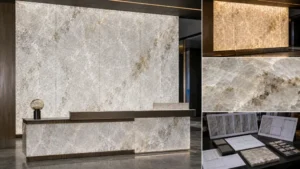
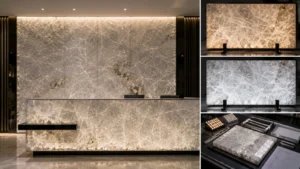
Backlit Cristallo Quartzite should not be approved only with the LEDs switched on. With backlighting on, transmitted light can make translucent crystalline areas luminous and increase contrast between transparent and opaque mineral zones. With the backlight off, the stone is viewed mainly through reflected daylight or ambient light, so its natural base color, grey areas, mineral structure, fissures, seams, slab variation, and layout become more important. For visually critical projects, review the actual Cristallo Quartzite in at least two conditions—backlight off and backlight on—and consider a separate daytime-on versus evening-on review when ambient light changes significantly.
Cristallo Quartzite is often selected for backlit feature walls, bars, reception counters, islands, and other architectural surfaces because portions of the natural stone can transmit light through its crystalline structure.
But a successful backlit installation has two identities.
There is the dramatic appearance when the lighting system is switched on—and there is the natural stone surface that remains when the LEDs are switched off.
These two conditions can look surprisingly different.
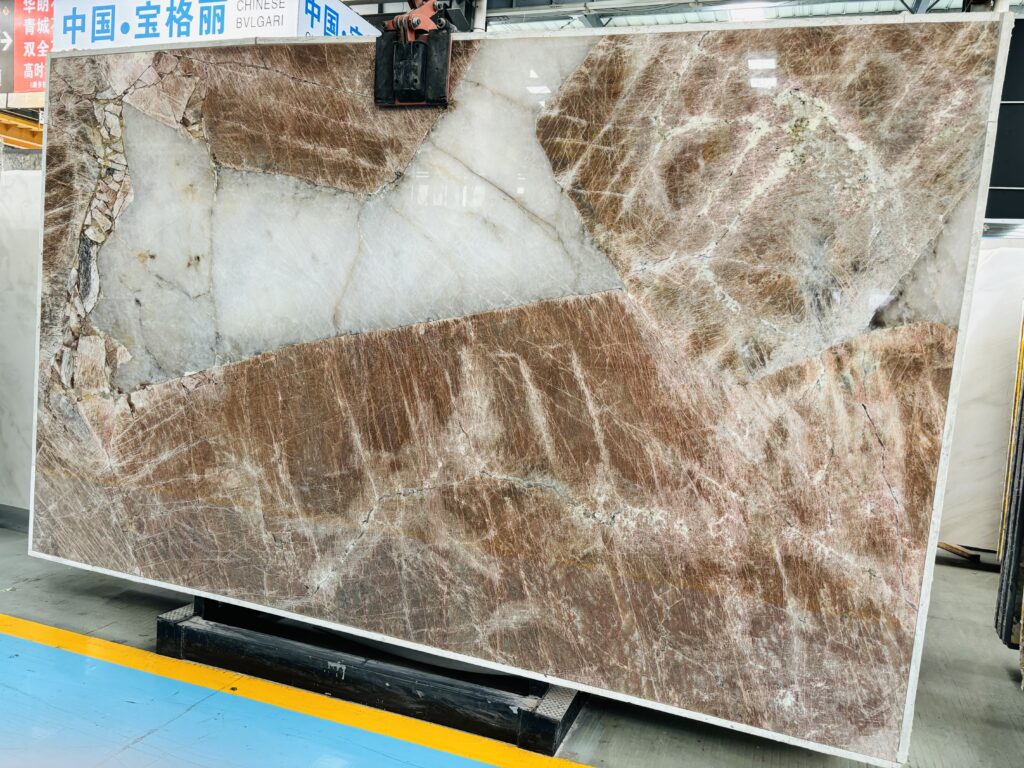
A Cristallo slab that appears luminous, layered, and highly crystalline under transmitted light may reveal a different balance of milky white areas, pale grey mineral structure, opaque zones, natural fissures, darker inclusions, seams, and slab-to-slab variation under daytime ambient light.
This leads to an important project rule:
Approving the backlit effect is not the same as approving Cristallo Quartzite with the backlight off.
For a project that will be seen during both day and night, both conditions matter.
Why Does Cristallo Quartzite Look Different with the Backlight Off?
Because the way light reaches the viewer changes.
When Cristallo Quartzite is backlit, part of the visual effect comes from light transmitted through translucent portions of the stone.
When the backlighting is switched off, the viewer sees the stone mainly through light reflected from its surface and surrounding environment.
The simplest distinction is:
Backlight ON = Transmitted Light + Reflected Light Backlight OFF = Mainly Reflected Ambient Light
This changes which geological features dominate the appearance.
Highly translucent crystalline areas can become luminous when illuminated from behind. More opaque minerals can interrupt that transmission and appear comparatively darker.
Once the backlight is switched off, those same regions are no longer being defined primarily by how much light passes through them. Their surface color, mineral structure, contrast, finish, and relationship with surrounding daylight become more important.
The stone has not changed. The lighting path has.
Transmitted Light vs Reflected Light: What Changes?
This distinction is central to understanding a translucent Natural Quartzite installation.
Review Point
Backlight On
Backlight Off / Daytime
Main Visual Light
Combination of transmitted and reflected light
Primarily reflected ambient or daylight
Translucent Crystal Zones
Can appear luminous, deeper, and visually dominant
Read more as natural crystalline mineral structure
Opaque Areas
May appear as darker islands or silhouettes against illuminated areas
May integrate more naturally into the overall slab pattern
Grey Mineral Structure
May be visually altered by transmitted light and LED color temperature
Often becomes more important to the natural daytime appearance
Natural Fissures
Can become strongly outlined where light transmission changes
Read through surface reflection, texture, and mineral contrast
Overall Contrast
Can become dramatic because translucency varies across the stone
Depends more strongly on natural slab color and ambient lighting
Primary Approval Question
Do we approve the luminous effect?
Do we approve the stone as a natural architectural surface?
cristallo-quartzite-lights-on-vs-lights-off
What Does “Daytime Approval” Mean for Backlit Cristallo Quartzite?
Daytime approval means reviewing Cristallo Quartzite with the decorative backlighting switched off under the project’s intended daytime ambient-light conditions.
It does not necessarily mean placing the slab in direct sunlight.
The relevant viewing condition might be:
Natural daylight entering through windows
Indirect daylight in a lobby
Daylight combined with general interior lighting
Artificial ambient lighting in an interior with little natural daylight
A project-relevant mock-up that approximates the final daytime environment
The purpose is to answer a different question from the backlighting test:
Will the client still approve this Cristallo Quartzite when it is functioning as stone rather than as a luminous feature?
What Should You Look for with the Cristallo Backlight Off?
A lights-off review should not be treated as simply looking at whether the slab is still “beautiful.”
The buyer, designer, or project team should review specific visual conditions.
1. Natural Base Color
Without transmitted light, the natural white, milky, pale grey, ivory, or other mineral tones become the primary color information.
A slab that looked almost luminous white when backlit may appear greyer or warmer when the LEDs are off.
2. Crystalline Structure
Cristallo’s crystalline areas remain visible without backlighting, but their visual depth changes.
Instead of appearing illuminated from within, they are read through surface reflection and natural mineral contrast.
3. Opaque Mineral Zones
Opaque areas deserve particular attention.
Under backlighting they may create strong dark contrast because less light passes through them. With the lights off, those areas may become more integrated with the overall stone pattern—or they may remain visually prominent because of their natural color.
4. Grey and Dark Mineral Features
Backlighting can change the perceived hierarchy of darker mineral structures.
A daytime review shows whether grey or darker areas are acceptable when they are viewed as part of the natural stone rather than as silhouettes against a luminous background.
5. Natural Fissures and Mineral Boundaries
Transmitted light can emphasize internal transitions that are less noticeable under ordinary front lighting.
The project should therefore review these features in both conditions rather than assuming one represents the other.
6. Slab-to-Slab Variation
If several Cristallo slabs are installed together, compare their natural base colors with the backlighting off.
Two slabs may produce similar luminous effects but still have visible differences in their unlit background tone.
7. Seams and Joints
A seam that becomes visually secondary when the entire wall is glowing may become more noticeable in daylight.
Joint position, vein direction, slab sequence, and adjacent mineral structures therefore remain important even when the primary design concept is backlighting.
Why Opaque and Translucent Areas Need Separate Review
One of the defining visual characteristics of Cristallo Quartzite is that translucency is not necessarily uniform across the slab.
Different areas can contain different mineral structures and transmit different amounts of light.
Under backlighting, this can create a dramatic composition:
More Translucent Area → More Light Transmission More Opaque Area → Less Light Transmission
But this should not be confused with the stone’s daytime color composition.
An opaque area that looks very dark during backlighting may have an attractive natural mineral character when viewed with reflected daylight.
Conversely, a highly translucent zone that dominates the illuminated design may become visually quieter with the lights off.
This is why the buyer should evaluate both:
Where does the slab transmit light?
and:
What does that same area look like when it does not?
cristallo-quartzite-opaque-vs-translucent-zones
Lights On vs Lights Off: Which Condition Should Control Approval?
Neither condition should automatically replace the other when the project will regularly be seen in both states.
A backlit bar may operate with the LEDs on throughout service hours, making the illuminated condition dominant.
A residential feature wall may remain unlit for most of the day and become illuminated only in the evening.
A hotel lobby may experience strong daylight during the day, artificial ambient light in the evening, and backlighting throughout both periods.
The approval priority should therefore follow the real use pattern.
Project Condition
What You Are Approving
Key Review Points
Backlight Off — Daytime
Natural stone appearance
Base color, slab matching, mineral structure, seams, joints, fissures, layout
Backlight On — Daytime
Backlighting effect under stronger ambient light
Visible translucency, brightness balance, contrast, hotspot control
Backlight On — Evening / Low Ambient Light
Maximum luminous feature effect
Brightness, LED uniformity, dark zones, luminous contrast, atmosphere
For many premium projects, these are three separate visual approval conditions—not one.
Why Daylight Can Change the Appearance of Cristallo Quartzite
Daylight is not a single fixed lighting condition.
The amount, direction, and character of natural light in an interior can change throughout the day.
A Cristallo installation near large glazing may therefore appear different in the morning, afternoon, and evening even before the backlighting system is switched on.
Factors include:
Window orientation
Distance from glazing
Direct versus indirect daylight
Cloud conditions
Interior wall and ceiling colors
Adjacent materials
Artificial room lighting operating during daytime
The goal is not to approve every possible lighting condition.
The goal is to identify the conditions that matter to the actual project and make sure the approval is not based only on a dramatic dark-room photograph.
Should Cristallo Be Approved in Direct Sunlight?
Not necessarily.
If the installed stone will never receive direct sunlight, a direct-sunlight test may not represent the intended project condition.
The more useful approach is to reproduce or approximate the expected viewing environment.
For example, a reception wall located ten meters from glazing may primarily receive diffuse ambient daylight. A mock-up reviewed in strong direct sun would answer a different question.
Project-relevant lighting is more useful than simply choosing the brightest available daylight.
Why the Actual Slab Matters More Than a Small Cristallo Sample
A small sample can show color, crystal structure, and some degree of translucency, but it cannot necessarily represent the distribution of features across a full slab.
A full Cristallo slab may contain:
Large translucent crystalline zones
More opaque mineral masses
Pale grey areas
Warm ivory transitions
Natural fissures
Localized darker mineral features
Changes in translucency across the slab
These variations affect both backlit and unlit appearance.
For visually important work, approval should therefore progress from:
Small Sample → Actual Slab → Proposed Cutting Layout → Project Mock-Up Where Required.
Should the Cutting Layout Be Reviewed with the Lights Off?
Yes, when the unlit daytime appearance is important to the project.
Backlighting can strongly influence where the eye is drawn, but the same layout must also function when the stone is not illuminated.
Review:
Vein and mineral movement
Orientation
Slab sequence
Seam positions
Bookmatched or mirrored relationships where applicable
Opaque zones
Highly translucent zones
Visible edge returns
Cut-outs
A cutting layout optimized only for the illuminated condition may not provide the preferred visual balance during daytime.
How Do Seams Read Differently Without Backlighting?
Seams interrupt both the physical slab and the visual mineral movement.
With backlighting on, strong transmitted light can dominate the viewer’s attention. Depending on the design, the seam may appear secondary—or it may become more obvious if light levels differ across the joint.
With the backlighting off, the seam is viewed against the natural surface color and pattern.
The project should therefore consider:
Whether mineral movement crosses the joint logically
Whether adjacent slabs have compatible daytime color
Whether the joint interrupts a major crystal zone
Whether one panel is naturally greyer or warmer than the next
Whether the seam position works in both lighting states
This is particularly important on large feature walls and long reception or bar fronts assembled from several stone pieces.
Does Surface Finish Matter in a Lights-Off Review?
Yes.
Surface finish influences how light is reflected from the face of the stone.
A polished surface can create stronger reflections and visual depth, while a honed or lower-sheen finish changes the way ambient light spreads across the surface.
For this reason, a daytime approval should use the intended project finish wherever practical.
Approving a polished sample and then fabricating a different finish introduces another variable into the visual result.
Daytime Approval vs Backlighting Approval
These should be treated as related but distinct decisions.
Approval Type
Main Question
Typical Evidence
Daytime / Lights-Off Approval
Do we approve the natural stone appearance without decorative backlighting?
Actual slab, slab photographs, layout, project-relevant ambient-light review
Backlighting Approval
Do we approve the illuminated effect?
Actual stone, LED system, CCT, cavity depth, diffuser, brightness, mock-up
Layout Approval
Do the selected slab areas and joints work as one composition?
A signature on one condition should not automatically be interpreted as approval of all three unless the project record explicitly says so.
Worked Example: Cristallo Quartzite Feature Wall
Consider a hypothetical Cristallo Quartzite feature wall for a luxury residential living area.
The selected slabs contain large milky-white crystalline areas, pale cool-grey mineral zones, subtle ivory variation, and a limited number of darker natural mineral features.
Review 1 — Backlight On in Low Ambient Light
The large crystal areas become luminous. Some pale-grey zones transmit less light and create internal contrast. Darker mineral features become stronger visual accents.
The client approves the dramatic illuminated effect.
Review 2 — Backlight Off During Daytime
With the LEDs switched off, the wall no longer reads primarily as a luminous surface.
The natural pale-grey structure becomes more noticeable. The difference between adjacent slabs is easier to judge through their base color rather than their translucency. Seams and mineral movement become more important to the composition.
The project team adjusts the proposed slab sequence before fabrication.
Review 3 — Backlight On During Daytime
The same LED output now competes with stronger ambient daylight.
The luminous effect is more restrained than it was in the evening review.
This does not mean the lighting system has failed. It means the surrounding illumination has changed the visual hierarchy.
The three reviews answer three different questions.
Common Cristallo Daytime Approval Mistakes
Common Mistake
Why It Matters
Better Approach
Approving only a dramatic backlit photograph
It does not show the normal unlit stone appearance
Review lights-on and lights-off conditions separately
Using only a small sample
It may not represent full-slab mineral distribution or translucency
Review actual slabs before final layout approval
Ignoring opaque areas
Their appearance can change substantially between transmitted and reflected light
Evaluate the same areas both on and off
Reviewing daytime appearance in unrealistic direct sunlight
The condition may not represent the installed environment
Use project-relevant ambient lighting
Approving the layout only with backlighting on
Seams and slab color relationships may read differently when unlit
Check the final layout in both conditions
Assuming daytime-on and evening-on are identical
Ambient-light level changes the perceived strength of the backlighting
Review both where the project experience depends on them
Cristallo Quartzite Lights-Off Approval Checklist
Before final fabrication or installation approval, review the following where relevant:
Actual Slab: Is the review based on the selected project slab rather than only a generic sample?
Daytime Condition: Does the review approximate the project’s intended ambient-light environment?
Backlight Off: Has the natural stone appearance been approved without decorative illumination?
Base Color: Are the natural white, grey, ivory, or other tones acceptable?
Crystal Structure: Does the unlit crystalline movement suit the design?
Opaque Zones: Are less-translucent mineral areas acceptable when viewed naturally?
Dark Features: Are darker mineral structures positioned appropriately?
Natural Fissures: Have visually significant natural features been reviewed?
Slab Matching: Do adjacent slabs coordinate when the backlight is off?
Vein Direction: Is the mineral movement oriented as intended?
Seams: Do joint positions work in the unlit composition?
Finish: Is the review using the intended surface finish?
Layout: Has the cutting proposal been reviewed in both illuminated and unlit conditions?
Daytime Backlight: If relevant, has the lighting effect also been checked against daytime ambient light?
Evening Backlight: Has the intended low-ambient-light effect been reviewed?
Approval Record: Are the approved conditions clearly documented?
cristallo-quartzite-final-daytime-approval-mockup
Buyer FAQ
1. Why should Cristallo Quartzite be reviewed with the lights off?
Because backlighting changes how the stone is perceived. With the LEDs on, transmitted light can make crystalline areas luminous and increase contrast with opaque zones. With the backlight off, reflected ambient light reveals the stone’s natural base color, mineral structure, seams, fissures, and slab variation more directly.
2. What does daytime approval mean for backlit Cristallo Quartzite?
Daytime approval means reviewing the stone with decorative backlighting switched off under the intended daytime ambient-light condition. It does not necessarily mean direct sunlight. The goal is to approve the Cristallo as a natural architectural surface in the environment where it will actually be seen.
3. Can I approve Cristallo Quartzite from a backlit slab photo?
A photograph can be useful for preliminary review, but a backlit image does not fully represent the slab’s unlit appearance. For visually important projects, review current slab images without backlighting and, where practical, the actual slab or a project-relevant mock-up.
4. Do opaque areas look different when the backlight is off?
They can. An opaque mineral area may appear strongly dark against illuminated translucent stone when the backlight is on, but its natural color and mineral character may integrate differently into the slab when viewed under reflected daylight.
5. Should the cutting layout be approved with Cristallo backlighting off?
Yes when daytime appearance matters. Vein direction, slab sequence, seams, base-color variation, opaque zones, and mineral movement can read differently without transmitted light, so the layout should work in both illuminated and unlit conditions.
6. Is backlight-on daytime approval different from nighttime approval?
It can be significantly different. Strong ambient daylight competes with the illuminated stone, while low evening ambient light can make the same backlighting appear much more dramatic. Projects that depend heavily on both experiences should review both conditions.
7. Does every Cristallo Quartzite slab have the same daytime appearance?
No. Cristallo Quartzite is natural stone, and slabs can vary in base color, crystal structure, grey or ivory areas, darker minerals, fissures, and translucency. Actual slab review is therefore important for visually sensitive projects.
8. Which Cristallo Quartzite lighting conditions should be approved?
For a project used throughout the day and evening, consider three conditions: backlight off during daytime, backlight on during daytime, and backlight on under evening or low ambient light. The exact approval sequence should reflect how the finished installation will actually be used.
Final Note
A successful Cristallo Quartzite backlighting project should work when the lights are on and when they are off. Backlighting reveals the stone through transmitted light; daytime lights-off review reveals it primarily through reflected ambient light. These conditions can emphasize different crystalline zones, opaque minerals, grey areas, fissures, seams, and slab relationships. For that reason, backlighting approval should not automatically be treated as daytime stone approval. Review the actual slabs, the proposed layout, and the project-relevant lighting conditions before final fabrication so that both the luminous feature and the natural stone surface are intentionally approved.
Copyright (c) HRST STONE / XIAMEN HRST STONE CO., LTD.
Hi, I am the author of this article. I have been working in the field of Natural Stone for more than 15 years. If you need customized Natural Stone services, please feel free to contact me.