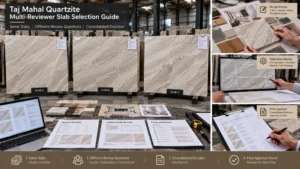
Quartzite Slab Ownership and Storage: What Happens After Reservation?
Post navigation
Quick Summary
Reserving Natural Quartzite slabs does not by itself answer who owns them, who is responsible for storage, whether storage is included, who may access or move the material, or whether fabrication can begin. After reservation, keep the exact board numbers connected to a written commercial status, physical storage location, access record, current drawings, production-release status, and final disposition. Ownership, payment, storage cost, insurance, cancellation, and liability should follow the actual quotation, purchase order, invoice, contract, or other governing project documents rather than assumptions based on the word “reserved.”
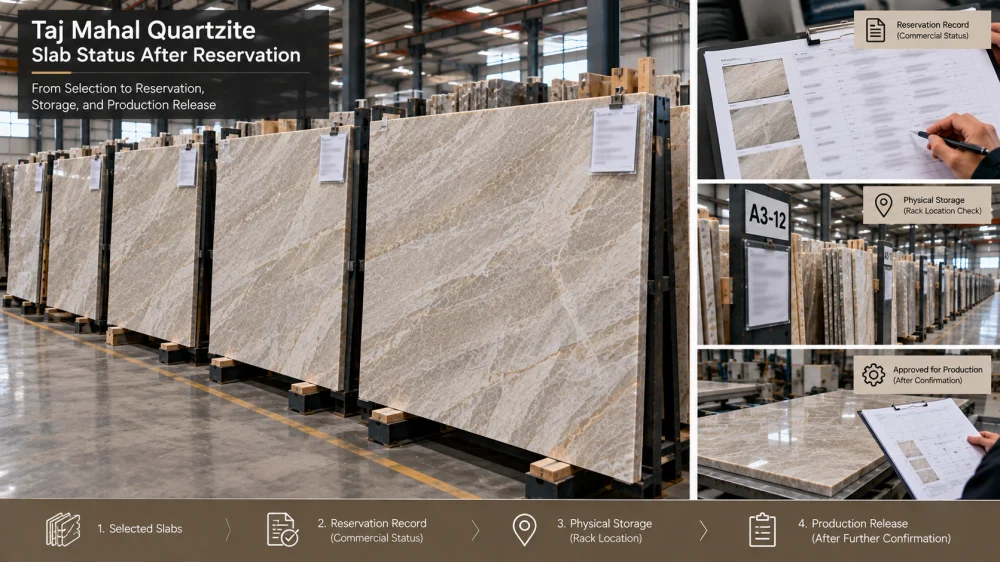
Taj Mahal Quartzite → Board IDs → Current Photos → Project → Reservation Status
What Changes When Payment Is Made?
Payment is an important commercial event, but a stone article should not invent the legal consequences of a deposit, partial payment, full payment, invoice, purchase order, or other transaction.
Instead, the buyer should ask what the applicable project documents say about:
when title or ownership transfers, if addressed;
what payment secures the identified slabs;
whether the slabs remain physically at the supplier or factory;
whether storage is included;
whether any storage period applies;
who may authorize movement or fabrication;
what happens if the project is cancelled or delayed; and
what document records any later change.
Buyer Checkpoint
Do not replace the actual commercial wording with assumptions such as “deposit paid = buyer owns the slabs” or “full payment = unlimited free storage.” Keep the payment record, material status, ownership question, and storage arrangement separately identifiable.
Physical Custody Does Not Automatically Define Ownership
A purchased or commercially confirmed slab may remain physically inside a supplier’s warehouse or fabrication facility.
Conversely, a slab may be temporarily held in a warehouse without the buyer having completed a purchase.
The warehouse record should state what it can actually establish:
Board ID → Physical Location → Date Checked → Current Physical Status
Questions about legal title, risk, liability, insurance, or contractual responsibility should be answered from the applicable transaction documents and appropriate responsible parties.
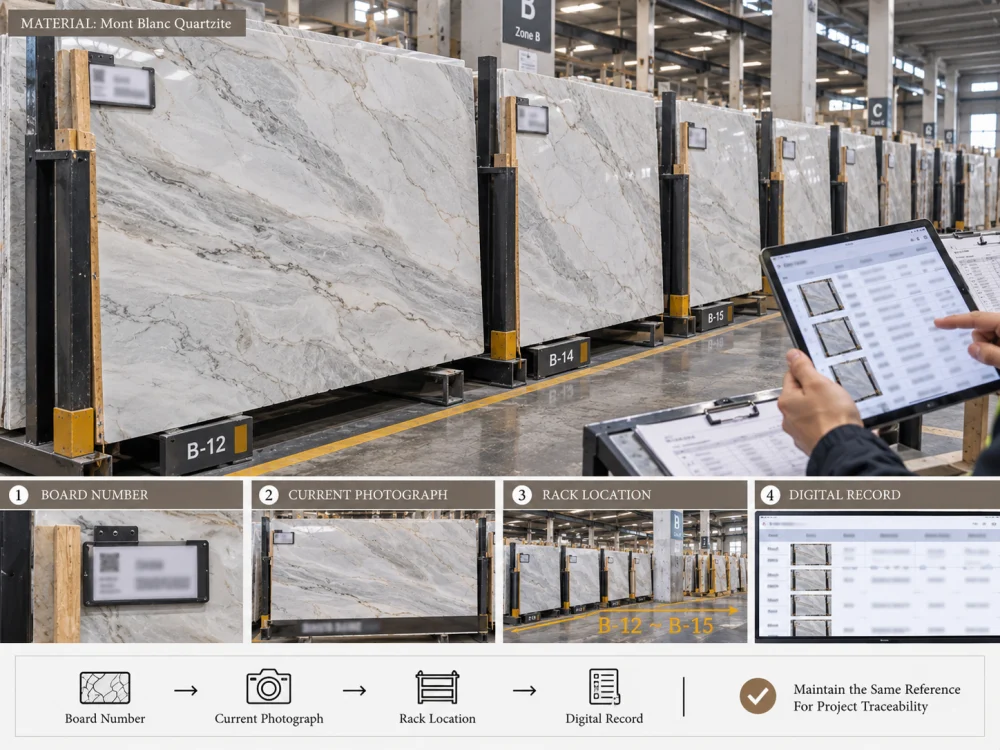
Create a Storage Record for Reserved or Purchased Slabs
Once identified Quartzite remains at a warehouse or factory beyond initial selection, its physical location should remain traceable.
A practical storage register can include:
Storage Field
Purpose
Board Number
Preserves physical slab identity
Project Reference
Connects the material to the correct order or project
Storage Location
Records warehouse, rack, bay or another controlled location system
Current Status
Shows whether the slab is reserved, commercially confirmed, awaiting layout, released or under another defined status
Last Physical Check
Provides a dated warehouse reference
Current Photograph
Helps connect the digital record to the physical material
Next Action
Shows whether the project awaits payment, layout, drawing approval, fabrication release, packing or another action
The exact warehouse coding system can vary.
The important principle is that the digital record and physical slab remain connected.
Storage Location Should Follow the Slab When It Moves
Slab Warehouse → Inspection Area → Layout Area → Fabrication Area → Finished-Piece QC → Packing Area
If the project relies on traceability, the record should not continue saying “Rack A” after the slab has moved to fabrication.
When location changes, update:
board number;
new physical location;
date of movement;
current processing status;
related drawing or layout reference where applicable; and
next controlled action.
This is particularly useful when several visually similar slabs are being handled at the same time.
Ask Whether Storage Has a Time or Cost Condition
A reservation period and a storage period are not necessarily the same thing.
For example, a buyer may reserve slabs while deciding whether to proceed.
Later, the slabs may become part of a confirmed order but remain physically at the factory because:
shop drawings are unfinished;
site dimensions are pending;
another trade must complete work first;
the construction schedule has moved;
fabrication is deliberately postponed; or
shipment is planned for a later phase.
At that point, ask separately:
Reservation period: How long are the slabs being held before commercial confirmation?
Post-purchase storage: What storage arrangement applies after the relevant commercial milestone?
Do not assume that the expiry date of one automatically defines the other.
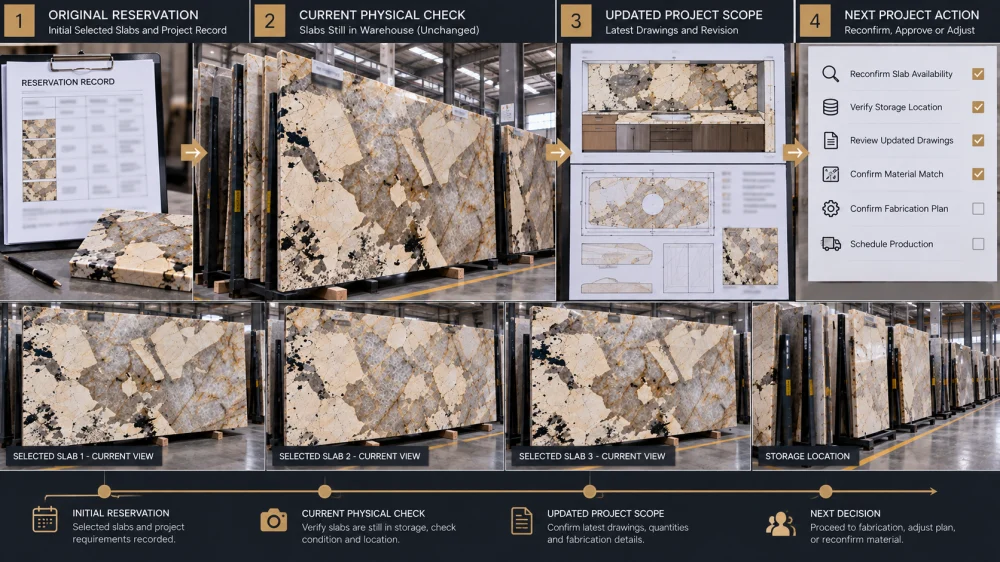
Long Project Delays Need a New Status Review
If a project is delayed substantially, do not rely indefinitely on an old reservation email.
Reconfirm the current record.
DELAY REVIEW
Original Slab Reservation
↓
Current Board Numbers Confirmed
↓
Commercial Status Confirmed
↓
Current Physical Location Checked
↓
Storage Arrangement Reviewed
↓
Latest Drawing / Quantity Checked
↓
Next Project Action Confirmed
A delayed project may also have changed dimensions, quantities, seam positions, finish requirements or destination information.
Material still being physically present does not prove that the original project scope remains current.
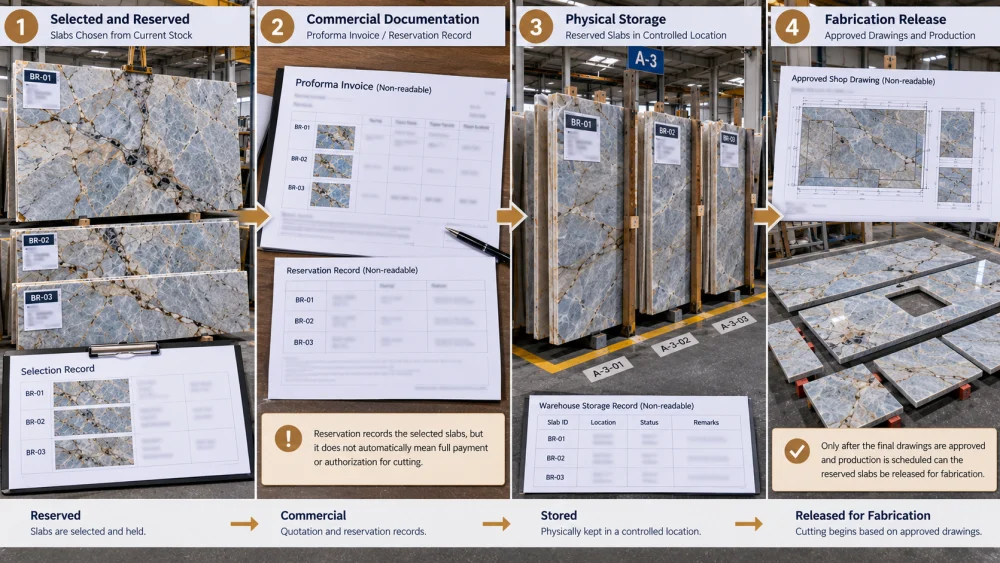
Reservation Still Does Not Mean “Cut the Slab”
This is one of the most important controls in a Quartzite project.
A reservation identifies material being held.
A production release authorizes fabrication against an approved project basis.
Between those two stages, the team may still need to confirm:
final dimensions;
shop drawing revision;
cutouts;
edge profiles;
seams;
waterfall relationships;
visible faces;
vein or mineral direction;
actual slab layout;
usable yield;
piece quantities; and
commercial approval.
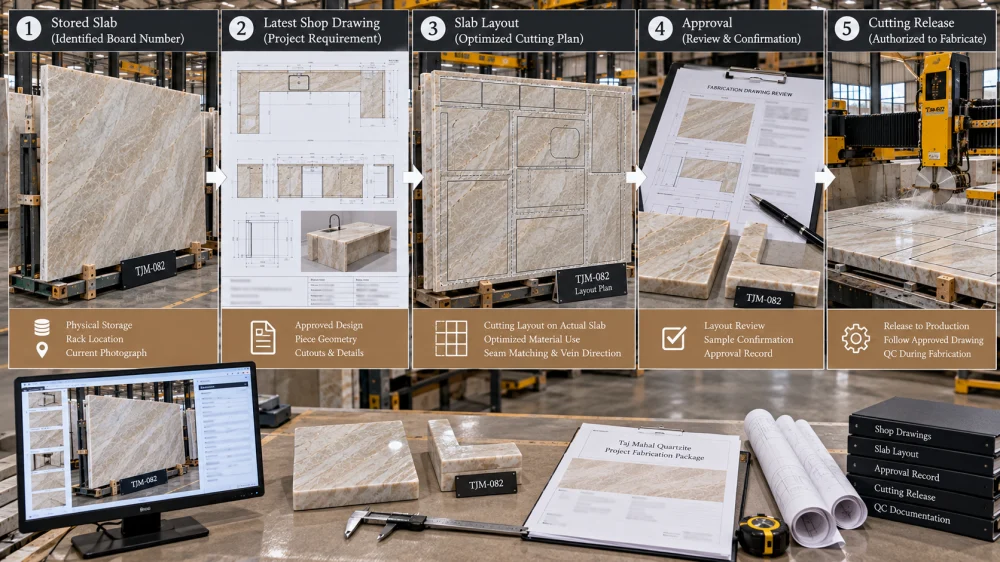
The correct chain is:
taj-mahal-quartzite-storage-to-production-release
Slab Selected → Slab Reserved → Commercial Status Confirmed → Layout Approved → Production Release → Cutting
Do not collapse the middle stages simply because the correct slabs are already sitting in the factory.
What If the Drawing Changes While the Slabs Are Stored?
The slab identity may remain unchanged while the project geometry changes.
Suppose three reserved slabs originally supported:
one kitchen island;
two waterfall ends;
perimeter countertops; and
backsplash pieces.
If the island becomes longer or another finished component is added, the project should recheck whether those same stored slabs still provide sufficient usable material.
Do not assume:
Slabs Still Stored = Original Layout Still Valid.
Where the change affects geometry, reconnect the latest drawing to the actual board numbers and recheck layout, yield, visual placement and affected approvals before cutting.
Who Can Access or Move the Stored Slabs?
This question is often overlooked.
For long-running projects, useful operational questions include:
Who may request the slabs to be moved for inspection?
Who may request new photographs?
Who can approve a substitution?
Who can authorize cutting?
Who can authorize packing or shipment?
Who should be informed if the storage location changes?
The answers depend on the project.
The important control is to prevent an informal request from being mistaken for a formal production instruction.
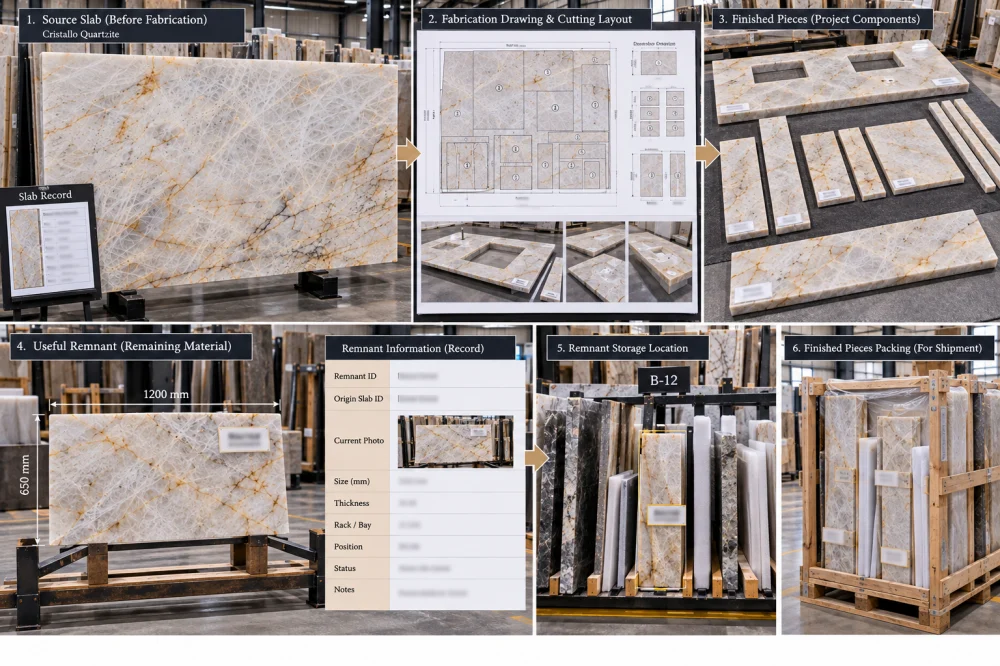
What Happens to the Stone Left After Fabrication?
Ownership and storage questions do not necessarily end when the main pieces are cut.
If the commercial arrangement involved purchasing a complete slab and only part becomes finished components, there may be remaining stone.
Ask:
Is the remaining material part of the buyer’s purchased scope?
Should useful pieces be fabricated into spares?
Should the remaining material be packed and shipped?
Will any useful remnant remain in storage?
How will retained remnants be identified?
Is there an agreed storage period?
Does later packing or shipment require a separate arrangement?
The answer should come from the commercial arrangement rather than from an assumption that every offcut automatically belongs to one party.
Do Not Let Purchased Remnants Become Anonymous
If a useful remaining section is intentionally retained, give it a traceable identity while its relationship to the original slab is still known.
A remnant register is a traceability tool, not proof that the material is still available or suitable for a future component. The physical piece should be rechecked when reuse is actually proposed.
From Stored Slab to Shipment: Keep One Identity Chain
The strongest project record does not stop at the warehouse.
It carries the material identity forward:
Reserved Board Number
↓ Commercial Status
↓ Storage Location
↓ Approved Cutting Layout
↓ Production Release
↓ Finished Piece IDs
↓ QC Record
↓ Crate / Packing Reference
↓ Shipment / Receiving Record
This prevents the project from having excellent slab-selection records at the beginning but losing traceability once fabrication starts.
Quartzite Slab Ownership and Storage Checkpoint
AFTER SLAB RESERVATION
□ Exact board numbers recorded
□ Current slab photographs linked
□ Reservation status recorded
□ Reservation expiry / review point recorded where applicable
□ Commercial / payment status kept separate
□ Ownership question checked against governing documents where relevant
□ Current physical storage location recorded
□ Storage time / cost conditions clarified where applicable
□ Access / movement authority understood
□ Current drawing revision connected to the slabs
□ Layout approval kept separate from reservation
□ Production release recorded before cutting
□ Remaining material disposition clarified
□ Retained useful remnants assigned traceable IDs
□ Piece and packing traceability continues after fabrication
FAQ
1. Does reserving Quartzite slabs mean I own them?
Not automatically. A reservation identifies material being held under an agreed project arrangement, but ownership or title should be determined from the applicable quotation, purchase order, invoice, contract, payment terms, or other governing documents. Do not infer ownership from the word “reserved” alone.
2. If I pay a deposit, do the reserved Quartzite slabs become mine?
Do not assume that a deposit creates the same ownership result in every transaction. Confirm what the applicable commercial documents say about payment, material allocation, title or ownership where addressed, cancellation, storage, and release.
3. Can purchased Quartzite slabs remain stored at the supplier’s factory?
They may remain physically at a supplier or fabrication facility under an agreed arrangement, but the applicable storage period, cost, access, handling, insurance, risk, and other responsibilities should be confirmed for the actual transaction rather than assumed.
4. Is slab reservation the same as approval to start cutting?
No. Reservation identifies the material being held, while production release authorizes fabrication against the approved project information. Final drawings, layout, dimensions, seams, cutouts, edges, visual placement, quantity, and commercial approvals may still need to be completed before cutting.
5. What happens if my project is delayed after the slabs are reserved?
Recheck the reservation or commercial status, board numbers, physical location, applicable storage arrangement, current drawings, quantities, and next required approval. Do not assume an old reservation message continues indefinitely or that the original project geometry remains valid.
6. Who owns the Quartzite left after my pieces are fabricated?
Do not assume ownership of the remaining material from the cutting result alone. The quotation or other commercial record should clarify whether unused material is shipped, fabricated into spares, retained, stored, or handled under another agreed arrangement.
7. Should stored Quartzite slabs keep their board numbers?
Yes, where slab-specific traceability matters. Keep the physical board identifier connected to current photographs, project reference, storage location, drawing or layout record, and production status until the slab is fabricated or otherwise released from the project record.
8. What should be recorded before stored Quartzite slabs are released for fabrication?
Confirm the exact board numbers, current drawing revision, finished dimensions, required pieces, layout, visible faces, seams, cutouts, edges, orientation, quantity, relevant approvals, and production-release status before irreversible cutting begins.
Final Control RuleDo not let Reserved, Purchased, Stored, and Released for Fabrication become interchangeable project labels. Keep the chain visible: Identified Slab → Reservation Status → Commercial Status → Physical Custody / Storage → Current Drawing → Layout Approval → Production Release → Finished-Piece Traceability → Remaining Material Disposition.
For project-based Natural Quartzite orders, HRST STONE can coordinate current slab identification, reservation records, slab photographs, CAD/shop drawings, cutting layouts, production records, QC photographs, piece identification, and export packing around the confirmed order scope. Send Josh the material name, board numbers where available, quantity, drawings, finish, current reservation or order status, required fabrication scope, project schedule, and delivery destination so the stone-related project record can be reviewed before the next production stage.
Hi, I am the author of this article. I have been working in the field of Natural Stone for more than 15 years. If you need customized Natural Stone services, please feel free to contact me.