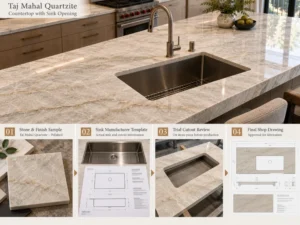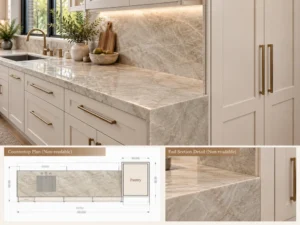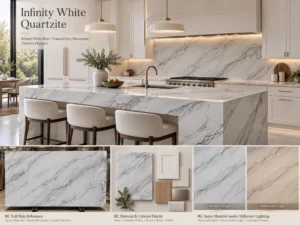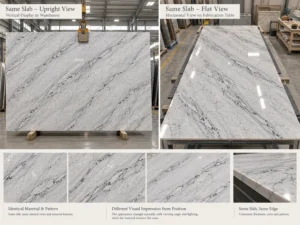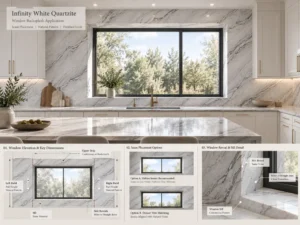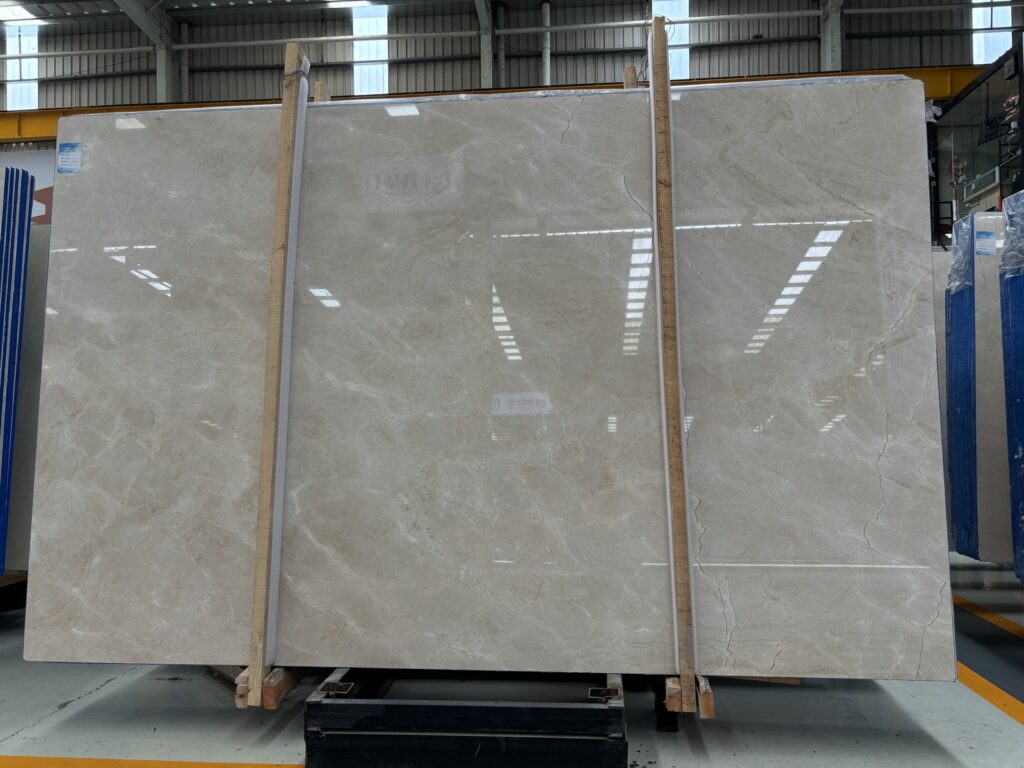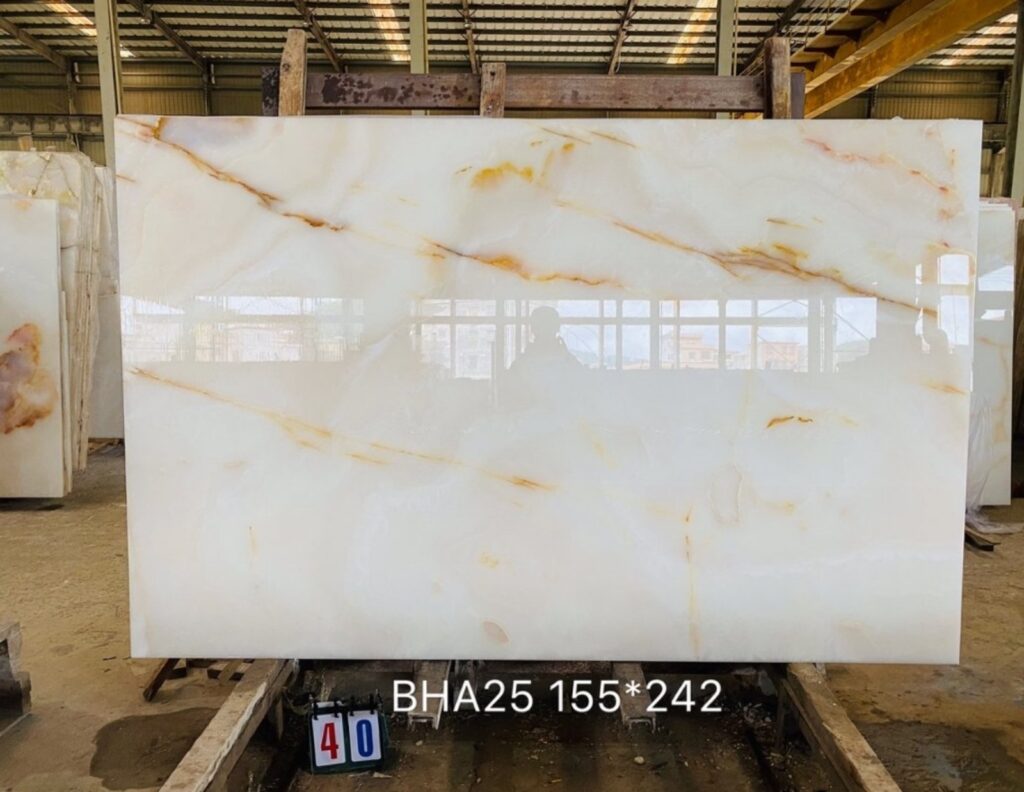

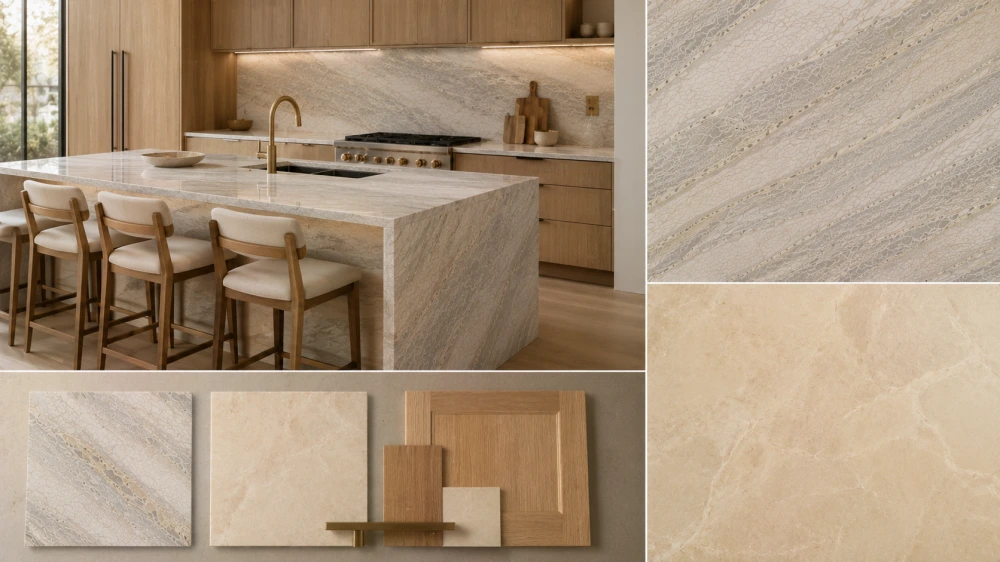
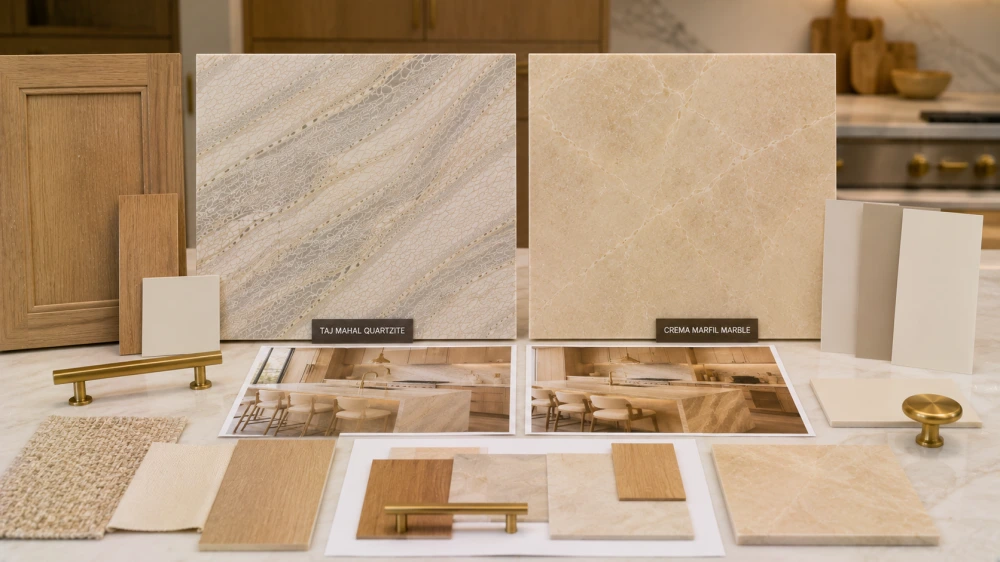
Taj Mahal Quartzite is usually the stronger choice for a warm-toned kitchen when the goal is a soft cream-to-greige natural stone appearance combined with the typical durability advantages of true quartzite. Crema Marfil Marble creates a warmer, more traditional cream-beige look but, as a marble, is more susceptible to acid etching and surface wear. Taj Mahal often pairs especially well with white oak, warm white, greige, and walnut cabinetry, while Crema Marfil suits kitchens seeking a more classic beige-marble character. The final choice should still be based on actual slab selection, finish, lighting, fabrication requirements, and the owner’s maintenance expectations.
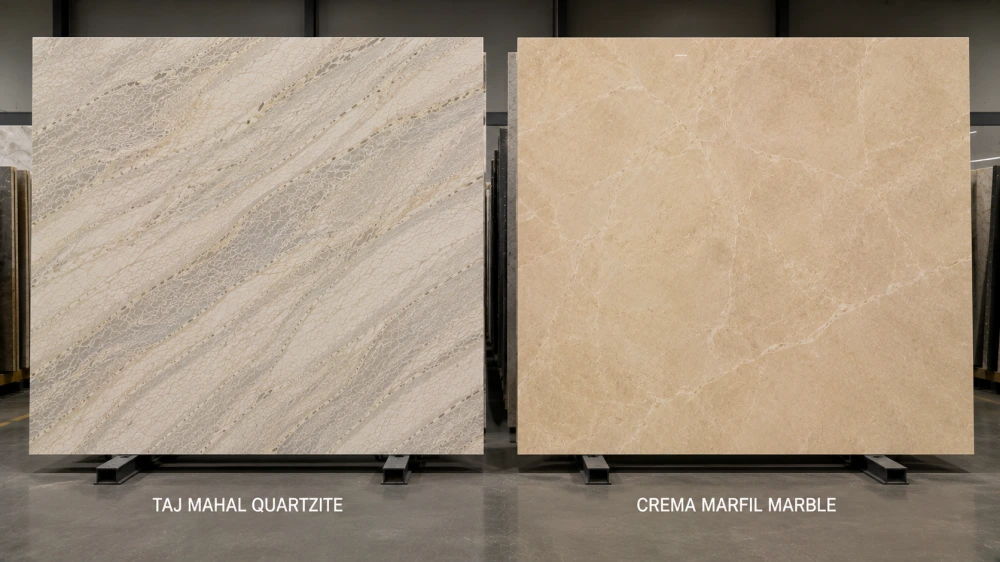
Taj Mahal Quartzite and Crema Marfil Marble can both create elegant warm-toned kitchens, but they achieve that look in very different ways.
Taj Mahal Quartzite is typically selected for its restrained cream, light beige, greige, taupe, and soft-grey movement. It can bridge warm wood cabinetry and contemporary neutral interiors without making the kitchen feel strongly yellow or traditionally beige.
Crema Marfil Marble usually creates a more recognizably creamy beige marble appearance. Its warmer beige and sometimes honey-toned character works naturally in classic, Mediterranean, transitional, and traditional luxury interiors.
The choice is therefore not simply about which stone is more attractive. Buyers should compare undertone, pattern, cabinet color, daily kitchen use, acid sensitivity, surface finish, slab variation, fabrication, and maintenance expectations.
| Comparison | Taj Mahal Quartzite | Crema Marfil Marble |
| Overall Color | Warm cream, light beige, greige, taupe and soft grey | Cream, beige and warmer honey-beige tones |
| Visual Character | Layered, cloudy, softly flowing and sometimes subtly crystalline | Classic marble character with softer veins, tonal variation and beige movement |
| Typical Design Direction | Warm modern, organic luxury, transitional and contemporary | Classic, Mediterranean, traditional and warm transitional |
| White Oak Pairing | Often particularly compatible because greige and taupe can balance the wood warmth | Can work well, but stronger beige or yellow undertones require closer checking |
| Acid Sensitivity | True quartzite is generally less acid-sensitive than calcitic marble; actual material should be verified | Marble is susceptible to etching from common kitchen acids |
| Scratch / Wear Resistance | True quartzite is generally harder and more scratch-resistant | Softer and more likely to develop wear over time |
| Maintenance Character | Suitable for buyers wanting natural stone with relatively practical kitchen performance | Better for buyers comfortable with the patina and care expectations of marble |
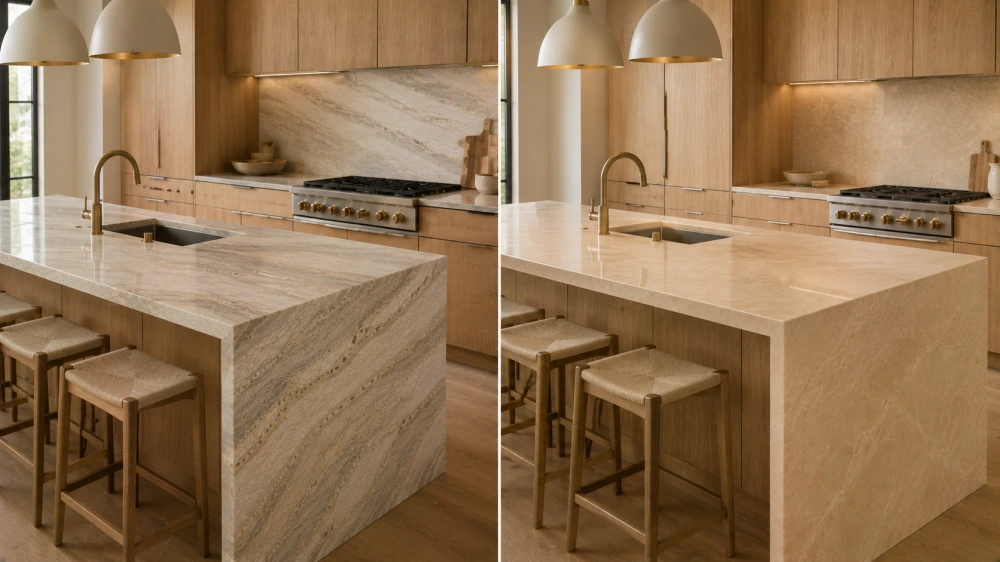
| Waterfall Island | Strong option where broad natural movement can be coordinated across mitered corners | Possible, with layout dependent on the selected slab and marble pattern |
In short: Taj Mahal Quartzite usually makes more sense when the kitchen needs a warm natural-stone appearance with stronger day-to-day practicality. Crema Marfil makes more sense when the project specifically wants classic warm beige marble and accepts the maintenance characteristics that come with marble.
Taj Mahal Quartzite is popular in warm kitchens because its color palette can sit between cream and greige rather than reading as strongly white, grey, or yellow.
Actual slabs vary, but the material commonly shows combinations of:
This restrained palette makes Taj Mahal useful when a designer wants warmth without turning the countertop into a dominant yellow-beige surface.
In a contemporary kitchen, Taj Mahal can act as a bridge between warm cabinetry, neutral wall colors, metal finishes, and natural flooring.
Crema Marfil Marble is known for its creamy beige appearance. Depending on the block and slab selection, the stone can range from relatively uniform light cream to warmer beige fields with veins, fossil-like details, tonal clouds, or darker natural markings.
Compared with Taj Mahal Quartzite, Crema Marfil usually reads more immediately as a traditional beige natural stone.
Its warmer character can work particularly well with:
For projects seeking a classic creamy marble atmosphere rather than a quieter greige-beige stone, Crema Marfil can be visually appropriate.
For most contemporary warm-toned kitchens, Taj Mahal Quartzite is often the more flexible choice.
The reason is not simply durability. Its combination of cream, beige, greige, taupe, and soft grey can coordinate with a wider range of modern warm neutrals.
Crema Marfil generally creates a warmer and more traditionally beige result. This can be desirable, but the undertone needs to be intentional.
A useful design distinction is:
Taj Mahal Quartzite → soft neutral warmth
Crema Marfil Marble → stronger creamy beige warmth
Neither direction is universally better. The correct choice depends on the cabinetry, flooring, lighting, hardware, backsplash strategy, and overall interior style.
Taj Mahal Quartzite is often easier to coordinate with contemporary white oak cabinetry.
White oak itself can contain cream, wheat, beige, tan, and subtle grey-brown undertones. A Taj Mahal slab with restrained cream, greige, and taupe movement can connect those colors without making the kitchen overly yellow.
This combination is especially effective in:
Crema Marfil can also work with white oak, but the actual sample comparison becomes more important. If both the oak and marble have strong yellow or honey undertones, the combined space may become significantly warmer than intended.
For either stone, evaluate the cabinet sample and slab under the project’s expected lighting rather than relying only on separate showroom photographs.
Both materials can work with cream cabinetry. Taj Mahal tends to create a quieter tonal transition, while Crema Marfil can produce a richer monochromatic cream-and-beige composition.
Taj Mahal Quartzite is generally easier to coordinate with greige because many slabs contain their own soft grey, taupe, and beige transitions.
A strongly warm Crema Marfil selection may create more visible contrast against a cooler greige cabinet.
Both stones can pair effectively with walnut.
Taj Mahal creates a lighter modern contrast against the deeper brown wood, while Crema Marfil can reinforce the overall warmth for a more traditional or Mediterranean-influenced interior.
The largest functional difference between the two materials comes from their geological composition.
True quartzite is a quartz-rich metamorphic stone and is generally harder and more resistant to scratching than marble.
Marble is primarily calcite-based and is softer. In a working kitchen, this means Crema Marfil can develop scratches, wear, and surface changes more readily than true quartzite.
However, commercial stone names should not replace material verification. Natural stones sold under similar trade names can vary, and the supplier or fabricator should confirm the actual material being offered for the project.
True quartzite is generally much less susceptible to acid etching than calcitic marble.
This distinction is particularly relevant in kitchens because common acidic substances include:
When acidic substances contact marble, they can react with the calcite and create a dull or lighter-looking area known as an etch mark.
Crema Marfil Marble should therefore be selected with an understanding that etching can occur during normal kitchen use.
Taj Mahal Quartzite is generally selected when the buyer wants a light warm natural stone without accepting the same level of acid sensitivity associated with marble.
That does not mean every commercially named Taj Mahal slab should automatically be treated as chemically identical. Material identity and finish should be confirmed for the actual stone being purchased.
Neither Taj Mahal Quartzite nor Crema Marfil Marble should be described as stain-proof.
Stain resistance depends on several factors, including:
Where required, an appropriate penetrating sealer can help reduce liquid absorption, but sealing does not make natural stone maintenance-free.
It is also important to distinguish staining from etching. A sealer may help with absorption-related staining, but it does not make calcitic marble immune to chemical etching from acids.
Surface finish affects both the appearance and the way normal wear is perceived.
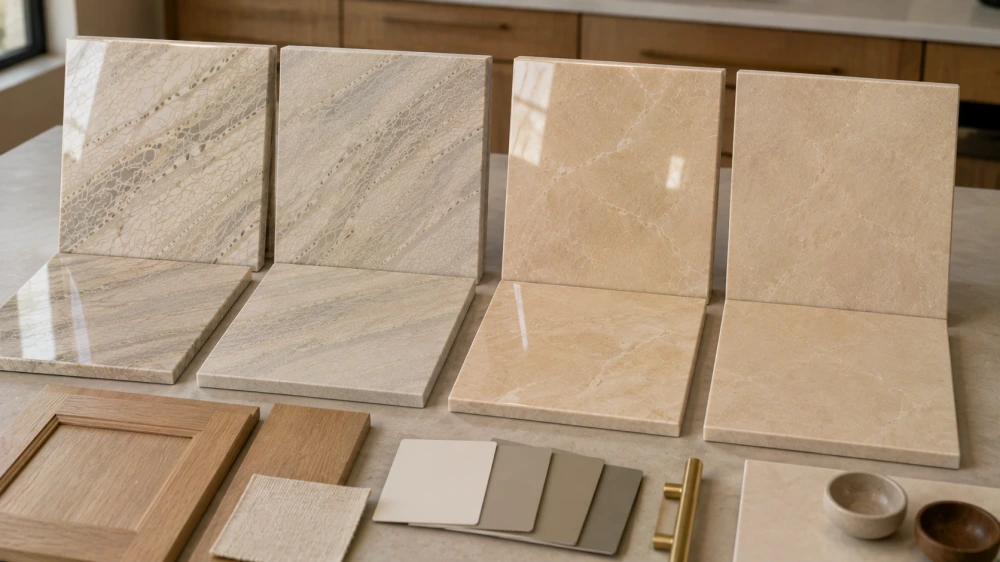
A polished finish can emphasize the stone’s depth, crystalline structure, cream-beige color transitions, and subtle mineral movement. It works particularly well in luxury kitchens where the countertop or island is intended to have stronger visual presence.
A honed finish produces a softer, lower-sheen appearance. It can suit contemporary, organic, and minimalist kitchens where the designer wants Taj Mahal to feel quieter and more architectural.
Polishing emphasizes the classic creamy marble character and can create a richer traditional appearance. However, etching can appear as dull areas against a highly reflective polished surface.
A honed finish creates a softer visual effect and may make some forms of wear less visually dramatic than on a highly polished surface. It does not eliminate marble’s underlying sensitivity to acidic substances.
| Kitchen Application | Taj Mahal Quartzite | Crema Marfil Marble |
| Main Countertops | Strong candidate for buyers prioritizing natural warmth and practical kitchen performance | Best for owners who specifically want marble and accept etching and patina |
| Full-Height Backsplash | Good for modern continuous slab movement | Good for classic creamy marble character |
| Waterfall Island | Well suited to coordinated slab layouts and subtle flowing movement | Possible where the selected slab provides the desired visual relationship |
| Low-Use Decorative Area | Suitable, although performance advantages may be less important | Strong option where marble character is the main design priority |
For a heavily used contemporary waterfall island, Taj Mahal Quartzite is often the more practical candidate because it combines warm natural movement with the typical hardness of true quartzite.
It also has a visual advantage for many modern designs: its broad cream, greige, and taupe movement can transition naturally from the horizontal island top down a mitered waterfall panel.
However, this effect depends on the actual slab.
The top and waterfall panel should be coordinated through a slab layout that considers:
A waterfall layout should aim for convincing visual continuity rather than promising that every fine vein will meet perfectly across the corner.
Neither Taj Mahal Quartzite nor Crema Marfil Marble should be selected for a large kitchen solely from a small sample.
A hand sample is useful for checking general color, finish, and cabinet compatibility, but it cannot show the complete movement of a full natural slab.
Before fabrication, review current full-slab photographs or the actual slabs for:
This is particularly important for islands, full-height backsplashes, and large visible surfaces where slab-to-slab differences become part of the finished design.
Taj Mahal Quartzite is often positioned in a higher material-price category than standard commercial selections of Crema Marfil Marble, but material name alone is not enough to determine the final project cost.
Pricing can change according to:
A cheaper slab can produce a more expensive fabricated project if poor slab dimensions or visual defects reduce usable yield.
For B2B procurement, compare the total fabricated and delivered scope rather than only the price per square meter or square foot of the raw slab.
Taj Mahal Quartzite is generally the stronger candidate when the project wants:
Crema Marfil can be the more appropriate choice when the project specifically wants:
Choosing marble is not automatically a mistake for a kitchen. It simply requires different expectations from choosing true quartzite.
| Decision Point | What to Review |
| Cabinet Undertone | Compare actual cabinet samples with the selected stone under project lighting |
| Kitchen Use | Decide how much scratching, etching, patina, and maintenance the owner will accept |
| Material Identity | Confirm the actual natural stone rather than relying only on the commercial trade name |
| Slab Selection | Review current full slabs for color, movement, variation, and usable area |
| Finish | Compare polished and honed samples where finish affects the design decision |
| Large Visual Areas | Plan islands, waterfalls, and full-height backsplashes from actual slab layouts |
| Fabrication | Confirm cut-outs, seams, edges, miters, supports, and visible faces |
| Total Cost | Compare material, usable yield, fabrication, packing, and logistics rather than slab price alone |
For many working kitchens, Taj Mahal Quartzite is the more practical choice because true quartzite is generally harder and less susceptible to acid etching than marble. Crema Marfil remains appropriate when the client specifically wants classic marble character and accepts its maintenance and patina.
Crema Marfil generally reads as a stronger creamy beige or honey-beige stone. Taj Mahal Quartzite is also warm but often combines cream and beige with greige, taupe, and soft-grey movement, creating a more neutral form of warmth.
Taj Mahal Quartzite is often easier to coordinate with contemporary white oak because its cream, greige, and taupe undertones can complement the wood without making the entire kitchen overly yellow. Crema Marfil can also work, but its actual beige undertone should be checked against the selected oak finish.
True quartzite is generally much less susceptible to acid etching than calcitic marble. Crema Marfil Marble can etch when exposed to lemon juice, vinegar, wine, tomato products, and other acids. The actual Taj Mahal material should still be verified rather than relying only on its trade name.
Taj Mahal Quartzite is generally the easier choice for buyers who want to reduce concerns about scratching and acid etching. Both materials may require appropriate sealing and routine natural-stone care depending on their porosity and finish.
Taj Mahal Quartzite is often priced above standard commercial Crema Marfil selections, but actual project cost depends on slab grade, dimensions, usable yield, thickness, fabrication, packaging, shipping, and current supply. Buyers should compare the complete fabricated scope rather than raw slab price alone.
Taj Mahal Quartzite is often a strong choice for a contemporary waterfall island because its broad cream, greige, and taupe movement can create a natural transition across a mitered corner. The result still depends on the actual slab layout, piece positions, miter relationship, and usable stone area.
For a warm-toned kitchen, the choice between Taj Mahal Quartzite and Crema Marfil Marble should begin with the design goal and daily-use expectations. Taj Mahal is often better suited to contemporary kitchens that need soft cream-greige warmth, white-oak compatibility, and the typical performance advantages of true quartzite. Crema Marfil is better suited to projects that intentionally want a richer classic beige-marble character and accept marble’s sensitivity to acids and natural patina. Before fabrication, review the actual slabs, cabinet samples, lighting, finish, cutting layout, and visible-piece relationships rather than approving the project from trade names or small samples alone.