


Lapis Lazuli
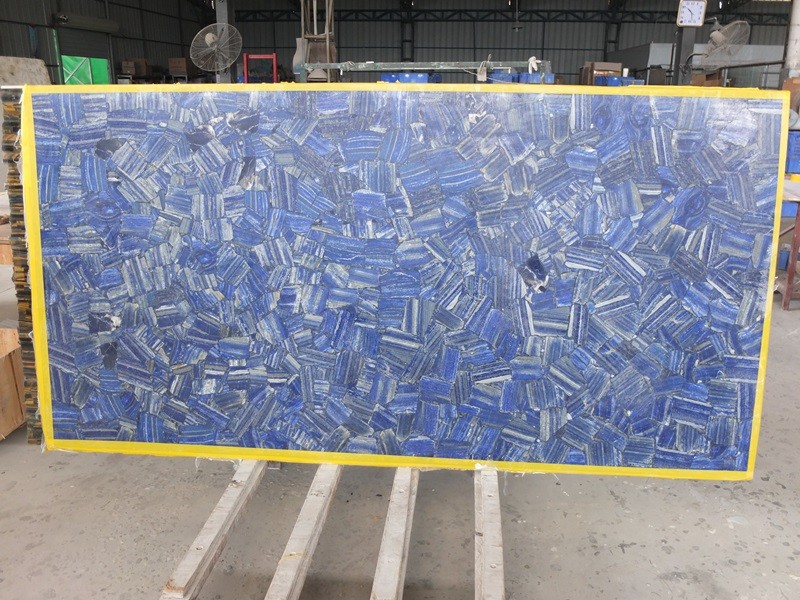
Lapis Lazuli is one of the most recognizable luxury gemstone materials, combining intense royal blue color with natural golden pyrite accents and white calcite movement. Its distinctive appearance makes it suitable for statement furniture, countertops, islands, bar tops, walls and custom architectural surfaces.
Royal Blue
Golden Pyrite
Slabs / Panels
Custom Fabrication

Semi-Precious Gemstone
Royal Blue
Golden Pyrite / White Calcite
Slabs / Panels / Fabrication
Lapis Lazuli Product Overview
Lapis Lazuli is a decorative gemstone material prized for its saturated blue color and naturally occurring mineral contrast. In premium architectural use, it is often selected when a surface needs to function as a visual focal point rather than a neutral background.
A typical Lapis Gemstone surface can combine deep ultramarine and royal blue areas with irregular golden pyrite flecks and white to pale-grey calcite movement.
This gives the material a stronger decorative identity than conventional Blue Stone and places it in the category of Semi Precious Stone surfaces used for luxury furniture and interiors.
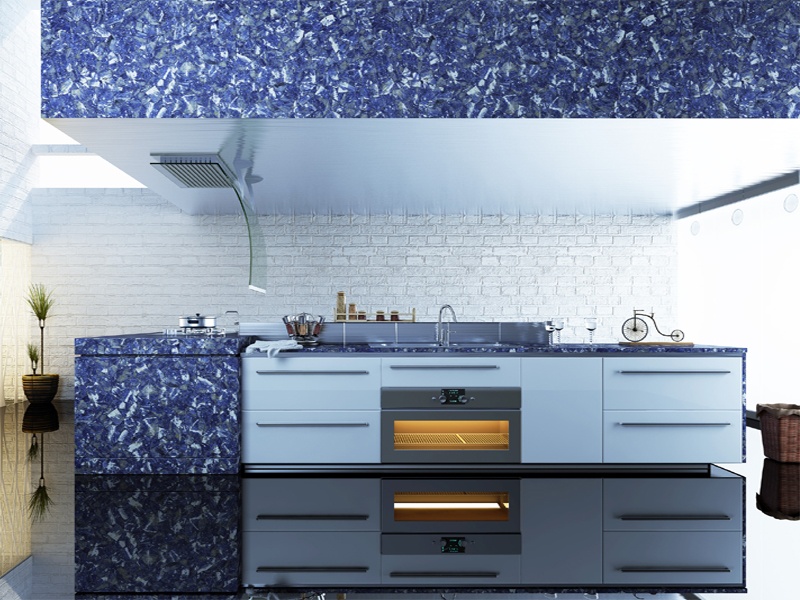
Product Specifications
| Item | Specification Details |
| Material Name | Lapis Lazuli |
| Material Type | Semi-Precious Gemstone Surface |
| Primary Colors | Royal Blue, Ultramarine Blue, White and Natural Golden Mineral Accents |
| Texture Pattern | Irregular blue gemstone composition with pyrite flecks and calcite movement |
| Surface Finish | Polished / Honed / Project-Specific Finish |
| Supply Forms | Gemstone Slabs / Panels / Tiles / Table Tops / Countertops / Custom Components |
| Available Thickness | Project-specific according to slab construction, backing system and finished application |
| Applications | Table Tops, Countertops, Islands, Bar Tops, Walls, Backsplashes, Furniture and Decorative Panels |
| Customization | CAD Layout / Cut-to-Size / Edge Processing / Openings / Panel Fabrication / Furniture Components |
Royal Blue Gemstone Character
The defining characteristic of Royal Blue Stone made from Lapis Lazuli is the depth and saturation of the blue field.
Some areas may appear cleaner and more uniform, while others show stronger calcite movement or denser golden pyrite accents. These variations are part of the natural gemstone character.
For high-end projects, the preferred balance between blue, white and gold should be established before fabrication begins.
For a cleaner luxury look → Choose pieces with broader royal blue areas.
For stronger gemstone character → Select material with more visible pyrite and calcite movement.
For multiple pieces → Group the material by color intensity before cutting.
For statement surfaces → Position the strongest natural composition in the main visible area.
Lapis Lazuli Slabs
A Lapis Lazuli Slab is suitable for larger decorative applications where the full gemstone composition needs to remain visible.
Because the material is valued for color distribution and mineral contrast, buyers should review the actual Lapis Slab rather than making a final selection from a small sample alone.
For large projects, slabs can be grouped according to blue intensity, pyrite distribution and white mineral movement before cutting.
Slab Approval:
Available Slabs → Blue Color Review → Pyrite Distribution → Calcite Movement → Finished-Piece Mapping → Cutting Approval
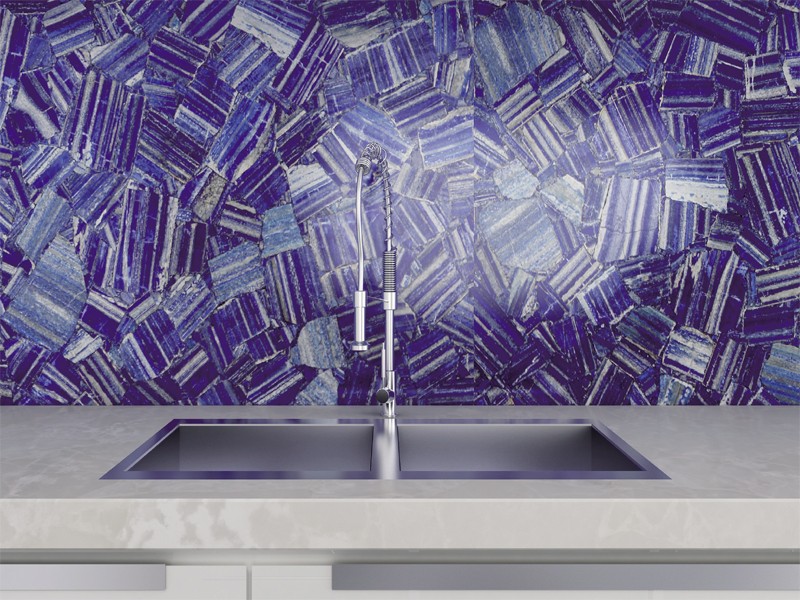
Lapis Lazuli Table Tops
A Lapis Table Top can turn a dining table, coffee table or console into a statement furniture piece.
For a Gemstone Table Top, the finished outline should be positioned carefully so royal blue areas, golden pyrite and white calcite movement create a balanced composition.
The tabletop can be combined with stone, metal, brass-tone or custom engineered bases depending on the furniture concept.
Tabletop Planning:
Furniture Dimensions → Actual Gemstone → Finished Template → Blue / Gold Position → Edge → Base → Approval
Lapis Dining Tables
A Lapis Dining Table can become the visual center of a luxury dining room, private residence, hotel or hospitality space.
For larger dining-table tops, color composition should be reviewed at full scale because isolated white or gold areas can become much more prominent once the table is fabricated.
Base geometry, seating clearance, tabletop dimensions and finished weight should also be considered as part of the complete furniture design.
Lapis Coffee Tables
A Lapis Coffee Table is particularly effective in luxury living rooms, lounges and hotel suites where a smaller gemstone surface can function as a strong decorative focal point.
Round, oval, rectangular and irregular shapes can be fabricated according to project drawings and available gemstone composition.
For compact furniture, the strongest pyrite and royal blue areas can often be positioned more selectively within the finished tabletop.
Lapis Lazuli Countertops
A Lapis Countertop creates a highly decorative blue gemstone surface for luxury bathrooms, bars, reception areas and selected kitchen applications.
Openings, seams and exposed edges should be coordinated with the actual material layout before fabrication.
Where the surface includes a basin or other cutout, important blue and gold gemstone areas should be kept away from large openings whenever possible.
Kitchen Tops and Islands
A Lapis Kitchen Top or decorative Lapis Island can create a dramatic focal point in a high-end kitchen or bar environment.
For a large island, slab or panel layout should be planned before cutting so the royal blue composition remains visually balanced across the entire surface.
If waterfall panels are required, the relationship between the horizontal top and vertical ends should be reviewed before fabrication.
Island Planning:
Finished Dimensions → Actual Material → Blue / Gold Composition → Cutouts → Waterfall Panels → Edge → Support → Final Approval
Lapis Bar Tops
A Lapis Bar Top is one of the strongest hospitality applications for this material because the saturated blue surface can create immediate visual impact.
The gemstone can be used for hotel bars, private clubs, luxury restaurants, reception counters and residential entertainment spaces.
For commercial installations, edge detailing, joint positions, substrate support and repeated-use conditions should be considered during the design stage.
Lapis Lazuli Feature Walls
A Lapis Wall can turn the gemstone into a large architectural focal surface.
A Gemstone Wall is especially effective in luxury entrances, hotel lobbies, reception spaces, private clubs and feature areas where the blue-and-gold composition can be viewed from a distance.
For a Blue Feature Wall, panel dimensions, joint positions, gemstone distribution and installation support should be reviewed before fabrication.
Wall Planning:
Elevation → Panel Size → Material Layout → Blue / Gold Distribution → Joint Position → Numbering → Dry-Lay Review
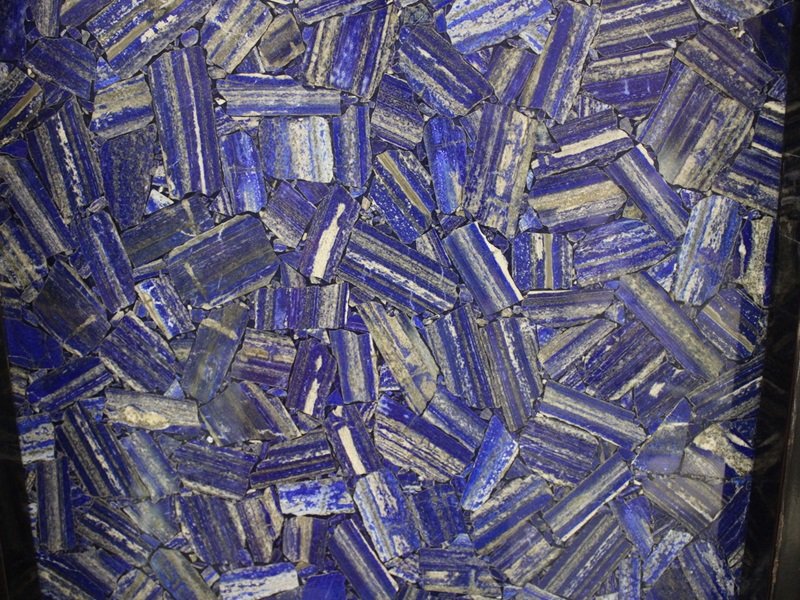
Gemstone Panels and Tiles
A Gemstone Panel can be used where large-format decorative surfaces are required, while a Lapis Tile format may suit smaller wall, furniture or decorative applications.
Panel size and thickness should be selected according to the backing structure, installation method and finished application.
For repeated modular layouts, color grouping is important so adjacent pieces do not create unintended jumps in blue intensity.
Polished Lapis Finish
A Polished Lapis surface provides the strongest color depth and makes the royal blue field, pyrite accents and calcite movement more visually pronounced.
The polished surface is especially suitable for statement furniture, decorative counters and feature walls where richness and reflective depth are desirable.
A lower-reflection finish may also be considered for specific projects, but it will create a softer interpretation of the gemstone character.
Custom Lapis Fabrication
Custom Lapis components can be developed from approved furniture, countertop and architectural drawings.
Fabrication may include cut-to-size processing, CNC shaping, edge finishing, openings, mitered details, panel production and custom furniture components.
Because gemstone surfaces can contain different mineral transitions and backing structures, the fabrication method should be selected according to the actual product construction rather than treated exactly like ordinary solid granite.
Custom Fabrication:
Material Review → CAD Layout → Cut-to-Size → CNC → Edge Processing → Openings → Assembly / Dry-Lay → Final QC
Quality Control
Finished component size
Royal-blue intensity
Golden mineral distribution
White mineral movement
Finish and visible quality
Profile and corner quality
Piece-to-piece composition
Surface and edge protection
Packaging and International Delivery
Finished gemstone components require packaging designed around their dimensions, backing system, exposed edges and fracture risk.
Visible surfaces should be covered with soft, non-staining protective materials. Finished edges and corners should receive additional cushioning, and adjacent finished gemstone faces should not rub directly against each other.
Components should be securely supported and fixed inside reinforced fumigated wooden crates designed according to actual size and weight. Final inspection should be completed before packing and export documentation and logistics support can be coordinated according to the agreed trade terms.
What Affects Lapis Lazuli Price?
Lapis Lazuli Price can vary significantly because the material is evaluated not only by dimensions but also by gemstone quality, blue intensity, pyrite distribution, white calcite content, panel construction and usable yield.
| Cost Factor | Typical Impact |
| Blue Intensity | Royal-blue depth and visual uniformity |
| Pyrite Distribution | Amount and pattern of natural golden mineral accents |
| Calcite Content | White mineral movement and overall visual grade |
| Finished Size | Large continuous pieces require suitable usable material |
| Fabrication | Cutouts, edges, curves, panels and custom furniture processing |
| Packing & Shipping | Finished dimensions, weight, crate design and destination |
Why Work with a Professional Gemstone Supplier?
A professional Lapis Supplier should provide more than a basic material photograph.
For high-value gemstone projects, support should include actual material selection, color grouping, finished-piece mapping, CAD coordination, fabrication, dry-lay review, QC and export packing.
A capable Gemstone Factory should also understand the different fabrication and handling requirements of gemstone panels, furniture pieces, countertops and wall applications.
Information Required for Quotation
Table / Counter / Island / Bar / Wall
Finished component sizes
Panels, pieces or total area
Blue intensity / pyrite / calcite balance
Polished / Honed
Edges / Openings / Curves / Panels
CAD / PDF / Furniture reference
Port or delivery address
Lapis Lazuli FAQ
1. What is Lapis Lazuli?
Lapis Lazuli is a blue semi-precious gemstone material recognized for its royal blue color, natural golden pyrite accents and white calcite movement.
2. What color is Lapis Lazuli?
The material is predominantly deep blue to royal blue, with natural white calcite and golden pyrite mineral variation.
3. Can Lapis Lazuli be supplied as slabs?
Yes. It can be supplied as gemstone slabs and panels, subject to available dimensions and product construction.
4. Can Lapis Lazuli be used for table tops?
Yes. Custom table tops can be fabricated for dining tables, coffee tables, consoles and other statement furniture.
5. Can Lapis Lazuli be used for countertops?
Yes. It can be used for decorative countertops, vanity surfaces, reception counters and selected kitchen or bar applications.
6. Is Lapis Lazuli suitable for feature walls?
Yes. Large gemstone panels can be used for luxury feature walls where the royal-blue and golden mineral composition is intended to become a focal point.
7. Can I select the actual Lapis Lazuli material?
Yes. Actual material approval is recommended because blue intensity, pyrite distribution and calcite movement can vary significantly.
8. What finish is recommended for Lapis Lazuli?
A polished finish is commonly used to maximize color depth and gemstone contrast, while other finishes may be considered for specific projects.
9. How is Lapis Lazuli packed for export?
Finished surfaces and edges are protected, components are separated and securely supported, and the material is packed in reinforced fumigated wooden crates.
10. What affects Lapis Lazuli price?
Price depends on gemstone quality, blue intensity, pyrite distribution, calcite content, finished dimensions, fabrication complexity, quantity, packing and shipping destination.
Final Note / Practical Takeaway
Lapis Lazuli is most effective when its royal blue color, natural golden pyrite and white calcite movement are treated as part of the overall design rather than as a uniform blue surface. For table tops → position the strongest blue-and-gold areas inside the finished furniture outline. For countertops and islands → coordinate cutouts, edges and seams with the actual gemstone layout. For walls → control panel sequence and joint placement before cutting. For high-value project orders → approve the actual material, finished-piece mapping, fabrication details, QC and reinforced export packing before production.