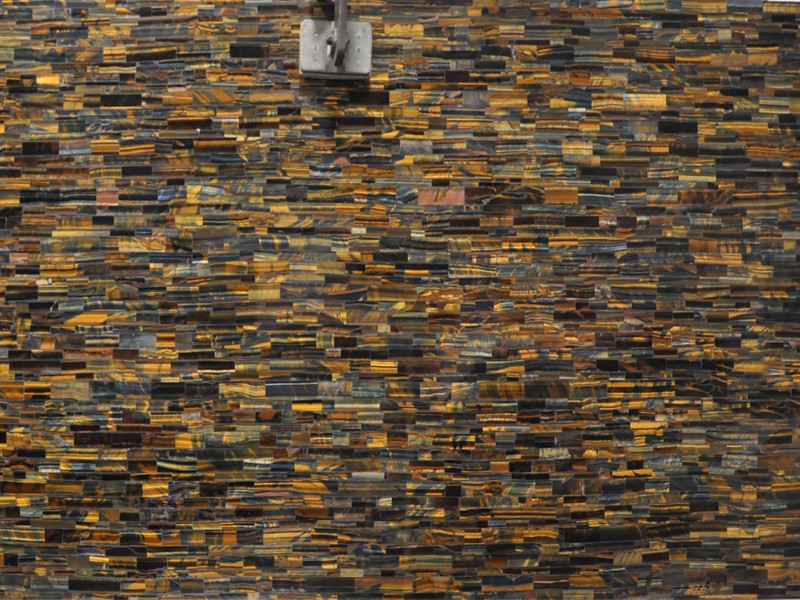

Blue Tiger Eye Semi-Precious Stone Overview
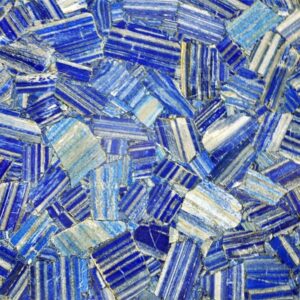
Blue Tiger Eye is a highly decorative gemstone material known for its dramatic silky light bands and strong directional optical effect.
The surface typically combines deep blue, blue-grey and darker mineral fields with golden, bronze or lighter blue bands that appear to move as the observer changes position.
Also marketed as Tiger Eye Blue, the material is valued less for static color and more for the way its chatoyant bands respond to light.
For luxury interiors, this makes the stone particularly effective where the surface can be viewed from several angles rather than only straight on.

Product Specifications
| Specification | Project Details |
| Material Name | Blue Tiger Eye Semi-Precious Stone Slab |
| Material Type | Semi-Precious Gemstone Decorative Slab |
| Primary Colors | Deep Blue / Blue-Grey / Gold / Bronze / Dark Mineral Accents |
| Visual Effect | Chatoyant / Silky / Directional Light Bands / Cat’s-Eye Effect |
| Texture Pattern | Parallel / Wavy / Striped / Directional Gemstone Bands |
| Slab Construction | Selected Tiger Eye Pieces Assembled into Decorative Slab Surface |
| Available Slab Size | Subject to Current Finished Slab Inventory and Production |
| Custom Size | Cut-to-Size According to Approved Drawings and Project Requirements |
| Thickness | Confirmed According to Slab Construction, Backing and Project Requirement |
| Surface Finishing | Polished / Project-Specific Finish |
| Backlight Capability | Subject to Actual Slab Construction and Translucency Test |
| Application Scope | Feature Walls / Bars / Table Tops / Counters / Vanities / Furniture Panels |
| Supply Forms | Full Slabs / Cut-to-Size / Table Tops / Wall Panels / Custom Fabrication |
| Package Details | Surface Protection + Edge Protection + Reinforced Export Wooden Crates |
| MOQ | Subject to Finished Slab Inventory and Fabrication Scope |
| Delivery Time | Confirmed According to Quantity, Slab Selection and Custom Processing |

Blue and Golden Tiger Eye Character
A Blue Tiger Slab often contains both cool blue and warmer golden bands, giving it more visual complexity than a uniformly blue gemstone.
The material may also be associated with Blue Eye Stone or Hawks Eye Stone search terminology because of its silky directional optical effect.
Depending on the slab, the warmer bands may appear gold, bronze or yellow-brown, while the cooler areas range from deep blue to blue-grey.
This blue-to-gold balance should be reviewed on the complete slab before material is allocated to a project.
Chatoyant Stone and Cat’s-Eye Effect
The defining characteristic of Blue Tiger Eye is chatoyancy.
As a Chatoyant Stone, the material contains silky bands that can appear brighter or darker as the viewer moves relative to the light source.
This optical response makes it a particularly distinctive Chatoyant Gemstone for decorative architectural surfaces.
Unlike static marble veining, the pattern seems to shift because individual fibrous or banded mineral areas reflect light directionally.
Main Viewing Direction → Determine where the strongest bands should face before cutting.
Lighting Direction → Side or angled illumination can strengthen the silky effect.
Band Orientation → Horizontal and vertical layouts create very different visual results.
Slab Approval → Use video or angled images, not only one frontal photograph.
Blue Stripe Gemstone Slab Construction
A Blue Gemstone Slab made with Tiger Eye is typically assembled from selected gemstone pieces into a larger decorative surface.
The characteristic Blue Stripe Stone appearance means the orientation of individual pieces is particularly important.
If adjacent pieces are arranged without directional control, the chatoyant bands may appear visually inconsistent across the finished panel.
For this reason, full-slab composition and band direction should be inspected as part of manufacturing quality control.
Semi-Precious Gemstone for Luxury Interiors
As a Gemstone Slab and Semi Precious Slab, Blue Tiger Eye is generally chosen for concentrated visual impact.
Its blue and gold optical movement makes it very different from conventional flat-color decorative materials.
A Semi Precious Stone installation can become a focal feature in hotels, villas, private clubs, bars, retail stores and high-end hospitality interiors.
As a Luxury Gemstone, it pairs naturally with dark timber, brass, bronze, black metal, champagne metal and restrained cream finishes.
Polished Tiger Eye Surface
A Polished Tiger Eye surface is generally preferred because the polish makes the silky chatoyant bands more visible and gives the darker blue areas greater depth.
Surface inspection should be carried out under directional light so polishing quality and optical movement can be evaluated at the same time.
Exposed edges should also be checked separately because the visible slab build-up may differ from the polished face depending on backing construction.

Backlit Blue Tiger Eye Considerations
Backlit Tiger Eye can be considered where the actual slab construction includes sufficient translucent gemstone areas or a suitable translucent backing system.
However, the chatoyant effect is primarily a reflected-light phenomenon. Strong cat’s-eye movement does not automatically mean that the slab will transmit light evenly.
A proposed Backlit Gemstone or Translucent Stone installation should therefore be tested with the actual finished slab before lighting design is finalized.
Backlight Review:
Actual Slab → Rear-Light Test → Translucent Zones → Backing Visibility → LED Distance → Hotspot Review → Final Approval
Blue Tiger Eye Countertops
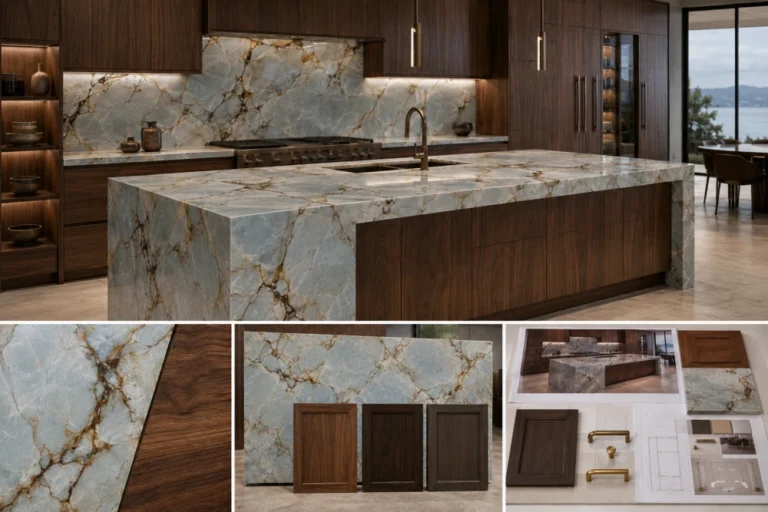
A Blue Countertop using Tiger Eye can create a highly decorative surface for bars, reception areas, private entertainment spaces and selected luxury interiors.
For a Tiger Eye Counter, the main band orientation should be selected before cutouts are positioned.
Sink, tap and service openings should be coordinated so they do not remove the most visually active chatoyant areas unnecessarily.
The primary viewing side should also be considered because the surface can look very different from opposite directions.
Blue Tiger Eye Bar Tops
A Blue Bar Top is one of the strongest applications for Tiger Eye because directional hospitality lighting can emphasize its silky bands.
For a Tiger Eye Bar Top, the band direction should be coordinated along the visible length of the bar rather than arranged randomly between components.
If the project includes a vertical front panel, the relationship between horizontal and vertical band orientation should be reviewed before fabrication.
Blue Tiger Eye Table Tops
A Blue Table Top allows the changing optical effect of Tiger Eye to be viewed from several positions around the furniture.
For a Tiger Eye Table Top, round, oval, rectangular or custom templates should be positioned over the actual slab before cutting.
The selected orientation determines whether the main silky bands appear across the width, length or diagonal of the finished table.
This should be coordinated together with the base design, support points and intended room orientation.
Blue Tiger Eye Vanity Applications
A Tiger Eye Vanity can introduce blue and gold optical movement into a powder room, private bathroom or luxury hotel suite.
Basin openings should be placed after the preferred band orientation is selected so the most active chatoyant area remains visible.
Wall-mounted mirrors and directional vanity lighting can also significantly influence the appearance of the stone.
Blue Tiger Eye Feature Walls
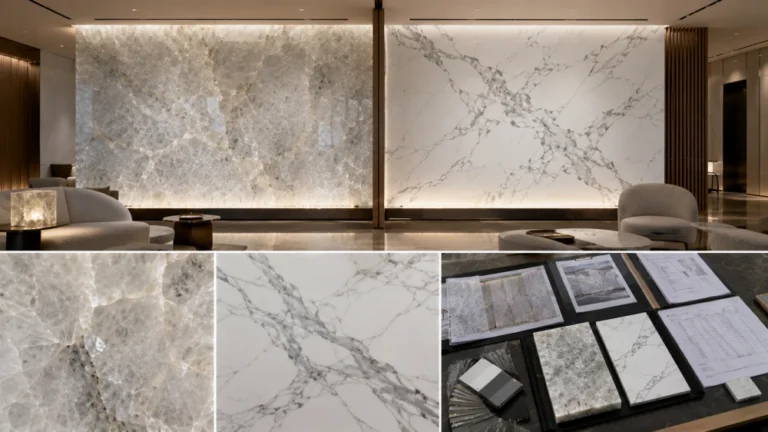
A large Tiger Eye Wall can transform the chatoyant effect into an architectural-scale visual feature.
The wall elevation should be considered together with the main viewing direction and lighting position before panels are cut.
For large hospitality or residential walls, band orientation can be arranged horizontally for a broader layered effect or vertically for a more elongated architectural composition.
Wall Planning:
Full Slab → Main Viewing Direction → Band Orientation → Panel Division → Lighting Direction → Piece Numbering → Trial Assembly
Visual Approval Under Directional Light
Blue Tiger Eye should not be approved only under flat warehouse lighting.
The same slab can appear significantly different when viewed from the opposite direction or when directional light moves across the surface.
| Approval Point | Buyer Check |
| Blue / Gold Balance | Compare full slab under consistent neutral lighting |
| Chatoyant Flash | Review video from several viewing angles |
| Band Direction | Confirm orientation relative to final installation |
| Joint Distribution | Check complete assembled gemstone slab composition |
| Backing | Confirm support system before edge and installation design |
Fabrication and Buyer Risk Control
| Buyer Risk | Recommended Control |
| Slab looks different from another viewing direction | Approve angled videos and define the main viewing side |
| Bands run opposite directions between pieces | Mark orientation arrows before cutting |
| Cutout removes strongest optical band | Overlay finished templates before fabrication |
| Backlight performance is weak | Test actual slab rather than assuming translucency |
| Finished panel is vulnerable during transport | Use rigid support and component-specific export packing |
Custom Fabrication and Quality Control
Blue Tiger Eye fabrication should follow approved drawings, final orientation marks and the confirmed slab construction.
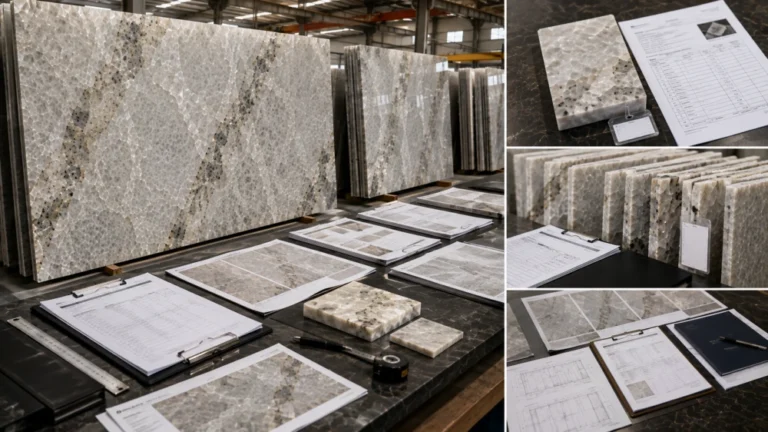
Approved material traceability
Orientation marking
Directional-light review
Finished size verification
Construction confirmation
Profile and visible build-up
Polish and joint quality
Inspection before packing
Packaging and International Delivery
Finished Blue Tiger Eye components require packaging based on slab construction, dimensions, exposed edges and transportation risk.
Polished faces should be covered with suitable soft non-staining protective materials. Corners, exposed edges, cutouts and narrow components require additional cushioning and rigid support.
Direction-marking information should remain identifiable through packing so pieces are not accidentally rotated during project installation.
Finished components are secured inside reinforced fumigated wooden crates or other appropriate reinforced export crates with internal blocking, cushioning and edge protection. Final QC and packing inspection are completed before shipment.
Working with a Tiger Eye Supplier
A professional Tiger Eye Supplier should provide more than one static slab photograph.
Useful B2B approval materials include frontal photos, angled-light videos, band-direction markings, backing information, finished-piece layouts and edge samples.
For architectural projects, this allows buyers to understand how the material will respond to the final viewing direction and lighting conditions before fabrication.
Why Choose HRST STONE
HRST STONE provides one-stop natural stone and decorative gemstone solutions backed by 17+ years of stone supply and project experience.
For Blue Tiger Eye projects, support can include current slab selection, full-slab photography and angled video, CAD and shop-drawing coordination, band-direction planning, finished-piece layouts, custom fabrication, backlight testing where required, surface inspection, final QC and international export packing.
This workflow helps designers, hospitality buyers, furniture companies and project purchasing teams control both the changing optical appearance and the technical requirements of fabrication and delivery.
Information Required for Quotation
| Quotation Item | Information Required |
| Application | Wall / Bar / Table / Vanity / Counter / Decorative Panel |
| Dimensions & Quantity | Finished sizes, drawings, slab quantity or project schedule |
| Thickness / Build-Up | Required thickness, backing and support specification |
| Visual Preference | More blue / stronger gold bands / finer stripes / stronger chatoyancy |
| Band Direction | Horizontal / Vertical / Other project-specific orientation |
| Backlighting | Required / Not Required / Lighting details if available |
| Destination | Destination port or complete project delivery location |
Blue Tiger Eye Semi-Precious Stone FAQ
1. What is Blue Tiger Eye?
Blue Tiger Eye is a decorative gemstone material known for deep blue and blue-grey fields with silky gold, bronze and blue directional bands.
2. Why does Blue Tiger Eye appear to move?
Its chatoyant structure reflects light directionally, creating bright and dark bands that shift as the viewer or light source moves.
3. Is Blue Tiger Eye the same as Hawk’s Eye?
Hawk’s Eye is commonly associated with blue forms of Tiger Eye, although commercial naming can vary between suppliers.
4. Can Blue Tiger Eye be backlit?
Some slab constructions may support partial backlighting, but chatoyancy itself is a reflected-light effect, so actual slab translucency must be tested.
5. Can Blue Tiger Eye be used for countertops?
Yes. Decorative counters and bar surfaces can be fabricated according to the specific slab construction, backing and support requirements.
6. Is Blue Tiger Eye suitable for table tops?
Yes. Table tops are particularly effective because users can view the changing silky optical bands from several directions.
7. Can Blue Tiger Eye be used for feature walls?
Yes. Large feature walls can display the directional blue-and-gold banding at architectural scale.
8. Why is band direction important?
Band orientation affects both the visual composition and how strongly the chatoyant effect is seen from the main viewing position.
9. What finish is normally used for Blue Tiger Eye?
A polished finish is commonly used because it helps reveal the silky directional optical effect and increases visual depth.
10. How is Blue Tiger Eye packed for export?
Finished pieces receive surface protection, edge and corner protection, rigid separation, orientation marking and reinforced export crate packing.
Final Note
Blue Tiger Eye Semi-Precious Stone should be purchased according to the actual finished slab and its directional optical behavior rather than one static image. For walls → define the main viewing direction before panel cutting. For bar tops and counters → coordinate band orientation with the longest visible surface. For table tops → test the slab from several viewing positions before final template placement. For backlit concepts → test actual translucency because chatoyancy and transmitted-light performance are different properties. Full-slab approval, angled-light review, orientation marking, fabrication QC and reinforced export packing give B2B buyers greater control over both the finished appearance and installation result.