

Invisible Marble
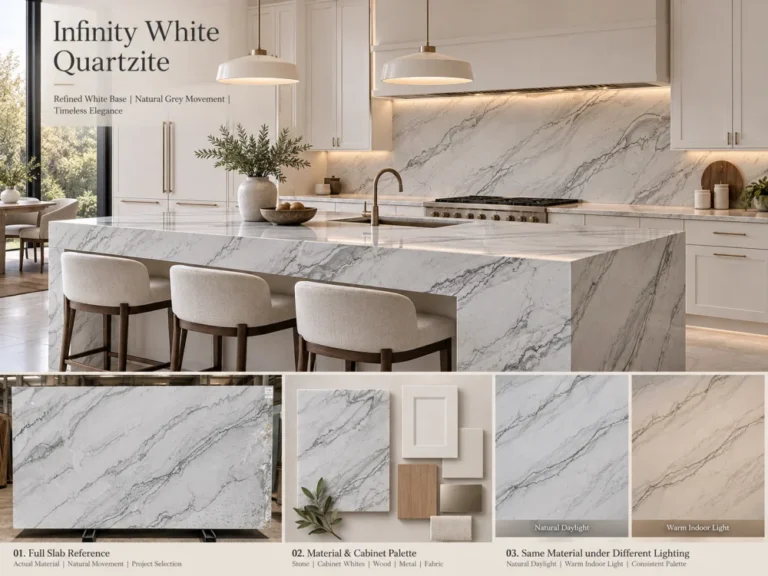
Invisible Marble combines a light white-to-grey background with expressive grey, charcoal and taupe mineral movement. Its irregular fractured pattern creates strong visual depth without relying on conventional linear marble veining, making it particularly suitable for contemporary countertops, islands, bathrooms, feature walls and custom stone interiors.
White / Pale Grey
Fractured Veining
18mm / 20mm
Custom Cut-to-Size
_1662444532063.jpg "Invisible Marble Slab")
Natural Marble
White / Grey / Taupe / Charcoal
Fractured / Irregular / Contemporary
Slabs / Panels / Cut-to-Size
Invisible Marble Product Overview
Invisible Marble is also commonly associated with market names such as Invisible Grey and Invisible White. The material is recognized for its pale background and distinctive fragmented mineral structure rather than a simple repetitive vein pattern.
A typical Invisible Slab combines white and light-grey areas with irregular medium-grey, charcoal and taupe movement. These mineral zones can intersect and overlap, producing the fractured appearance that gives the stone its recognizable identity.
As a Luxury Marble, it works particularly well in contemporary interiors where designers want natural variation and visual impact while maintaining a relatively neutral white-grey palette.
_1662444666907.jpg "Natural Invisible Grey Marble")
Product Specifications
| Item | Specification Details |
| Material Name | Invisible Marble |
| Alternative Names | Invisible Grey / Invisible White / Invisible Stone |
| Material Type | Natural Marble |
| Typical Origin | Turkey |
| Primary Colors | White, Pale Grey, Medium Grey, Charcoal and Taupe |
| Texture Pattern | Irregular fractured and intersecting mineral movement with strong natural slab-to-slab variation |
| Available Thickness | 18mm / 20mm |
| Surface Finishing | Polished / Honed / Brushed / Project-Specific Finish |
| Supply Forms | Slabs, Countertops, Island Tops, Vanity Tops, Wall Panels, Floor Pieces, Shower Panels and Table Tops |
| Application Scope | Luxury Villas, Hotels, Kitchens, Bathrooms, Living Rooms, Lobbies, Restaurants and Custom Furniture |
| Custom Fabrication | Cut-to-Size, CNC Openings, Mitered Edges, Waterfall Panels, Bookmatch Layout, Wall Panels and Custom Table Tops |
White, Grey and Fractured Natural Movement
The visual identity of Invisible Marble comes from the interaction between its pale base and irregular darker mineral structures. Rather than forming a predictable linear pattern, the movement can branch, intersect and break into angular zones across the slab.
This allows the material to function as a distinctive White Grey Marble while maintaining more geological complexity than a conventional softly veined white stone.
Depending on the individual slab, the pattern may include stronger Grey Vein Marble, Dark Vein Marble or Taupe Vein Marble characteristics. Some selections have a particularly cool appearance reminiscent of fragmented ice, making them suitable for projects seeking an Ice White Marble aesthetic.
For stronger contrast → Select slabs with more visible charcoal and dark-grey mineral movement.
For a warmer neutral result → Look for slabs with controlled taupe movement.
For connected surfaces → Group slabs by background tone, pattern density and movement direction before fabrication.

Invisible Marble Countertops
An Invisible Counter can introduce strong natural pattern into a kitchen without requiring a highly colorful stone. The white-grey palette remains relatively neutral, while the fractured mineral structure creates visual depth.
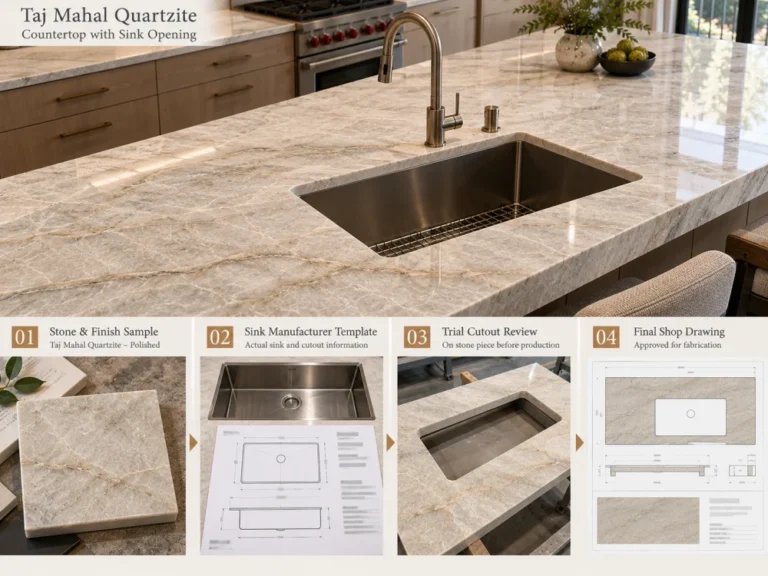
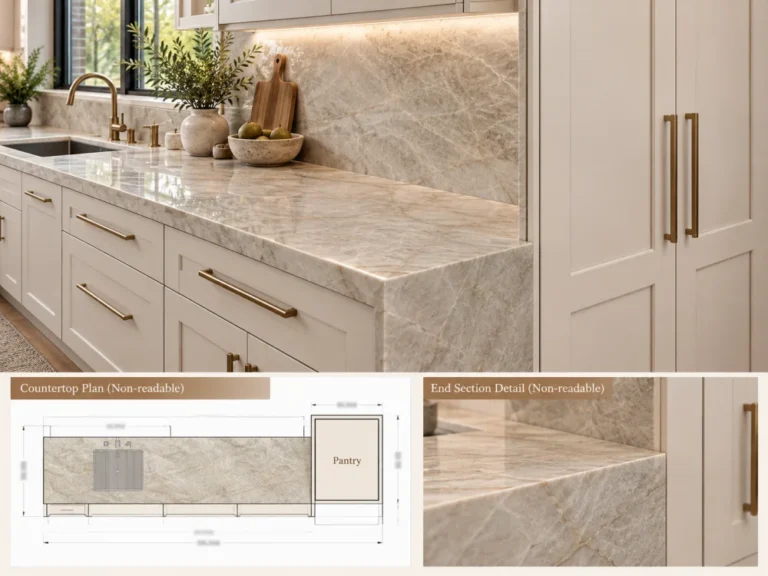
For a custom Marble Countertop, sink openings, cooktop cutouts, seams and exposed edges should be mapped against the actual slab before cutting.
Finished Dimensions → Actual Slab → Sink / Cooktop Position → Main Pattern Zones → Seam Position → Edge Profile → Cutting Approval → CNC Fabrication
Invisible Marble Applications
Invisible Counter
Countertops combine a neutral white-grey palette with expressive fractured movement for contemporary kitchen and bar designs.
Invisible Island
Large islands preserve more of the complete slab pattern and can be coordinated with mitered waterfall ends.
Invisible Vanity
Vanity tops bring the fractured white-grey marble pattern into luxury bathrooms and hotel suites.
Invisible Wall
Large wall panels allow the fragmented mineral movement to become a complete architectural composition.
Invisible Shower
Large-format shower panels can reduce visual fragmentation while highlighting the natural marble pattern.
Invisible Table
Selected slab sections can be fabricated into dining tables, coffee tables, consoles and bespoke furniture.
Kitchen Island Design
An Invisible Island provides enough surface area to display the stone’s fractured pattern on a larger architectural scale. The strongest grey and taupe structures can be intentionally positioned across the main visible area.
For waterfall islands, the top and vertical side pieces should be mapped together. A well-planned miter can allow major pattern zones to transition through the corner rather than ending randomly.
Island Dimensions → Slab Selection → Top Layout → Waterfall Layout → Main Pattern Zones → Miter Direction → Openings → Cutting Approval → Trial Alignment
Bathroom, Vanity and Shower Applications
An Invisible Vanity can combine the clean character of pale marble with stronger fragmented movement around the basin and backsplash areas.
For an Invisible Shower, large-format wall panels allow more of the original slab composition to remain visible. Joint locations, niches, plumbing penetrations and fixtures should therefore be coordinated with the stone layout before fabrication.
Room Elevation → Vanity Dimensions → Basin Template → Shower Wall Dimensions → Fixture Locations → Slab Allocation → Pattern Position → Joint Planning → Cutting Approval
Feature Wall and Bookmatch Design
As a Feature Wall Stone, Invisible Marble can create a dramatic surface because its fractured grey structures become more visible when several large panels are viewed together.
Where suitable paired slabs are available, Bookmatch Marble layouts can transform the irregular pattern into a mirrored architectural composition.
Because the pattern is naturally complex, the entire wall elevation should be reviewed before fabrication rather than approving individual panels independently.
Slab Pair Review → Wall Elevation → Mirror Direction → Centerline → Main Pattern Zones → Panel Dimensions → Joint Position → Cutting Layout → Dry-Lay Confirmation
Invisible Marble Flooring
An Invisible Floor can create a light contemporary base while retaining visible natural stone movement.
For larger floors, randomly mixing pieces from different slab zones may produce excessive visual contrast. Pieces should therefore be grouped by background tone and pattern density before installation.
Room Dimensions → Piece Size → Slab Selection → Tone Grouping → Pattern Distribution → Layout Sequence → Piece Numbering → Packing Reference
Invisible Marble Table Tops
The strong graphic character of the material also makes it suitable for custom furniture. For an Invisible Table or Marble Table Top, the finished tabletop outline should be positioned directly on the selected slab.
Large tabletops preserve broad sections of the original fractured pattern.
Smaller furniture can use selected areas with concentrated grey or taupe movement.
Long or compact shapes can be positioned around visually distinctive slab areas to improve material utilization.
Surface Finishes and Fabrication
Polished Finish
Polishing increases surface clarity and strengthens the contrast between pale background areas and darker fractured mineral structures.
Honed Finish
A honed surface reduces reflection and creates a softer contemporary appearance suitable for walls, bathrooms and furniture.
Custom Fabrication
CNC openings, mitered edges, waterfall panels, shower components, bookmatched walls and custom furniture can be fabricated according to approved drawings.
Application Selection Guide
| Project Requirement | Recommended Form | Selection Priority |
| Statement kitchen island | Invisible Island | Main pattern position and waterfall continuity |
| Kitchen countertop | Invisible Counter | Openings, seams and pattern distribution |
| Bathroom vanity | Invisible Vanity | Basin position and visible pattern balance |
| Shower walls | Invisible Shower | Joint position, niches and fixture coordination |
| Feature wall | Bookmatch Marble | Slab pairing, centerline and complete composition |
| Custom furniture | Invisible Table | Finished shape and pattern position |
Key Procurement Risks
A small sample cannot represent the full fractured movement, grey distribution and slab-scale variation of Invisible Marble.
Mixing pale slabs with darker or more taupe-dominant pieces can create visible inconsistency across connected surfaces.
Important pattern zones can be lost inside sink openings, cutouts or poorly positioned seams.
Large mirrored wall compositions should be approved as complete elevations before individual panels are cut.
Common Purchasing Mistakes and Consequences
| Common Mistake | Possible Consequence | Recommended Control |
| Selecting from a small sample only | Unexpected full-slab pattern density and tone | Approve actual slab images and video |
| No slab grouping | Visible tone differences across connected surfaces | Group slabs by background and pattern density |
| No cutting layout | Strong pattern areas may be removed or poorly positioned | Approve finished-piece mapping before fabrication |
| No dry-lay review | Wall or waterfall components can appear disconnected | Dry-lay important connected components before packing |
| Comparing slab price only | Differences in slab quality, yield, fabrication and packing are overlooked | Compare material, fabrication, QC, packing and logistics together |
Custom Fabrication and Quality Control
Invisible Marble can be fabricated into countertops, waterfall islands, vanity tops, shower panels, bookmatched feature walls, floor pieces, table tops and other architectural components according to approved drawings.
Before cutting, actual slabs should be reviewed for background tone, fractured pattern distribution, natural fissures, repaired areas, finished dimensions, exposed edges and component orientation.
Material Inspection → Actual Slab Selection → Tone & Pattern Review → Drawing Approval → Slab Allocation → Bookmatch / Cutting Layout → Precision Cutting → CNC & Edge Fabrication → Surface & Edge Check → Dry-Lay Confirmation → Final QC → Packing Inspection
Packaging and Project Delivery
Finished Invisible Marble components should be packed according to their dimensions, geometry, weight and breakage risk. Large wall panels, shower pieces, islands and countertops with openings require appropriate internal support during international transportation.
Finished marble faces should be separated with soft non-staining protective materials. Exposed corners, polished edges, mitered returns and vulnerable cutouts should receive additional cushioning before the components are securely fixed inside reinforced fumigated wooden crates.
For multi-panel walls, bathrooms and complete interior projects, numbered components and packing references can be coordinated with shop drawings to simplify identification during installation.
Information Required for Quotation
For accurate project pricing, provide the main application and fabrication requirements so slab quantity, usable yield, processing, packing and logistics can be evaluated together.
Counter / Island / Vanity / Wall / Shower
Finished component sizes
Pieces or total area
18mm / 20mm
Polished / Honed / Brushed
Required / Not Required
CAD / PDF / Shop Drawings
Port or Delivery Address
Invisible Marble FAQ
1. What does Invisible Marble look like?
Invisible Marble typically features a white to pale-grey background with irregular grey, charcoal and taupe mineral movement, creating a distinctive fractured appearance.
2. Is Invisible Grey a natural marble?
Yes. Invisible Grey is a natural marble, so color, vein density, fractured structures and other geological characteristics vary between slabs.
3. Can Invisible Marble be used for countertops?
Yes. Invisible Counter applications can be fabricated with sink openings, cooktop cutouts, seams and custom edge profiles according to approved drawings.
4. Is Invisible Marble suitable for kitchen islands?
Yes. A large Invisible Island can display more of the complete fractured pattern and can be coordinated with mitered waterfall panels.
5. Can Invisible Marble be used for bathrooms?
Yes. It can be fabricated for vanity tops, shower walls, bathroom wall panels and selected floor applications.
6. Is Invisible Marble suitable for shower walls?
Yes. Large Invisible Shower panels can preserve more of the slab pattern, although joints, fixtures and niches should be planned before cutting.
7. Can Invisible Marble be bookmatched?
Where suitable paired slabs are available, Bookmatch Marble layouts can be created for feature walls, bathrooms and other large decorative surfaces.
8. Can Invisible Marble be used for table tops?
Yes. Invisible Table applications can include dining tables, coffee tables, consoles and other custom furniture according to project drawings.
9. Which finish is suitable for Invisible Marble?
Polished finishes emphasize contrast and pattern clarity, while honed surfaces create a softer and more restrained contemporary appearance.
10. What affects Invisible Marble price?
Price depends on slab grade, background quality, pattern distribution, dimensions, thickness, usable yield, finish, fabrication complexity, bookmatch requirements, quantity, packing and shipping destination.
Final Note / Practical Takeaway
Invisible Marble is particularly suitable for contemporary projects where a light neutral palette is required without losing the expressive character of natural stone. Its white, pale-grey, charcoal and taupe fractured movement works well for countertops, waterfall islands, bathrooms, shower walls, feature walls, floors and custom furniture. For B2B procurement, actual slab selection, tone grouping, pattern mapping, finished-piece layout, bookmatch planning, fabrication drawings, QC and export packaging should be evaluated together. If a lighter result is preferred → choose slabs with broader white and pale-grey areas. If stronger contrast is required → prioritize slabs with more visible charcoal movement. For large connected surfaces → approve the complete slab allocation and cutting layout before fabrication.