Red Agate
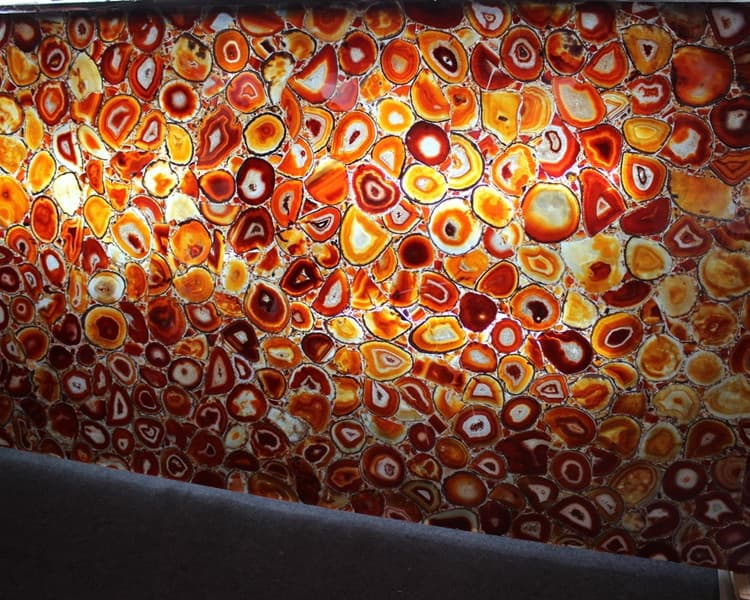
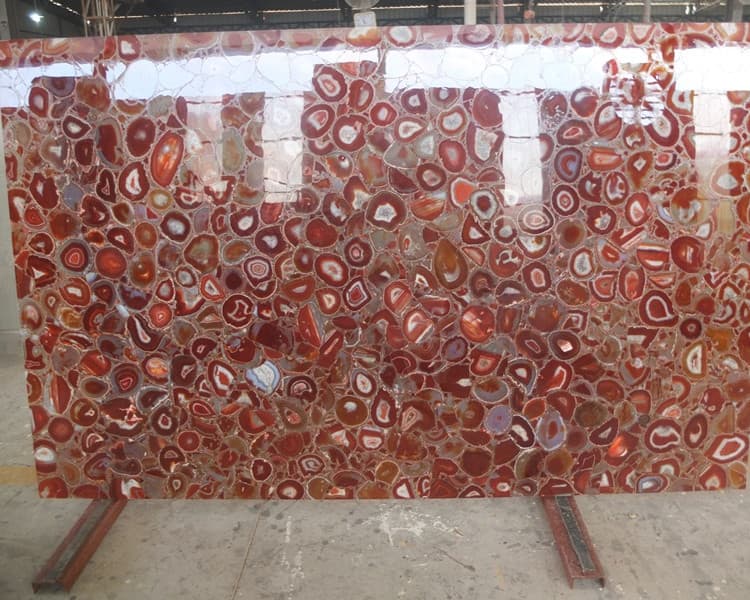
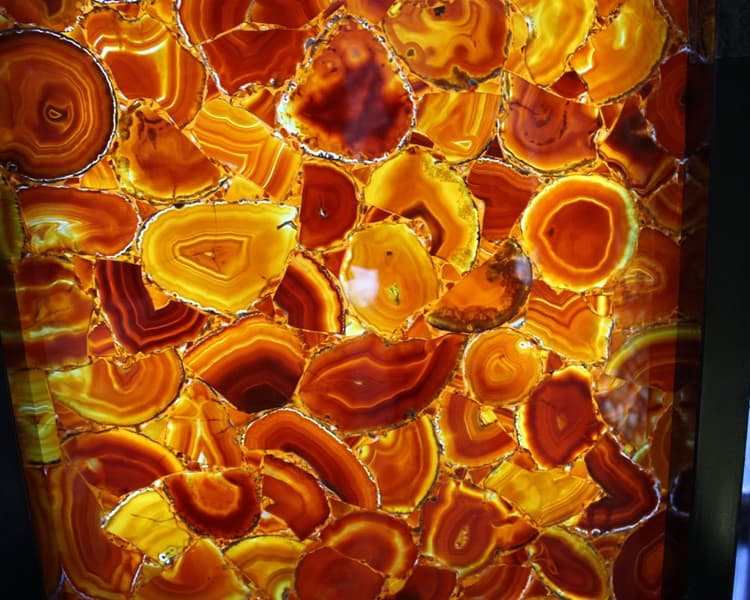
Red Agate is a striking decorative gemstone surface made from natural agate sections with layered red, amber, rust, cream and crystalline banding. Its natural translucency allows selected areas to transmit light, giving the material exceptional value for luxury feature walls, illuminated panels, reception counters, bar fronts and custom stone furniture.
Red / Amber / Cream
Translucent
Backlit Applications
Custom Fabrication

Natural Agate / Semi-Precious Stone
Red / Amber / Rust / Cream
Banded & Translucent
Slabs / Panels / Cut-to-Size
Red Agate Product Overview
Red Agate, also searched as Red Agate Stone, Agate Gemstone or Red Gemstone Slab, is selected primarily for its layered mineral banding and natural translucency.
A typical Red Agate Slab contains individual agate sections with concentric or irregular red, amber, cream and crystalline zones. The combined slab creates a rich mosaic-like gemstone surface while preserving the unique mineral structure of each agate section.
Unlike conventional marble or granite, the design value comes from color layering, crystal transparency and the relationship between individual agate pieces. This makes the material particularly suitable for statement architectural applications.

Product Specifications
| Item | Specification Details |
| Material Name | Red Agate |
| Material Type | Natural Agate Semi-Precious Stone Surface |
| Primary Colors | Deep Red, Amber, Rust, Orange-Red, Cream and Crystal White |
| Texture Pattern | Natural agate slices with concentric banding, irregular crystalline zones and layered mineral transitions |
| Translucency | Good translucency in selected agate and crystal areas; light transmission varies across the slab |
| Surface Finishing | Polished / Project-Specific Finish |
| Supply Forms | Slabs, Wall Panels, Countertops, Island Tops, Vanity Tops, Bar Fronts, Table Tops and Decorative Components |
| Application Scope | Luxury Villas, Hotels, Reception Areas, Bars, Restaurants, Retail Interiors, Bathrooms and Custom Furniture |
| Backlighting | Suitable for selected illuminated wall panels, counters and furniture applications after actual slab testing |
| Custom Fabrication | Cut-to-Size, CNC Shaping, Edge Finishing, Wall Panels, Countertops, Bar Fronts and Custom Table Tops |
How to Select Red Agate
For Red Agate, buyers should evaluate overall red intensity, amber-to-cream balance, agate banding, crystal distribution and translucency. Some slabs appear deeper and more saturated, while others contain larger pale crystalline areas.
For a Red Agate Counter, Red Agate Island or large wall panel, the most attractive agate sections should be deliberately positioned before cutting.
Selection Logic
If a stronger red result is preferred → Choose slabs with more concentrated deep-red agate sections.
If a warmer amber look is desired → Select slabs with more orange-red, amber and cream zones.
If backlighting is planned → Test the actual slab under rear illumination before cutting.
If several panels connect visually → Approve the complete slab sequence and finished-piece layout before production.
Red Agate Applications
The combination of color, translucency and gemstone structure makes this Luxury Red Stone particularly suitable for statement interior applications.
Red Agate Island
Kitchen islands can use large gemstone surfaces as strong focal elements, with selected translucent sections retained in highly visible areas.
Agate Countertop
Countertops and reception counters can be fabricated with custom dimensions, edge finishing and coordinated slab layouts according to project requirements.
Red Agate Vanity
Vanity tops can create a decorative gemstone focal point in luxury bathrooms, especially when combined with warm lighting and restrained surrounding finishes.
Red Agate Wall
Large decorative panels can be used in hotel lobbies, villa entrances, reception spaces, bars and premium retail interiors.
Backlit Red Agate
Rear lighting can reveal the natural translucency and layered banding of selected agate sections, creating a warm red-amber illuminated effect.
Red Agate Table Top
Dining tables, coffee tables, consoles and side tables can use carefully selected gemstone sections as high-value custom furniture surfaces.
Backlit Red Agate Design
One of the strongest design advantages of Translucent Agate is the ability to integrate controlled rear lighting. The light can pass through selected agate and crystal areas, revealing deeper red, amber and cream mineral structures that may appear more subtle without illumination.
However, the complete panel does not transmit light uniformly. Darker red areas, thick mineral zones, resin joints and crystal sections can all react differently to the same light source.
Recommended Backlit Planning:
Actual Slab Review → Rear-Light Test → Translucency Mapping → Panel Size → Lighting Distance → LED Layout → Support Structure → Wiring Access → Cutting Approval → Trial Illumination
Agate Wall Panel Planning
An Agate Wall Panel should be treated as a decorative architectural surface rather than a conventional repetitive stone tile. The position of major red bands, lighter crystal zones and resin joints should be considered when determining panel dimensions.
For large installations, multiple panels should be reviewed together before fabrication so the complete wall maintains a balanced color composition.
Recommended Wall Process:
Slab Selection → Wall Elevation → Panel Dimensions → Color Balance → Joint Planning → Translucency Review → Lighting Coordination → Cutting Layout → Dry-Lay Review
Countertops, Islands and Bar Fronts
A Red Agate Counter or island can create a dramatic focal surface in a luxury kitchen, bar or hospitality interior. Because the visual character is stronger than most conventional stone, surrounding cabinetry and finishes are usually more effective when kept comparatively restrained.
For bar fronts and reception counters, backlighting can be integrated where suitable so the gemstone surface becomes visible both as a material and as an architectural lighting feature.
For kitchen islands → Prioritize the most balanced agate sections on the main visible top.
For bar fronts → Map translucent areas against the proposed lighting system.
For reception counters → Coordinate stone panel joints with the furniture structure and service access.
Red Agate Furniture
Red Agate can be used for bespoke furniture including Agate Dining Table, Agate Coffee Table, console and side-table designs.
For furniture, the full table outline should be positioned over the selected slab before cutting so visually strong agate sections remain inside the finished shape.
Suitable for large statement furniture where the full agate composition can remain visible.
Allows selected red and crystalline sections to be concentrated in a smaller premium surface.
Well suited to villa entrances, hotel foyers and luxury residential furniture schemes.
Color and Interior Coordination
A Deep Red Agate surface already carries strong color and mineral detail, so the surrounding interior should usually support rather than compete with the stone.
Warm timber → Works naturally with amber and rust-colored agate sections.
Champagne bronze → Can complement the warm crystalline tones without introducing excessive contrast.
Black or charcoal → Creates a darker luxury setting around illuminated red agate.
Warm white or cream → Provides a cleaner architectural background when the stone is intended to be the dominant feature.
Application Selection Guide
| Project Requirement | Recommended Form | Selection Priority |
| Backlit feature wall | Red Agate Panel | Translucency, color balance and lighting layout |
| Luxury island | Red Agate Slab | Main visible agate composition and edge design |
| Reception counter | Agate Countertop / Panel | Panel joints, lighting and support structure |
| Bathroom vanity | Red Agate Vanity | Opening position, edge quality and visible color balance |
| Custom furniture | Red Agate Table Top | Table shape, agate pattern and base coordination |
Surface Finish and Fabrication
Polished Red Agate
A polished finish enhances color depth, crystal clarity and visual contrast between red, amber and cream mineral bands.
Custom Edge Finishing
Edges can be refined according to countertops, table tops, reception counters and furniture requirements, subject to actual panel construction.
Panel Fabrication
Wall and counter panels can be cut and finished according to approved drawings, lighting requirements and final installation dimensions.
Key Procurement Risks
A small sample cannot show full slab color balance, agate section distribution or overall translucency.
Different agate sections transmit different amounts of light. Rear-light testing should be completed before panel fabrication.
Strong red or crystal areas may be divided awkwardly by joints when the finished-piece layout is not approved before cutting.
Large decorative agate panels and table tops should be coordinated with suitable support systems rather than treated as unsupported thin decorative sheets.
Common Purchasing Mistakes and Consequences
| Common Mistake | Possible Consequence | Recommended Control |
| Selecting from a small sample only | Unexpected full-slab color composition | Approve actual slab images and video |
| No backlight test | Uneven illuminated effect | Test actual slab and lighting distance |
| No finished-piece layout | Best agate sections cut into less important pieces | Allocate primary visible pieces first |
| Lighting designed separately | Hot spots, shadows or uneven brightness | Coordinate stone, lighting and support system together |
| Comparing slab price only | Incomplete finished-project cost comparison | Compare slab, fabrication, support, lighting, packing and logistics |
Custom Fabrication and Quality Control
Red Agate can be fabricated into wall panels, reception counters, bar fronts, countertops, islands, vanity tops, dining tables, coffee tables and other custom decorative components according to approved drawings.
Before cutting, the actual slab should be checked for overall color balance, agate banding, resin joints, crystal distribution, translucent zones, finished-piece dimensions and edge requirements.
Recommended Project Flow
Slab Inspection → Actual Slab Selection → Color & Agate Review → Rear-Light Test Where Required → Panel Mapping → Drawing Approval → Lighting Coordination → Cutting Layout → Cutting → Edge Finishing → Trial Illumination / Dry-Lay → Final QC → Packing Inspection
Packaging and Project Delivery
Finished Red Agate components require careful packaging because large decorative panels, table tops and pieces with openings can be vulnerable to edge impact and concentrated transport loads.
Finished surfaces should be separated with soft non-staining protective materials. Corners and exposed edges should receive dense cushioning, and each component should be securely supported inside reinforced fumigated wooden crates designed around the actual finished dimensions.
For multi-panel projects, component numbers and installation references can be matched to drawings so wall panels, reception counters and furniture pieces can be identified more easily after delivery.
Information Required for Quotation
For accurate project pricing, provide the main application and fabrication requirements so material yield, panel layout, lighting requirements, fabrication, packing and logistics can be evaluated together.
Wall / Counter / Island / Vanity / Table
Finished panel or furniture sizes
Pieces or total area
Required / Not Required
Polished / Project Specific
Cutouts / Edge / Panel / Furniture
CAD / PDF / Shop Drawings
Port or Delivery Address
Red Agate FAQ
1. What does Red Agate look like?
Red Agate typically combines deep red, amber, rust, cream and crystalline white areas with natural concentric or irregular banding. Exact color balance varies between slabs.
2. Is Red Agate a natural gemstone?
Yes. Red Agate surfaces are produced using natural agate sections assembled into decorative semi-precious stone slabs or panels.
3. Is Red Agate translucent?
Many agate and crystal areas are translucent, but light transmission varies across the slab. Actual rear-light testing is recommended for illuminated projects.
4. Can Red Agate be backlit?
Yes. Backlit Red Agate can be used for feature walls, reception counters, bar fronts and selected furniture applications when lighting and support are properly coordinated.
5. Can Red Agate be used for countertops?
Yes. Agate Countertop applications can be fabricated according to project dimensions, edge requirements and approved panel layouts.
6. Is Red Agate suitable for kitchen islands?
Yes. Red Agate Island applications can create a strong decorative focal point where the gemstone pattern is intentionally positioned across the main visible surface.
7. Can Red Agate be used for feature walls?
Yes. Red Agate Wall and Agate Wall Panel applications are among the strongest uses for the material because large surfaces preserve its color, banding and translucency.
8. Can Red Agate be used for furniture?
Yes. Red Agate Table Top products can be used for dining tables, coffee tables, consoles and other bespoke stone furniture.
9. What finish is commonly used for Red Agate?
Polished Red Agate is commonly used because the polished surface enhances color depth, crystal clarity and the visibility of natural agate banding.
10. What affects Red Agate price?
Price depends on slab size, agate section quality, color composition, translucency, finished dimensions, fabrication complexity, lighting requirements, quantity, packing and shipping destination.
Final Note / Practical Takeaway
Red Agate is best suited to luxury projects where gemstone color, banded mineral structure and controlled translucency are intended to become a major design feature. Its deep red, amber, rust and crystalline tones work especially well for backlit feature walls, reception counters, bar fronts, islands, vanity tops and custom stone furniture. For B2B procurement, actual slab selection, translucency testing, finished-piece layout, lighting coordination, support design, fabrication drawings, QC and export packaging should be evaluated together. If a stronger red result is preferred → select slabs with more concentrated deep-red agate sections. If a warmer luminous effect is required → choose slabs with more amber and cream crystalline zones. If backlighting is planned → test the actual slab and lighting arrangement before fabrication rather than assuming uniform light transmission.