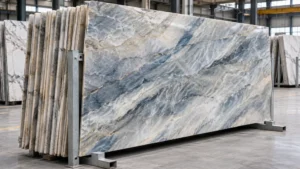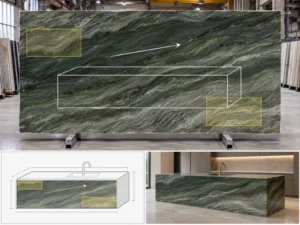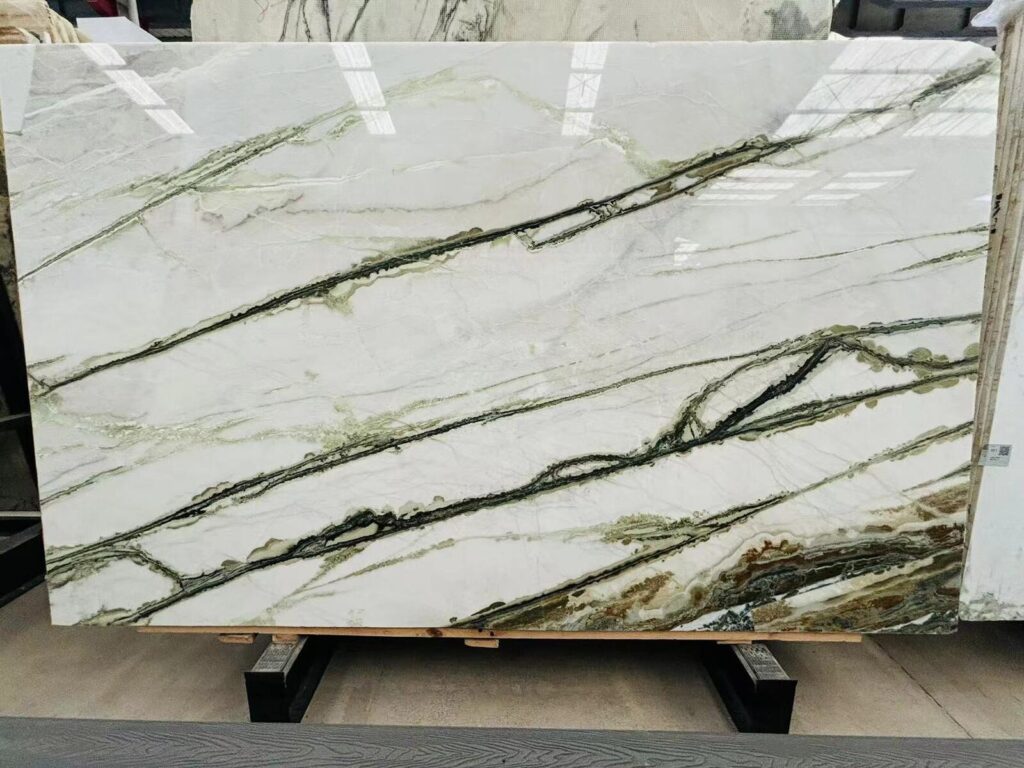


A Natural Quartzite project is already designed.
The main surface may remain polished or honed.
But one architectural detail is intended to look different.
Perhaps it is:
The designer proposes a sandblasted finish.
The drawing looks convincing.
The finish description sounds simple.
Then the actual Quartzite offcut is processed.
The stone appears lighter.
The polished depth disappears.
Fine mineral lines become softer while some crystalline areas become more tactile.
A dark feature reacts differently from the pale background.
The texture looks excellent under side light but noticeably rougher when viewed close.
This is the real reason to test Quartzite Sandblasted Details: Testing a Decorative Finish on an Offcut.
The project should not ask:
“Is sandblasted Quartzite a good finish?”
It should ask:
“Does this controlled sandblasted finish produce the intended visual and tactile result on this identified Natural Quartzite, in this project location, with this lighting and fabrication detail?”
The first correction is conceptual.
The project is not comparing:
Natural Quartzite
versus
Sandblasted Material.
It is comparing two surface conditions of the same stone.
The control may begin as:
Abrasive blasting modifies the exposed face and creates a textured surface.
Depending on the actual stone and process, the result can change:
Do not assume one Natural Quartzite will react exactly like another.
Record:
If the offcut comes from the actual selected slab, record that relationship.
If it is only a representative sample from another slab group, say so.
Same Natural Quartzite → Original Reference → Sandblasted Trial. The finish changes the surface condition; it does not create a new material category.
A sandblasted sample is much easier to interpret when part of the original stone remains available for comparison.
One useful approach is to divide a representative offcut into controlled areas:
Original Surface → Sandblasted Test Zone.
This reduces unrelated variation between two completely different pieces of Natural Quartzite.
If the fabrication process requires separate pieces, choose offcuts that are as closely related as practical.
Record that they are separate samples.
Without the original reference, reviewers may forget:
Before the abrasive process, record:
The site’s Etching vs Staining on a Quartzite Sample guide uses the same controlled-comparison principle: the strongest visual evidence often comes from the identified sample, same finish history, same lighting, and adjacent control rather than an unrelated internet photograph.
A finish trial can answer the wrong question if it uses only the easiest area of the slab.
A uniform pale area can show overall texture and colour change clearly.
But it may not reveal how the process interacts with stronger natural features.

If the production detail crosses a major mineral band, test an offcut that includes comparable movement where practical.
Crystalline areas may present different visual depth or texture after the reflective surface is removed.
Review rather than assume.
A darker area may retain a different contrast relationship after blasting than the surrounding pale stone.
If the actual production area contains known:
consider whether the finish test should include a representative area.
Do not assume that a trial on one pristine offcut automatically approves every treated or repaired zone.
The How to Define Acceptable Repairs in a Natural Quartzite Order guide explains why natural features, existing repairs, treatments, finished-piece location and fabrication evidence should remain connected.
A visual sample is useful.
A repeatable production reference is stronger.
Where known and controlled by the fabricator, the result can be influenced by factors such as:
This article does not prescribe universal settings.
The responsible fabricator should define and reproduce the process appropriate to the actual Natural Quartzite and required finish.
Two samples can both be described as sandblasted while showing noticeably different texture.
A useful approval therefore records:
A setting that produces an acceptable decorative surface on one limestone, granite, or another Quartzite should not automatically become the production specification for the current stone.
Use the project offcut to establish the current result.
| Test Variable | What to Record |
| Quartzite Reference | Material, sample ID and slab relationship where known |
| Original Condition | Polished / honed / sawn / other documented starting surface |
| Test Area | Representative mineral zone and sample face |
| Blasting Process | Controlled fabricator process reference where required |
| Post-Process Treatment | Brushing / washing / sealing / none / other confirmed step |
| Approval | Accepted / revise / reject / larger-area trial required |
The finish can change how the same geology is read.
A polished surface often gives Natural Quartzite greater visual depth and stronger reflection.
When that reflective face becomes textured, the stone may read lighter or flatter.
Do not treat this visual change automatically as damage or contamination.
Fine mineral lines that appear crisp under polish may become less visually dominant on a textured low-sheen face.
Broad bands, colour fields and major geological structures can remain clearly visible even after fine detail becomes softer.
The eye is no longer reading only the geological pattern.
It is also reading the granular or pitted surface texture.
At close range, that texture may dominate.
At room distance, the major stone movement may become more important again.
Review:
The site’s Polished vs Honed Quartzite for Kitchen Countertops guide explains the broader principle that reducing surface reflection changes perceived colour depth, contrast and pattern presentation even when the physical stone remains the same.
Original Quartzite → Colour Depth → Pattern Clarity → Reflection → Sandblasted Quartzite → Texture → Lower Reflection → Revised Pattern Reading. Approve the complete change, not only the roughness.
A textured finish can look very different depending on light direction.
This is useful for understanding:

Raking light can make the small surface relief much more visible.
It can help identify:
Raking light is useful for finding texture differences.
It can also exaggerate how noticeable those differences appear compared with normal viewing.
Review:
Normal Light → Raking Light → Normal Light Again.
The Quartzite Under Raking Light: Why Surface Marks Become More Visible guide explains why low-angle light is an effective diagnostic condition but should not answer the entire appearance-acceptance question by itself.
A decorative detail often contains a boundary between different finishes.
This can become more visually important than the centre of the sandblasted area.
If one finished component combines:
Polished Face → Sandblasted Decorative Zone
review the boundary.
Check whether it is:
Where the finish stops at a precise line, the trial should show whether the transition can be fabricated cleanly.

If the sandblasted surface reaches a visible edge, review:
Decorative wall and reception details may include:
The offcut or larger mock-up should include these interfaces if they are central to the design.
A flat 150 mm sample can show texture.
It may not show:
Expand the trial if those details are visually important.
A rougher decorative finish changes the way the surface interacts with water, residue and cleaning tools.
The test should reflect the actual application.
Use only the project-approved or technically appropriate cleaning approach.
Observe whether:
Photograph the sample clean and dry first.

For locations that may be cleaned with water or experience occasional wetting, compare:
Dry Before → Wet → Drying → Dry After.
A textured Natural Quartzite surface may look temporarily darker while wet.
Do not automatically call temporary wet darkening a permanent stain.
The sandblasted finish should be tested under the project’s expected exposure.
Do not state that all sandblasted Quartzite:
Those questions depend on the selected stone, finish, treatment, environment, substances and maintenance system.
If the detail is intended for flooring, steps or another walking surface, visual roughness alone does not establish a project-specific slip-resistance result.
Any required performance criterion should be addressed through the applicable project specification and appropriate testing route.
| Offcut Review | Question |
| Dry Appearance | Is colour, texture and pattern acceptable? |
| Raking Light | Is the texture reasonably consistent for the approved visual standard? |
| Wet Condition | How does temporary wetting change appearance? |
| Dry After | Does the sample return to the expected dry appearance? |
| Cleaning | Can normal project maintenance remove expected residue acceptably? |
| Transition / Edge | Does the decorative finish terminate cleanly at adjoining surfaces? |
A small offcut can answer many finish questions.
It cannot answer every project question.
A larger mock-up may be justified for:
A useful record can say:
Approved: sandblasted texture, dry colour direction and local polished-to-sandblasted transition on Sample SB-01.
Pending: large-panel uniformity and final production slab review.
This is stronger than:
“Sandblast approved.”
The sample becomes useful only when production can reproduce the approved intent.
Show exactly which surface is sandblasted.
Identify:

If the selected production slab contains significantly different geological zones from the test offcut, review whether the previous sample remains representative.
For important custom decorative work, the first finished production piece can provide an additional checkpoint.
Compare it with the approved sample using:
Do not submit only one attractive 50 mm close-up.
Show:
□ Actual Natural Quartzite identified.
□ Offcut or sample ID recorded.
□ Relationship to selected slab or slab group recorded where known.
□ Original surface condition documented before testing.
□ Untreated control retained where practical.
□ Representative mineral zone selected for the test.
□ Sandblasting process reference recorded where required.
□ Any brushing, washing, sealing or post-treatment recorded.
□ Dry appearance reviewed.
□ Colour shift reviewed.
□ Pattern visibility reviewed.
□ Texture uniformity reviewed.
□ Normal-light appearance reviewed.
□ Raking-light appearance reviewed where useful.
□ Edge and finish-transition detail reviewed where relevant.
□ Cleaning trial completed where maintenance is part of the decision.
□ Wet / dry appearance reviewed where relevant.
□ No unsupported slip-resistance claim made from visual texture alone.
□ Small offcut scope distinguished from large-area approval.
□ Current drawing identifies the exact decorative-finish zone.
□ Actual production slab or piece confirmed before finish transfer.
□ First-production review required where the project specifies it.
□ Final QC compares the actual decorative detail with the approved finish reference.
Sandblasted finishes can be produced on selected quartz-based natural stones, including some Quartzites, but the actual result should be tested on the specific Natural Quartzite being considered. Mineral structure, existing treatments, finish history and project requirements can affect the result. Use an identified offcut or representative sample before releasing important production work.
It can make the surface appear lighter or less colour-saturated because sandblasting removes the polished reflective condition and creates a textured surface that interacts with light differently. The actual visual change depends on the stone and process, so compare the sandblasted trial directly with an untreated control from the same or closely related material.
That is useful where practical, especially for a visually sensitive decorative detail. If the sample comes from another representative slab group, record that limitation. A finish approved on one offcut should not automatically be extended to materially different mineral zones or unrelated future slabs without review.
Not always. A small offcut can establish texture, general colour shift, sheen reduction and local finish quality, but it may not prove large-area uniformity, long finish transitions, pass consistency or the appearance across several geological zones. Large or highly visible work may require a larger mock-up or first-production review.
No universal statement should be applied. The textured surface changes how cleaning tools, water and residue interact with the stone, but practical maintenance depends on the actual texture, stone, treatment, use and cleaning system. Test the identified sample using the intended care method when maintenance is part of the project decision.
No. A textured appearance should not be treated as a project-specific slip-resistance result. Where the finish is proposed for floors, steps or other walking surfaces, use the applicable project specification and appropriate performance testing rather than inferring compliance from visual roughness alone.
Send Josh the proposed Natural Quartzite material, current slab or offcut reference where available, intended decorative location, finished dimensions, quantity, starting finish, required sandblasted area, edges and transitions, project drawings, lighting context, expected cleaning or wet exposure where relevant, and delivery destination. Identify whether you need a small offcut trial, a larger finish mock-up, an edge or transition sample, or first-production approval before the full order is processed.
For custom Natural Quartzite decorative finishes, HRST STONE can coordinate identified offcuts, polished or honed control references, sandblasted finish trials, edge and transition samples, larger mock-ups where required, project drawings, actual-slab references, fabrication QC, first-production photographs, packing and export documentation within the confirmed stone scope. Send Josh the material, intended finish location, drawings, dimensions, quantity, starting finish, edge or transition requirements, visual priorities and destination before full production release.