Quick Summary:
Attending Xiamen Stone Fair 2026 without a structured evaluation system increases procurement risk. This comprehensive supplier checklist helps global buyers verify factory ownership, slab consistency, fabrication control, inspection discipline, export readiness, and long-term supply stability before placing large stone orders.

Why a Structured Supplier Checklist Is Essential at Xiamen Stone Fair 2026
Xiamen Stone Fair 2026 will gather thousands of exhibitors representing marble, quartz, granite, sintered stone, and architectural fabrication services. For international buyers, the exhibition presents a valuable sourcing opportunity, but it also introduces complexity. With so many visually impressive booths and competitive quotations, decision-making can easily become influenced by surface-level comparisons rather than operational fundamentals. Professional procurement requires a structured evaluation method that goes beyond appearance.
Large-scale stone projects involve multi-container shipments, strict installation schedules, coordination between architects and contractors, and compliance with export regulations. A single inconsistency in slab grading, thickness tolerance, packaging discipline, or documentation accuracy can disrupt an entire project timeline. The purpose of a supplier checklist is to convert subjective impressions into measurable verification criteria. When buyers use a checklist systematically, they shift the conversation from marketing claims to operational evidence.
This structured approach also strengthens negotiation leverage. Suppliers who recognize that buyers evaluate them through objective checkpoints tend to provide clearer information and demonstrate stronger transparency. Ultimately, the checklist protects both sides by aligning expectations early in the sourcing process.
Section 1: Manufacturing Ownership and Production Capability
The foundation of reliable stone procurement begins with manufacturing ownership. Buyers must confirm whether the exhibitor operates as a direct manufacturer or primarily functions as a trading intermediary. While trading companies can provide convenience and communication support, they often rely on third-party factories for production. This additional coordination layer can reduce scheduling flexibility and complicate quality control alignment.
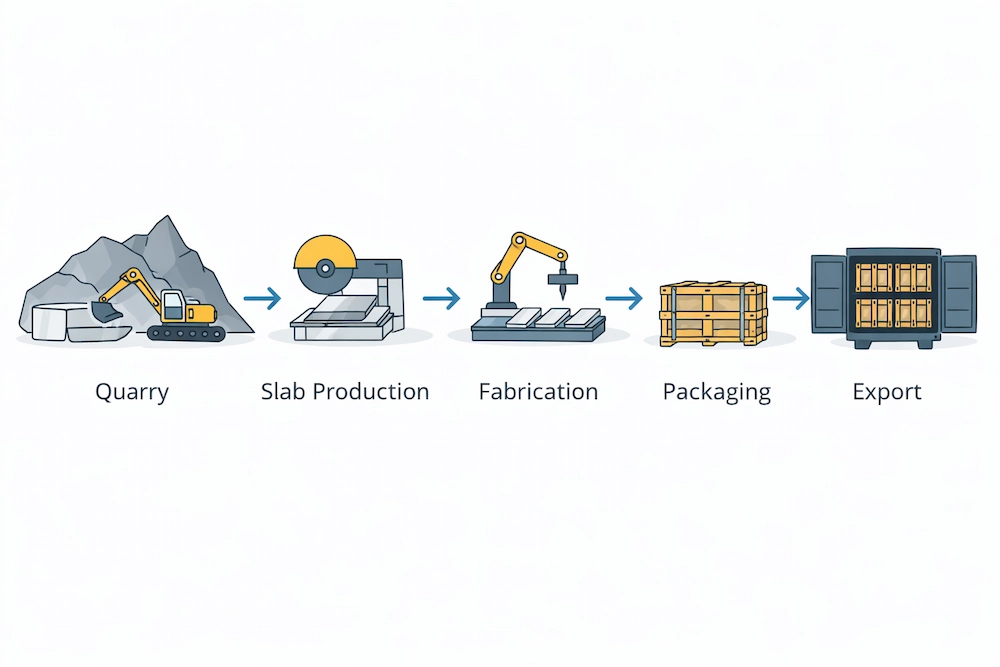
Direct manufacturers typically own cutting lines, polishing equipment, calibration systems, and fabrication workshops. Ownership of machinery enables tighter scheduling control and faster response to technical adjustments. Buyers should ask specific operational questions during booth discussions. How many cutting machines are currently in use? What is the daily slab output? How is production capacity allocated across multiple projects? Reliable manufacturers can explain their production flow clearly, from raw block arrival to final crate loading.
Production capability also includes engineering support. Complex architectural projects require technical drawing interpretation and dimensional accuracy verification. Suppliers with in-house technical teams reduce the risk of fabrication misunderstandings and on-site installation conflicts.
| Checkpoint |
Verification Focus |
| Own machinery and workshop |
Direct production control |
| Structured production schedule |
Lead time stability |
| Engineering support team |
Technical drawing alignment |
| Transparent capacity explanation |
Operational clarity |
Section 2: Slab Grading Transparency and Batch Consistency
Natural stone variation is unavoidable, but uncontrolled variation creates conflict. A professional supplier implements a structured grading system that categorizes slabs based on tone, veining intensity, and surface consistency. Buyers should request a documented explanation of grading criteria rather than accepting generic descriptions such as “premium selection.”
Batch consistency becomes especially important for projects requiring multiple shipments. Buyers should confirm whether slabs can be reserved from the same block for future production phases. Without reservation planning, subsequent shipments may differ visually from initial deliveries. Structured batch management ensures appearance continuity and reduces dispute potential.
Traceability also plays a crucial role. Slabs should carry identifiable references linking them to specific blocks or batch numbers. Traceability simplifies issue resolution and strengthens accountability. Suppliers unable to demonstrate traceable labeling practices may lack systematic inventory management.
| Checkpoint |
Verification Focus |
| Documented grading system |
Appearance consistency |
| Slab photo approval |
Expectation alignment |
| Batch reservation capability |
Future reorder stability |
| Traceable labeling |
Inventory control |

Section 3: Fabrication Accuracy and Dimensional Control
Fabrication precision determines whether stone fits correctly on site. Even minor tolerance deviations can lead to installation delays and additional labor costs. Buyers should confirm whether thickness measurement and dimensional calibration follow documented procedures. Digital calipers and standardized inspection tools should be used to verify slab thickness before shipment.
Edge finishing standards also require verification. Different markets may demand specific edge profiles or polishing levels. Suppliers who maintain standardized finishing procedures reduce inconsistency across project components. Structured inspection reports prior to container sealing demonstrate quality discipline and enhance trust.
Fabrication control reflects operational maturity. Factories that record tolerance measurements systematically are more likely to deliver repeatable results over long-term collaboration.
| Checkpoint |
Verification Focus |
| Thickness measurement system |
Dimensional accuracy |
| Edge finishing standards |
Consistency across units |
| Tolerance documentation |
Pre-shipment validation |
| Inspection reporting |
Quality transparency |
Section 4: Export Documentation and Packaging Discipline
International stone procurement requires more than material quality. Accurate commercial invoices, detailed packing lists, certificates of origin, and compliance documentation must be prepared correctly. Errors in documentation can delay customs clearance and increase demurrage costs. Buyers should confirm that the supplier maintains a standardized export documentation workflow.
Packaging discipline is equally critical. Marble and quartz slabs are heavy and susceptible to edge damage during transportation. Reinforced wooden crates, protective foam, moisture barriers, and balanced container loading reduce shipping risk. Suppliers should be able to describe their container loading procedure and provide photographic confirmation before departure.
Export-oriented manufacturers such as HRST STONE integrate documentation and packaging protocols into daily operations. Structured export readiness significantly reduces international supply chain uncertainty.
| Checkpoint |
Verification Focus |
| Standard export documentation |
Customs compliance |
| Reinforced packaging |
Damage prevention |
| Container load supervision |
Logistics control |
| Pre-shipment photo record |
Shipment transparency |
Section 5: Long-Term Supply Stability and Partnership Potential
Supplier selection should consider long-term collaboration rather than single-order execution. Buyers should evaluate whether marble suppliers maintain stable quarry access and whether quartz manufacturers operate consistent production lines capable of supporting repeat orders. Lead time predictability and communication responsiveness are key indicators of partnership potential.
Transparency during factory visits strengthens confidence. Suppliers willing to host structured inspections typically demonstrate stronger operational confidence and managerial discipline. Long-term supply stability depends on consistent systems rather than one-time performance.
By using a structured checklist across these five sections, buyers transform Xiamen Stone Fair 2026 into a controlled sourcing environment rather than an overwhelming exhibition experience.

Frequently Asked Questions
Why should buyers use a structured checklist at the fair?
Because structured evaluation reduces reliance on visual impression and ensures that operational systems are verified objectively.
How many suppliers should be evaluated deeply?
Most buyers shortlist eight to twelve suppliers for detailed comparison using structured checkpoints.
Can this checklist be applied during factory visits?
Yes, the same checkpoints can guide post-fair factory inspections and production follow-up discussions.
Is price less important than verification?
Price matters, but long-term delivery reliability and quality stability often have greater financial impact.
What is the biggest risk in international stone sourcing?
Uncontrolled variation, inconsistent fabrication tolerance, and incomplete export documentation are among the most common risks.
Should buyers verify documentation before paying deposits?
Yes, confirming documentation workflow and packaging standards before financial commitment reduces future disputes.
Final Note / Practical Takeaway
Expert Commentary & Analysis:
A structured supplier checklist converts Xiamen Stone Fair 2026 from a browsing event into a disciplined procurement process. Buyers who verify manufacturing ownership, grading transparency, fabrication accuracy, export readiness, and long-term supply stability reduce operational uncertainty and strengthen negotiation clarity. Sustainable sourcing partnerships are built on documented systems and transparent production practices rather than exhibition presentation alone.