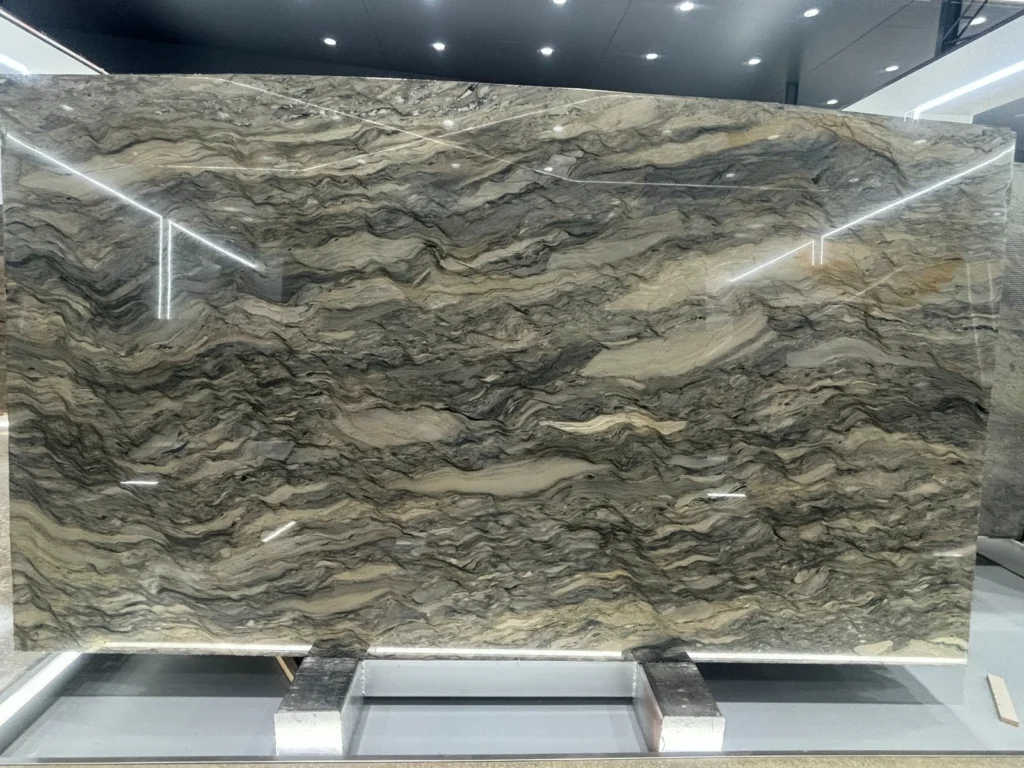


Furniture brands should approve a worked Quartzite edge sample before releasing a production run, but that sample must define more than the name of an edge profile. The approval should identify the stone construction, finished thickness, profile section, surface and edge finish, outside-corner treatment, visible underside and acceptable workmanship. For repeat furniture orders, connect the retained sample to the current manufacturing drawing, verify a first production piece and use the approved reference during factory QC. A small edge sample establishes a defined workmanship target; it does not automatically approve every future slab or the complete structural furniture assembly.
Quick SummaryA Quartzite furniture edge sample is a worked physical reference used to approve the geometry, finish and visible workmanship of a specified furniture edge before repeat manufacturing. Brand buyers should distinguish a material sample, a profile sample, a corner sample and a full pre-production furniture piece. The production baseline should identify the approved edge section, stone thickness, finish, corner transitions, sample ID and drawing revision. A first-article check then establishes whether the complete product can reproduce those approved details. Later production should be inspected against that baseline without demanding identical natural veining from every slab.
Quartzite furniture edge sample approval is the process of reviewing and accepting a physically fabricated edge detail that can serve as a defined reference for the subsequent production of custom natural-stone furniture.
This matters for furniture brands, private-label collections, hospitality furniture suppliers and interior product developers ordering multiple tables, consoles, shelves or stone furniture components from one or more production batches.
The edge is one of the most frequently viewed and touched parts of a piece of furniture. A small change in the radius, bevel, mitre, sheen or underside treatment can alter how the entire product appears.
That difference becomes a commercial problem when a furniture brand approves one attractive prototype but receives later pieces with noticeably different edge proportions or finishing quality.
A furniture development programme may use several types of physical Quartzite samples. These should not share one vague approval status.
| Sample Type | What It Can Establish | What It Cannot Establish Alone |
| Material Sample | General Quartzite appearance, local texture and material direction | Complete slab range, final edge geometry or finished furniture construction |
| Worked Edge Sample | Profile shape, face-to-edge finish, touch and local workmanship | Long-edge consistency, complete corner treatment or furniture assembly |
| Corner / Joint Sample | How edge geometry turns a corner or meets another fabricated component | Complete product fit, base connections or packaging suitability |
| Pre-Production Furniture Sample | Finished product proportions, edges, assembly interfaces and representative workmanship | Identical natural movement in every later Quartzite slab or automatic structural approval |
| First Production Article | Whether the defined production process produces a component consistent with the approved specification | Every future unit’s quality without further production inspection |
The correct starting question is:
Which decision will this particular sample authorize?
If the brand wants to approve a rounded tabletop edge, a worked profile sample may be sufficient for that decision.
If the concern is how the edge looks at a curved outside corner or a mitred return, a simple straight sample is not enough.
If the brand is about to release a new collection for repeated manufacturing, a complete pre-production article may be necessary to establish the relationship between the stone, the base, connections and packaging.
Terms such as eased, bevelled, rounded, bullnose and mitred are useful design descriptions.
They are not complete manufacturing instructions.
Two suppliers may interpret a “soft rounded edge” differently. One may fabricate a very small radius at the top arris. Another may produce a visibly broader curve.
Both may believe they followed the written request.
To prevent that problem, the production drawing should identify the actual profile section.
Relevant information can include:
The Quartzite bevel-versus-rounded-edge guide explains how two physically different profiles can create noticeably different reflections, visual thickness and tactile results even when fabricated from the same Quartzite.
For repeat orders, the brand should approve the physical section and finished sample together rather than relying on the edge name alone.
Edge Definition RuleProfile Name → Dimensioned Section → Actual Stone Construction → Worked Sample → Approved Production Reference
Every production unit should use the current approved profile, not an individual operator’s interpretation of a broad descriptive term.
The profile should be assessed in relation to the furniture’s intended design and use.

An eased edge reduces the sharpness of the arris while keeping the general appearance of a square stone section.
Review the scale of the easing, the consistency of the transition and how the edge feels when touched.
A bevel creates a distinct angled facet between the top surface and the vertical edge.
It may make a tabletop read as visually slimmer or more architectural, depending on the angle, width, material and lighting.
The sample should establish the actual facet rather than simply describing the result as a “small bevel.”
A rounded profile replaces a relatively sharp transition with a curve.
The radius affects apparent thickness, reflected light and touch.
The brand should review the curve from above, at normal furniture-viewing height and at outside corners.
A mitred construction can create the appearance of a much thicker piece of stone using separate components.
The visible edge height does not necessarily equal the thickness of the horizontal stone panel.
A mitred sample should demonstrate the joint, outside corner, side return, finishing and the actual construction behind the visible face.
It should not be treated as a solid-stone section unless the design actually uses one.
There is no universal best edge profile for every Quartzite furniture product.
A low coffee table, long console, dining table and decorative shelf can have different expectations for touch, visual proportion, fabrication and protection.
One of the highest-risk points in furniture edge approval is the outside corner.
A straight edge sample may have perfect geometry and a consistent polish, but the same profile can become difficult to reproduce where two sides meet.
Consider a rectangular Quartzite coffee table.
Its long edges use a broad rounded profile.
The designer approves a short, straight worked sample.
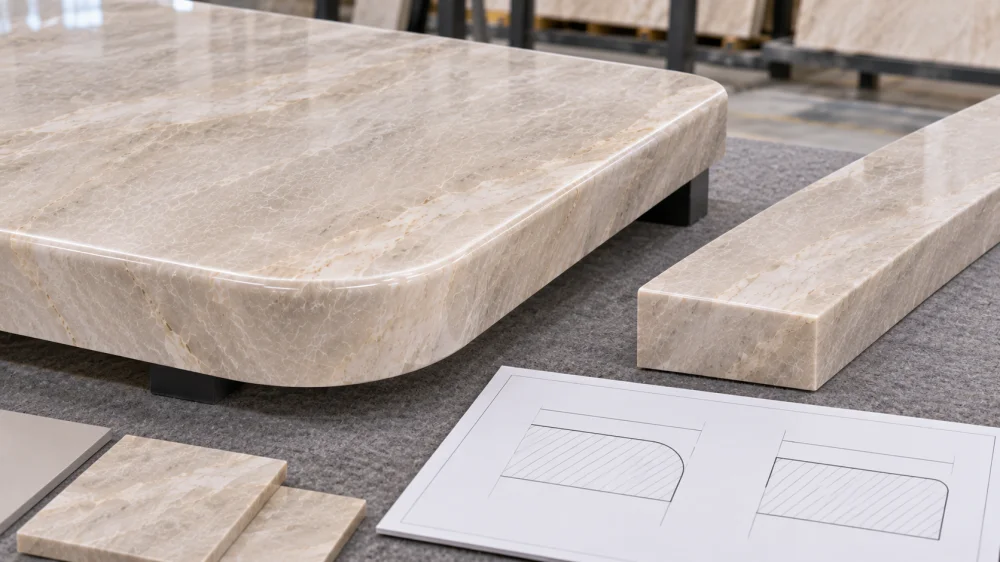
During production, the corners may develop a different radius, uneven reflected highlight or inconsistent transition to the short end.
The approved straight piece did not demonstrate the actual corner condition.
For brand production, the corner sample should include the important geometry:
An oval dining tabletop or rounded-rectangle side table may contain a continuously changing perimeter.
A straight sample cannot establish all of those transitions.
The brand may need a representative curved-edge section or a complete first article so the factory can demonstrate that the intended profile remains consistent around the curved perimeter.
Where the design creates a visually thick edge with a vertical fascia, the relevant control is not simply one polished bevel.
Review the assembled top-to-fascia joint, outside corner and end return.
Also confirm that the joint detail is compatible with the actual furniture assembly and support arrangement.
The physical approval should represent the geometry that customers will see in the finished product.
The face of a Quartzite tabletop and its worked edge may not have identical visual characteristics.
Natural mineral structures, cut-face orientation and finishing operations can influence how the edge reflects light.
A brand should review the complete face-to-edge transition rather than requiring artificial colour uniformity across every natural mineral zone.
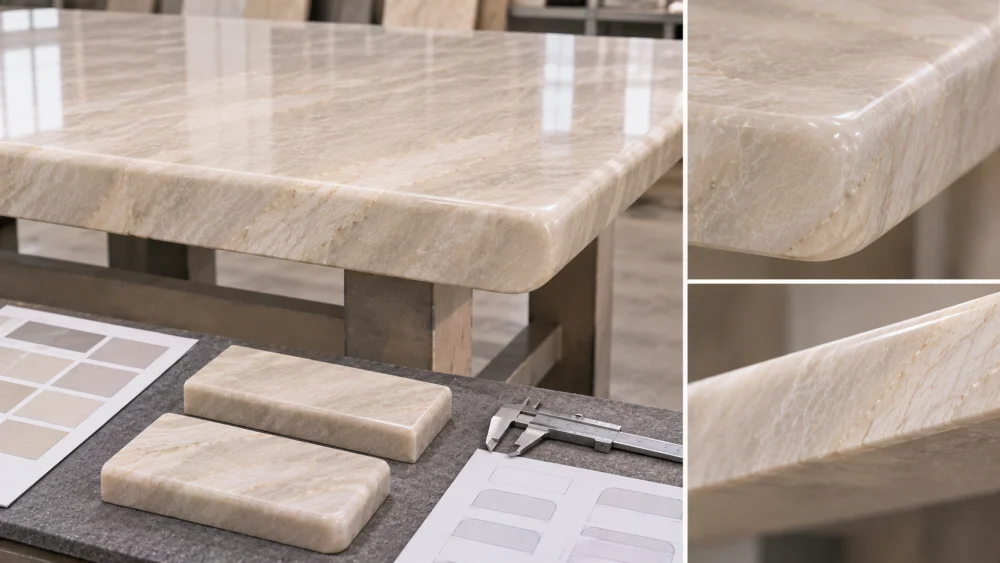
Check whether the finished edge has the intended relationship to the top surface.
For a polished top, the edge may be expected to have a comparable polished appearance.
For a honed top, the brand may prefer a softer, less reflective edge.
The exact acceptance criteria should be established by the approved sample and relevant specification.
Furniture edges are often touched directly.
Review the transition from the horizontal face over the front profile and toward the underside.
Check for unintended sharpness, rough local areas, abrupt profile changes and finishing residue.
An edge may look correct when viewed from above while the lower transition remains unfinished or uncomfortable to touch.
This can matter on dining tables, coffee tables, consoles and shelves where the underside is visible or reachable.
Quartzite contains natural variation.
A mineral line, local inclusion or change in background colour should not automatically be classified as a fabrication defect.
On the other hand, inconsistent tool marks, an unintentionally altered profile, unfinished polishing or physical edge damage may be workmanship issues.
The inspection criteria should distinguish those categories.
When there is a disagreement, compare the actual piece with the approved sample under agreed conditions instead of relying on phrases such as “too rough” or “not premium enough.”
A physical sample is more useful when it is connected to an unambiguous manufacturing record.
The approval pack should be understandable to a factory supervisor who was not present during the brand’s design meeting.
The following fields provide a practical format for a repeat-production furniture programme.
| Control Field | Example Reference | Why It Is Needed |
| Brand / Product SKU | Collection A / Coffee Table CT-01 | Identifies the product covered by the reference |
| Material / Finish | Natural Quartzite / Honed | Defines the material and surface-finish scope |
| Edge Profile Code | EP-02 | Links the edge to the approved section and sample |
| Physical Sample ID | ES-02 | Identifies the retained worked reference |
| Drawing Revision | FD-01 / Rev C | Prevents use of an obsolete manufacturing detail |
| Corner / Joint Detail | CS-01 | Controls outside corners and component transitions |
| Approval Scope | Profile geometry and visible finish only | Prevents an edge sample from becoming blanket furniture approval |
| Decision / Date / Owner | Accepted / Current Record | Connects the reference to an authorized review |
| Supersession Status | Current / Superseded | Avoids comparison with an obsolete sample |
All identifiers in this example are illustrative rather than actual HRST production records.
The physical sample and the approved drawing should refer to one another.
If a sample is replaced, preserve the history of what changed and identify the new reference.
The Quartzite sample-library status guide describes how sample IDs, source relationships, purposes and superseded references should be controlled so an old physical piece does not remain the production benchmark by accident.

An approved worked edge does not prove that a complete table, console or stone furniture assembly will work as intended.
For some simple components, the approved drawings and representative worked sample may provide sufficient evidence for the agreed production scope.
For a new furniture collection or a technically complex product, a full pre-production piece may be more appropriate.
A complete sample allows the buyer and fabricator to examine the edge in its actual product context.
For example, a rectangular dining table may require review of:
A pre-production sample may also reveal that a profile is difficult to reproduce consistently over a long curved perimeter or that the intended edge conflicts with a joining detail.
These are better identified before repeated components are manufactured.
A one-off prototype may require custom programming, special machining, manual development or additional trial work.
Its cost and production method do not necessarily represent the recurring cost of a standard production piece.
When a brand requests a repeat order, establish whether the approved prototype was made through the intended repeat-production process or whether the production method has changed.
The Quartzite prototype-cost guide for furniture brands explains why prototype development, one-off fabrication and recurring production pricing should be treated separately.
The important question for this article is whether the approved result can be reproduced by the final manufacturing process.
After the brand accepts the design reference, the factory should confirm that the intended production workflow produces the required result.
A first-article review is a useful hold point when the order volume, complexity or commercial exposure justifies it.
It should examine the real production component, not only a specially polished display offcut.
For a Quartzite furniture collection, check:

Where measurements are required, take them at defined inspection locations using the agreed dimensional basis.
Where appearance matters, compare the actual production piece with the retained sample under suitable, consistent conditions.
If the first production article does not meet the approved reference, correct and re-review the affected process before releasing unrestricted repeat fabrication.
Do not treat a single accepted first article as a guarantee that every subsequent unit will be acceptable without further quality control.
Production Transfer TestApproved Physical Edge → Current Shop Drawing → Real Production Process → First Article → Recorded Approval → Repeat Production
If the edge was approved using a hand-finished prototype but production will use a different CNC program, tooling or finishing sequence, verify the production result before relying on the earlier sample.
Repeatability requires both a defined reference and a practical inspection method.
Natural Quartzite should not be expected to show identical veining, but the agreed machining geometry and workmanship should remain controlled.

Operators and QC personnel should use the current drawing and approved sample rather than an outdated photograph or informal description.
Where several furniture models use similar profiles, the profile code should prevent confusion between them.
Edge results can change when tooling, machines, operators, finishing operations or material construction change.
The factory should define which changes require renewed verification.
That may include a change in:
Do not assume that identical program names guarantee identical physical results after a meaningful process change.
The brand and factory should establish what needs to be checked on the first piece, during production and before packing.
The scope may include dimensions, profiles, finish consistency, visible defects, corners and complete-product condition.
Any sampling frequency or numerical tolerance must come from the agreed product specification and quality plan.
Do not invent a universal AQL level, edge-radius tolerance or polish value and apply it to every natural-stone furniture order.
A batch may contain slabs with different mineral movement while all finished pieces are correctly fabricated.
Conversely, several visually similar slabs may still produce furniture with inconsistent edge machining.
These are different approval dimensions.
For brand production, evaluate:
Natural Stone Range — accepted colour and movement differences.
Fabrication Standard — controlled geometry, finish and workmanship.
Do not reject a correctly fabricated edge merely because its natural mineral pattern differs from the sample, unless that difference falls outside the separately approved material criteria.
A rejection is useful only if it tells the factory what should change.
Consider the following weak instruction:
“The edge looks wrong. Please make it more premium.”
The factory cannot determine whether the problem concerns radius, bevel width, corner transition, sheen, roughness or the apparent thickness.
A stronger review note identifies the actual condition.
Illustrative Edge-Rejection NoteProduct: CT-01 Coffee Table
Edge Sample: ES-02 / Rev C
Observation: The rounded transition appears broader than the approved physical reference at the outside corner, while the straight edge is visually consistent.
Required Action: Review the outside-corner processing method and submit a revised corner sample for confirmation before continuing the affected production scope.
Approval Status: Straight-profile appearance accepted; outside-corner detail remains pending.
This is a fictional example, not an actual factory nonconformance report.
The point is to isolate the deviation without reopening every previously approved decision.
Where production pieces are already affected, record the product IDs, quantity or defined scope, disposition and required corrective action.
Do not allow rejected items to return to accepted stock without the agreed reinspection or disposition.
Furniture brands often refine their collections after receiving a physical sample.
A buyer may request a smaller radius, a sharper bevel, a different finish or a thicker visual edge.
Such changes can affect more than appearance.
They may require:
Before accepting the change for production, identify its impact on the current product revision and any existing completed stock.
The revised physical sample should receive a clear reference.
The original sample should be retained or documented as superseded where necessary.
Do not keep two conflicting edge references marked “approved” for the same product and revision.
The final edge is often particularly vulnerable during handling and transportation.
A brand may approve a delicate visual profile that requires additional protection.
Final inspection should record:

For separate stone components, reinforced wooden frames, suitable base support, secure positioning and thin protective interleaving may be appropriate where the geometry and transport design allow.
Heavy stone panels should not be separated by large unsupported gaps or thick soft blocks that prevent stable restraint.
Finished furniture may require a different custom packing assembly than raw slabs because the edges, corners, support bases and connection hardware are already fabricated.
The approved edge profile should therefore inform the packaging design.
Where a table is shipped as separate top and base components, confirm the identification, hardware, assembly drawing and installation sequence before dispatch.
Furniture Production Release GateAn approved colour sample is not an approved edge. An approved straight edge is not automatically an approved corner. An approved prototype is not proof of every later production piece.
Release the defined furniture-production scope when the required material, edge section, corner construction, finish, drawings, first-article review and inspection plan have reached their agreed approval status.
Buyer Next Step: Send HRST STONE the furniture SKU drawings, selected Quartzite, actual thickness, finish, proposed edge profile, outside-corner detail, quantity, sample approval requirements and destination so the physical edge reference can be coordinated before repeat production.
A worked edge sample allows the brand and factory to agree on actual profile geometry, finish, touch and visible workmanship before repeat manufacturing. It reduces the risk that a descriptive term such as rounded or bevelled will be interpreted differently during production.
Not necessarily. A straight sample can establish a defined edge profile but may not show the outside-corner transition, full perimeter, base connection, assembled proportions or packing requirements. A complete pre-production piece or first-article review may be needed for the actual furniture design.
An edge sample focuses on a particular worked profile and its finish. A pre-production furniture sample represents a more complete product and can support review of dimensions, edge continuity, corner details, assembly interfaces and overall appearance within the stated approval scope.
The agreed fabrication geometry and workmanship should be controlled against the approved reference. Natural Quartzite colour, veining and mineral movement can vary between slabs, so the material’s visual range should be approved separately rather than requiring identical natural patterns on every piece.
Where corners are visually prominent or technically different from the straight edge, yes. A corner sample can reveal variations in radius, bevel transitions, mitred joints, polishing and underside treatment that a straight sample does not demonstrate.
It can serve as an approved manufacturing reference for defined characteristics if it is clearly identified and represents the intended production construction and quality. If the production method or geometry differs, verify a first production article rather than assuming the earlier prototype covers every change.
Update the relevant profile drawing, sample ID, approval and affected production documents. Review the impact on tooling, corners, finish, construction, cost and completed stock. The previous sample should no longer be treated as the current production reference for the changed detail.
Send the furniture drawings or CAD files, product SKUs, selected Quartzite or material references, actual thickness, surface finish, proposed edge sections, important corners, quantity, anticipated repeat-production scope, assembly information, required sample types, acceptance criteria and delivery destination. Specify which decisions must be approved before full production.