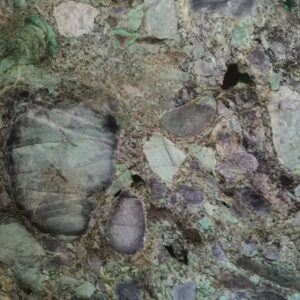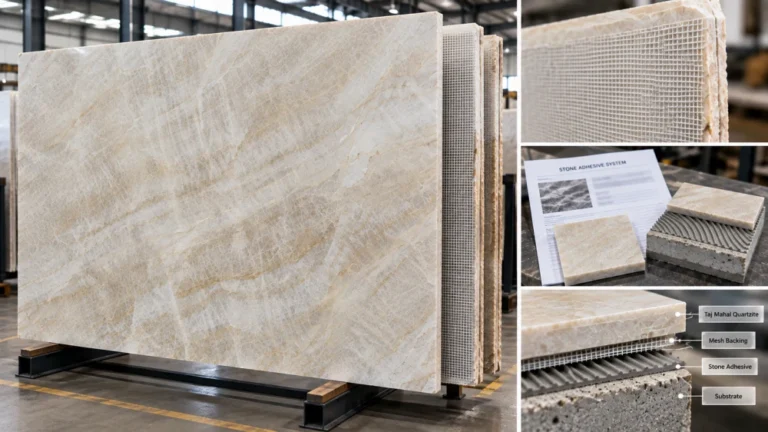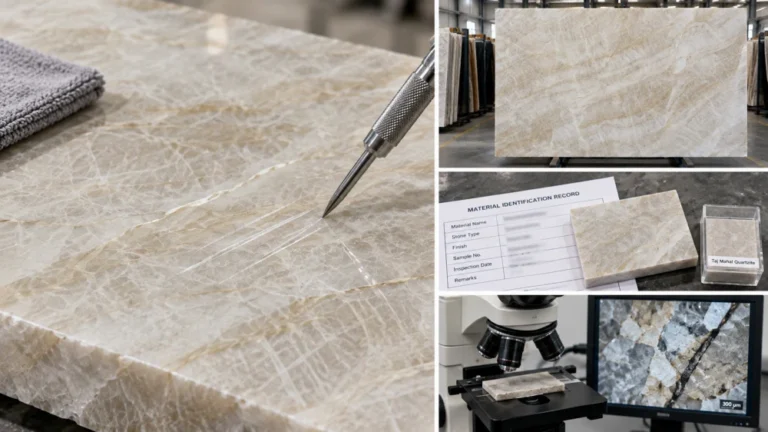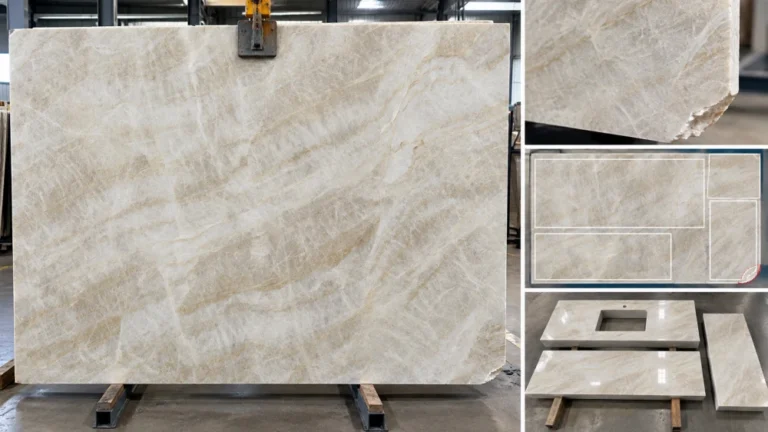

Patagonia White Granite is a highly expressive natural stone characterized by large white and ivory crystalline masses, warm beige-to-golden mineral sections, smoky grey transitions and contrasting black fragments. Its broad crystalline composition gives each slab a highly individual appearance and makes the material especially suitable for luxury projects where the stone itself is intended to become a focal architectural feature.
Brazil Origin
15mm / 18mm
Crystal Structure
Custom Fabrication

Natural Granite
Brazil
White / Ivory / Beige / Gold / Grey / Black
Slabs / Cut-to-Size / Custom Pieces
Patagonia White Granite Product Overview
Patagonia White, also searched as Patagonia Granite, White Patagonia or Patagonia Stone, is valued for its dramatic contrast between large pale crystal fields and darker mineral structures.
Some slabs are dominated by milky-white and ivory crystal zones, while others contain stronger beige, gold, smoky grey or black mineral areas. This gives each Patagonia Slab a different visual balance and makes actual slab selection essential for large visible applications.
Because selected crystal areas may transmit light, Patagonia can also be considered for controlled Backlit Patagonia applications where translucency is tested and mapped before fabrication.

Product Specifications
| Item | Specification Details |
| Material Name | Patagonia White Granite |
| Alternative Names | Patagonia White / Patagonia Granite / White Patagonia / Patagonia Extra |
| Material Type | Natural Granite |
| Origin | Brazil |
| Primary Colors | Milky White, Ivory, Cream, Beige, Gold, Smoky Grey and Black |
| Texture Pattern | Large irregular crystalline fields combined with warm mineral zones and contrasting dark fragments |
| Translucency | Selected crystal zones may transmit light; intensity varies by slab and section |
| Available Thickness | 15mm / 18mm |
| Surface Finishing | Polished / Honed / Leathered / Project-Specific Finish |
| Supply Forms | Slabs, Countertops, Island Tops, Vanity Tops, Backsplashes, Wall Panels, Fireplace Pieces, Table Tops and Custom Components |
| Application Scope | Luxury Residential, Villas, Hotels, Kitchens, Bathrooms, Feature Walls, Fireplaces, Bars and Custom Furniture |
| Custom Fabrication | Cut-to-Size, CNC Openings, Miters, Edge Profiles, Waterfall Pieces, Wall Panels, Fireplace Components and Table Tops |

How to Select Patagonia White Granite
For Patagonia White Granite, buyers should evaluate the complete relationship between pale crystalline areas, warm beige-gold mineral structures, smoky grey transitions and black fragments.
For a Patagonia Counter, Patagonia Island or feature wall, the most attractive crystal areas should be allocated deliberately before cutting. Large black fragments and natural structural zones should also be considered when positioning openings and narrow components.
If a brighter result is preferred → Choose slabs with larger milky-white and ivory crystal areas.
If a warmer composition is desired → Choose slabs with stronger beige and gold mineral zones.
If greater contrast is required → Choose slabs with more visible smoky grey and black structures.
If backlighting is planned → Test actual crystal zones before fabrication rather than assuming uniform translucency.
Patagonia White Granite Applications
The dramatic composition of this Luxury White Stone makes Patagonia particularly suitable for applications where large-scale crystal structure can remain visible.
Patagonia Island
Large kitchen islands allow the white crystal, warm beige-gold and darker mineral structures to remain visible at full architectural scale.
Patagonia Counter
Countertops can be fabricated with sink openings, cooktop cutouts, edge profiles and seams coordinated with the actual slab composition.
Patagonia Vanity
Vanity tops can use selected pale crystal areas with basin openings, faucet holes, backsplashes and finished edges based on approved drawings.
Patagonia Wall
Large wall panels can display the full crystalline composition in villas, hotels, reception areas and premium commercial interiors.
Patagonia Fireplace
Fireplace surrounds can use large crystal structures and dark fragments deliberately around the opening to create a dramatic architectural focal point.
Patagonia Table Top
Dining tables, coffee tables, consoles and bar tops can use selected crystalline sections as high-value custom furniture surfaces.
Kitchen and Backsplash Coordination
A Patagonia Kitchen can use the stone as the dominant island material or as a more controlled White Countertop. Because the slab already contains several strong colors and mineral structures, surrounding cabinetry and finishes should be coordinated after actual material selection.
For a Patagonia Backsplash, the countertop and wall pieces should ideally be laid out together. Major crystal fields and black fragments can look disconnected if horizontal and vertical components are cut independently.
If the kitchen uses pale cabinetry → Slabs with stronger black mineral fragments can create more architectural contrast.
If countertop and backsplash use the same material → Approve both layouts together before cutting.
Crystal Structure and Backlit Potential
One of the defining visual characteristics of Patagonia is the presence of large pale crystalline zones. Some of these areas may transmit light, which allows selected slabs to be considered as Translucent Granite for illuminated architectural details.
However, light transmission is not uniform. Beige, grey or black mineral structures can block or reduce light compared with clearer crystal areas.
If only part of the slab transmits light → Map those areas and allocate them to the intended illuminated sections.
If uniform lighting is required → Coordinate stone thickness, support spacing, LED layout and panel joints together.
Feature Walls and Bookmatched Layouts
A Patagonia Wall Panel application allows the large-scale crystal and mineral structure to remain visible across a broad architectural surface. This is often more effective than dividing the material into many small pieces.
Selected slabs may also be evaluated for Patagonia Bookmatch layouts where paired slab faces create a mirrored or coordinated composition. Actual slab pairs should be reviewed because natural crystal and dark mineral structures may not produce perfect symmetry.
Actual Slab Review → Slab Pairing → Wall Elevation → Panel Dimensions → Joint Position → Crystal Coordination → Cutting Layout → Dry-Lay Review → Final Approval
Large-Scale Crystal and Cutting Layout
Patagonia is an Exotic White Stone with exceptionally large mineral structures. A single crystal field, beige zone or black fragment can occupy a substantial portion of a finished island, wall panel or table top.
For premium projects, finished-piece placement should therefore guide the cutting plan. Cutting purely for maximum yield can remove important crystal areas inside openings or place visually weaker zones on focal components.
If several focal pieces are required → Allocate the strongest crystal sections to the most visible components first.
If sink or cooktop openings are required → Position them away from the most valuable crystal areas where practical.
Application Selection Guide
| Project Requirement | Recommended Form | Selection Priority |
| Statement kitchen island | Large Patagonia Slab | Crystal composition and waterfall continuity |
| Luxury countertop | Patagonia Counter | Opening position and visible crystal zones |
| Feature wall | Patagonia Wall Panel | Panel sequence and crystal continuity |
| Backlit architectural feature | Selected translucent Patagonia areas | Rear-light testing and crystal-zone mapping |
| Statement furniture | Patagonia Table Top | Visible crystal composition and finished edge quality |
Surface Finishes and Fabrication
Polished Patagonia
A polished finish enhances crystal depth, warm beige-gold mineral areas and the contrast between pale and dark structures.
Honed Patagonia
A honed finish reduces surface reflection and produces a softer architectural appearance while retaining the large natural crystal structure.
Custom Fabrication
Processing can include CNC openings, miters, waterfall returns, edge profiles, wall panels, fireplace pieces, vanity tops, bar fronts and custom furniture components.
Key Procurement Risks
A small sample cannot represent the full crystal scale, beige-gold zones or dark mineral distribution. Full-slab review is strongly recommended.
Some crystal zones transmit more light than others. Backlit performance should be tested on the actual slab.
The strongest crystal areas may be lost inside sink or cooktop openings or used on secondary components when slab mapping is skipped.
Large crystal boundaries, fissures and repaired areas should be evaluated before assigning narrow strips, openings or highly stressed fabrication details.
Common Purchasing Mistakes and Consequences
| Common Mistake | Possible Consequence | Recommended Control |
| Ordering from sample only | Unexpected full-slab crystal composition | Approve actual slab photos or video |
| No translucent-zone test | Uneven backlit appearance | Test the actual slab from behind |
| No finished-piece layout | Best crystal areas used on secondary pieces | Allocate focal surfaces before cutting |
| Incomplete fabrication drawings | Incorrect openings, seams or edge details | Approve CAD or shop drawings before fabrication |
| Comparing slab price only | Incomplete finished-project cost comparison | Compare usable yield, fabrication, packing and logistics |
Custom Fabrication and Quality Control
Patagonia White Granite can be fabricated into countertops, waterfall islands, vanity tops, backsplashes, wall panels, fireplace surrounds, table tops, bar tops and other custom architectural components according to approved CAD or shop drawings.
Before cutting, actual slab identity, visible face, crystal zones, beige-gold mineral areas, dark fragments, natural fissures or repaired areas, finished dimensions, cutout positions, seam locations and exposed edges should be reviewed.
Material Inspection → Actual Slab Selection → Crystal & Structural Review → Translucency Test Where Required → Slab Mapping → Drawing Approval → Cutting Layout → Cutting → CNC & Edge Fabrication → Dry-Lay Confirmation → Final QC → Packing Inspection
Packaging and Project Delivery
Finished Patagonia White Granite components should be packed according to their dimensions, geometry, weight and breakage risk. Large islands, countertops with openings, wall panels, fireplace pieces and long furniture tops require appropriate internal support during handling and international transportation.
Finished surfaces should be separated with soft non-staining protective materials. Exposed corners, polished edges, openings and vulnerable crystal zones should receive additional cushioning before components are securely fixed inside reinforced fumigated wooden crates.
Information Required for Quotation
For accurate B2B pricing, provide the main project requirements so slab quantity, usable yield, fabrication complexity, packing and logistics can be evaluated together.
Island / Counter / Wall / Fireplace / Table
Finished component sizes
Pieces or total area
15mm / 18mm
Polished / Honed / Leathered
Required / Not Required
Edges / Cutouts / Miters / Waterfall
Port or delivery address
Patagonia White Granite FAQ
1. What does Patagonia White Granite look like?
Patagonia White Granite typically combines large milky-white and ivory crystalline areas with beige, gold, smoky grey and black natural mineral structures. Exact composition varies considerably between slabs.
2. Is Patagonia White Granite a natural Brazilian stone?
Yes. Patagonia White is a Brazilian natural stone, so crystal size, color balance, dark fragments and natural mineral structures vary from slab to slab.
3. Can Patagonia White Granite be used for countertops?
Yes. Patagonia Counter applications can be fabricated with sink openings, cooktop cutouts, edge profiles and seams coordinated according to the selected slab layout.
4. Is Patagonia Granite suitable for kitchen islands?
Yes. Patagonia Island applications are particularly effective because large surfaces allow the dramatic crystalline composition to remain clearly visible.
5. Can Patagonia Granite be used for backsplashes?
Yes. Patagonia Backsplash pieces can be coordinated with countertops or islands so large crystal zones and darker structures remain visually connected.
6. Can Patagonia White Granite be used for feature walls?
Yes. Patagonia Wall and Patagonia Wall Panel applications are among the strongest uses because broad surfaces can display the complete crystal and mineral composition.
7. Can Patagonia Granite be backlit?
Selected pale crystal areas may transmit light, but translucency varies across each slab. Actual rear-light testing should be completed before any backlit design is finalized.
8. Can Patagonia White Granite be bookmatched?
Selected slab pairs can be considered for Patagonia Bookmatch applications, but actual faces should be reviewed because natural crystal structures may not create perfect mirror symmetry.
9. Which finish is suitable for Patagonia White Granite?
Polished Patagonia emphasizes crystal depth and mineral contrast, while honed finishes create a softer lower-reflection appearance. Leathered finishes may also be considered for selected applications.
10. What affects Patagonia White Granite price?
Price depends on crystal quality, slab composition, dimensions, thickness, usable yield, finish, fabrication complexity, translucency requirements, quantity, packaging and shipping destination.
Final Note / Practical Takeaway
Patagonia White Granite is best suited to projects where dramatic natural crystal structure is intended to become part of the architectural identity. Its white and ivory crystalline masses, warm beige-gold mineral zones, smoky grey movement and contrasting black fragments work especially well for kitchen islands, countertops, backsplashes, feature walls, fireplaces and custom stone furniture. For B2B procurement, actual slab selection, crystal-zone mapping, structural review, cutting layout, finish approval, fabrication drawings, QC and export packaging should be evaluated together. If a brighter appearance is preferred → choose slabs with larger pale crystal zones. If a warmer result is desired → choose slabs with stronger beige and gold areas. If backlighting is planned → test the actual slab before fabrication rather than assuming uniform translucency.