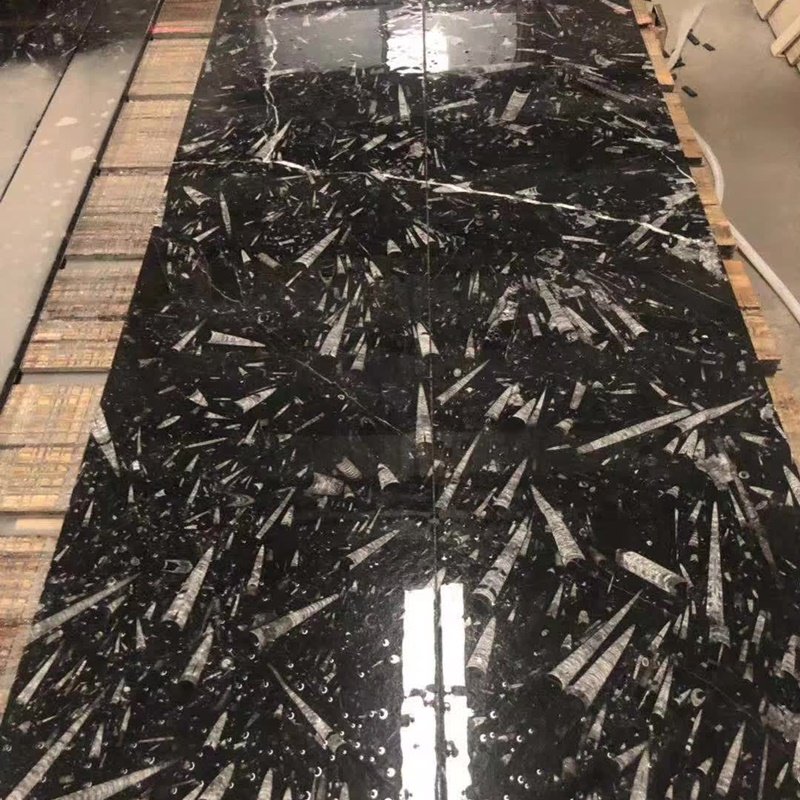
Fossil Black Marble Overview
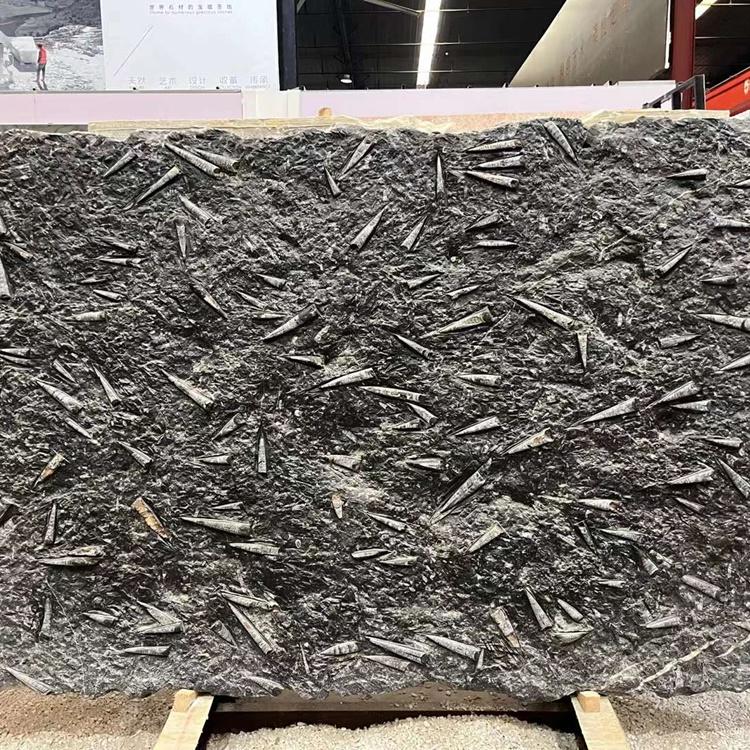
Fossil Black Marble is a distinctive natural marble from Morocco featuring a dark black matrix filled with contrasting shell fossils and irregular organic mineral structures.
The material is also commercially associated with names such as Black Fossil Marble, Nero Fossile, Fossile Black and Nero Fossil Marble.
Unlike black marbles dominated by conventional linear veining, its visual identity comes primarily from actual fossil-like shapes embedded within the dark stone.
This geological character makes the material suitable for architectural projects where the stone itself is intended to become a visible design feature.
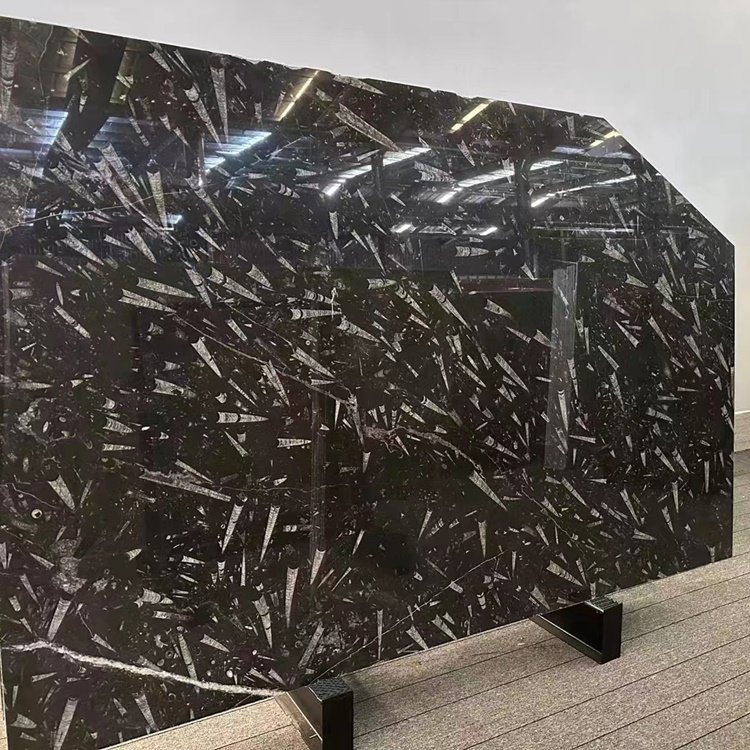
Product Specifications
| Specification | Project Details |
| Material Name | Fossil Black Marble |
| Material Type | Natural Marble / Fossil-Bearing Limestone-Based Decorative Stone |
| Origin | Morocco |
| Primary Colors | Deep Black / Charcoal / White / Pale Grey |
| Texture Pattern | Shell Fossils / Organic Fragments / Irregular Fossil Clusters / Dark Matrix |
| Standard Thickness | 18mm / 20mm; other project thicknesses subject to confirmation |
| Available Forms | Slabs / Tiles / Wall Panels / Vanity Tops / Countertops / Cut-to-Size |
| Available Slab Size | Subject to Current Block and Slab Inventory |
| Custom Size | Produced According to Approved Drawings and Slab Yield |
| Surface Finishing | Polished / Honed / Brushed / Project-Specific Finish |
| Edge Options | Straight / Eased / Beveled / Mitered / Custom Profile |
| Application | Feature Walls / Floors / Vanities / Counters / Furniture / Interior Stonework |
| Package Details | Surface Protection + Edge Protection + Reinforced Fumigated Wooden Crates |
| MOQ | According to Slab, Tile or Custom Fabrication Requirements |
| Delivery Time | Confirmed According to Quantity, Slab Availability and Fabrication Scope |
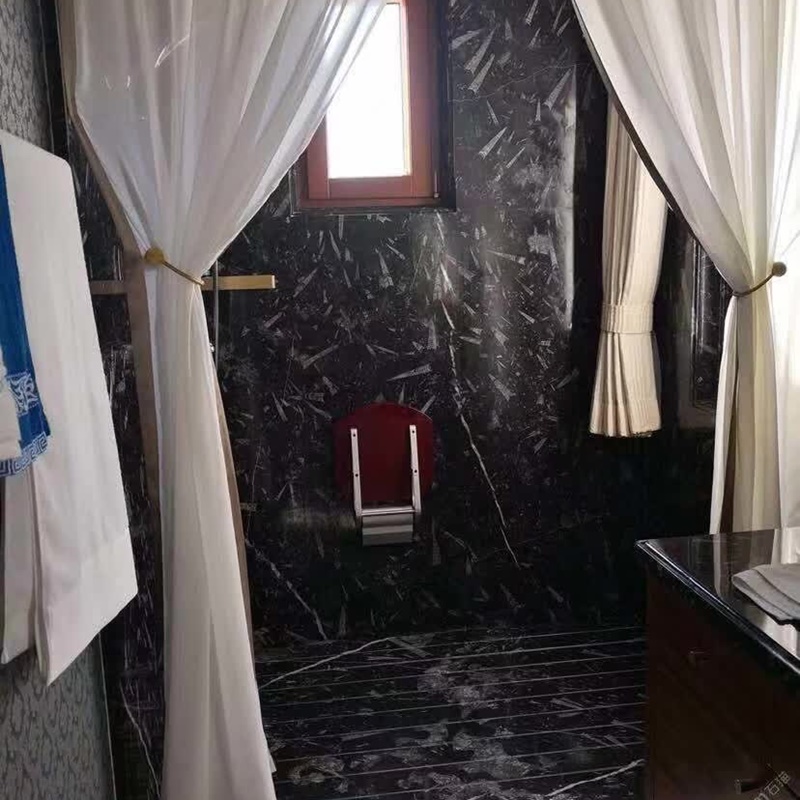
Natural Shell Fossil Character
The main visual value of this Fossil Marble comes from pale shell and organic forms naturally preserved within the dark matrix.
Individual fossils can vary in size, orientation and concentration. Some areas may contain clearly recognizable larger shell forms, while others show fragmented white-grey fossil clusters.
This makes Shell Fossil Marble fundamentally different from a conventional black stone with artificial-looking repeated markings.
The result is a geological surface where each slab has its own fossil composition.
Moroccan Black Marble Character
As a Morocco Black Marble, Fossil Black combines a dark architectural base with visible natural history inside the stone.
The black field may range from deep black to charcoal depending on the block, finish and lighting, while the fossils normally appear in white, cream-grey or pale mineral tones.
For buyers searching Morocco Fossil stone, the most important visual distinction is therefore not simply how black the slab is, but the relationship between its black negative space and fossil content.
Deep Black Matrix → Provides the architectural background and contrast.
Large Shell Fossils → Create recognizable natural focal details.
Small Fossil Fragments → Add finer geological texture between major shell forms.
Natural Variation → Changes fossil density, scale and placement between slabs.
Fossil Black Marble Slabs
A Fossil Marble Slab should be purchased by reviewing the complete slab surface rather than relying only on a small physical sample.
For a Fossil Black Slab, the full slab reveals the actual fossil density, fossil scale, background depth and areas available for finished-piece nesting.
A Black Marble Slab with large fossils can look very different after being divided into smaller components, so the finished product dimensions should be considered during material selection.
For a Large Marble Slab used in a wall, reception counter or furniture piece, large shell fossils can be intentionally retained as focal elements.
Slab Approval Before Fabrication
Full-slab approval is particularly important for fossil-bearing stone because a small sample cannot represent the complete pattern range.
| Approval Point | What Buyers Should Review |
| Black Field | Compare background depth across the slabs required for one project zone |
| Fossil Density | Define whether the project requires restrained, medium or fossil-rich surfaces |
| Fossil Size | Identify large shell forms before determining cutting positions |
| Micro-Fissures | Review their position relative to narrow pieces, cutouts and exposed edges |
| Resin Treatment | Inspect visible repairs, color matching and finished surface quality |
| Usable Yield | Confirm finished components can be nested within approved slab areas |
Fossil Black Marble Feature Walls
A Black Marble Wall made from Fossil Black creates a dark architectural surface while retaining visible natural fossil detail.
As a Feature Wall Marble, it can be considered for hotel lobbies, reception areas, restaurants, luxury residences, retail interiors and other high-visibility spaces.
For large Marble Wall Panel projects, the objective is usually to balance large shell fossils, smaller fragments and black negative space across the complete elevation.

Wall Layout and Fossil Placement
Fossil Black does not require conventional vein matching in the same way as strongly directional marble.
Instead, the layout should focus on fossil scale, visual balance and the relationship between patterned and quieter black areas.
Recommended Project Workflow:
Actual Slab Selection → Full-Slab Photography → Wall Elevation → Fossil Mapping → Panel Cutting Layout → Joint Review → Piece Numbering → Dry-Lay → Final QC
Large fossils should not be accidentally divided by an important architectural joint when an alternative cutting position can preserve them more effectively.
Fossil Black Marble Flooring
A Fossil Marble Floor provides a dark base with visible natural shell details distributed across the installation.
When producing Fossil Marble Tile, individual pieces can show significantly different fossil content depending on their original slab position.
For a large Black Marble Floor, tiles should therefore be sorted before installation rather than opened and installed randomly from individual crates.
A controlled mix of fossil-rich and quieter pieces generally produces a more balanced architectural result.
Fossil Black Marble Countertops
A Marble Countertop made from Fossil Black can create a distinctive surface for reception counters, bars, bathroom furniture and selected residential applications.
Before cutting, the countertop template should be positioned over the approved slab so large shell fossils can be retained in intentional locations.
Sink openings, service cutouts and seams should also be checked against natural micro-fissures and resin-treated areas.
Because this remains a natural carbonate stone, project specifications should account for normal marble care, sealing and sensitivity to acidic substances.
Fossil Black Marble Vanity Tops
A Marble Vanity Top is particularly suitable when the designer wants the fossil structure to remain visible at close viewing distance.
The basin template should be overlaid on the actual slab before cutting so an important shell fossil is not unnecessarily removed by the basin opening.
Backsplashes and side returns can be produced from adjacent slab areas where closer visual continuity is required.
For hotel projects with multiple bathrooms, finished pieces can be allocated and numbered by room after visual sorting.
Polished Fossil Black Marble
Polished Marble emphasizes the contrast between the black matrix and pale fossil structures, making shell details easier to identify.
However, polishing also makes surface flatness, resin treatment, scratches and local gloss differences more visible on the dark background.
Finished pieces should therefore be inspected under broad reflected lighting before packing rather than checking only from a direct front view.
Micro-Fissures and Resin Treatment
Natural micro-fissures and pores can occur within fossil-bearing stone, particularly around mineral transitions and complex fossil structures.
Appropriate resin treatment can stabilize and fill suitable areas during slab preparation, but buyers should still inspect the final visible surface.
The important question is not simply whether resin exists, but whether the treated area is structurally appropriate, flat, well color-matched and visually acceptable after finishing.
For narrow bridges around sinks, long strips and other vulnerable components, the cutting layout should avoid questionable areas where practical.
B2B Procurement Risk Control
| Procurement Risk | Recommended Control |
| Fossil density differs from the approved sample | Approve actual full slabs before material reservation and cutting |
| Large fossils are lost inside cutouts | Overlay finished templates on slab photos before fabrication |
| Wall panels have unbalanced fossil distribution | Prepare full-elevation cutting and dry-layout plans |
| Micro-fissure crosses a vulnerable component | Review structural condition before final nesting and cutting |
| Resin treatment is visible after polishing | Inspect color, flatness and gloss under reflected lighting |
| Finished pieces are installed in the wrong sequence | Use dry-lay records, piece numbers and corresponding packing marks |
Custom Fabrication and Quality Control
Fossil Black fabrication should begin only after the material range and finished-piece layout have been established.
Approved material traceability
Pattern-range comparison
Finished-piece layout review
Structural suitability check
Finished size verification
Profile and corner inspection
Resin and finish inspection
Inspection before packing
Packaging and International Delivery
Fossil Black Marble packaging should be designed according to the actual component size, weight, edge profile and fracture risk rather than using one standard packing method for every order.
Finished visible faces receive soft protective materials, while corners, exposed edges and vulnerable cutout areas require additional cushioning.
Wall panels and other sequential components can be packed according to their installation numbers so the site team can identify the correct sequence more efficiently.
Finished stone is secured inside reinforced fumigated wooden crates using suitable separators, internal blocking and edge protection. Production inspection and final packing inspection are completed before shipment, with export documentation and logistics support available for international orders.
Working with a Marble Supplier
A professional Marble Supplier should help buyers understand the actual slab range rather than treating every Fossil Black slab as visually identical.
Useful procurement support includes current slab photography, fossil-density comparison, slab measurements, micro-fissure inspection, CAD cutting layouts, wall elevations, dry-lay records, fabrication QC, finished-piece numbering and export packing.
For project buyers, this process provides better control over both the geological appearance and the usable fabrication yield of the selected material.
Why Choose HRST STONE
HRST STONE provides one-stop natural stone solutions backed by 17+ years of stone supply and international project experience.
For Fossil Black Marble projects, support can cover slab selection, full-slab photography, CAD and shop drawings, cutting optimization, wall-panel layouts, vanity and countertop fabrication, dry-lay checking, surface inspection, final QC and international export packing.
This integrated workflow helps designers, importers, contractors and project purchasing teams control fossil appearance, material yield, fabrication accuracy, installation sequence and delivery risk from slab approval through shipment.
Information Required for Quotation
| Quotation Item | Information Required |
| Product Form | Slabs / Tiles / Walls / Floors / Vanities / Counters / Cut-to-Size |
| Dimensions | Required slab or finished component dimensions |
| Quantity | Number of slabs, pieces or total project area |
| Thickness | 18mm / 20mm or specified project thickness |
| Finish | Polished / Honed / Brushed / Other specified finish |
| Fossil Preference | Restrained / Medium / Fossil-Rich / Large Shell Features |
| Fabrication | Cutouts / Edge Profiles / Wall Panels / Vanity Tops / Custom Processing |
| Destination | Destination port or complete project delivery location |
Fossil Black Marble FAQ
1. What is Fossil Black Marble?
Fossil Black Marble is a natural Moroccan decorative stone characterized by a dark black matrix containing contrasting white-to-grey shell fossils and organic fragments.
2. Where does Fossil Black Marble come from?
The commercial material is associated with Morocco and is widely selected for architectural and decorative natural stone applications.
3. Is Nero Fossile another name for Fossil Black Marble?
Nero Fossile and Nero Fossil Marble are commonly used commercial naming variants for Moroccan black fossil-bearing stone.
4. Why do Fossil Black Marble slabs vary?
Fossil density, fossil size, black-background depth, mineral structure, micro-fissures and natural surface characteristics vary according to the individual block and slab.
5. Is Fossil Black Marble suitable for feature walls?
Yes. Large panels allow the natural shell fossils to become visible architectural features, especially when slab selection and panel layout are coordinated before cutting.
6. Can Fossil Black Marble be used for flooring?
Yes. Floor tiles and cut-to-size pieces can be produced, with pre-sorting recommended to balance fossil-rich and quieter pieces across the installation.
7. Can Fossil Black Marble be used for countertops?
Yes, particularly for decorative counters and selected residential or hospitality applications. Buyers should account for normal marble sealing, maintenance and acid sensitivity.
8. Does Fossil Black Marble require resin treatment?
Resin treatment may be used during slab preparation to address suitable pores and micro-fissures. Finished visible areas should still be inspected for repair quality, color matching and surface flatness.
9. What should buyers approve before cutting?
Approve actual slab photos, fossil density, fossil size, black-field depth, micro-fissure condition, visible repairs, slab dimensions and finished-piece layouts.
10. How is Fossil Black Marble packed for export?
Finished components receive suitable surface, edge and corner protection before being secured in reinforced fumigated wooden crates according to size, weight and fracture risk.
Final Note
Fossil Black Marble should be purchased according to the actual slab composition rather than fossil samples alone. For feature walls → approve fossil scale, black negative space and full-panel distribution before cutting. For floors → pre-sort pieces to avoid uncontrolled fossil concentration. For counters and vanities → overlay finished templates so important shell fossils are retained while questionable fissures remain away from vulnerable cutouts. Full-slab approval, resin and micro-fissure inspection, CAD layout, dry-lay planning, fabrication QC, piece numbering and reinforced export packing provide a more controlled B2B procurement process.