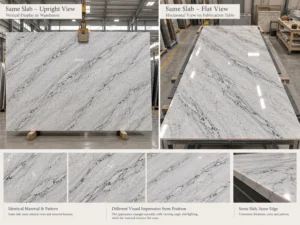
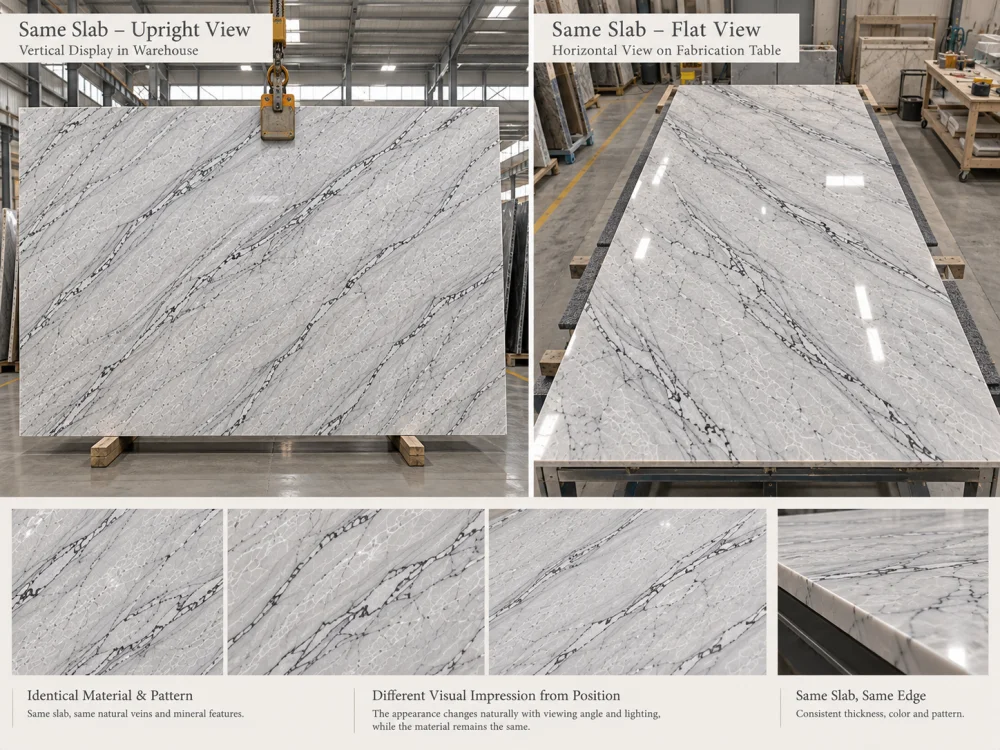
빠른 요약천연 석영암은 슬랩 창고에서 수직으로 전시될 때와 제작 테이블 위에 평평하게 놓였을 때 서로 다르게 보일 수 있습니다. 이는 돌 자체가 반드시 변화한 것이 아니라, 빛의 방향, 표면의 반사, 관찰 각도, 거리, 그리고 관찰자가 자연 패턴과 맺는 관계 등이 달라졌기 때문입니다. 수직으로 전시하면 구매자는 전체 슬랩을 하나의 수직적 구성으로 이해하기 쉽고, 평평하게 전시하면 수평적 용도를 상상하거나 특정 부분을 위에서 살펴보는 데 유리합니다. 어느 한 가지 전시 방식만으로 최종 적용 사례를 모두 예측할 수는 없습니다. 동일한 슬랩을 문서화된 조건 하에서 비교하고, 의도된 프로젝트의 표면을 기준으로 어떤 시각이 가장 중요한지 판단하시기 바랍니다.
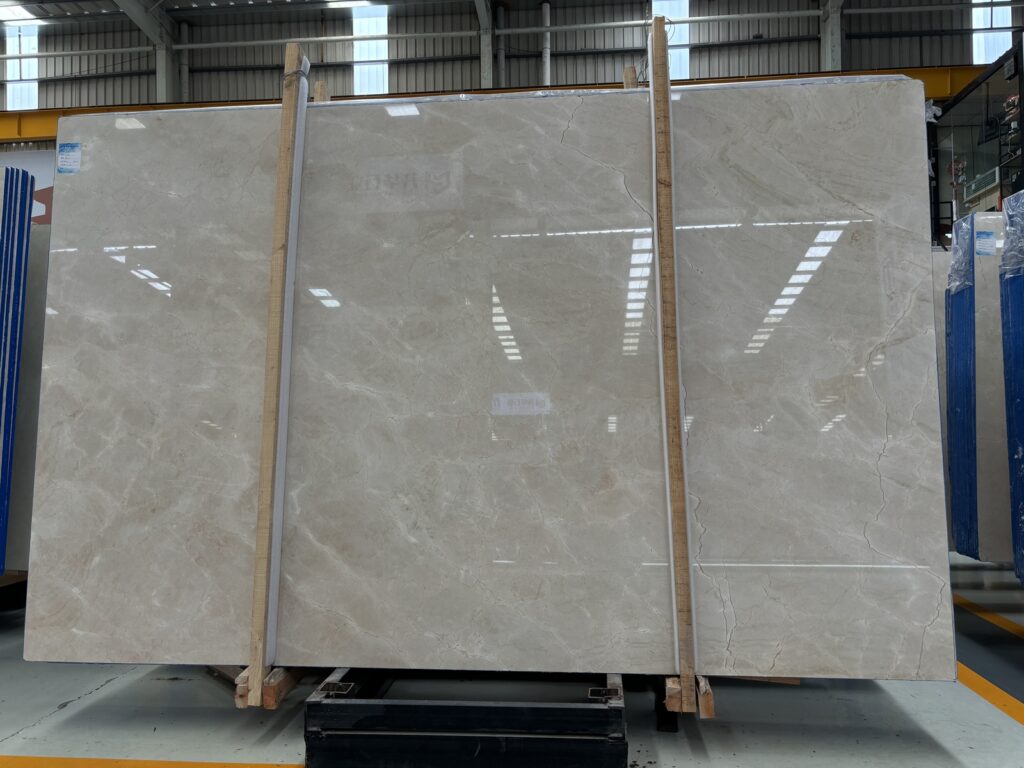
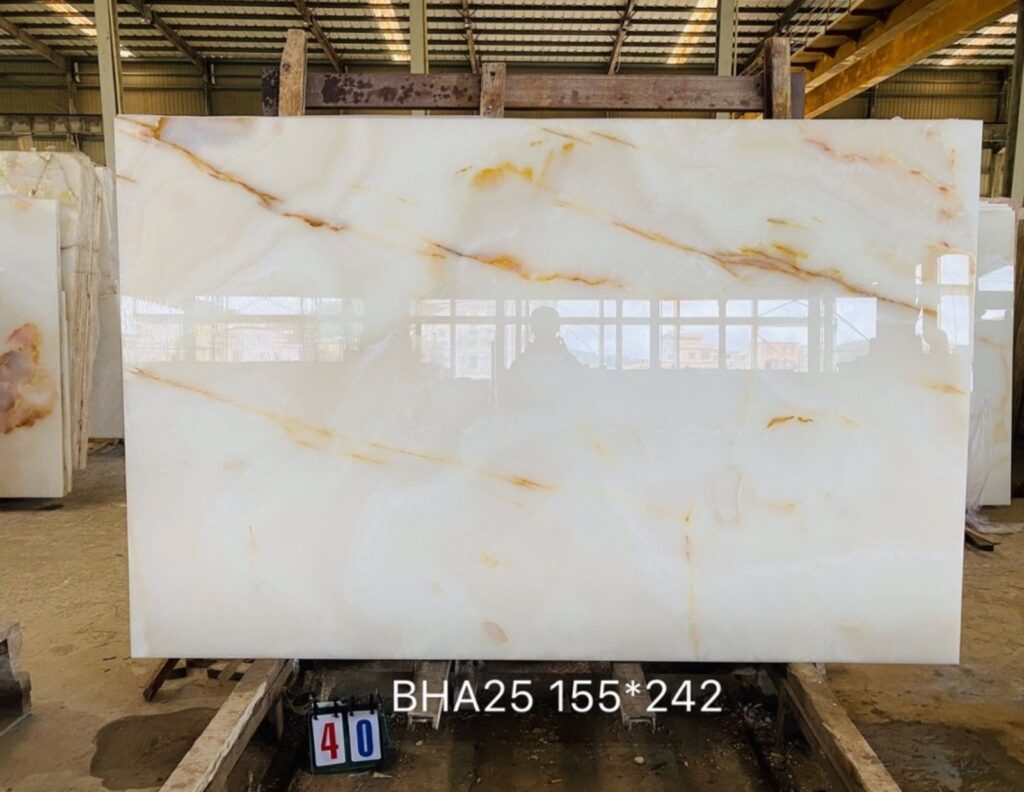
구매자가 석재 창고에서 거의 수직으로 전시된 대형 천연 석영암 슬랩 앞에 서 있습니다. 움직임이 극적으로 느껴지고, 결정질 영역이 쉽게 구분되며, 전체 구성은 마치 건축적 특화 벽처럼 읽힙니다.
이후 같은 슬랩을 제작 검토를 위해 수평으로 배치합니다. 이제 표면은 천장 조명을 반사하고, 관찰자는 다른 각도에서 접근하며, 일부 광물학적 특징은 더욱 두드러지고 다른 부분은 덜 중요해 보입니다.
돌이 변했나요?
꼭 그렇지는 않습니다. 겉보기 차이는 재료 자체의 변화보다는 관찰 조건에 의해 발생한 것일 수 있습니다.
이해하기 석영암 슬랩의 수직 vs 평평한 전시 는 특히 쇼룸에서 슬랩을 선택했지만, 최종적으로 주방 아일랜드, 조리대, 식탁, 벽면 패널 또는 리셉션 표면으로 사용될 경우에 매우 유용합니다.
슬랩의 전시 위치는 관찰자가 표면을 어떻게 접하는지를 결정합니다.
수직으로 전시될 때, 슬랩은 종종 몇 걸음 떨어진 곳에 서 있는 사람을 마주하게 됩니다. 관찰자는 비교적 직접적인 시선으로 슬랩의 전체 높이와 너비를 한눈에 파악할 수 있습니다.
같은 슬랩을 평평하게 놓으면, 관찰자는 슬랩 옆에 서서 비스듬한 각도로 내려다보게 됩니다. 슬랩의 일부는 다른 부분보다 눈에 더 가까이 위치하며, 천장 조명이 표면을 통해 다르게 반사될 수 있습니다.
이러한 차이는 돌의 마감 상태, 치수, 지질학적 패턴이 변하지 않았더라도 인식에 영향을 미칩니다.
| 관찰 요인 | 수직 전시 | 평평한 전시 |
| 전형적인 관찰자 자세 | 슬랩 앞에 서서 관찰하기 | 슬랩 옆이나 위에 서서 관찰하기 |
| 전체 패턴 | 대개 하나의 수직적 구성으로 이해하기 더 쉽습니다 | 수평 표면이나 비스듬한 시점에서 바라볼 수도 있습니다 |
| 조명 | 수직 면은 쇼룸의 조명 방향과 상호작용합니다 | 천장 조명과 창문은 서로 다른 반사를 만들어낼 수 있습니다 |
| 유용한 적용 맥락 | 특화 벽, 벽면 패널, 수직 가구 면 | 조리대, 아일랜드, 테이블, 수평 부품 |
| 주요 한계 | 수평으로 완성된 표면을 자동으로 예측하지 못합니다 | 수직 설치를 자동으로 예측하지 못합니다 |
이는 전시 방식의 차이일 뿐, 검사 정확도의 순위가 아닙니다. 어떤 시각도 정의된 질문에 답할 수 있다면 유용합니다.
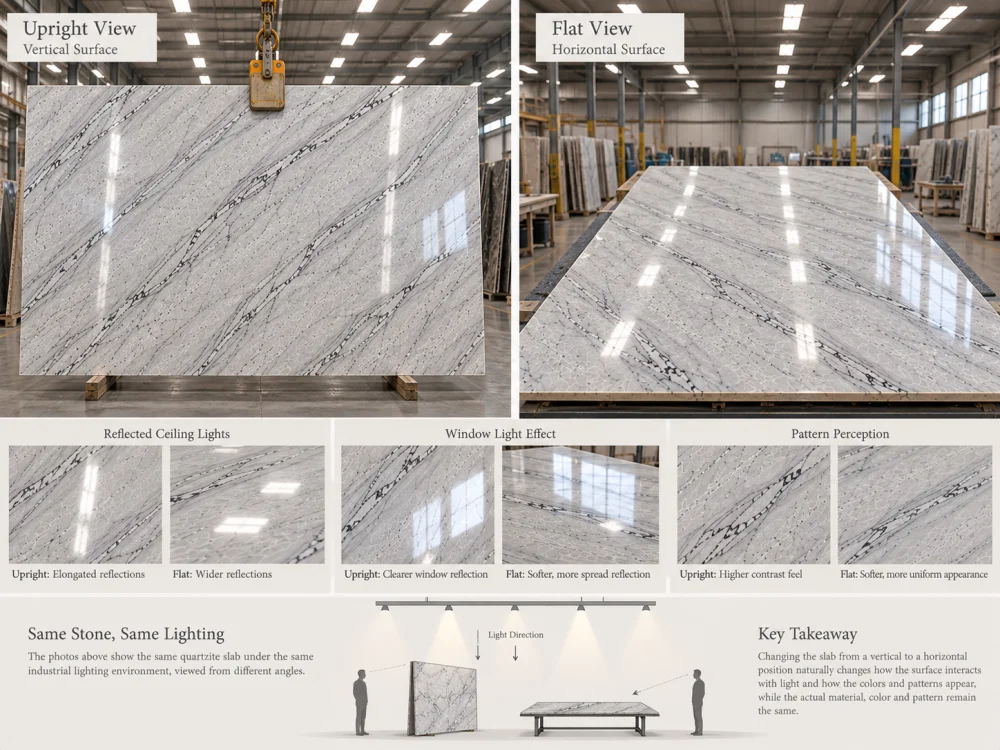
빛은 동일한 연마 처리된 석영암 슬랩이 두 가지 위치에서 다르게 보이는 가장 강력한 원인 중 하나입니다.
슬랩이 수직으로 놓여 있을 때, 천장 조명은 그 표면을 비스듬히 비출 수 있습니다. 관찰자는 창고 배치에 따라 돌의 넓고 비교적 단절되지 않은 부분을 볼 수 있습니다.
슬랩이 평평하게 놓여 있을 때, 같은 조명은 수평 표면 전체에 눈에 띄는 반사를 일으킬 수 있습니다. 이러한 반사는 특정 영역을 강조하거나, 광물학적 패턴의 일부를 가리거나, 밝고 어두운 지질학적 특징 간의 명암 대비를 변화시킬 수 있습니다.
광택 처리된 표면은 창문, 천장 조명, 인근 슬랩, 주변 색채 등을 반사할 수 있습니다. 연마 및 텍스처 마감은 반사 분포를 다르게 할 수 있지만, 실제 외관은 표면과 조명 조건에 따라 달라집니다.
부드러운 회색 움직임을 지닌 옅은 석영암 슬랩을 상상해 보세요. 한 관찰 조건에서는 배경이 차분하고 비교적 균일하게 보입니다. 다른 조건에서는 천장 조명의 반사가 자연 패턴과 경쟁하는 밝은 반점을 만들어냅니다.
밝은 반점은 반드시 더 밝은 광물 영역인 것은 아닙니다. 그것은 반사된 빛일 수 있습니다.
마찬가지로, 더 어둡게 보이는 지역은 주변 조명이나 관찰자가 표면을 바라보는 각도에 의해 부분적으로 발생할 수 있습니다.
색상에 민감한 결정을 내릴 때는 통제된 대표적 조명 아래에서 돌을 비교하고, 필요시 물리적 참조를 활용하세요. 쇼룸 사진만으로는 실내 완성 색상의 정확한 매칭을 확정할 수 없습니다.
표면을 따라 얕은 각도로 진행하는 빛은 반사와 국소적인 시각적 변화를 더욱 두드러지게 만들 수 있습니다. 이는 좀 더 세밀한 관찰이 필요한 영역을 확인하는 데 유용합니다.
그러나 곡선처럼 보이거나 끊어진 듯한 반사선만으로는 평탄도 결함을 입증할 수 없습니다. 치수적 평탄도 문제는 적절한 측정 방법과 프로젝트별 기준이 필요합니다.
유용한 구분은 간단합니다: 시각적 관찰은 무엇을 조사할지 파악하고, 기술적 측정은 측정 가능한 상태를 규정합니다.
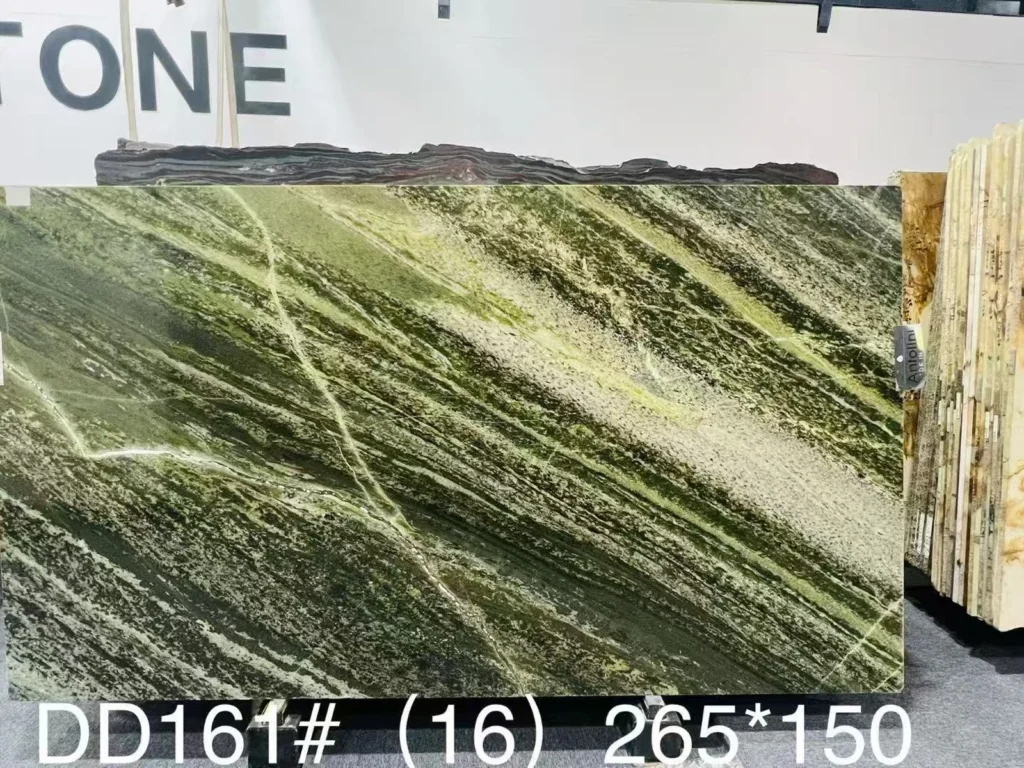
천연 석영암에는 여러 스케일의 지질학적 특징이 존재합니다. 일부 슬랩에는 넓은 띠나 결정질 영역이 있고, 다른 슬랩에는 더 작은 정맥, 불규칙한 광물 집중, 혹은 인접 구역 간의 강한 대비가 나타납니다.
수직 슬랩을 몇 걸음 떨어진 곳에서 관찰할 때, 눈은 이러한 세부 사항들을 더 큰 구성으로 묶어 해석하는 경향이 있습니다.
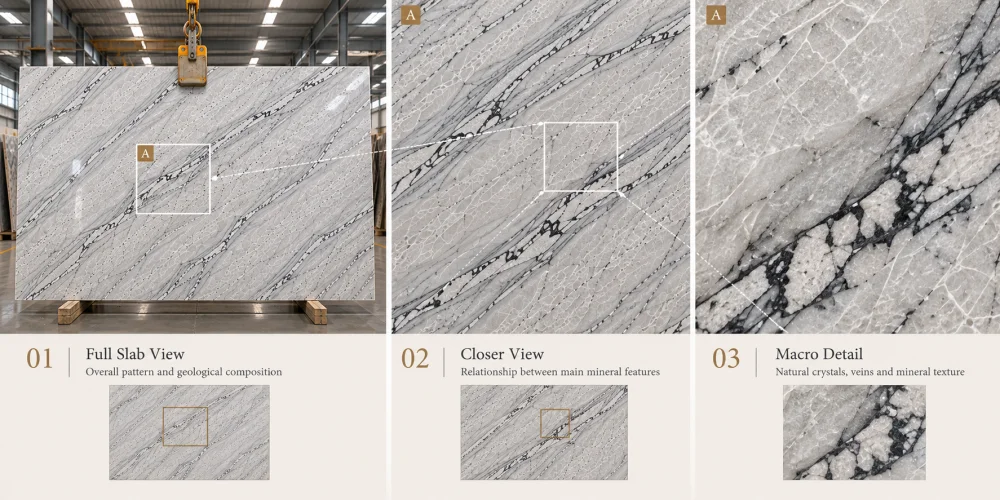
더 가까이 다가가면, 개별 정맥, 광물 경계, 결정, 그리고 국소적 변이들이 더욱 두드러집니다.
A flat slab introduces another viewing relationship. Someone standing beside a large board may be close to one end while the far end is viewed at a greater distance and a different perspective angle.
This can make the near portion visually dominant, even when the overall pattern is more balanced from a direct overhead view.
Whole-Slab Distance: Step far enough away to see the complete board. Use this view to understand the overall movement, dominant mineral areas, and general composition.
Working Distance: Move closer to examine the portions likely to become important finished surfaces. For a kitchen island, this may include the planned countertop crop and waterfall areas.
Detail Distance: Inspect a specific feature, finish, or local area that needs clarification. Keep the detail connected to its position on the full slab.
No single distance should be treated as sufficient for every decision.
Viewing Scale Rule
Whole Slab → Finished-Surface Area → Local Detail. Review all three scales when the project decision depends on both overall movement and particular natural features.
The finished use of the stone should guide the presentation review. A slab selected for a wall does not need to be evaluated in exactly the same way as one selected for a horizontal dining table.
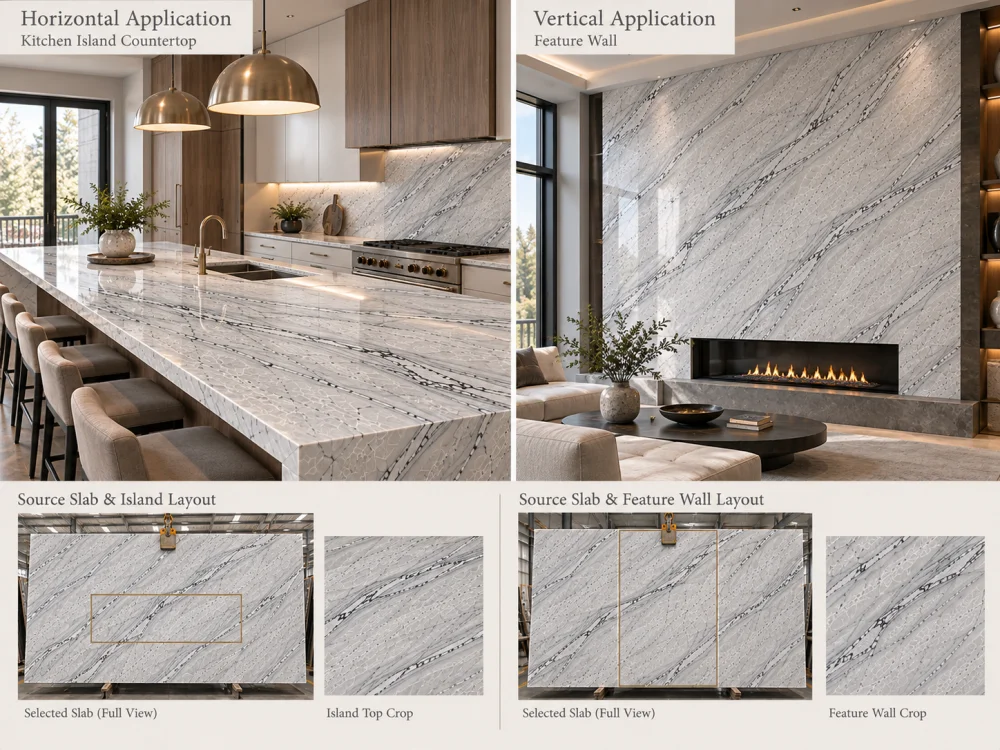
For a vertical feature wall, an upright slab presentation can provide a useful first impression of how the material reads as a large vertical composition.
However, the finished wall may be viewed from a greater distance, illuminated by different fixtures, or divided into several panels. The showroom view is therefore a reference, not a complete installation simulation.
For a kitchen island, the horizontal appearance becomes more important. A flat presentation may help reviewers consider how broad mineral features occupy a top surface.
Yet a person using the kitchen rarely views the entire countertop from directly overhead. Standing-height views and realistic room perspectives remain useful.
Where an island includes waterfall ends, the project contains both horizontal and vertical faces. Neither upright nor flat presentation alone describes the complete finished composition.
For a large table, the stone is experienced mainly from seated and standing positions around its perimeter.
A flat review can help the team examine the proposed tabletop crop, but it should be supplemented by an appropriate perspective view that considers the table’s actual dimensions and viewing height.
Bathroom vanities may combine a horizontal top with a vertical backsplash or front apron. The same stone can be experienced differently across these surfaces because their orientations and light exposure differ.
In these projects, it is more useful to identify the main finished planes than to declare one warehouse presentation universally preferable.
When a project requires both views, the comparison should preserve the identity of the stone and distinguish presentation effects from changes in the material itself.
Begin with the same identified slab and confirm which face and finish are being examined. If the slab cannot be safely moved or repositioned, use existing documented views or suitable controlled references rather than attempting an unnecessary handling operation.

Record the complete visible slab, its identification, presentation angle, approximate viewing distance, and lighting conditions.
Observe the overall direction of movement, relative size of mineral areas, and the way the pattern reads from the front.
Where a properly supported horizontal review is available, examine the same visible face and identify the changes in perspective, reflection, and visual emphasis.
Do not assume the lighting is identical merely because the review takes place in the same building. Rotating the slab changes how its surface faces the available light.
Connect the observations to the project drawing. If the stone will become a countertop, focus on the proposed horizontal finished area. If it will become a wall, evaluate the intended vertical composition.
For mixed-plane work, review each principal finished face separately and then consider the complete assembly.
This process is a comparison of visual evidence, not an instruction to repeatedly move large stone slabs. Slab handling must be carried out only by appropriately equipped personnel using suitable supports and established safety procedures.
Remote buyers may receive one photograph of a slab upright in a warehouse and another of the same slab lying flat on a fabrication table.
It is tempting to compare the photographs as though they were controlled images of the same scene. In practice, several variables may have changed simultaneously.
The camera may have moved closer. A wide-angle lens may exaggerate perspective. The slab may face a different light source. Automatic exposure or white balance may alter the apparent brightness or tone.
Even a correctly identified slab can therefore appear different across two photographs.
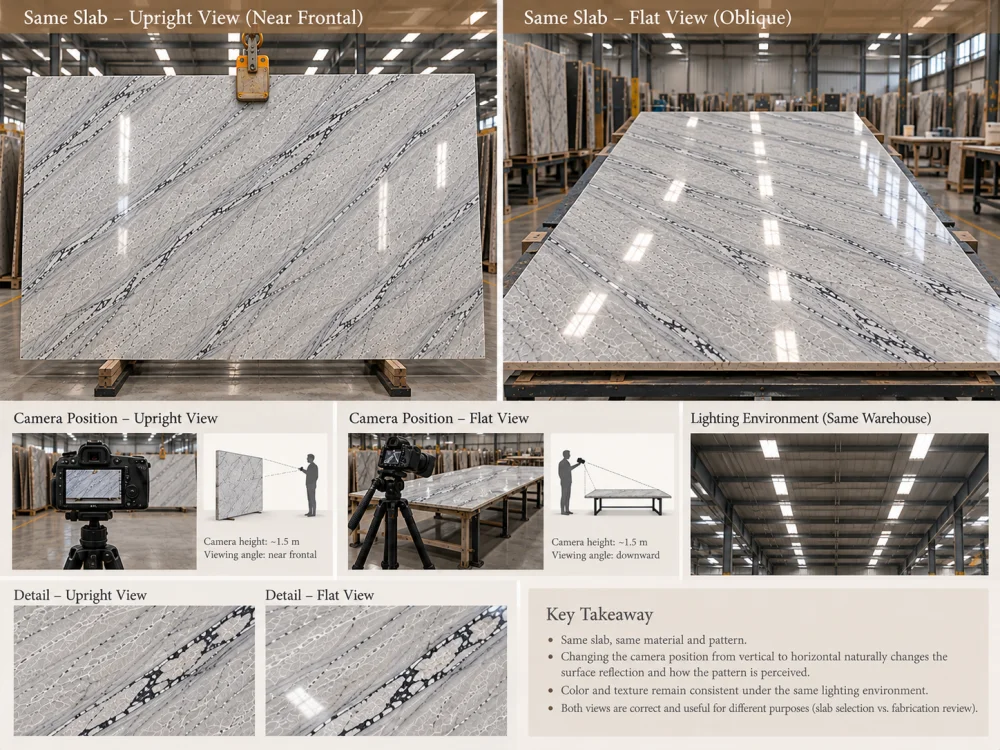
Before concluding that the material has changed, check whether the images show the same board, the same finished face, and the same surface finish.
Then ask for the available lighting and viewing information. If the difference matters to a material decision, request a targeted clarification rather than treating one photograph as automatically more truthful.
The related Quartzite slab showroom selection guide explains how complete slab photographs, board identification, and targeted details can support a more useful material review.
A change in appearance between upright and flat presentation does not automatically indicate a defect. Equally, a visually attractive slab display does not establish that every technical requirement has been met.
Consider three different observations.
Observation A: The natural veins appear more prominent when the slab is upright. This may be a matter of viewing distance, pattern scale, or perspective.
Observation B: The polished surface shows a strong reflected line when the slab is flat. This may be a reflection effect that warrants further review if it raises a specific concern.
Observation C: A local area appears different under another lighting condition. The team may need to examine whether the difference belongs to the stone itself, the surface finish, or the viewing environment.
None of these observations alone establishes a measurable defect, a petrographic classification, or a fabrication acceptance result.
Natural Quartzite should also be distinguished from engineered quartz. A commercial material name does not replace confirmation of the actual product being offered.
If a project raises a dimensional or material-condition question, record the relevant slab area and request the appropriate technical review. Keep that question separate from the aesthetic comparison of upright and flat views.
A useful slab-viewing record does not need to become a long production checklist. It should simply preserve the conditions needed to understand the visual decision.
If several people are reviewing the material, their comments should remain connected to the same slab evidence. The Quartzite slab selection with multiple decision makers guide explains how to distinguish visual preferences from technical and approval decisions.
The key point is that an upright display and a flat display are two different ways of observing the same natural material. A meaningful decision uses the view that answers the project’s question and recognizes what that view cannot prove.
The surface interacts differently with lighting, reflections, viewing distance, and perspective. The natural stone pattern may be unchanged even though certain features become more or less prominent.
Not universally. Upright viewing can help with the overall vertical composition, while flat viewing may be useful for horizontal applications. The better review is the one that matches the decision being made.
A properly supported flat review can be helpful where available, but it is not always necessary or practical. The project can also use actual slab photographs, a proposed cutting layout, and realistic finished-island views to evaluate the horizontal composition.
Changing presentation position does not by itself change the stone’s intrinsic color. It can change perceived appearance because the surface faces the light and viewer differently. Surface reflections and photographic settings may contribute further differences.
No. A photograph can document visual observations, but it cannot replace a defined dimensional measurement where flatness must be verified against a project requirement.
Confirm the slab identity, visible face, finish, presentation position, lighting, and camera conditions. Request complete slab views and targeted details that answer the actual project question.
Record the material and board reference, the viewing positions considered, important lighting and distance conditions, the intended application, the specific visual decision, and any issues requiring further review.
Review Natural Quartzite for Its Intended ApplicationFor an international Quartzite project, HRST STONE can help coordinate available full-slab photographs, identified material references, proposed stone layouts, relevant CAD/shop drawing information, and visual inspection records according to the confirmed scope. Send Josh the material name, project application, required dimensions, quantities, surface finish, and delivery destination to discuss the next review steps.
저작권 © HRST STONE / XIAMEN HRST STONE CO., LTD. 모든 권리 보유.