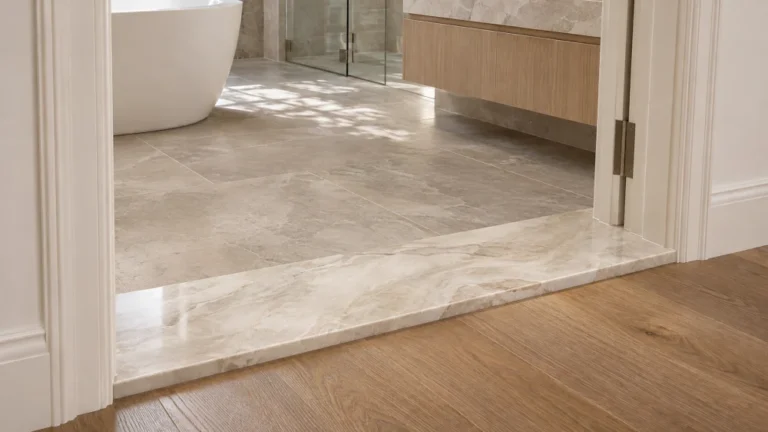
클리비아 마블
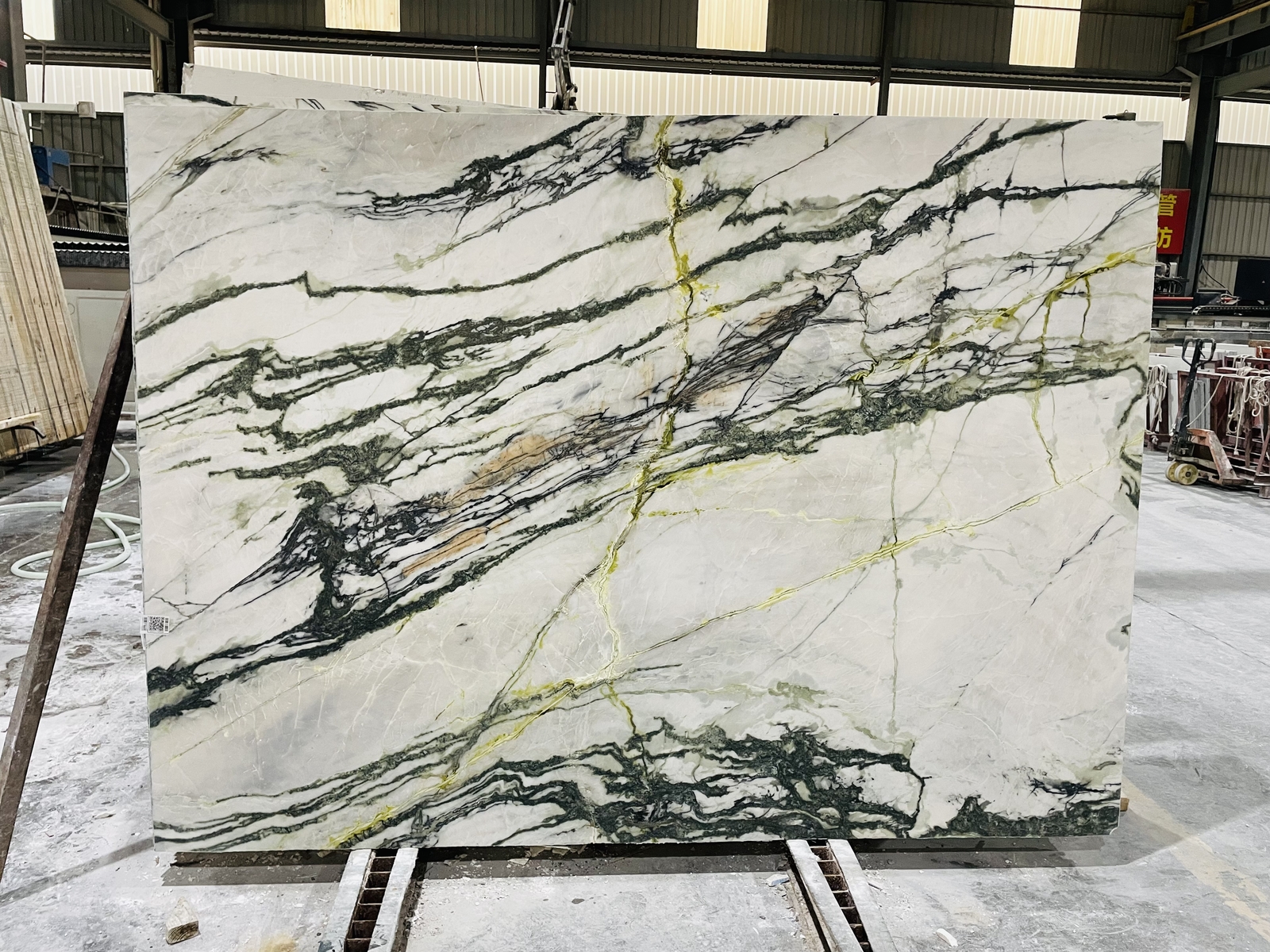
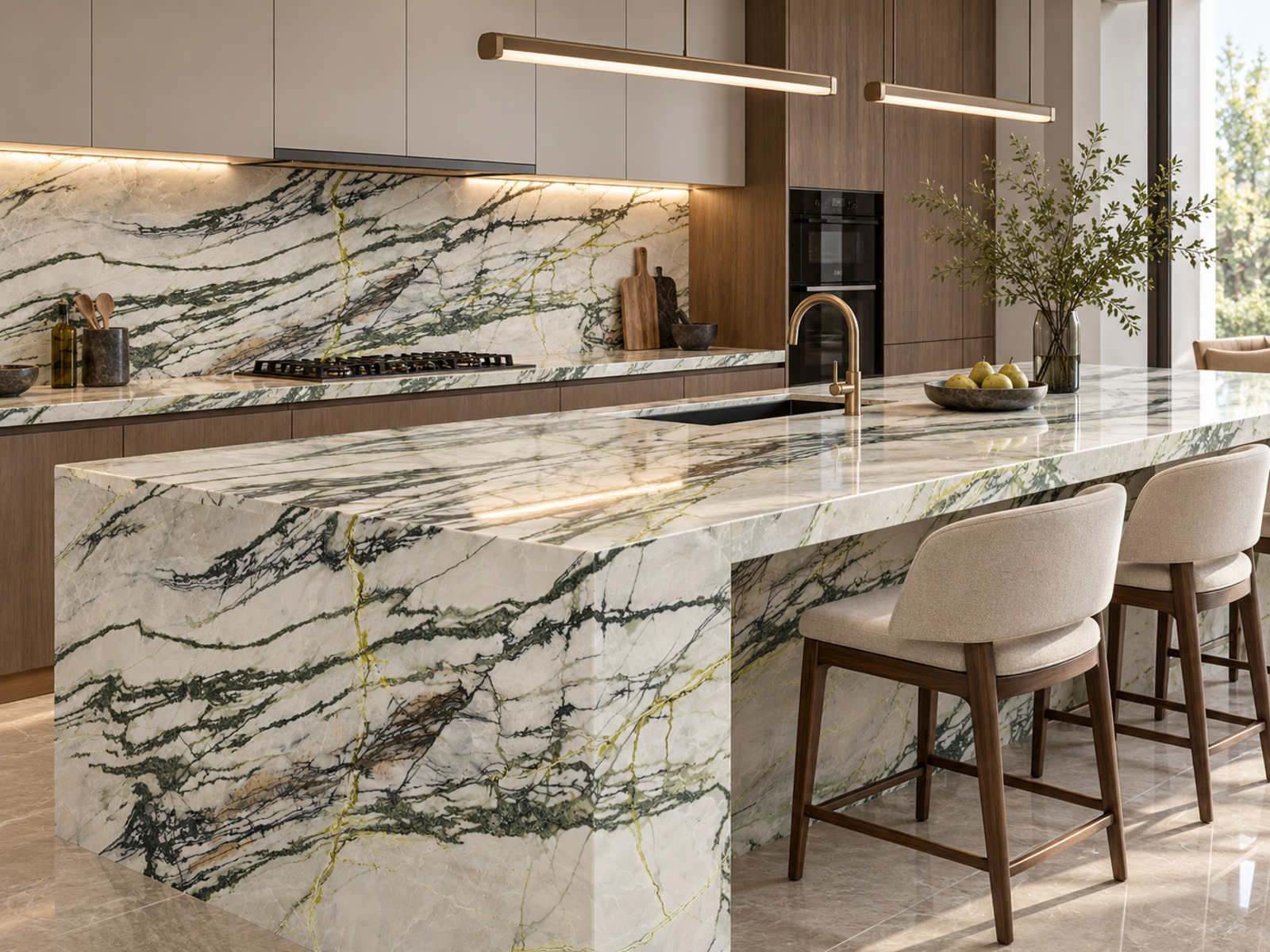
클리비아 마블, also known commercially as Clivia White Marble or China Calacatta Verde Marble, is a natural marble from China characterized by an ivory-white to pale background crossed by expressive green, dark green and occasional grey-black mineral lines.
Unlike white marbles dominated by soft grey veining, Clivia Marble gains much of its identity from the contrast between the light field and its stronger green movement. Some slabs contain long directional veins, while others show branching, layered or more concentrated mineral structures.
This makes slab selection especially important for countertops, feature walls, vanity tops and custom components. A successful project should consider not only which slab is selected, but also where the major green veins will appear after cutting.
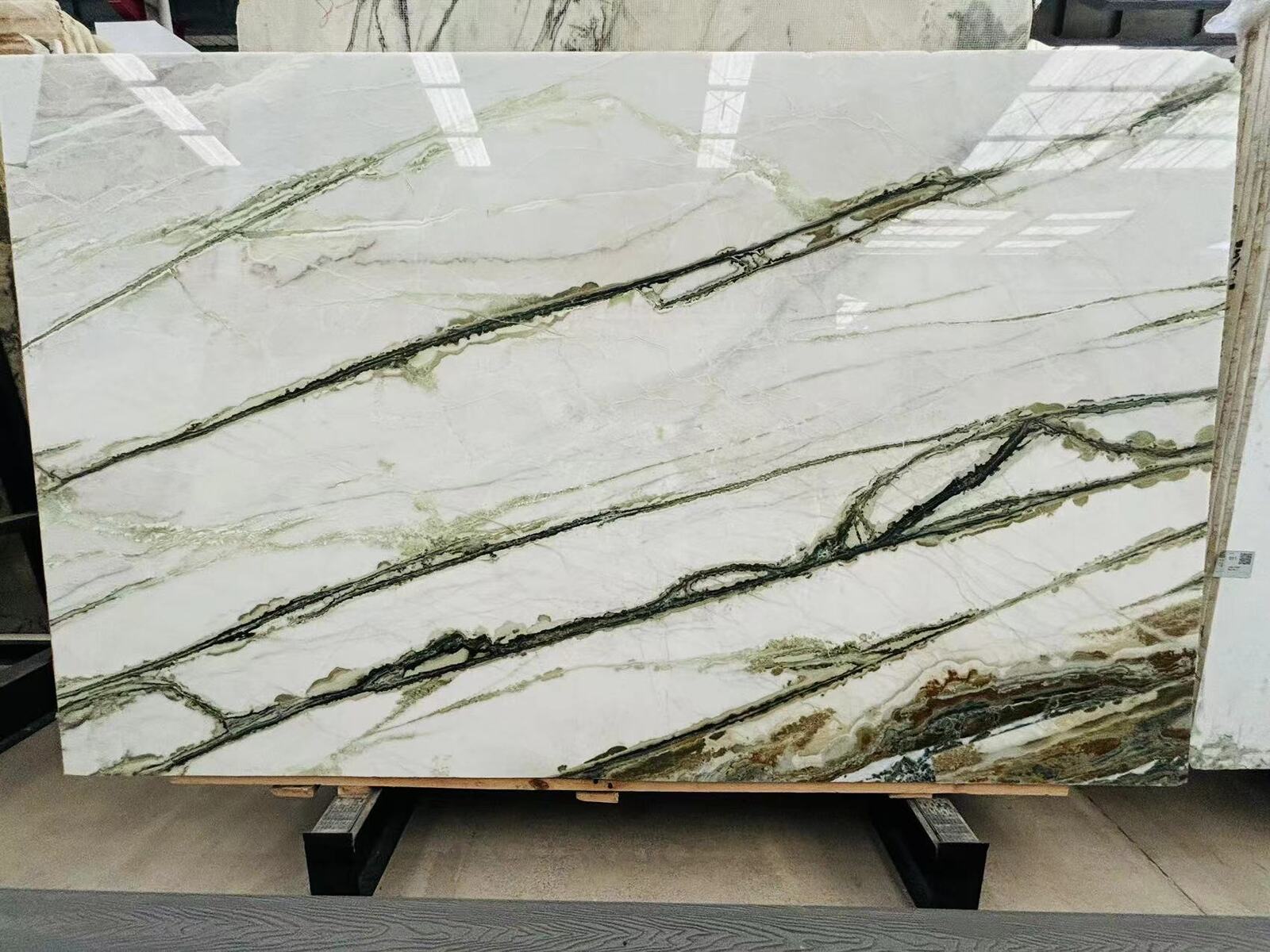
천연 대리석
중국
Ivory White · Green · Dark Veins
Slabs · Panels · Custom Pieces
제품 사양
| 사양 | 세부 정보 |
| 재료 명칭 | 클리비아 마블 |
| 재료 유형 | 천연 대리석 |
| Alternative Names | Clivia White Marble / China Calacatta Verde Marble |
| 원산지 | 중국 |
| 주요 색상 | Ivory white, white, green, dark green and occasional grey-black mineral accents |
| 텍스처 패턴 | Directional, branching and naturally irregular green-to-dark veining across a light marble background |
| 제공 가능한 두께 | 18mm / 20mm |
| 제공 가능한 형태 | Slabs, cut-to-size panels, countertops, vanity tops, tiles, stairs and custom-fabricated components |
| 사용 가능한 슬래브 규격 | 현재 블록 및 슬래브 재고에 따라 달라집니다 |
| 맞춤형 규격 | According to approved drawings, slab layout and fabrication requirements |
| 표면 마감 | 폴리시드, 호닝 등 프로젝트별 마감 처리는 최종 확인 후 적용 |
| 모서리 옵션 | Straight polished, eased, bevel, mitered and custom edge profiles according to project requirements |
| 적용 범위 | Countertops, feature walls, bathroom vanities, floors, stairs, fireplaces, table tops and custom architectural stonework |
| 포장 세부사항 | 강화된 훈증 처리된 목재 상자로 프로젝트별 보호 제공 |
| 최소 주문 수량(MOQ) | 판재, 타일 또는 맞춤형 제작 요구사항에 따라 |
| 배송 시간 | 재료 가용성, 수량 및 가공 범위에 따라 확정됩니다 |
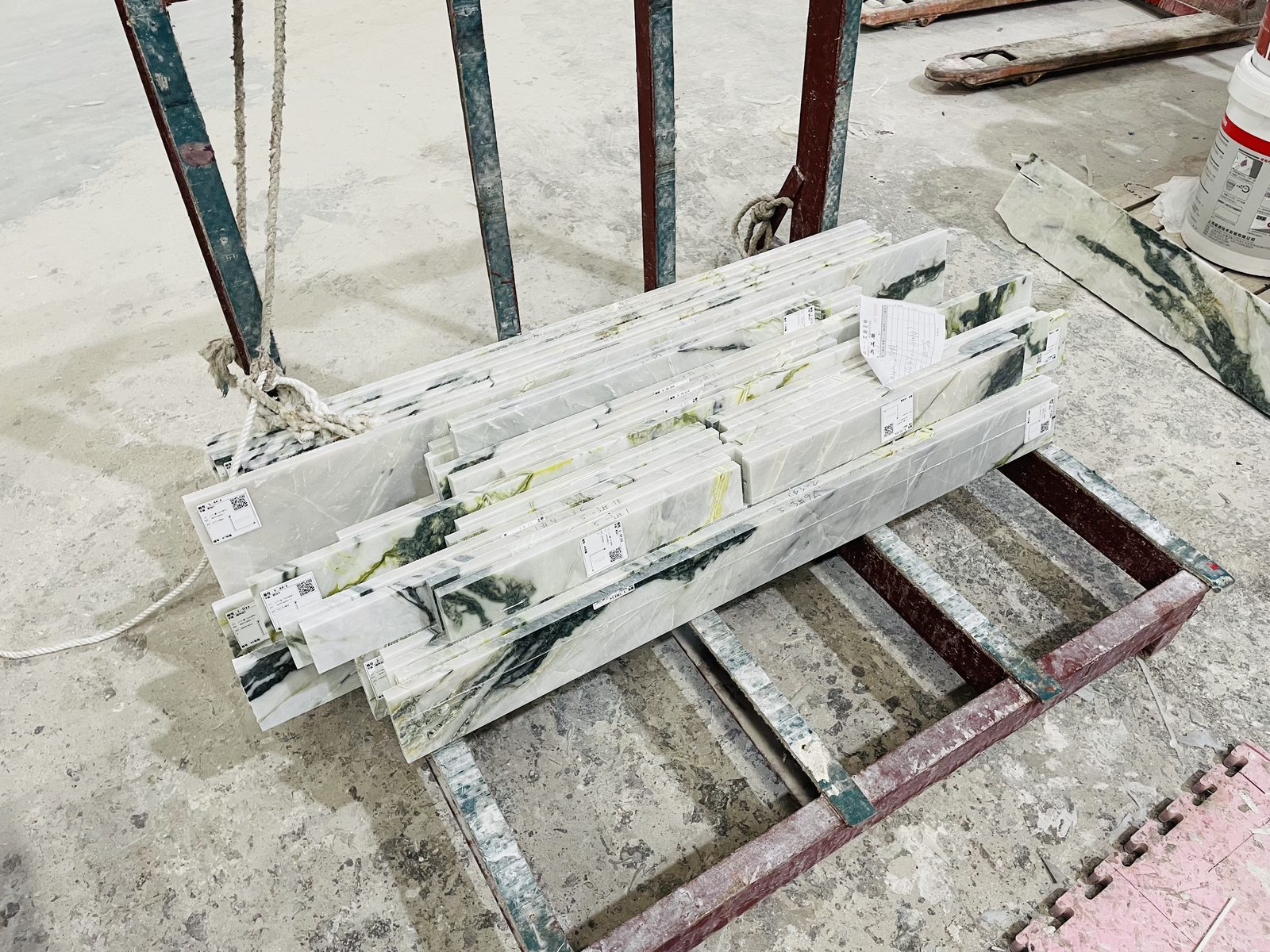
Green Veins Are the Main Design Variable
The strongest visual characteristic of Clivia Marble is the relationship between its light background and green-to-dark mineral lines. These veins can move across the slab as long strokes, branching structures or more concentrated clusters.
For a large wall, the objective may be to preserve the strongest vein as a focal movement. For a countertop, the same vein may need to be repositioned so that it remains visible without being interrupted by a sink or cooktop opening.
This means that the slab should be treated as a complete visual composition before cutting rather than simply as raw square-meter material.
Cutting Position and Slab Yield
Cutting Clivia Marble requires balancing finished dimensions with visual positioning. A layout that achieves the highest theoretical material yield is not always the best layout if it removes the most important green movement from a focal component.
Before cutting, finished component outlines can be positioned against the actual slab. This helps determine which veins will remain on the countertop, wall panel, vanity or other visible piece.
Sink openings, cooktop cutouts, joints and edge returns should also be considered at this stage so that important visual features are not unintentionally removed.
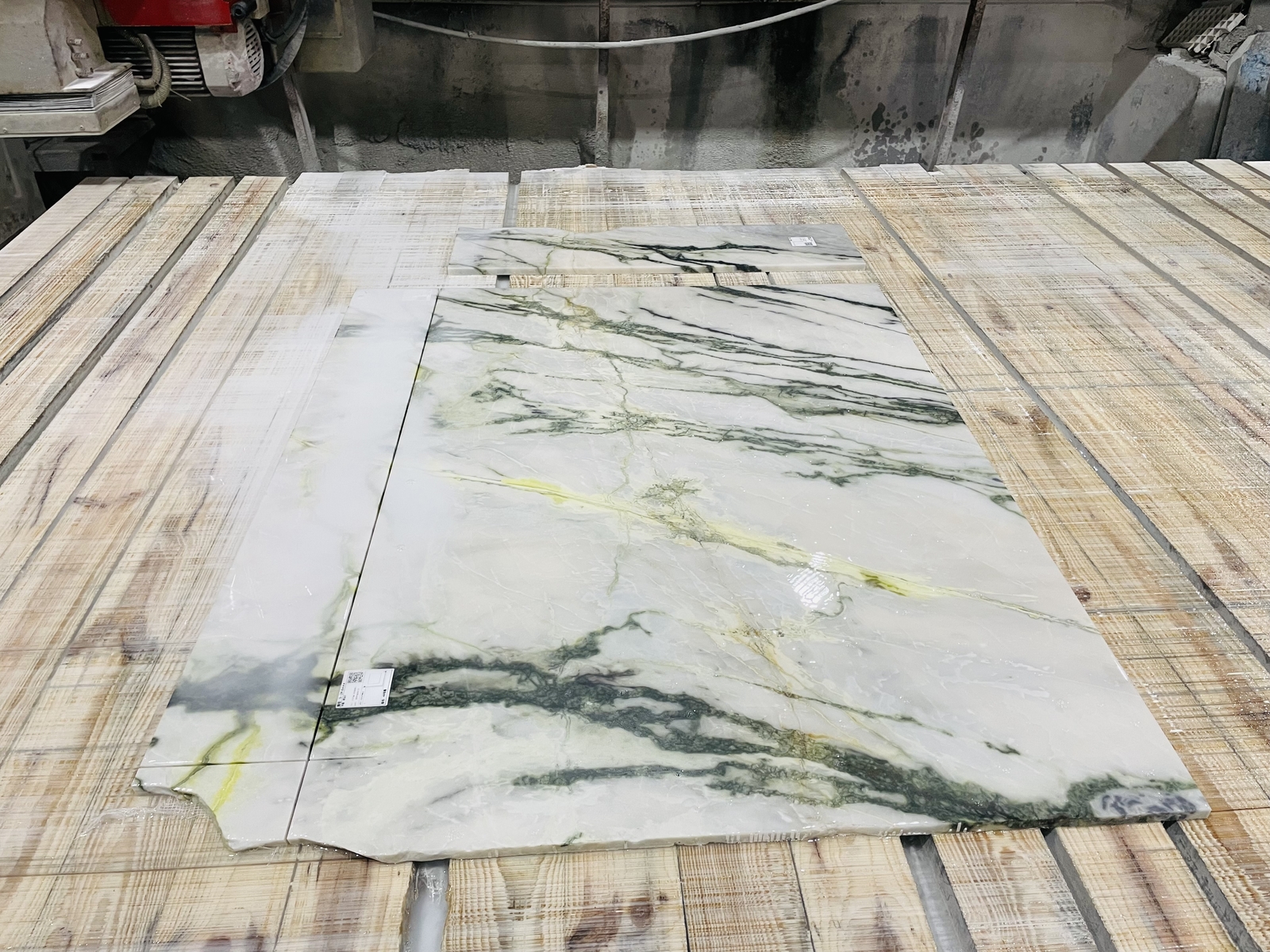
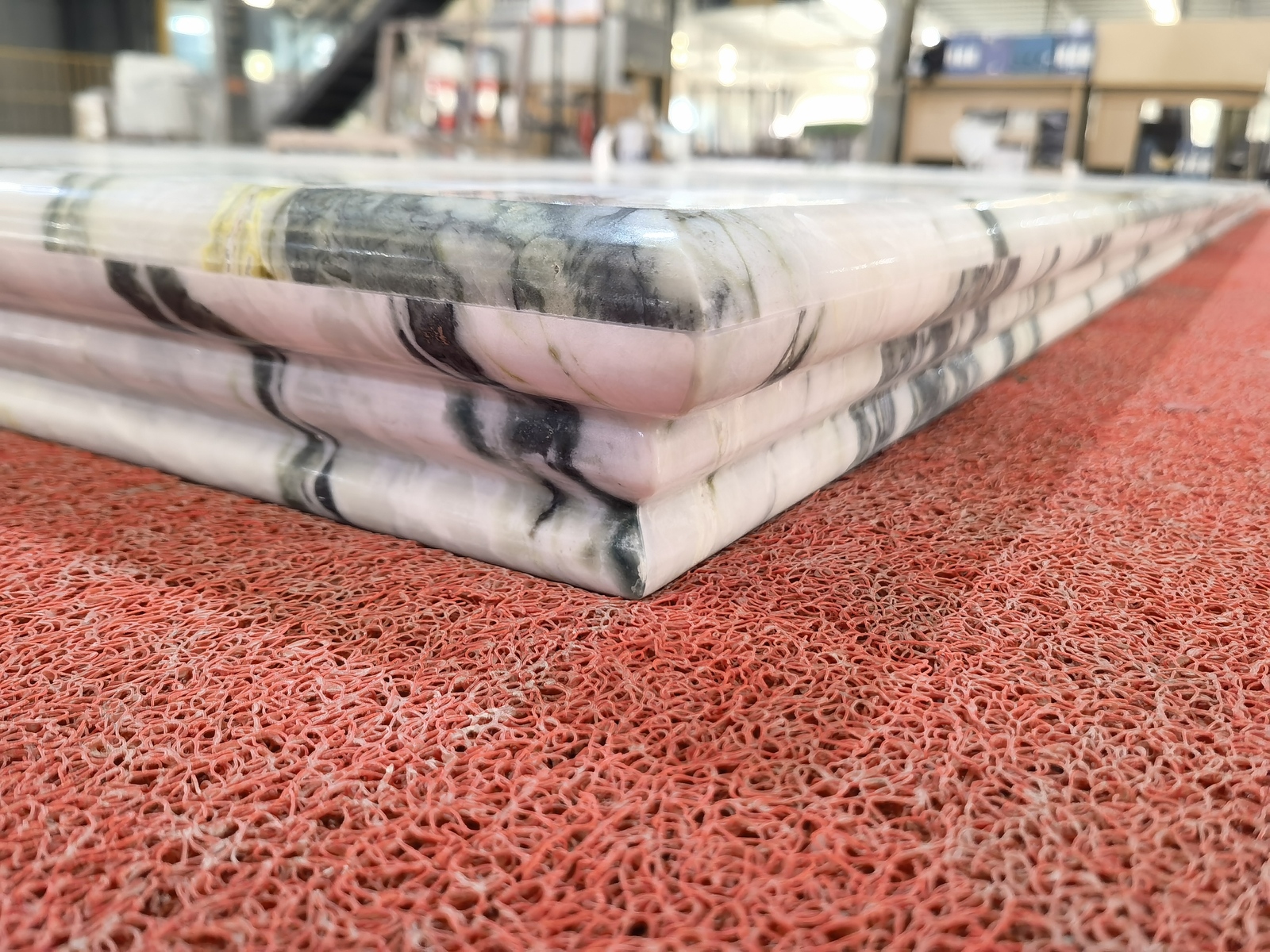
Corner Matching and Mitered Returns
Corners become particularly important when Clivia Marble is used on a thickened countertop edge, return panel, column or other multi-face architectural detail.
A strong green vein that ends abruptly at a visible corner can change the intended appearance. When visual continuity is required, adjoining pieces should be planned from compatible areas of the slab and reviewed together before final fabrication.
Miter preparation, edge alignment, finished thickness and the relationship between the front and return faces should therefore be included in the cutting and fabrication plan.
Custom Fabrication from Drawing to Finished Piece
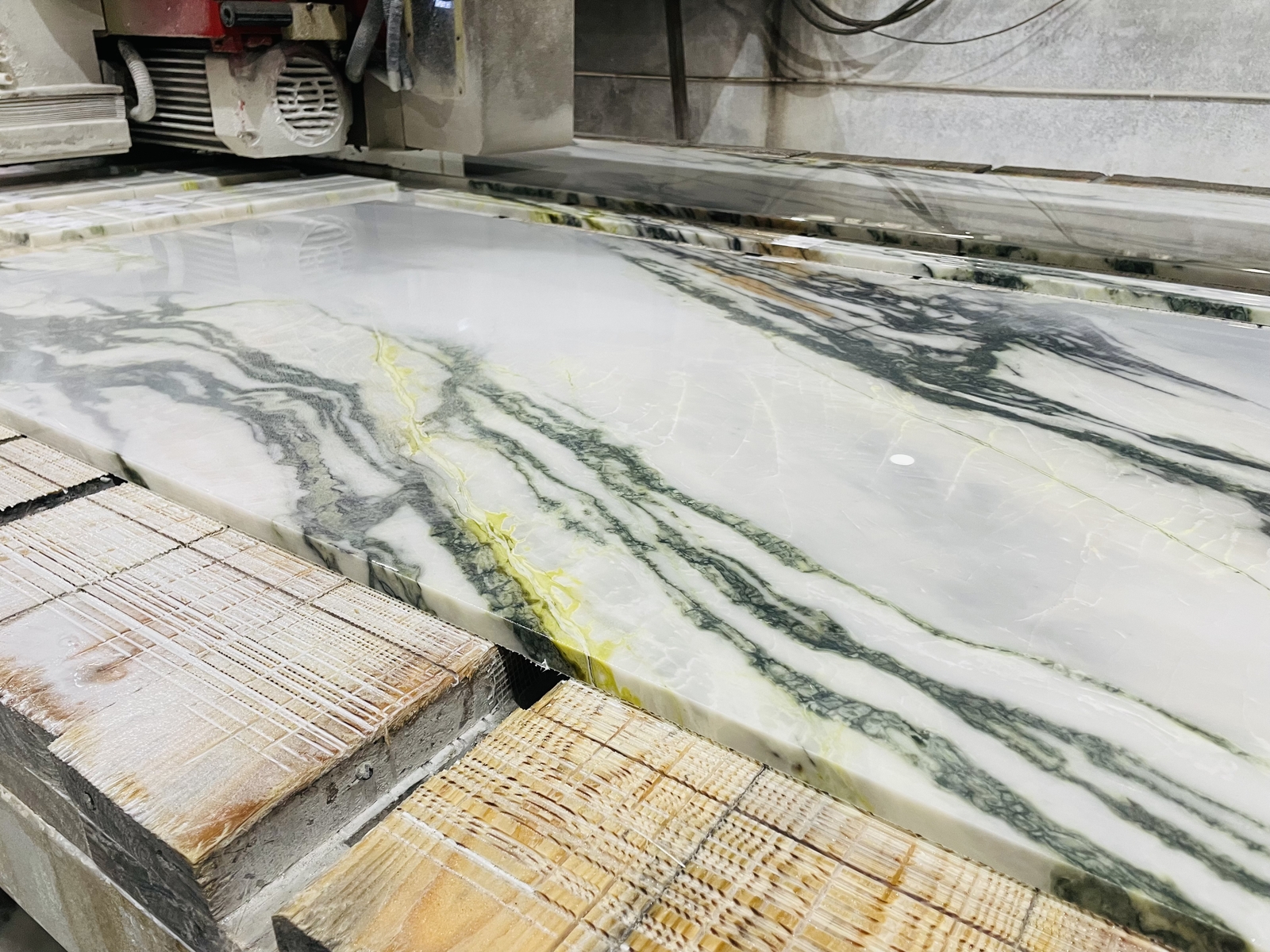
Custom Clivia Marble components can require several fabrication stages depending on the application. These may include precision cutting, openings, edge processing, miter preparation and surface finishing.
CAD or shop drawings should define the finished geometry before production begins. For countertops and vanity tops, this includes overall dimensions, sink or cooktop openings, faucet holes, joint positions and visible edge requirements.
The drawings should then be coordinated with the actual stone layout so dimensional requirements and visual requirements are resolved together.
광택과 연마 표면 옵션
A polished finish increases reflection and typically gives stronger visual definition to the contrast between Clivia Marble’s light background and green mineral movement.
A honed finish reduces surface reflection and can create a softer presentation while retaining the characteristic green-vein structure.
Whichever finish is specified, representative finished pieces should be inspected for overall surface consistency, edge quality and the visibility of natural mineral features or repairs before packing.
Dry Layout Before Packing
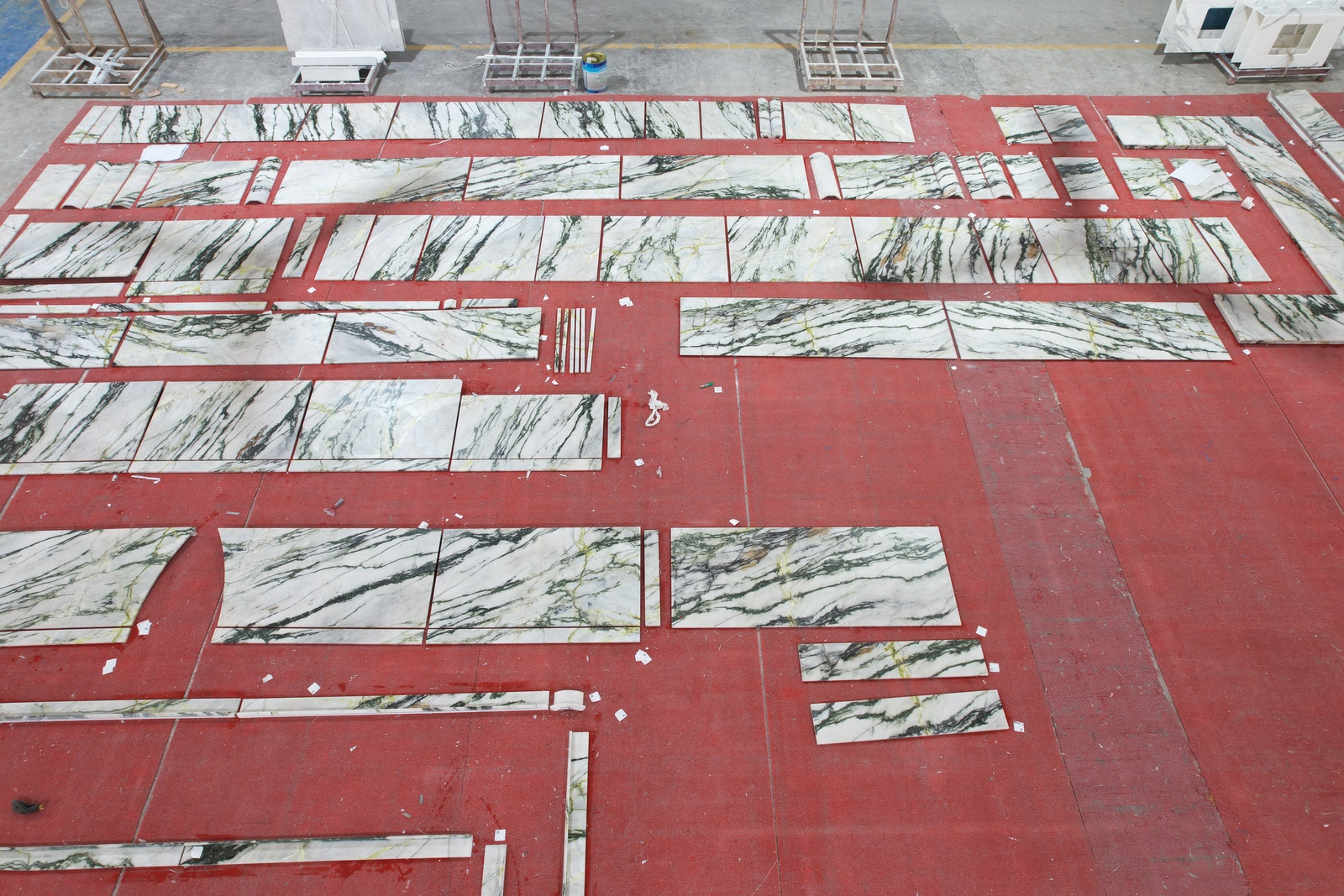
After fabrication, related Clivia Marble components can be arranged in their intended relationship for visual inspection. This is especially useful for feature walls, large countertops, multi-piece vanity assemblies and projects where green-vein continuity has been deliberately planned.
Dry layout allows the factory to verify orientation, piece sequence, major vein relationships and overall visual balance before the components are separated for export packing.
Clivia Marble Countertops
Countertops are an effective application for Clivia Marble because the horizontal surface provides enough area for its green-vein movement to remain visible as a design feature.
Before fabrication, the actual countertop outline should be positioned against the selected slab. Sink and cooktop locations are especially important because a large opening can remove or interrupt the strongest part of the pattern.
For countertops with thickened edges, returns or adjoining vertical faces, those pieces should be considered together during slab layout rather than cut independently.
B2B 조달 위험 관리
| 구매자 위험 / 프로젝트 위험 | Recommended Control |
| Approved sample does not represent the actual vein composition of the slab | Approve actual slabs when green-vein direction and concentration are important to the finished design. |
| Main green vein is lost during cutting | Position finished component outlines on the actual slab and approve the cutting layout before production. |
| Sink or cooktop opening removes the focal vein | Coordinate openings with the stone layout before CNC or waterjet processing begins. |
| Vein movement stops abruptly at a visible corner | Plan adjoining faces together and review corner or miter relationships before cutting. |
| Adjacent wall panels have incompatible vein direction | Use panel layout and dry-lay review to establish the intended sequence and orientation. |
| Natural fissure or repair becomes prominent in a focal component | Inspect the actual slab and allocate critical visible pieces before fabrication. |
| Finished components are mixed during packing or installation | Use piece identification and installation references after the approved dry layout. |
Custom Fabrication and Quality Control
Clivia Marble QC should verify both fabrication accuracy and the visual relationship between finished components. For strongly veined natural stone, dimensional accuracy alone does not guarantee that the installed result will match the approved design.
Track approved slabs from material selection through cutting and fabrication.
Confirm component position, orientation, joints and major vein placement before cutting.
Verify dimensions and confirm the intended stone area has been retained.
Check sink openings, cooktop openings, edge profiles and miter preparation.
Inspect polish or hone consistency, natural features and visible repairs.
Check adjoining faces and returns where visual continuity has been planned.
Arrange related components to verify orientation and vein relationships.
Confirm component identity, protection and crate arrangement before shipment.
포장 및 국제 배송
Fabricated Clivia Marble pieces should be packed according to their geometry and installation relationship. Finished surfaces receive 부드럽고 얼룩이 생기지 않는 표면 보호재, while vulnerable edges and corners are protected with 모서리 보호대 및 코너 보호.
강성 분리판 및 내부 블로킹 are used to reduce movement between components during transportation. Countertops or other pieces containing large cutouts can receive temporary reinforcement or support where appropriate.
When a wall, countertop or other assembly has been dry-laid in a controlled sequence, component identification should remain connected to the approved layout during packing. Production inspection is completed before packing, followed by final packing inspection.
Export components are secured in reinforced fumigated wooden crates appropriate to the finished dimensions, component type and transport requirements.
Why Choose HRST STONE for Clivia Marble Projects?
함께 17년 이상의 of natural stone project experience, HRST STONE provides one-stop natural stone solutions covering slab selection, CAD and shop drawings, custom fabrication, QC, dry-lay review and international export packing.
For Clivia Marble, project support can include actual slab selection, vein-position review, cutting-plan coordination, countertop and panel fabrication, corner and miter processing, surface inspection, dry-lay confirmation, piece numbering and final packing QC.
This is particularly useful for projects where the green veining is an intentional part of the design. Instead of treating each component independently, the workflow connects actual slab → CAD layout → cutting → fabrication → dry layout → installation sequence.
견적에 필요한 정보
- 제품 형태: slab, countertop, wall panel, vanity top, tile, stair or custom component
- 크기: finished dimensions or required slab quantity
- 수량: 개수, 제곱미터 또는 판재 수량
- 두께: 요구되는 석재 두께
- 마감 처리: 폴리시드, 호닝 또는 기타 요청된 마감 처리
- 시각적 선호: desired green-vein density, direction and overall slab character
- 제작: cutouts, edge profiles, miters, corners, returns or other custom processing
- 레이아웃 요구사항: confirm whether specific vein positioning or continuity is required
- 도면: CAD, PDF, elevations, countertop plans or dimensional sketches where available
- 목적지: 물류 평가를 위한 목적지 항구 또는 배송 장소
Clivia Marble FAQ
1. 클리비아 마블은 어떻게 생겼나요?
클리비아 대리석은 일반적으로 아이보리 화이트에서 연한 배경에 독특한 녹색, 짙은 녹색 및 드물게 회흑색의 광물성 무늬선을 지니고 있습니다. 무늬의 방향성, 분지 형태 또는 밀도는 각 판재마다 다를 수 있습니다.
2. 클리비아 마블은 어디에서 유래했나요?
클리비아 대리석은 중국산 천연 대리석으로, 주로 중국 후베이성에서 생산되는 자재와 연관됩니다. 천연의 무늬 방향과 농도는 다양하므로, 실제 판재의 외관은 개별적으로 확인하시기 바랍니다.
3. 클리비아 대리석은 조리대에 적합한가요?
네. 클리비아 대리석은 녹색 무늬의 흐름이 강렬한 시각적 특징으로 드러나는 조리대 제작에 적합합니다. 절단 작업에 앞서 싱크대와 쿡탑의 위치, 이음부, 가장자리 및 의도된 무늬 배치를 사전에 조율해야 합니다.
4. 클리비아 대리석을 제작하기 전에 왜 절단 배치도를 승인해야 합니까?
동일한 판재라도 각 구성 요소의 배치 위치에 따라 최종 결과가 크게 달라질 수 있습니다. 레이아웃 승인을 통해 바람직한 녹색 무늬를 보존하고, 컷아웃에서 중심적인 시각적 흐름이 사라지는 것을 방지하며, 인접한 조각들 간의 조화를 맞출 수 있습니다.
5. 클리비아 대리석의 모서리를 따라 녹색 무늬가 계속 이어질 수 있나요?
시각적 연속성은 종종 슬래브의 서로 호환되는 구역에서 인접한 조각들을 선택하고 그 방향을 맞춤으로써 계획할 수 있습니다. 절단에 앞서, 각 슬래브마다 자연적인 무늬의 흐름이 다르게 나타나므로 제안된 모서리 또는 마이터 결합 방식을 반드시 검토해야 합니다.
6. 클리비아 마블 벽 패널은 출하 전에 건식 시공을 해야 하나요?
Dry-lay review is recommended when a wall design depends on panel sequence, vein direction or continuity. It allows related pieces to be checked together and numbered according to the approved installation arrangement.
7. What should buyers approve before Clivia Marble production begins?
Buyers should confirm the actual slabs, acceptable vein character, dimensions, thickness, finish, fabrication drawings, component orientation and cutting layout. Projects requiring controlled vein continuity should also approve the dry-layout approach and piece-numbering method.
마지막 메모
For slab selection: evaluate the complete green-vein composition rather than choosing only by background color.
For countertops: place sink and cooktop openings only after reviewing how they interact with the major veins.
For corners and returns: plan adjoining faces together when visual continuity is important.
벽면 패널용: approve panel orientation and sequence before cutting, then verify the relationship again during dry layout.
For export projects: maintain piece identification from the approved layout through final QC and packing so the intended sequence can be reconstructed during installation.
For custom Clivia Marble projects, the recommended control sequence is actual slab approval → vein-position review → CAD/shop drawing → cutting layout → precision cutting → custom fabrication → corner and edge inspection → surface QC → dry-lay confirmation → piece numbering → final QC → reinforced export packing.