

Clivia White Marble Overview
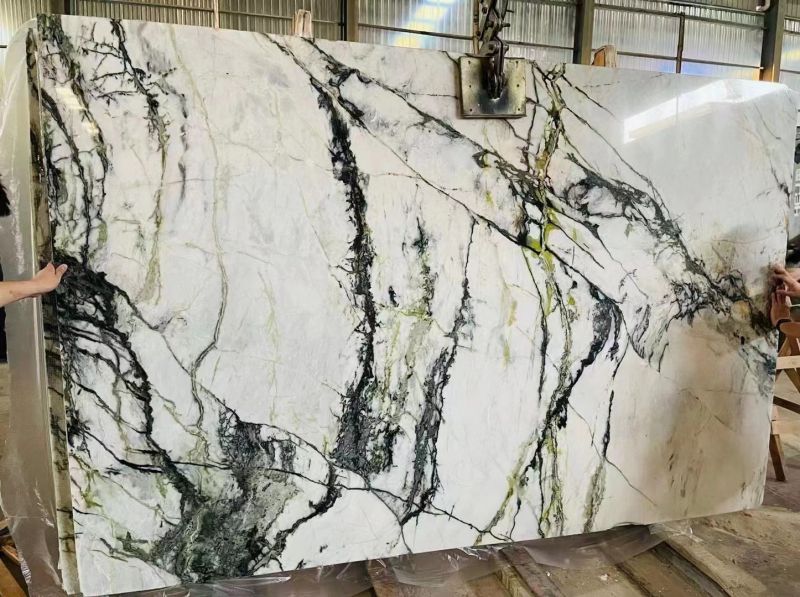
Clivia White Marble is a decorative natural marble known for its bright white-to-ivory background and distinctive green mineral movement.
Also searched as Clivia White, Clivia Marble or White Clivia Marble, the stone combines light neutral areas with jade-green, forest-green and darker mineral veins.
Some slabs remain relatively clean with isolated green movement, while others show denser brushstroke-like patterns with stronger dark accents.
This contrast gives Clivia White a recognizable identity for architectural interiors where a white stone is required but conventional grey veining feels too restrained.
Product Specifications
| Specification | Project Details |
| Material Name | Clivia White Marble |
| Alternative Name | Clivia Marble / Junzilan Marble |
| Material Type | Natural Marble |
| Origin | China |
| Primary Colors | Ivory White / Soft White / Jade Green / Forest Green / Charcoal |
| Texture Pattern | Irregular Green Veins / Dark Brushstroke Lines / Natural Cloudy Movement |
| Available Thickness | 18mm / 20mm Standard Options |
| Available Forms | Slabs / Tiles / Wall Panels / Floors / Countertops / Vanity Tops |
| Available Slab Size | Subject to Current Block and Slab Inventory |
| Custom Size | Cut-to-Size According to Approved Drawings and Slab Yield |
| Surface Finishing | Polished / Honed / Project-Specific Finish |
| Edge Options | Straight / Eased / Beveled / Mitered / Custom Profile |
| Application Scope | Walls / Floors / Countertops / Vanities / Stairs / Furniture / Interior Stonework |
| Package Details | Surface Protection + Edge Guards + Reinforced Fumigated Wooden Crates |
| MOQ | According to Slab, Tile or Custom Fabrication Requirements |
| Delivery Time | Confirmed According to Material Availability, Quantity and Fabrication Scope |
White and Green Visual Character
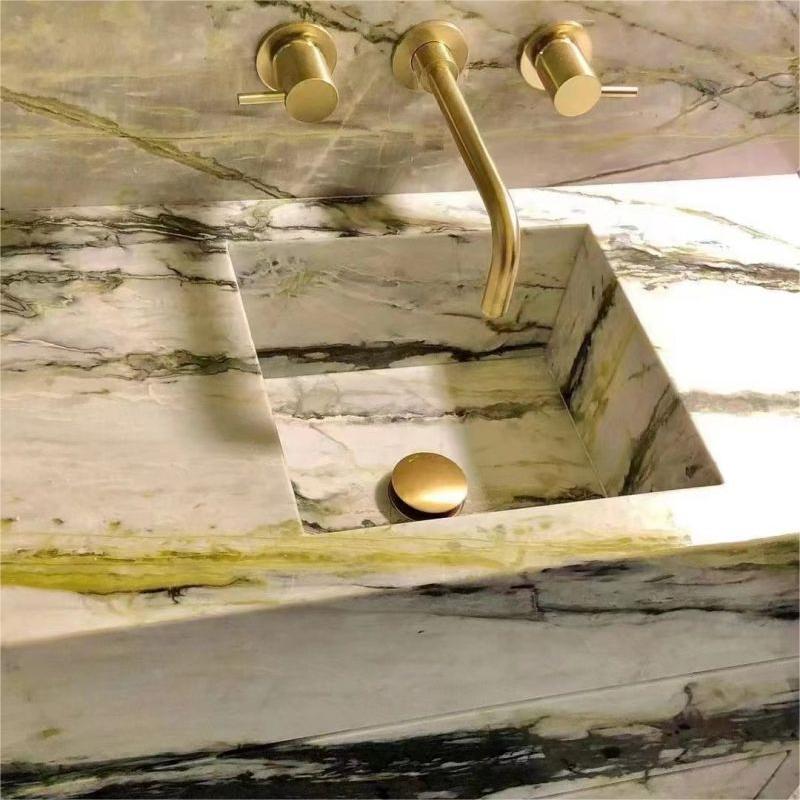
The identity of White Green Marble comes from the contrast between a pale stone field and much stronger natural green mineral movement.
Clivia White can show jade-like green lines, wider forest-green streaks and occasional dark charcoal accents.
As a Green Vein Marble, the material creates more color contrast than conventional white marble with soft grey veining.
For architectural projects, buyers should define whether they prefer a cleaner white field or a more active green-patterned selection before material reservation.
Jade-Green and Dark Mineral Movement
The visual character of Jade Vein Marble can range from delicate green lines to strong irregular mineral bands.
Some Clivia White slabs contain broad white areas with isolated dark-green movement, while others display more complex interaction between green and charcoal veins.
Ivory White Areas → Create calm visual space and keep the stone bright.
Jade Green Veins → Provide the main recognizable color identity.
Forest Green Movement → Adds stronger natural contrast on focal surfaces.
Charcoal Accents → Increase graphic depth and should be intentionally positioned.
Clivia White Marble Slabs
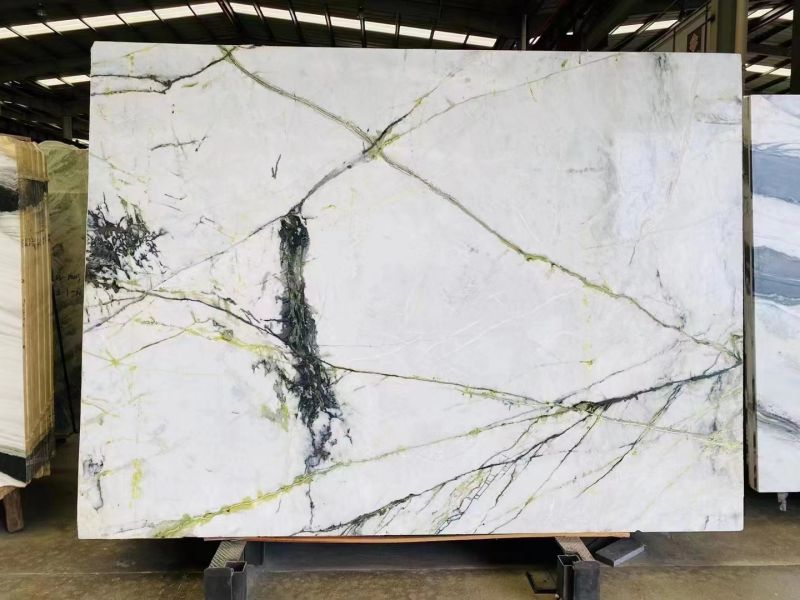
A Clivia White Slab should be selected at full scale because small samples cannot represent the actual proportion of white, green and darker mineral areas.
A Clivia Marble Slab may appear relatively quiet on one side while containing a much stronger green mineral zone elsewhere.
For a White Marble Slab, buyers should also check background tone, natural fissures, repairs, usable dimensions and surface finish.
A Large Marble Slab offers greater flexibility for preserving the best green movement within wall panels, countertops and large architectural pieces.
Slab Selection and Vein-Density Control
| Selection Point | Buyer Review |
| White Background | Compare brighter ivory slabs with softer cream-white selections |
| Green Vein Density | Separate cleaner slabs from stronger patterned slabs where required |
| Dark Accent Ratio | Review the amount of charcoal or very dark green mineral movement |
| Fissures | Check stronger vein zones around cutouts and exposed edges |
| Batch Continuity | Allocate visually compatible slabs to connected project areas |
Clivia White Marble Countertops
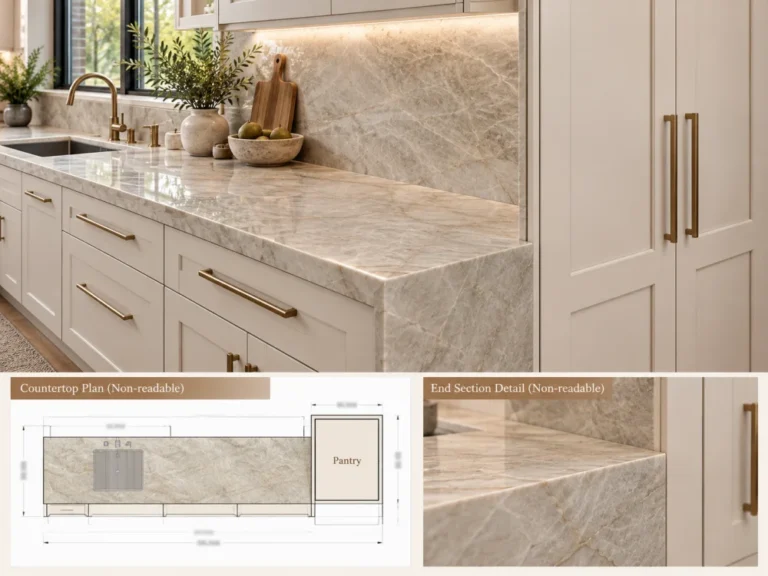
A Marble Countertop made from Clivia White can create a bright surface with more natural color than conventional white or grey marble.
A Clivia Countertop should be laid out on the actual slab so strong green veins do not fall unintentionally through sink openings, narrow bridges or seams.
For islands or longer counters, related pieces can be cut from adjacent slab zones to improve visual continuity.
As with other natural marble, countertop use should account for sealing, acid sensitivity, staining risk and normal marble maintenance.
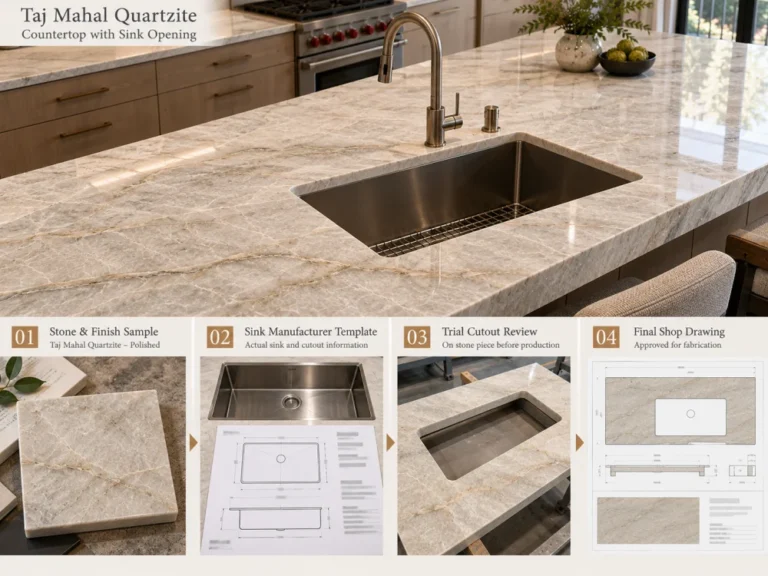
Countertop Cutting Layout
For countertop fabrication, the strongest green vein should be treated as part of the design rather than as random slab decoration.
Actual Slab → Finished Template → Sink Cutout → Seam Position → Green Vein Location → Edge Profile → Cutting Approval
Where possible, vulnerable natural fissure zones should be kept away from narrow sink bridges and projecting corners.
The finished layout should balance visual continuity with structural suitability and material yield.
Clivia White Marble Vanity Tops
A Marble Vanity Top is a strong application for Clivia White because the green mineral movement remains visible at close range.
Basin openings, faucet holes, backsplash pieces and exposed edges should be coordinated with the selected slab before fabrication.
For multi-room villa or hotel projects, vanity tops can be sorted into compatible visual groups based on white tone and green-vein density.
Where closer continuity is required, backsplash pieces can be allocated from adjacent slab areas.
Clivia White Marble Feature Walls
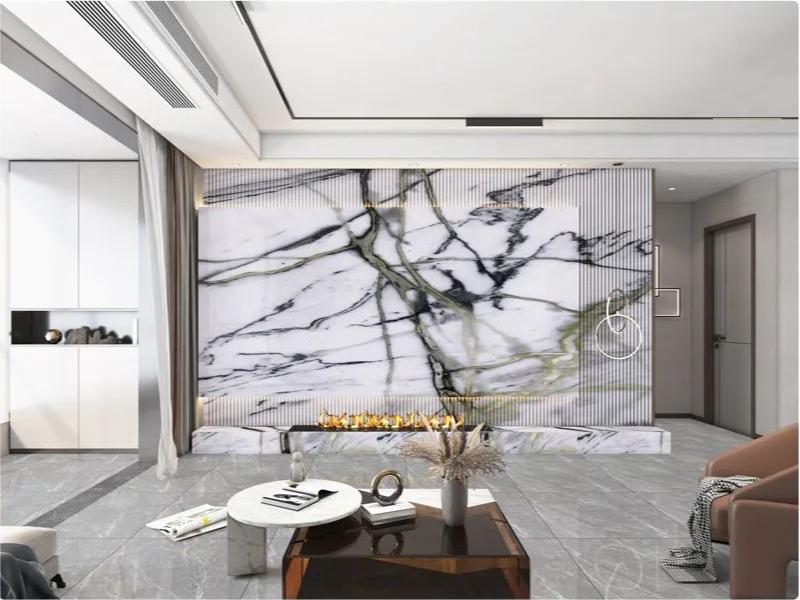
A White Marble Wall using Clivia White can remain bright while introducing substantial green mineral movement.
For a large Marble Wall Panel installation, stronger jade and dark-green areas become part of the overall architectural composition.
Used as a Feature Wall Marble, Clivia White is particularly suitable for villas, hotel lobbies, reception areas, restaurants and premium residential interiors.
The complete elevation should be developed using actual selected slabs before panel cutting begins.
Wall Panel Layout and Vein Balance
Wall fabrication should control the distribution of strong green and dark mineral areas across the complete elevation.
Slab Sequence → Wall Elevation → Green Vein Balance → Dark Accent Placement → Panel Joints → Piece Numbering → Dry-Lay → Final Approval
If all strongly veined panels are concentrated in one section while adjacent areas remain almost white, the wall may appear visually unbalanced.
Dry-lay allows buyers to review the complete composition before shipment.
Clivia White Marble Floors
A White Marble Floor fabricated from Clivia White can introduce green natural movement across a bright architectural surface.
Clivia White Tile can be produced for residential, hotel and selected commercial interiors.
For White Marble Tile and Marble Floor Tile programs, pieces should be pre-sorted according to green-vein density and dark accents.
This prevents heavily patterned pieces from clustering randomly inside an otherwise quiet floor area.
Polished Clivia White Marble
Polished Marble increases the visual contrast between Clivia White’s pale background and its green mineral veins.
Jade and forest-green areas appear deeper, while charcoal accents become more graphic.
This finish works particularly well for feature walls, vanity tops, decorative counters and furniture.
Final QC should review gloss uniformity, scratches, repairs and exposed edge polish before packing.
Honed Clivia White Marble
A honed finish produces a softer, lower-reflection surface.
The white background becomes more subdued and the green veins appear less glossy, creating a calmer architectural character.
This finish is suitable for modern walls, floors, bathrooms and furniture where strong reflection is not required.
Actual finish samples should be approved because polishing and honing can noticeably alter the apparent white tone and vein contrast.
Natural Fissures and Strong Vein Zones
Some of the strongest green and dark mineral veins may coincide with natural fissures or repaired zones.
These areas should be evaluated according to the final component rather than treated only as visual features.
For narrow countertop bridges, stair nosings or thin architectural profiles, potentially vulnerable areas should be avoided where practical.
On polished surfaces, resin color and gloss should also be checked so repairs remain visually compatible with surrounding stone.
B2B Procurement Risk Control
| Buyer Risk | Recommended Control |
| Actual slabs contain more dark green than expected | Approve current full-slab photos before material reservation |
| Connected wall panels have inconsistent vein density | Prepare elevation layouts and dry-lay panels before packing |
| Strong green vein is removed by a sink cutout | Overlay finished countertop templates on actual slab images |
| Natural fissure crosses a narrow finished component | Review vein structure and adjust the cutting layout where required |
| Floor shows random concentration of dark-green pieces | Pre-sort tiles and allocate them according to installation zones |
| Finished surfaces show inconsistent gloss or visible repairs | Inspect the complete batch under consistent reflected lighting |
Custom Fabrication and Quality Control
Clivia White project fabrication should follow approved slabs, drawings and visual allocation plans.
Approved material traceability
Background comparison
Density and layout control
Finished-piece positioning
Finished size verification
Structural suitability check
Wall and floor visual review
Surface and packing inspection
Packaging and International Delivery
Finished Clivia White components are inspected before packing for dimensions, surface quality, visible repairs, edges, quantity and piece identity.
Polished and honed surfaces receive soft non-staining protection, while exposed edges, corners and narrow finished sections receive additional cushioning.
Wall panels and sequential project pieces can be packed according to their installation numbers so site teams can follow the approved layout.
Finished stone is secured inside reinforced fumigated wooden crates using rigid separators, edge guards and suitable internal blocking according to the actual component size and fracture risk.
Working with a Marble Supplier
A professional Marble Supplier should help buyers evaluate the actual Clivia White slab range rather than assuming all white-and-green slabs are visually identical.
Useful B2B support includes current full-slab photography, green-vein sorting, dark-accent comparison, slab measurements, countertop layouts, wall elevations, dry-lay photos, fabrication QC, piece numbering and export packing.
This process gives designers, importers and contractors more control over the most important visual variable of Clivia White: the balance between white negative space and strong green mineral movement.
Why Choose HRST STONE
HRST STONE provides one-stop natural stone solutions backed by 17+ years of stone supply and international project experience.
For Clivia White Marble projects, support can include slab selection, full-slab photography, CAD and shop drawings, countertop and vanity fabrication, wall and floor panels, visual dry-lay, surface inspection, final QC and international export packing.
This coordinated workflow helps designers, importers, contractors and project purchasing teams control white-field tone, green-vein density, dark mineral accents, fabrication accuracy, installation sequence and shipping risk from material approval through delivery.
Information Required for Quotation
| Quotation Item | Information Required |
| Product Form | Slabs / Tiles / Walls / Floors / Countertops / Vanities / Cut-to-Size |
| Dimensions | Required slab sizes or finished component dimensions |
| Quantity | Slabs / Square Meters / Finished Pieces |
| Thickness | 18mm / 20mm or specified project thickness |
| Finish | Polished / Honed / Project-Specific Finish |
| Visual Preference | Cleaner white / balanced green / stronger jade veins / darker accents |
| Fabrication | Cutouts / Edges / Wall Panels / Vanity Tops / Custom Processing |
| Destination | Destination port or complete project delivery location |
Clivia White Marble FAQ
1. What is Clivia White Marble?
Clivia White Marble is a Chinese natural marble characterized by an ivory-white background with jade-green, forest-green and occasional charcoal mineral veins.
2. Is Clivia White Marble completely white?
No. Its identity comes from the contrast between the pale background and irregular green and darker mineral movement.
3. Does every Clivia White slab have the same pattern?
No. White-field tone, green-vein density, dark-accent ratio and natural fissure structure vary between slabs.
4. Is Clivia White suitable for wall panels?
Yes. Large wall panels are one of its strongest applications because the green mineral movement can be coordinated across the complete elevation.
5. Can Clivia White Marble be used for countertops?
Yes. Countertops can be fabricated with sink openings, seams and edges coordinated against the actual slab pattern.
6. Can it be used for vanity tops?
Yes. Vanity tops can be custom fabricated with basin openings, backsplash pieces, faucet holes and finished edge profiles.
7. Is Clivia White suitable for flooring?
Yes. Floor tiles and cut-to-size pieces can be produced, with visual pre-sorting recommended to control green-vein density across large areas.
8. What finishes are available?
Polished and honed finishes are common interior options. Polishing strengthens contrast, while honing creates a softer lower-reflection appearance.
9. What should buyers approve before fabrication?
Review actual slabs for white-field tone, green-vein density, dark accents, fissures, repairs, usable dimensions and finished-piece allocation.
10. How is Clivia White Marble packed for export?
Finished pieces receive face protection, edge and corner protection, rigid separation, piece identification and reinforced fumigated wooden crate packing.
Final Note
Clivia White Marble should be purchased according to the actual balance between white background and green mineral movement rather than from a small reference sample alone. For countertops → approve sink cutouts, seams and major green veins before cutting. For feature walls → coordinate vein density, dark accents and panel joints through a complete elevation and dry-lay. For floors → pre-sort pieces so heavily patterned tiles do not cluster randomly. For vanity tops → allocate compatible slab zones around basin openings and backsplashes. Full-slab approval, CAD layout, fissure inspection, visual sorting, fabrication QC, piece numbering and reinforced export packing provide a more controlled B2B procurement process.