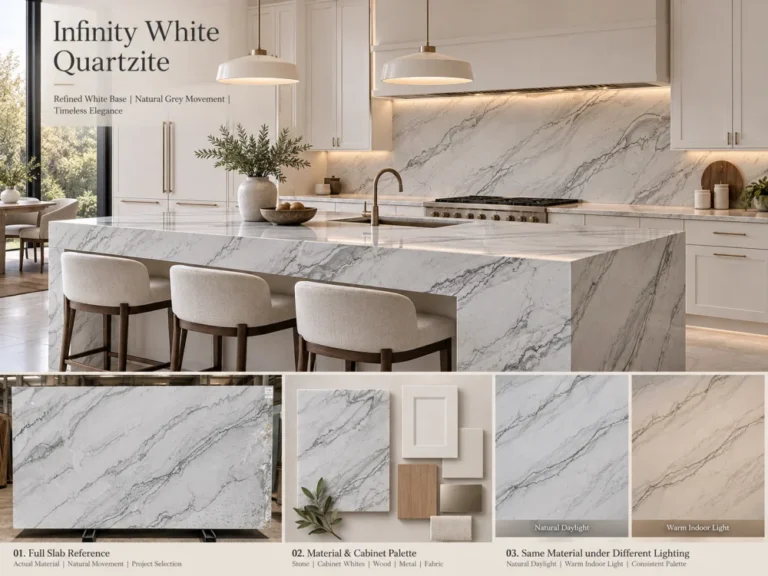


Green Maestro Quartzite Product Overview
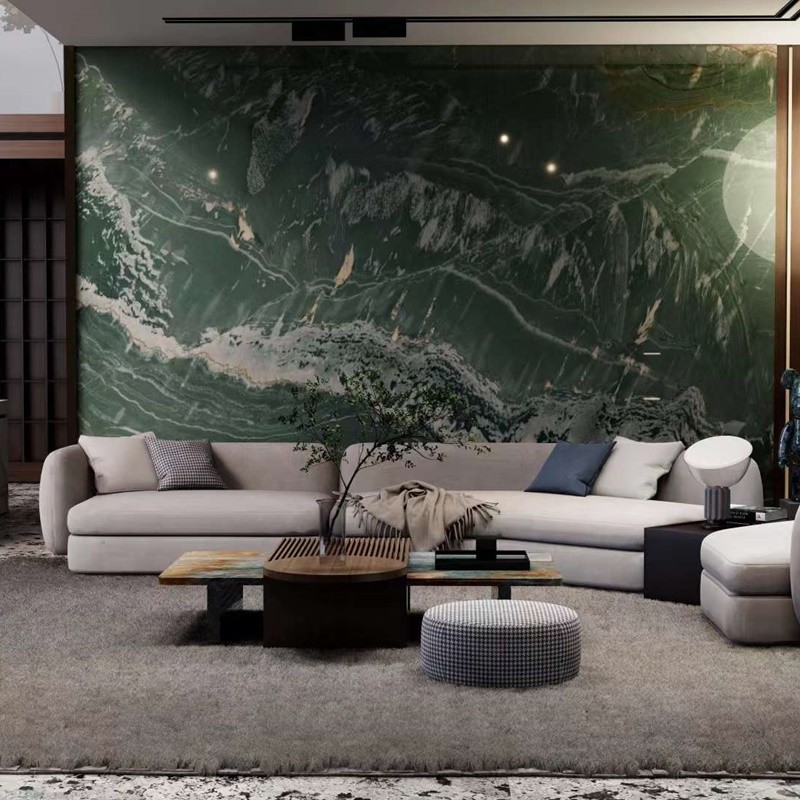
Green Maestro Quartzite is a visually expressive natural stone from Brazil, characterized by layered green and blue-green fields crossed by grey, white and occasionally warmer mineral movement.
Also associated with trade names such as Maestro Green and Verde Maestro, the material has a directional, landscape-like appearance that can change significantly across the length of a slab.
Unlike visually uniform green surfaces, Maestro Quartzite is selected for the geological composition of each individual slab. This makes it particularly suitable for statement surfaces where the stone itself becomes part of the architectural design.
Product Specifications
| Specification | Project Details |
| Material Name | Green Maestro Quartzite |
| Material Type | Natural Quartzite |
| Origin | Brazil |
| Related Trade Names | Maestro Green / Verde Maestro |
| Primary Colors | Green / Blue-Green / Grey / White / Restrained Warm Mineral Accents |
| Texture Pattern | Layered / Directional / Wavy / Flowing Natural Mineral Movement |
| Available Slab Size | Subject to Current Slab Inventory and Block Production |
| Available Tile / Custom Size | Cut-to-Size According to Approved Drawings and Project Requirements |
| Available Thickness | 18mm / 20mm |
| Surface Finishing | Polished / Honed / Leathered / Project-Specific Finish |
| Edge Options | Straight / Eased / Beveled / Mitered / Custom Profile |
| Application | Countertops / Islands / Walls / Vanities / Table Tops / Flooring / Custom Stonework |
| Package Details | Protective Separation + Edge Protection + Reinforced Fumigated Wooden Crates |
| Payment Details | T/T or Agreed Commercial Terms |
| MOQ | Subject to Current Slab Availability and Fabrication Scope |
| Delivery Time | Confirmed According to Quantity, Material Selection and Fabrication Requirements |

Brazilian Green Quartzite Character
As a Brazil Quartzite, Green Maestro belongs to a category of exotic natural stones valued for large-scale geological movement and distinctive color combinations.
Its green areas may range from muted grey-green to stronger blue-green tones, while pale mineral bands create movement across the surface.
This makes Green Quartzite particularly useful where designers want a natural green material without relying on a flat or uniformly saturated color.
Some slabs can appear more linear and directional, while others contain broader waves and irregular transitions. Actual inventory should therefore be reviewed before a project palette is finalized.
Blue-Green Stone with Layered Movement
The visual appeal of Green Maestro comes from the relationship between green, blue-grey and pale mineral structures rather than from one dominant color.
As a Blue Green Stone, it can shift visually depending on the slab section, surface finish and surrounding materials.
For buyers searching for an Emerald Quartzite aesthetic, it is important to understand that Green Maestro is typically more complex and geological than a uniform emerald-green stone.
Its layered character makes it an Exotic Quartzite and Luxury Quartzite option for interiors where the natural slab is intended to become a focal design element.
More Movement → Choose slabs with stronger blue-grey and pale directional waves.
Large Statement Pieces → Position the strongest geological composition inside the primary viewing area.
Multi-Slab Projects → Group compatible slabs before cutting.
Green Maestro Quartzite Slab Selection
A Green Maestro Slab should be approved from full-size photographs or video rather than selected from a small sample alone.
For each Quartzite Slab, buyers should review green tone, wave direction, mineral contrast, structural areas and usable cutting dimensions.
Where several slabs are required, they should be displayed or photographed under similar lighting conditions so the buyer can evaluate compatibility before fabrication.
Current Inventory → Full-Slab Photos → Slab Numbers → Green Tone → Wave Direction → Usable Area → Buyer Approval
Green Maestro for Luxury Interiors
Green Maestro can become the dominant natural material in a contemporary interior without requiring excessive decorative elements around it.
Its green and blue-grey palette coordinates particularly well with walnut, dark oak, black metal, bronze, warm neutral cabinetry and restrained architectural finishes.
Large-format surfaces preserve the natural scale of the pattern and generally communicate the material more effectively than numerous small disconnected pieces.

Green Maestro Quartzite Countertops
A Maestro Counter provides a strong natural focal surface for residential and hospitality interiors.
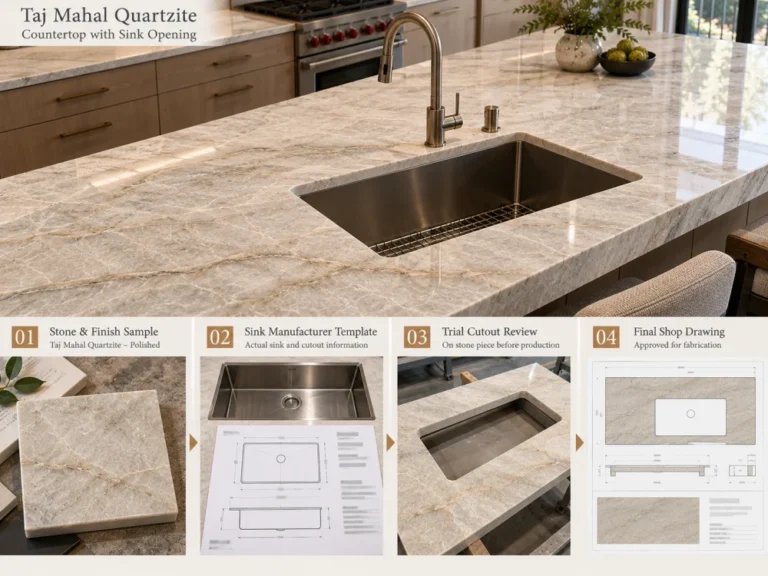
For a Green Countertop, the main mineral waves should be positioned before sink and cooktop openings are finalized.
A custom Quartzite Counter should be nested on the approved slab according to finished dimensions. This allows the buyer to understand which geological areas remain visible after openings, seams and edge fabrication are completed.
Approved Slab → Finished Template → Main Wave Direction → Sink / Cooktop → Seam → Edge Profile → Cutting Approval
Green Maestro Quartzite Kitchens
A Maestro Kitchen can use the stone as a central island, perimeter countertop, backsplash or coordinated combination of these elements.
Because the material already has strong movement, the kitchen layout should identify which component is intended to become the main visual focus.
For example, the most expressive slab can be reserved for the island while quieter compatible areas are assigned to perimeter worktops or smaller components.
Green Maestro Quartzite Islands
A large Maestro Island is one of the most effective applications for Green Maestro because the broad uninterrupted surface preserves its layered geological movement.
For a Quartzite Island, the main viewing side should be established before slab nesting. Sink or cooktop openings can then be positioned with the overall composition in mind.
For long islands, slab dimensions and finished dimensions should also be compared early to determine whether a seam is required and where it can be positioned most logically.
Waterfall Island Pattern Continuity
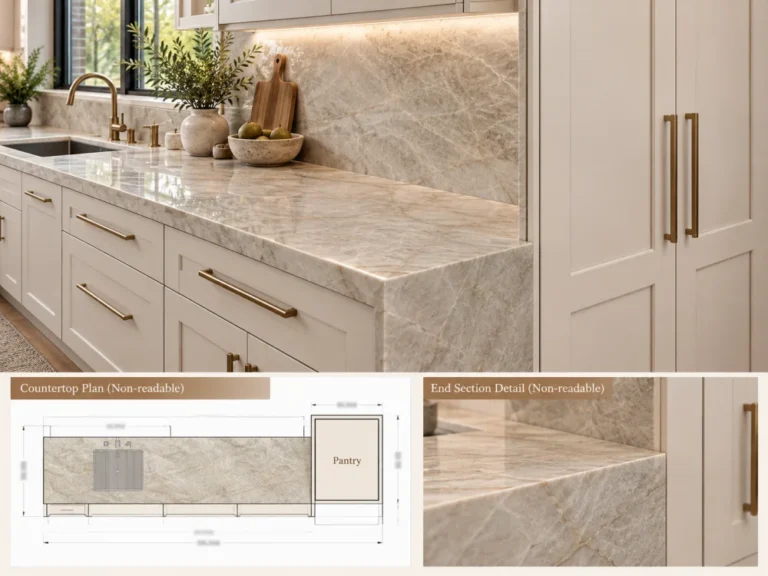
A Waterfall Island requires coordination between the horizontal top and vertical side panels.
With Green Maestro, the goal is usually to maintain a believable continuation of directional movement around the miter rather than simply matching background color.
The cutting layout should show the proposed top, waterfall panel and miter relationship before production.
Top Orientation → Side Orientation → Wave Relationship → Miter Line → Support → Trial Fit → Final Inspection

Green Maestro Quartzite Table Tops
A Maestro Table Top can isolate one particularly attractive geological section and turn it into a furniture-scale composition.
For a Quartzite Table Top, round, oval, rectangular or irregular templates can be positioned digitally over the actual slab before cutting.
This is especially useful for Green Maestro because rotating the same template can produce very different visual results from one slab.
Green Maestro Quartzite Vanity Tops
A Maestro Vanity can introduce natural green and blue-grey tones into bathrooms without requiring a large architectural installation.
For single or double vanities, basin openings should be mapped onto the slab before cutting so the strongest mineral movement remains visible rather than being removed by the cutout.
Backsplashes and side returns can be taken from adjoining areas where visual continuity is required.
Green Maestro Quartzite Feature Walls
A large Maestro Green Wall allows the natural horizontal or diagonal movement of the material to become part of the architectural composition.
For a Green Feature Wall, full elevations should be prepared before cutting so panel divisions, slab direction and major mineral bands can be coordinated.
Applications can include hotel lobbies, reception areas, luxury residences, restaurants, retail interiors and other statement spaces.
Slab Selection → Elevation → Panel Division → Wave Direction → Piece Numbering → Dry-Lay → Installation Reference
Green Maestro Quartzite Flooring
Maestro Flooring can be considered for selected interior areas where a durable natural quartzite surface and strong decorative character are required.
For larger floor layouts, designers should decide whether the directional movement will follow one primary axis or be distributed more naturally.
Finish selection should also consider the required slip resistance, maintenance expectations and actual project environment.
Surface Finishes and Fabrication
Polished Quartzite
A Polished Quartzite finish emphasizes color depth, mineral contrast and the layered movement of Green Maestro.
Honed Finish
Honing reduces reflection and gives the complex green-grey pattern a softer architectural appearance.
Leathered Finish
A leathered finish can introduce tactile depth while producing a more subdued reflection than a polished surface.
Custom fabrication can include countertops, vanity tops, table tops, cut-to-size panels, CNC profiles, sink and cooktop openings, mitered edges, waterfall components and project-specific architectural stonework.
Natural Variation and Buyer Risk Control
Green Maestro is naturally variable. One reference photograph should therefore not be treated as a guarantee that every future slab will have exactly the same green tone, wave density or mineral distribution.
For projects requiring several slabs, visual grouping is particularly important. Slabs intended for adjoining pieces should be checked together before fabrication begins.
| Buyer Risk | Recommended Control |
| Green tone differs between slabs | Compare actual slabs under consistent lighting |
| Wave direction conflicts between pieces | Approve orientation before cutting |
| Important pattern removed by cutout | Overlay finished templates on slab images |
| Waterfall movement appears disconnected | Coordinate top and side-panel nesting together |
| Finished pieces become difficult to identify | Use clear piece numbering and layout references |
Custom Fabrication and Quality Control
Fabrication should follow approved drawings and the final slab layout. Each finished component should remain identifiable from cutting through final packing.
Approved slab verification
Finished size inspection
Wave direction verification
Position and geometry check
Miter and profile quality
Finish consistency review
Adjacent piece relationship
Inspection before packing
Packaging and International Delivery
Finished Green Maestro components require packaging designed around actual dimensions, weight, edge geometry and cutout conditions.
Finished stone faces are separated using suitable protective materials. Corners, mitered edges, narrow components and vulnerable areas around large openings receive additional cushioning and support.
Components are secured inside reinforced fumigated wooden crates with appropriate internal blocking and separation. Production inspection is completed before packing, and export documentation and logistics support can be coordinated according to the destination and agreed trade terms.
Working with a Quartzite Supplier and Factory
A professional Quartzite Supplier should help buyers evaluate the actual material rather than relying only on a catalog image.
For Green Maestro, useful purchasing support includes current slab photos and videos, slab numbering, visual grouping, finished-piece layouts and fabrication planning.
A capable Quartzite Factory can then convert the approved design into countertops, islands, wall panels, vanities and custom stone furniture while maintaining traceability between drawings, slab positions and finished components.
Why Choose HRST STONE
HRST STONE provides one-stop natural stone solutions backed by 17+ years of stone supply and project experience.
For Green Maestro Quartzite projects, support can include material selection, current full-slab photography, CAD and shop-drawing coordination, cutting-layout planning, custom fabrication, production tracking, dry-lay review, final QC and international export packing.
This workflow helps designers, contractors, distributors and project buyers control natural variation, pattern placement, fabrication details and delivery risk through one coordinated supply process.
Information Required for Quotation
| Quotation Item | Information Required |
| Application | Countertop / Island / Wall / Vanity / Table / Flooring |
| Dimensions & Quantity | Finished dimensions, quantity schedule or CAD drawings |
| Thickness | 18mm / 20mm or specified project requirement |
| Finish | Polished / Honed / Leathered / Other specified finish |
| Visual Preference | More green / stronger waves / quieter movement / specific slab reference |
| Fabrication | Cutouts / Miter / Edge profile / Waterfall / Pattern coordination |
| Destination | Destination port or complete delivery location |
Green Maestro Quartzite FAQ
1. What is Green Maestro Quartzite?
Green Maestro Quartzite is a Brazilian natural quartzite known for layered green, blue-green, grey and pale mineral movement.
2. Where does Green Maestro Quartzite come from?
Green Maestro Quartzite is commercially sourced from Brazil.
3. Are Maestro Green and Verde Maestro the same material?
Maestro Green and Verde Maestro are commonly used as related trade names. Actual slabs should always be confirmed because commercial naming can vary between suppliers.
4. Can Green Maestro Quartzite be used for kitchen countertops?
Yes. Its natural quartzite composition and distinctive appearance make it suitable for custom kitchen countertops when properly fabricated and installed.
5. Is Green Maestro suitable for a large kitchen island?
Yes. Large islands are particularly effective because they preserve the broad directional movement of the slab.
6. Can Green Maestro be used for waterfall islands?
Yes. The top and vertical waterfall panels should be nested together to coordinate wave direction and miter transitions.
7. Is Green Maestro Quartzite suitable for feature walls?
Yes. Large wall panels allow its green and blue-grey geological movement to become an architectural focal point.
8. Should buyers approve actual slabs before fabrication?
Yes. Green tone, wave direction, mineral distribution and visual intensity vary naturally between slabs.
9. What finishes are available for Green Maestro Quartzite?
Polished, honed and leathered finishes can be considered according to current slab condition and project requirements.
10. How is fabricated Green Maestro Quartzite packed for export?
Finished pieces are inspected, separated with protective materials, protected at vulnerable edges and secured inside reinforced fumigated wooden crates.
Final Note
Green Maestro Quartzite should be purchased according to the actual available slabs rather than one reference photograph. For countertops → map sinks, cooktops and seams before cutting. For islands → reserve the strongest composition for the primary viewing area. For waterfall designs → coordinate the top and vertical panels together. For table tops → compare multiple template orientations on the slab. For walls → sequence panels according to directional movement. Full-slab approval, CAD layout, fabrication QC and protected export packing provide B2B buyers with greater control over the finished visual result and project delivery.