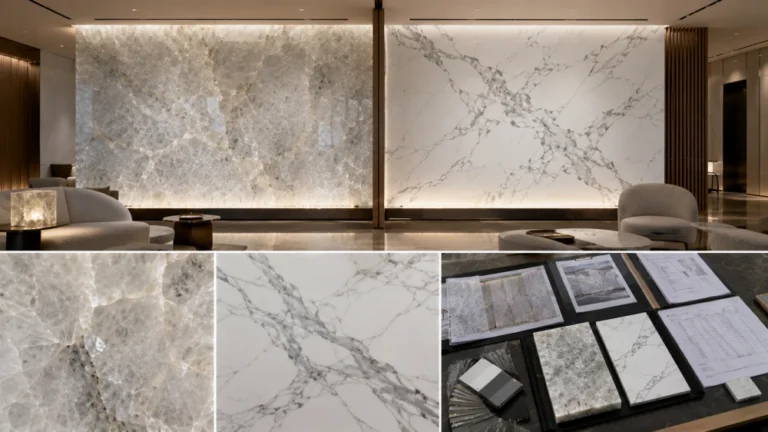

Michelangelo Quartzite Product Overview
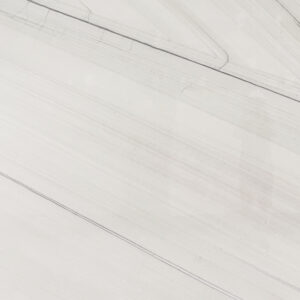
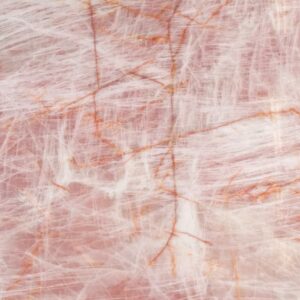
Michelangelo Quartzite is a visually expressive Brazilian natural stone whose identity comes from the interaction of multiple mineral colors rather than one uniform background.
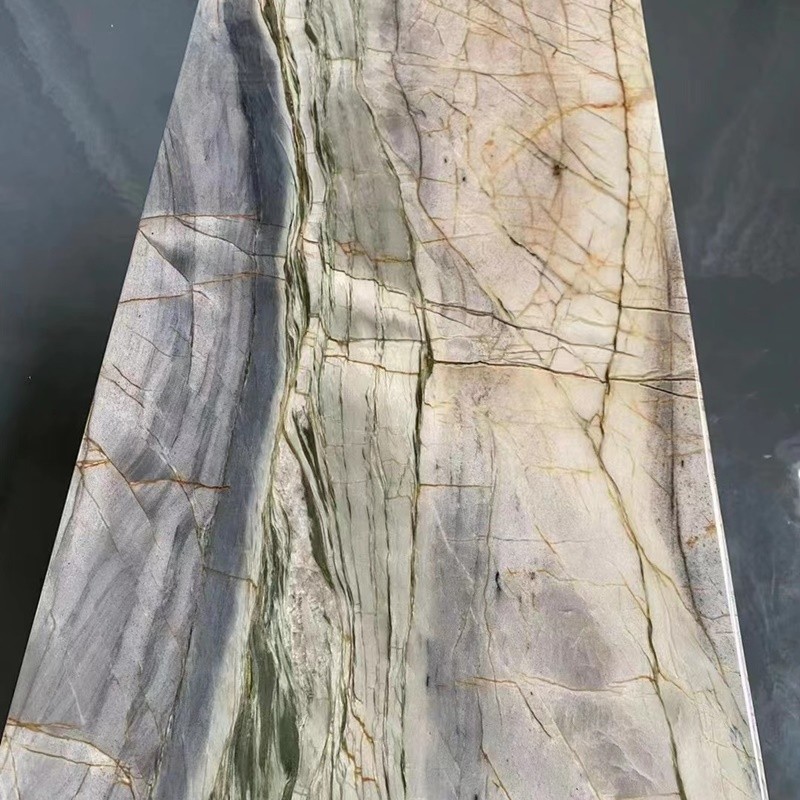
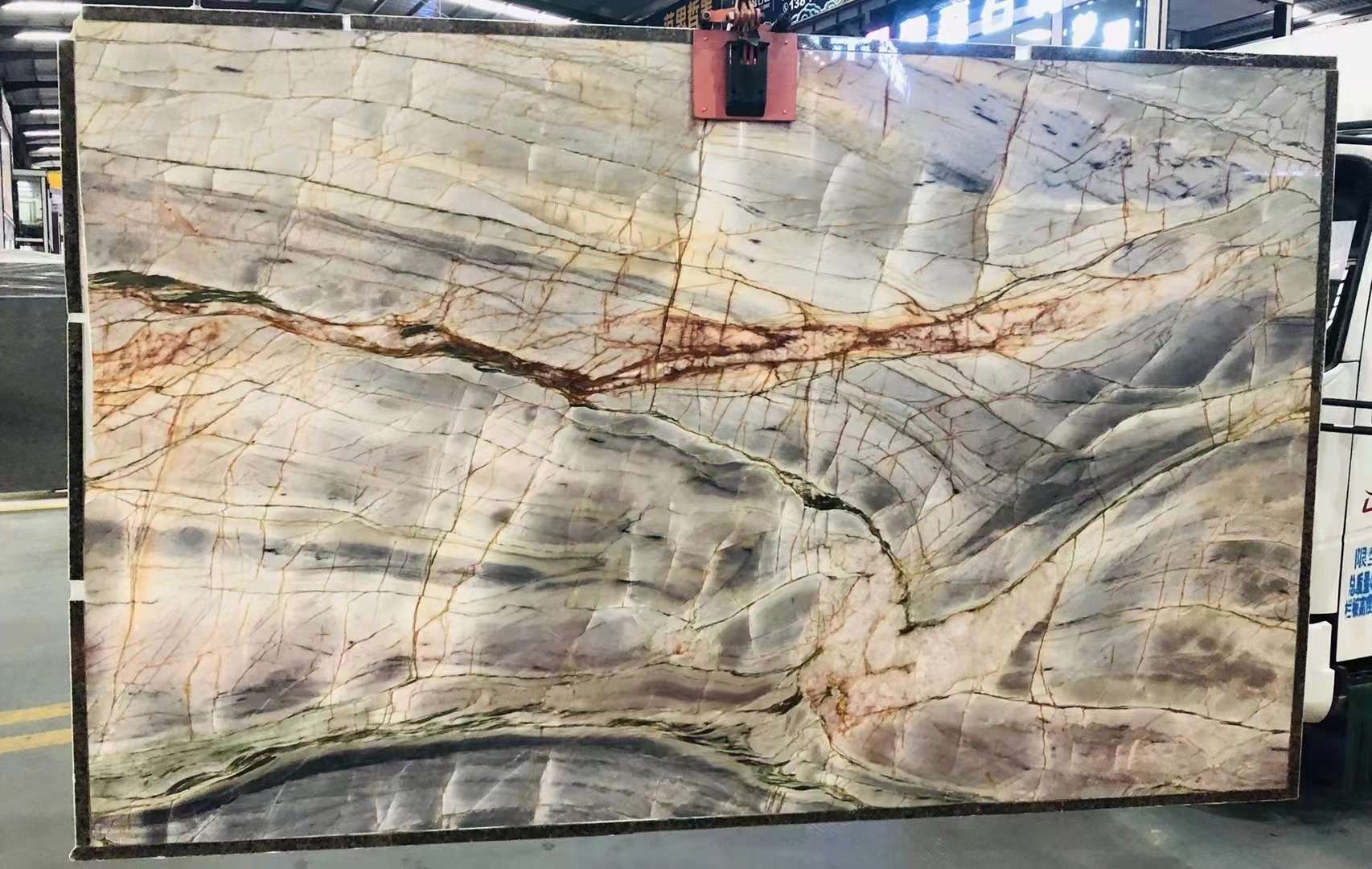
Depending on the slab, cream and pale neutral areas may transition into green, blue-grey, grey, beige and warmer mineral formations. Darker structures can create additional depth between these larger color zones.
This gives Michelangelo Stone a naturally artistic appearance and makes every slab composition noticeably individual.
For designers and project buyers, its value lies not only in the colors themselves but in how those colors are positioned within the finished surface.
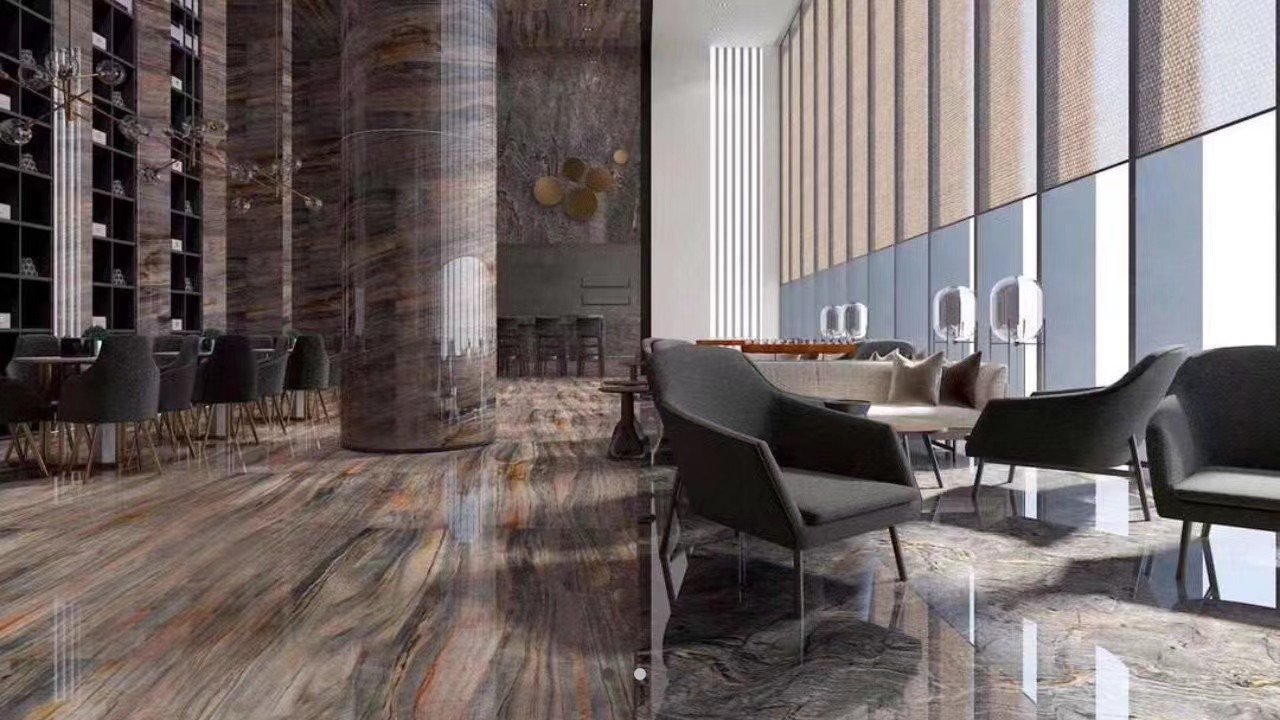
Product Specifications
| Specification | Project Details |
| Material Name | Michelangelo Quartzite |
| Material Type | Natural Quartzite |
| Origin | Brazil |
| Primary Colors | Cream / Green / Blue-Grey / Grey / Beige / Warm Mineral Accents |
| Texture Pattern | Layered / Flowing / Irregular / Multicolor Geological Movement |
| Available Slab Size | Subject to Current Slab Inventory and Block Production |
| Custom Size | Cut-to-Size According to Approved Drawings and Project Requirements |
| Available Thickness | 18mm / 20mm |
| Surface Finishing | Polished / Honed / Leathered / Project-Specific Finish |
| Edge Options | Straight / Eased / Beveled / Mitered / Custom Profile |
| Application Scope | Countertops / Islands / Walls / Vanities / Table Tops / Custom Stonework |
| Supply Ability | Slabs / Cut-to-Size / Countertops / Wall Panels / Project Fabrication |
| Package Details | Protective Separation + Edge Protection + Reinforced Fumigated Wooden Crates |
| MOQ | Subject to Current Slab Availability and Fabrication Scope |
| Delivery Time | Confirmed According to Quantity, Slab Selection and Fabrication Requirements |
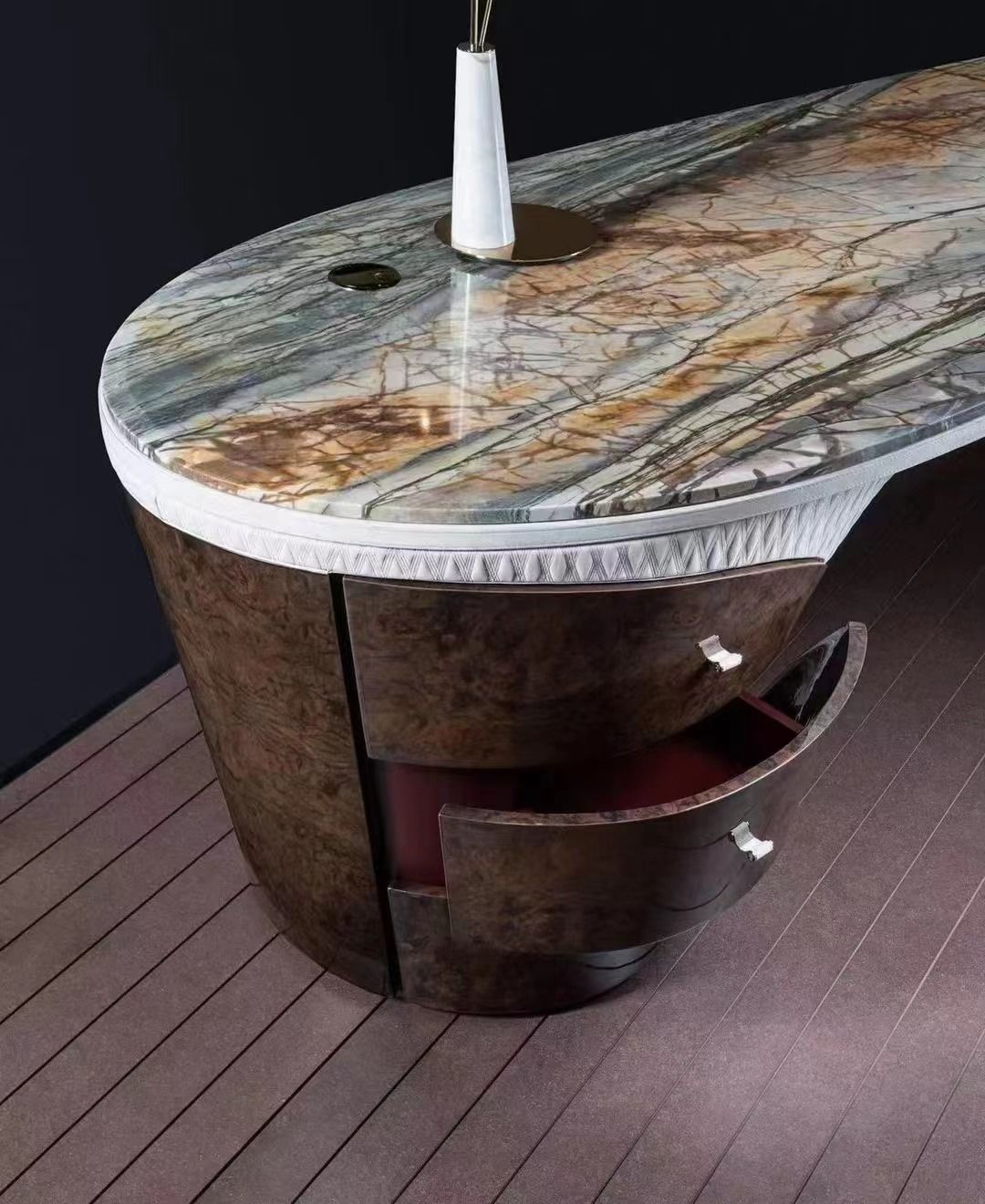
A Multicolor Brazilian Quartzite
As a Brazil Quartzite, Michelangelo is valued for large-scale geological variation and expressive mineral composition.
Individual areas can visually relate to White Quartzite, Green Quartzite or Blue Quartzite, but the material is better understood as a Multicolor Quartzite rather than being classified by one dominant color.
Warm beige or gold-toned mineral structures can also occur beside cooler green and blue-grey fields, producing the contrast often associated with a distinctive Gold Vein Quartzite.
The result is a stone whose final appearance depends strongly on which part of the slab is selected for each finished component.
Visual Character and Design Value
Michelangelo differs from stones dominated by repetitive linear veins. Its visual structure is typically broader and more irregular, with individual mineral zones forming their own shapes, directions and transitions.
This makes it an effective Exotic Quartzite for projects where the stone itself is expected to function as a major design element.
As a Luxury Quartzite, it pairs especially well with restrained surrounding materials because too many competing colors can reduce the impact of its natural composition.
Lighter Composition → Prioritize slabs with broader cream and pale mineral fields.
Cooler Composition → Select stronger green, grey and blue-grey areas.
Warmer Composition → Look for beige and restrained gold-toned mineral zones.
Statement Surface → Preserve the most distinctive geological area rather than cutting it into small unrelated pieces.
Michelangelo Quartzite Slab Selection
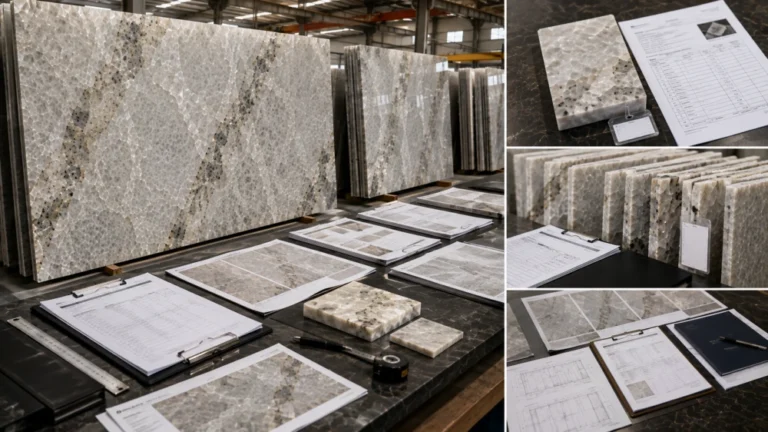
Selecting a Michelangelo Slab should begin with current full-slab photographs rather than a small physical sample or historical catalog image.
Each Quartzite Slab should be evaluated for dominant colors, pattern position, usable dimensions, major mineral transitions and the intended location of finished components.
For multi-slab orders, consecutive or visually compatible slabs should be identified and grouped before cutting.
Recommended Selection Flow:
Current Inventory → Full-Slab Photos → Slab Numbers → Dominant Colors → Signature Mineral Zones → Usable Area → Project Matching → Buyer Approval
Designing with Michelangelo Quartzite
The strongest Michelangelo installations normally treat the slab as a composition rather than simply as raw square-meter material.
Large-format applications preserve the relationship between its cream, green, blue-grey and warmer mineral areas and allow the natural geological structure to remain readable.
For this reason, islands, feature walls, large table tops and selected vanity surfaces are especially suitable applications.
Michelangelo Quartzite Countertops
A Michelangelo Counter can create a highly individual natural-stone work surface for residential and hospitality interiors.
For a custom Quartzite Counter, slab nesting should be completed before production so sink openings, cooktops and seams do not unintentionally remove the most attractive mineral formations.
Where several countertop pieces meet, their dominant colors should also be coordinated. A cream-dominant section placed directly beside a strongly green or blue-grey section may create an abrupt visual break unless this contrast is intentional.
Countertop Control:
Approved Slab → Finished Dimensions → Main Visual Area → Sink / Cooktop → Seam Location → Edge Profile → Final Cutting Layout
Michelangelo Quartzite Kitchens
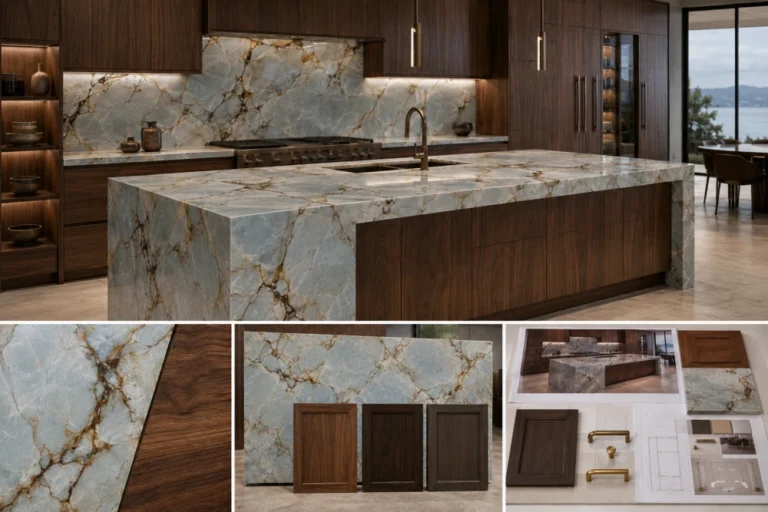
A Michelangelo Kitchen works particularly well when the stone is allowed to become the primary visual material.
Simple cabinetry in warm white, cream, natural wood, charcoal or restrained metallic finishes can provide a neutral framework around the multicolor quartzite.
For kitchens using both perimeter counters and an island, the project should decide whether all stone components need a similar color balance or whether the island is intentionally selected as the stronger statement piece.
Michelangelo Quartzite Kitchen Islands
A large Michelangelo Island is one of the most effective ways to display the material because it provides enough uninterrupted surface area for several mineral zones to interact.
For a Quartzite Island, the primary viewing side should be established before the slab is nested. This allows the strongest section to remain visible rather than being lost beneath cabinetry, seating overhangs or appliances.
Large sink or cooktop openings should also be considered during visual selection, not only after the stone has been allocated.
Waterfall Island Layout
A Waterfall Island adds another level of complexity because the horizontal top and vertical side panels become one visual assembly.
With Michelangelo Quartzite, matching only the vein direction is not enough. The relationship between cream, green, blue-grey and warm mineral zones should also be considered around the miter.
Where exact continuation is impossible, the priority should be a deliberate and visually balanced transition rather than an artificial-looking match.
Waterfall Planning:
Main Island Top → Viewing Side → Waterfall Panel → Color Transition → Pattern Relationship → Miter → Trial Assembly
Michelangelo Quartzite Table Tops
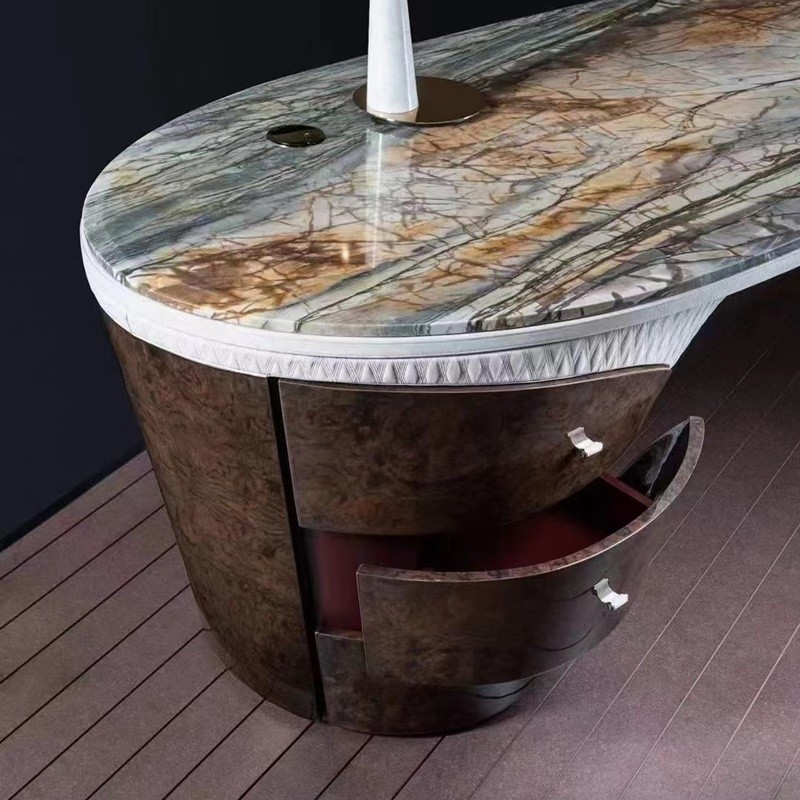
A Michelangelo Table provides an opportunity to select one particularly attractive section of the slab and present it as a complete furniture composition.
For a Quartzite Table Top, round, oval or irregular templates can be positioned digitally over the full slab before cutting.
The preferred orientation should balance visual composition with usable yield and structural requirements around the finished perimeter.
Michelangelo Quartzite Vanity Tops
A Michelangelo Vanity can introduce a concentrated area of natural color into a luxury bathroom without requiring the entire room to use the same material.
Basin openings should be positioned after the preferred mineral composition has been selected. For double vanities, the relationship between both basin zones should be reviewed before fabrication.
Backsplashes and side returns can be cut from related slab areas when visual continuity is required.
Michelangelo Quartzite Feature Walls
A large Michelangelo Wall allows the full multicolor geological composition to become an architectural feature.
For a Quartzite Wall, the complete elevation should be planned before individual panels are cut.
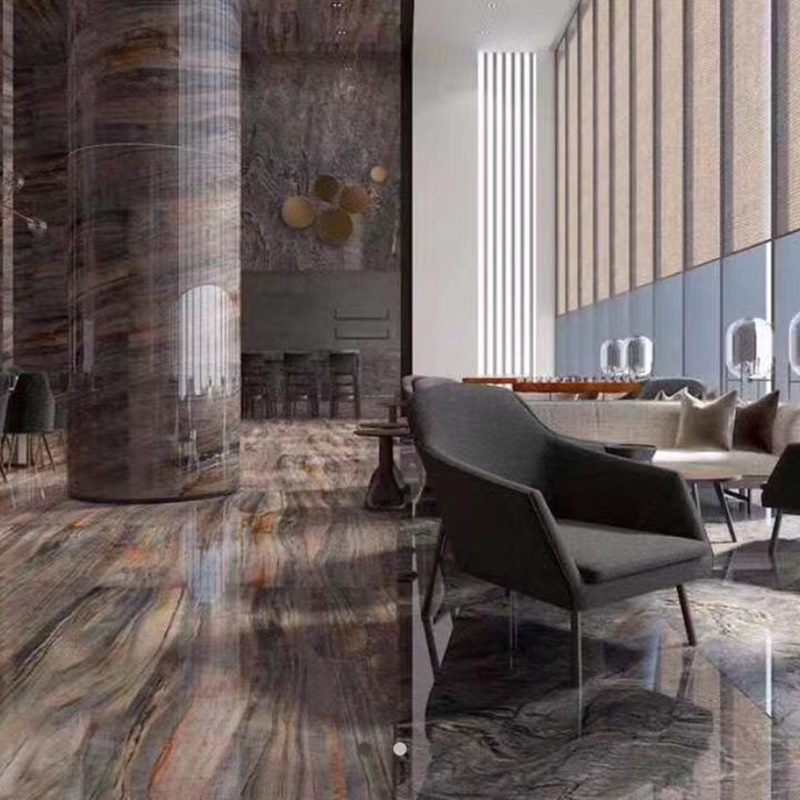
Used as a Feature Wall Stone, Michelangelo can work particularly well in villa living rooms, hotel lobbies, reception spaces, restaurants and other interiors where the stone is intended to attract attention.
Wall Layout:
Slab Group → Full Elevation → Color Distribution → Panel Joints → Pattern Relationship → Piece Numbering → Dry-Lay
Surface Finishes and Fabrication
Polished Quartzite
A Polished Quartzite finish generally increases visual depth and makes the contrast between cool and warm mineral areas more pronounced.
Honed Quartzite
A Honed Quartzite finish reduces surface reflection and can give the multicolor composition a quieter architectural appearance.
Leathered and other project-specific finishes can also be considered according to current slab condition, approved finish samples and the intended application.
Natural Variation and Procurement Risk
Michelangelo Quartzite has stronger visual variation than many relatively uniform stones. This is a design advantage, but it also creates specific procurement risks.
The most important control is to define the project standard from the actual available slab group rather than from a small sample or one promotional image.
| Buyer Risk | Recommended Control |
| Slabs have different dominant colors | Group slabs by overall visual compatibility before approval |
| Signature mineral area is lost during cutting | Overlay finished-piece templates on full-slab images first |
| Sink or cooktop removes the focal pattern | Coordinate cutouts with visual layout before CNC processing |
| Island pieces appear unrelated | Plan top, edge strips and waterfall panels together |
| Small sample creates wrong color expectation | Use actual full-slab photos as the visual approval standard |
Custom Fabrication and Quality Control
Once the slab layout is approved, fabrication should follow the confirmed shop drawings and cutting plan so the intended composition is preserved throughout production.
Track approved material
Preserve focal areas
Verify finished sizes
Check geometry and position
Inspect profiles and miters
Check finish consistency
Review adjoining pieces
Inspect before packing
Packaging and International Delivery
Finished Michelangelo Quartzite components are inspected before packing. Finished surfaces should be separated with suitable non-staining protective materials, while exposed corners, mitered edges and vulnerable areas around sink or cooktop openings require additional protection.
Long components and narrow stone sections should receive appropriate internal support to reduce concentrated transport stress.
Project pieces are secured inside reinforced fumigated wooden crates with protective materials, separators, edge protection and internal fixing selected according to the actual product dimensions and transportation risk.
Export documentation and logistics support can be coordinated according to the agreed trade term and project destination.
Working with a Quartzite Supplier
For a visually variable material such as Michelangelo, the role of the Quartzite Supplier extends beyond supplying square meters of stone.
Useful B2B support includes current slab photography, slab numbering, visual grouping, CAD cutting layouts, fabrication drawings, custom processing, production inspection, dry-lay review and export packing.
These controls allow designers, contractors and distributors to understand what the finished pieces will look like before irreversible cutting begins.
Why Choose HRST STONE
HRST STONE provides one-stop natural stone solutions backed by 17+ years of stone supply and project experience.
For Michelangelo Quartzite projects, support can include current slab selection, full-slab photos and videos, CAD and shop-drawing coordination, cutting-layout planning, custom fabrication, production tracking, dry-lay confirmation, final QC and international export packing.
This workflow is particularly valuable for multicolor natural quartzite because slab selection, finished-piece positioning and fabrication decisions directly influence the final architectural appearance.
Information Required for Quotation
| Quotation Item | Information Required |
| Application | Countertop / Island / Wall / Vanity / Table Top / Custom Project |
| Dimensions & Quantity | Finished dimensions, quantity schedule or CAD drawings |
| Thickness | 18mm / 20mm or specified project requirement |
| Finish | Polished / Honed / Leathered / Other specified finish |
| Visual Preference | Cream dominant / greener / cooler blue-grey / stronger multicolor contrast |
| Fabrication | Cutouts / Miters / Waterfalls / Edge profiles / Pattern coordination |
| Destination | Destination port or complete project delivery location |
Michelangelo Quartzite FAQ
1. What is Michelangelo Quartzite?
Michelangelo Quartzite is a Brazilian natural quartzite known for complex cream, green, blue-grey, grey and warm multicolor mineral movement.
2. Where does Michelangelo Quartzite come from?
Michelangelo Quartzite is commercially sourced from Brazil.
3. What color is Michelangelo Quartzite?
Its color can include cream, green, blue-grey, grey, beige and warmer mineral accents, with the balance varying between slabs.
4. Can Michelangelo Quartzite be used for kitchen countertops?
Yes. It can be fabricated for kitchen countertops, but the actual slab layout should be approved before sink, cooktop and seam locations are finalized.
5. Is Michelangelo Quartzite suitable for kitchen islands?
Yes. Large islands are especially suitable because they preserve more of the stone’s broad multicolor geological composition.
6. Can Michelangelo Quartzite be used for waterfall islands?
Yes. The island top and waterfall panels should be nested together so color transitions and mineral movement remain visually coordinated.
7. Can Michelangelo Quartzite be used for feature walls?
Yes. Its large-scale multicolor pattern makes it suitable for statement walls in residential, hospitality and commercial interiors.
8. Do buyers need to approve the actual slabs?
Yes. The distribution of cream, green, blue-grey and warm mineral areas can vary significantly, so full-slab approval is strongly recommended.
9. What finishes are available for Michelangelo Quartzite?
Polished, honed and leathered finishes can be considered depending on current material availability, approved samples and project requirements.
10. How is Michelangelo Quartzite packed for export?
Finished pieces are inspected, separated with protective materials, protected at vulnerable edges and secured inside reinforced fumigated wooden crates.
Final Note
Michelangelo Quartzite should be purchased as an actual slab composition rather than as a fixed catalog color. For countertops → coordinate focal mineral areas with sink, cooktop and seam locations. For islands → preserve the strongest composition on the primary viewing surface. For waterfall designs → plan top and vertical panels as one visual assembly. For table tops → test the finished outline on the slab before cutting. For walls → establish the complete panel sequence before fabrication. Full-slab approval, CAD layout, fabrication QC and protected export packing provide much greater control over the finished project.