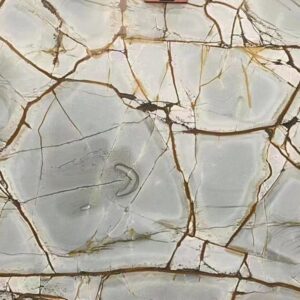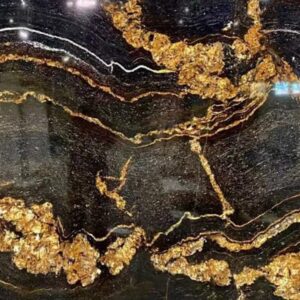


Botanic Green Quartzite is a visually rich Brazilian natural stone featuring layered green mineral fields, flowing white and grey structures, and selected warm ochre, pink or gold-toned movement. Its botanical color palette gives the material a distinctive architectural character, making it especially suitable for projects where natural green stone is intended to become a focal design element.
Brazil Origin
18mm / 20mm
Green Mineral Movement
Custom Fabrication

Natural Quartzite
Brazil
Green / White / Grey / Warm Accents
Slabs / Tiles / Cut-to-Size
Botanic Green Quartzite Product Overview
Botanic Green Quartzite, also searched as Botanic Green, Botanic Quartzite or Botanic Stone, is valued for its rich natural green color and complex mineral structure.
The background can range from moss and jungle green to deeper emerald tones. White and grey veins move through the slab irregularly, while selected warm ochre, pink or gold-toned mineral areas can add contrast and depth.
Because one Botanic Green Slab can differ substantially from another, actual slab selection is particularly important for large islands, feature walls and connected architectural surfaces.

Product Specifications
| Item | Specification Details |
| Material Name | Botanic Green Quartzite |
| Alternative Names | Botanic Green / Botanic Quartzite / Botanic Stone |
| Material Type | Natural Quartzite |
| Origin | Brazil |
| Primary Colors | Jungle Green, Moss Green, Emerald Green, White, Grey with Ochre, Pink or Gold-Toned Accents |
| Texture Pattern | Layered and flowing natural mineral movement with irregular green fields and contrasting pale veins |
| Available Thickness | 18mm / 20mm |
| Surface Finishing | Polished / Honed / Brushed / Leathered / Project-Specific Finish |
| Supply Forms | Slabs, Tiles, Countertops, Island Tops, Vanity Tops, Wall Panels, Flooring, Fireplace Pieces, Table Tops and Bar Tops |
| Application Scope | Luxury Residential, Villas, Hotels, Kitchens, Bathrooms, Feature Walls, Floors, Fireplaces and Custom Furniture |
| Custom Fabrication | Cut-to-Size, CNC Openings, Miters, Edge Profiles, Waterfall Pieces, Wall Panels, Fireplace Components and Table Tops |

How to Select Botanic Green Quartzite
For Botanic Green Quartzite, buyers should evaluate overall green saturation, vein direction, the balance between white-grey movement and warm mineral accents, and the distribution of stronger or calmer slab zones.
For a Botanic Countertop, Botanic Island or large wall panel, the strongest green and white vein areas should be allocated intentionally rather than cut only for maximum yield.
Selection Logic
If a deeper botanical result is required → Choose slabs with broader jungle or emerald-green fields.
If a lighter composition is preferred → Choose slabs with more visible white and grey mineral movement.
If warmer visual character is desired → Choose slabs with restrained ochre, pink or gold-toned accents.
If several finished pieces connect visually → Approve the complete slab allocation and cutting layout before fabrication.
Botanic Green Quartzite Applications
The rich botanical character of this Luxury Green Stone makes Botanic Green especially suitable for projects where natural stone is intended to create a strong visual identity.
Botanic Island
Large kitchen islands provide enough surface area to display the deep green fields and flowing pale mineral movement at architectural scale.
Botanic Countertop
Countertops can be fabricated with sink openings, cooktop cutouts, edge profiles and seams coordinated with the selected slab composition.
Botanic Vanity
Vanity tops can use selected green and pale mineral zones with basin openings, faucet holes, backsplashes and finished exposed edges.
Botanic Wall
Large wall panels can display the full natural composition in villas, hotels, reception areas and premium commercial interiors.
Botanic Fireplace
Fireplace surrounds can use strong green and pale movement around the opening to create a distinctive architectural focal point.
Botanic Table Top
Dining tables, coffee tables, consoles and bar tops can use selected slab sections as expressive custom furniture surfaces.
Kitchen and Countertop Coordination
A Botanic Kitchen can use the stone as a statement island, a full Green Countertop system or a selected accent surface. Because the material already has strong color, cabinetry and metal finishes should be coordinated after actual slab selection.
Warm timber, bronze and brass finishes can work well with slabs containing ochre or gold movement, while pale cabinetry can create sharper contrast with deeper green slabs.
If the cabinetry is natural timber → Choose slabs with balanced green and warm mineral accents.
If the cabinetry is white or cream → Deeper jungle-green slabs can create stronger contrast.
If the cabinetry is charcoal → Slabs with larger white and grey movement can provide better visual separation.
Feature Walls and Large Panels
A Botanic Wall Panel installation can display the material’s broad green and white mineral movement more effectively than small modules.
For feature walls, slab sequence and panel dimensions should be coordinated before cutting so stronger veins and color transitions continue logically across the elevation.
Recommended Wall Planning:
Actual Slab Review → Wall Elevation → Panel Dimensions → Slab Sequence → Joint Position → Vein Coordination → Cutting Layout → Dry-Lay Review → Final Approval
Flooring and Tonal Grouping
For a Botanic Floor, tonal grouping becomes increasingly important as the installation area grows. Randomly mixing pieces with very different green intensity can produce abrupt visual breaks.
For large floor areas, pieces should be grouped by color strength and vein density before installation. Finish selection should also reflect traffic, slip conditions and maintenance expectations.
If visual consistency is the priority → Group pieces with similar green-to-white balance.
If expressive variation is preferred → Maintain natural contrast but organize the sequence through dry laying.
Large-Scale Pattern and Cutting Layout
Botanic Green is an Exotic Green Stone with broad natural mineral structures rather than a repetitive small pattern. A single emerald, white or warm mineral zone can occupy a substantial portion of a finished island or wall panel.
For premium projects, finished-piece allocation should guide cutting so the strongest visual areas remain on focal surfaces.
If a waterfall island is required → Coordinate the top and vertical return using compatible green and vein sections.
If several focal pieces are required → Allocate the strongest green and pale mineral areas to the most visible components first.
If seams are unavoidable → Position them near natural transitions in the mineral pattern.
Application Selection Guide
| Project Requirement | Recommended Form | Selection Priority |
| Statement kitchen island | Large Botanic Green Slab | Green composition and waterfall continuity |
| Luxury countertop | Botanic Countertop | Opening position and seam planning |
| Bathroom vanity | Botanic Vanity | Tone balance and edge quality |
| Feature wall | Botanic Wall Panel | Panel sequence and vein continuity |
| Statement furniture | Botanic Table Top | Visible green composition and finished edge quality |
Surface Finishes and Fabrication
Polished Botanic
A polished finish increases color depth and makes the green, white and warm mineral structures appear richer and more reflective.
Honed Botanic
A honed finish reduces reflection and creates a softer architectural appearance while preserving the natural green mineral character.
Brushed or Leathered
Brushed or leathered finishes can add subtle tactile texture and lower glare for selected countertops, bar tops, walls and custom furniture.
Key Procurement Risks
A small sample cannot represent the complete green range, vein scale or warm mineral distribution. Actual slab review is recommended.
Natural slabs can range from moss green to deeper emerald and jungle tones. Variation should be managed through slab grouping.
Strong veins and green zones can be lost inside openings or divided poorly at seams when slab mapping is skipped.
Maximizing yield first can place premium slab areas on secondary pieces while less attractive sections appear on focal surfaces.
Common Purchasing Mistakes and Consequences
| Common Mistake | Possible Consequence | Recommended Control |
| Ordering from a small sample only | Unexpected full-slab green balance | Approve actual slab photos or video |
| Mixing unrelated green tones | Abrupt differences across connected surfaces | Review all project slabs together |
| No finished-piece layout | Best slab areas used on secondary components | Allocate focal surfaces before cutting |
| Incomplete fabrication drawings | Incorrect openings, miters or dimensions | Approve CAD or shop drawings before fabrication |
| Comparing slab price only | Incomplete finished-project cost comparison | Compare usable yield, fabrication, packing and logistics |
Custom Fabrication and Quality Control
Botanic Green Quartzite can be fabricated into countertops, waterfall islands, vanity tops, wall panels, flooring pieces, fireplace surrounds, table tops, bar tops and other custom architectural components according to approved CAD or shop drawings.
Before cutting, actual slab identity, visible face, green intensity, major white-grey movement, warm mineral areas, natural fissures or repaired zones, finished dimensions, cutout positions, seam locations and exposed edges should be reviewed.
Recommended Project Flow
Material Inspection → Actual Slab Selection → Color & Pattern Review → Slab Mapping → Drawing Approval → Cutting Layout → Cutting → CNC & Edge Fabrication → Surface & Edge Check → Dry-Lay Confirmation Where Required → Final QC → Packing Inspection
Packaging and Project Delivery
Finished Botanic Green Quartzite components should be packed according to their dimensions, geometry, weight and breakage risk. Large islands, countertops with openings, wall panels and long furniture tops require suitable support during handling and international transportation.
Finished stone faces should be separated with soft non-staining protective materials. Exposed corners, polished edges, sink openings and vulnerable areas should receive additional cushioning before components are securely fixed inside reinforced fumigated wooden crates.
Information Required for Quotation
For accurate B2B pricing, provide the main project requirements so slab quantity, usable yield, fabrication complexity, packing and logistics can be evaluated together.
Island / Counter / Vanity / Wall / Table
Finished component sizes
Pieces or total area
18mm / 20mm
Polished / Honed / Brushed
Edges / Cutouts / Miters / Waterfall
CAD / PDF / Shop Drawings
Port or delivery address
Botanic Green Quartzite FAQ
1. What does Botanic Green Quartzite look like?
Botanic Green Quartzite typically combines jungle, moss or emerald-green mineral fields with white and grey movement and selected warm ochre, pink or gold-toned accents.
2. Is Botanic Green Quartzite a natural Brazilian stone?
Yes. Botanic Green Quartzite is a Brazilian natural quartzite, so green intensity, vein movement, natural markings and mineral distribution vary from slab to slab.
3. Can Botanic Green Quartzite be used for countertops?
Yes. Botanic Countertop applications can be fabricated with sink openings, cooktop cutouts, edge profiles and seams coordinated with the selected slab layout.
4. Is Botanic Green Quartzite suitable for kitchen islands?
Yes. Botanic Island applications are particularly effective because large surfaces allow the green and pale mineral movement to remain highly visible.
5. Can Botanic Green Quartzite be used for vanity tops?
Yes. Botanic Vanity applications can be fabricated with basin openings, faucet holes, backsplashes and finished visible edges according to approved drawings.
6. Can Botanic Green Quartzite be used for feature walls?
Yes. Botanic Wall and Botanic Wall Panel applications can display the broad natural green composition across large architectural surfaces.
7. Can Botanic Green Quartzite be used for flooring?
Yes. Botanic Floor applications can be considered where the selected finish, traffic conditions, slip requirements and tonal grouping suit the project.
8. Is Botanic Green Quartzite suitable for fireplaces?
Yes. Botanic Fireplace applications can create a strong architectural focal point when major green and pale mineral areas are positioned intentionally around the opening.
9. Which finish is suitable for Botanic Green Quartzite?
Polished Botanic emphasizes color depth and mineral contrast, while honed or brushed finishes create a softer lower-reflection architectural appearance.
10. What affects Botanic Green Quartzite price?
Price depends on slab selection, green color quality, pattern composition, dimensions, thickness, usable yield, finish, fabrication complexity, quantity, packaging requirements and shipping destination.
Final Note / Practical Takeaway
Botanic Green Quartzite is best suited to projects where rich botanical color is intended to become part of the architectural identity. Its jungle-to-emerald green fields, white-grey movement and restrained warm mineral accents work especially well for kitchen islands, countertops, vanities, feature walls, fireplaces, floors and custom furniture. For B2B procurement, actual slab selection, green-tone grouping, pattern direction, cutting layout, finish approval, fabrication drawings, QC and export packaging should be evaluated together. If a deeper green result is preferred → choose slabs with broader jungle or emerald areas. If a lighter composition is required → choose slabs with more visible white-grey movement. If several finished pieces form one visual installation → approve the complete slab allocation and cutting layout before fabrication.