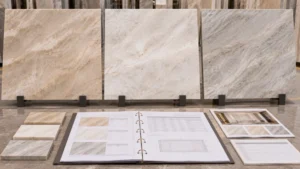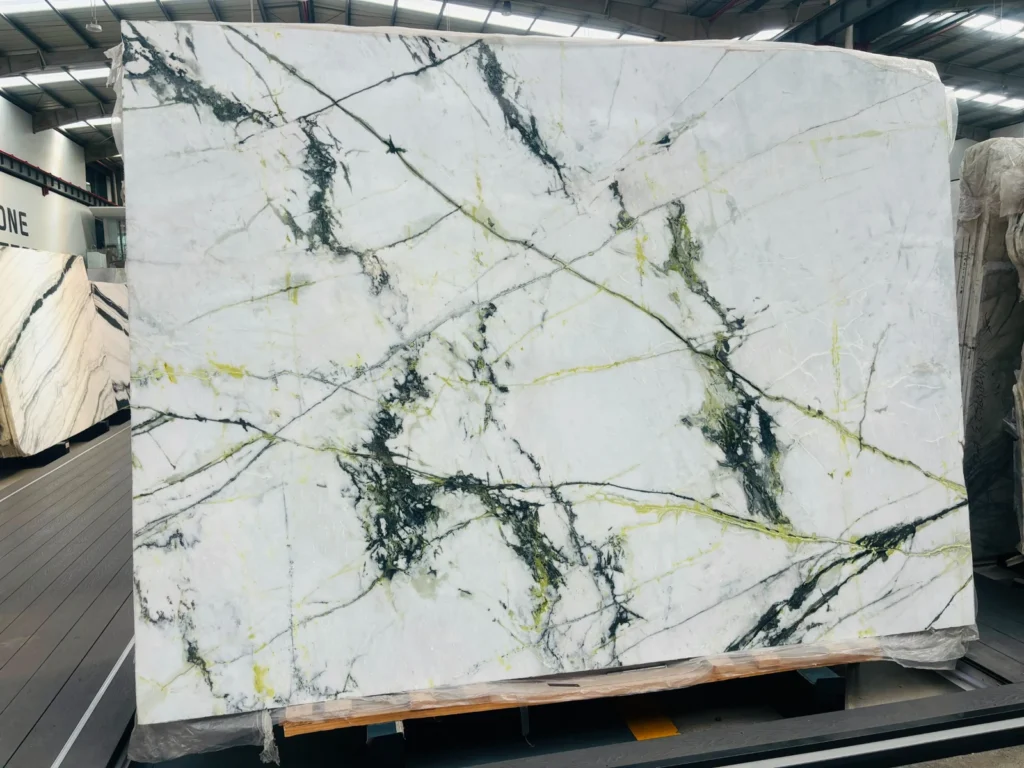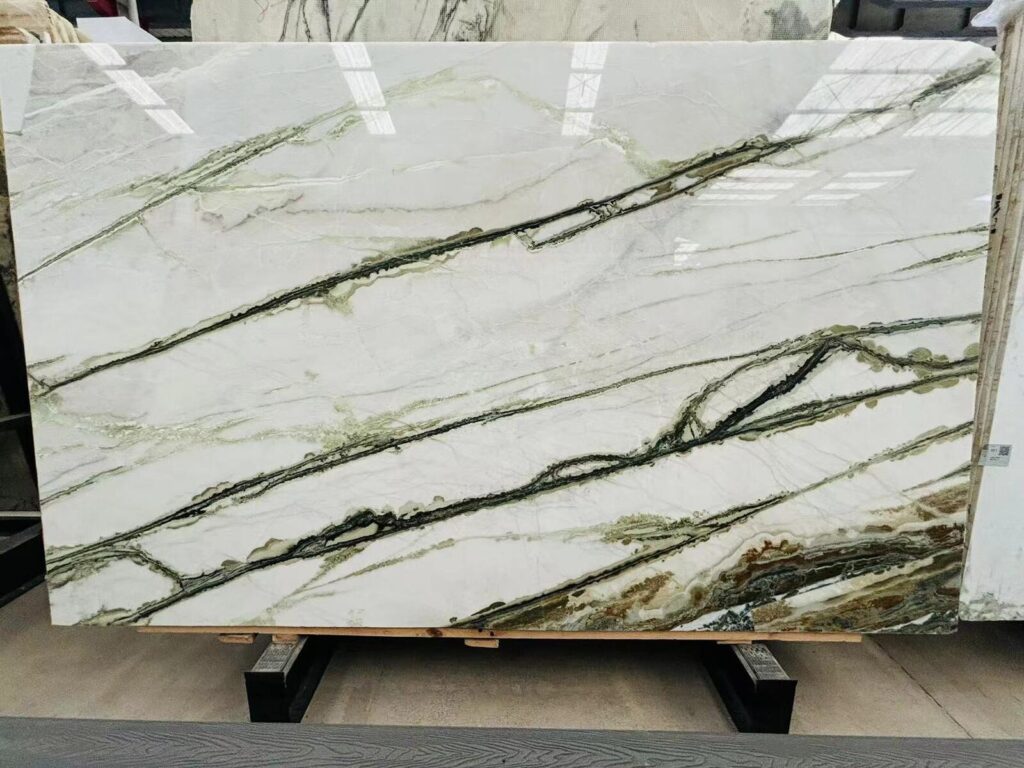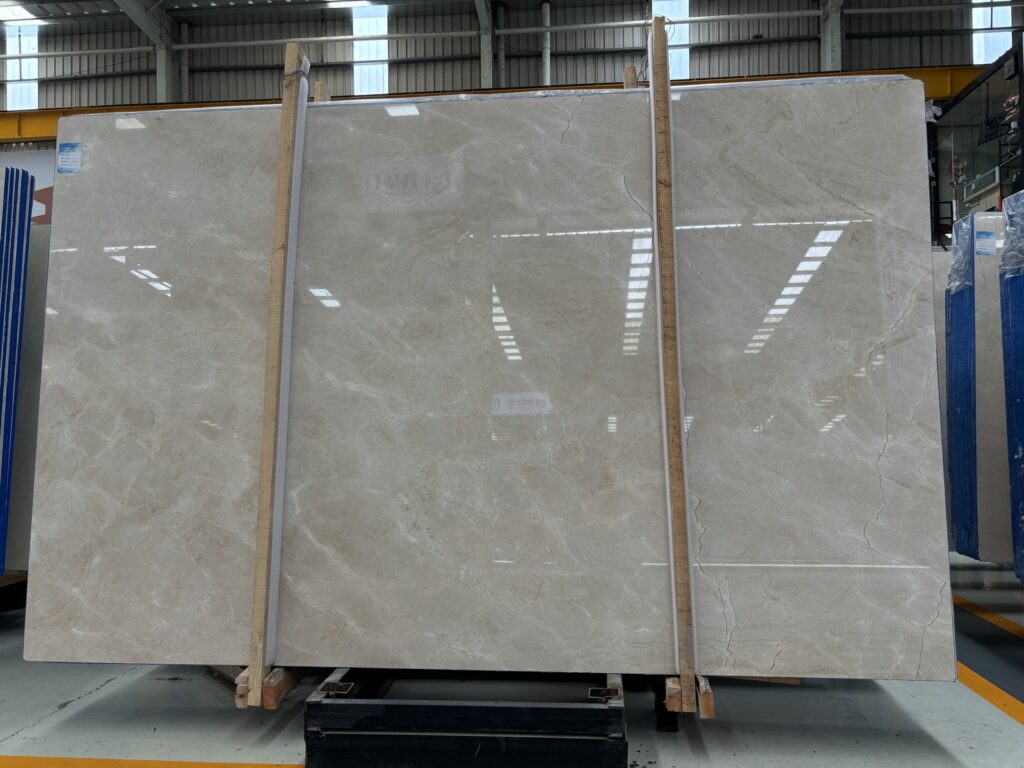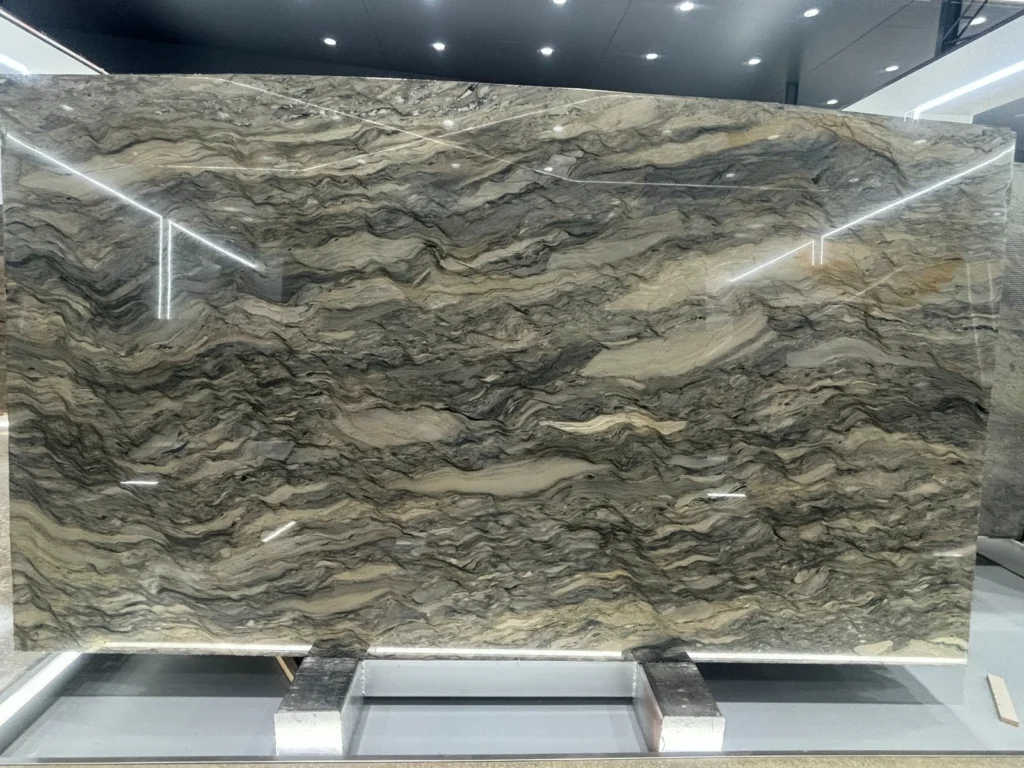


A Quartzite fireplace surround should be designed around the exact appliance installation instructions before its stone opening, mantel, hearth or wall panels are released for fabrication. Confirm the fireplace manufacturer, model, approved configuration and current manual. Then translate the required facing areas, clearances to combustible construction, trim boundaries, ventilation openings, access requirements and adjacent mantel or hearth conditions into the project drawings. Natural Quartzite may be noncombustible, but that does not remove the appliance’s installation restrictions or establish the suitability of the complete surround assembly.
A Quartzite fireplace surround is a natural-stone finishing assembly around a fireplace opening. It may consist of side jambs, a head panel, upper wall cladding, returns, a mantel, a hearth or other project-specific stone components.
Its geometry must be coordinated with the actual appliance and the construction surrounding it.
The critical issue is not whether Quartzite looks suitable beside a flame. It is whether the proposed natural-stone assembly fits within the selected fireplace’s permitted installation and finishing conditions.
Two fireplaces may look nearly identical on an interior rendering but have different installation requirements.
A gas fireplace, wood-burning appliance, electric fireplace or fireplace insert may require different treatment around its front, enclosure, mantel and adjacent finishes.
Even appliances made by the same manufacturer can use different trim assemblies, heat-management options or framing arrangements.
Therefore, the stone fabricator should not receive only:
“Fireplace opening: as shown on the drawing.”
The project should establish the appliance identity first.
Record:
Do not assume that an older manual, an online product photograph or instructions for a similar fireplace model establish the current installation requirements.
Manufacturer documentation can be obtained through the appropriate product or support channel. For example, Heat & Glo’s manual directory allows users to locate documents by appliance model.
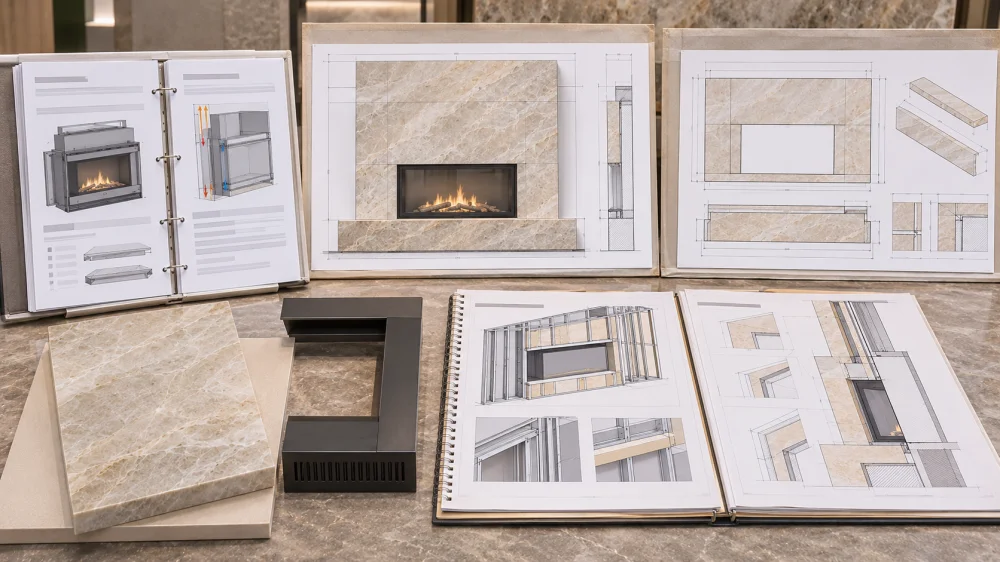
The appropriate fireplace installer or responsible designer should confirm which instructions apply to the actual unit and project.
Required input: Exact appliance model, configuration, applicable manual, current architectural drawing and an identified reviewer for the fireplace installation requirements.
The fireplace manual should be reviewed as an installation document, not merely as a catalogue of appliance dimensions.
A specific fireplace may include different drawings for framing, facing materials, mantels, hearths, venting, heat management and service access.
These should be translated into a coordinated schedule that the architect, fireplace installer and stone fabricator can understand.
| Manual Requirement | Question for the Quartzite Surround | Drawing / Record |
| Appliance and Framing Dimensions | Where does the appliance body sit relative to the finished wall and stone facing? | Appliance setting-out section and elevation |
| Clearances to Combustibles | Are timber framing, boards, adhesives, cabinetry or other combustible components within restricted areas? | Coordinated enclosure and clearance detail |
| Noncombustible Facing Requirements | Which areas require a specified noncombustible facing or backing assembly? | Facing-zone drawing and material schedule |
| Finishing / Trim Boundary | Where may the Quartzite edge terminate without obstructing the appliance front or trim? | Opening and perimeter detail |
| Mantel and Side Projections | Are the proposed stone shelf, side returns and nearby combustible elements within the permitted arrangement? | Mantel / side-jamb sections |
| Hearth Requirements | Is a hearth or floor-protection assembly required, and where is its boundary? | Hearth plan and section |
| Air Openings / Heat Management | Will any stone facing, frame or trim obstruct an outlet, intake or required heat path? | Ventilation and enclosure coordination |
| Service and Front Removal | Can required screens, glass, doors or service components still be removed? | Service-access / trim-removal detail |
Not every appliance has the same categories or restrictions.
If the relevant manual does not provide enough information for a proposed custom facing arrangement, request written clarification through the appliance manufacturer, dealer or responsible installation professional.
Do not create an assumed clearance from a screenshot or an unrelated product manual.
One of the most important distinctions is between the visible noncombustible stone surface and the other materials behind or around it.

These are the distances and conditions established for materials that can burn or otherwise fall within the manufacturer’s combustible-material restrictions.
Depending on the appliance, the affected construction may include:
The appliance manual establishes how those materials may be arranged.
A manufacturer may permit or require specified noncombustible facing near the appliance.
However, the permission may be limited by the required construction method, finish thickness, attachment technique, ventilation arrangement or the location of the fireplace front.
Therefore, the statement “Quartzite is noncombustible” does not, by itself, authorize stone installation directly against every part of a fireplace.
The front of the appliance may include a frame, door, safety barrier, trim, outlet or another functional component.
Stone facing may need to stop at a specific permitted line to allow correct assembly, operation and maintenance.
This is a different question from whether the stone itself can burn.
Assembly: Are the backing, fixing, adhesive and concealed components suitable for the installation conditions?
Appliance: Does the finished assembly preserve every required clearance, air opening and operational or service function?
All three must be resolved before the detail is treated as coordinated.
No. The appliance type influences which technical issues require attention, but the exact model and installation instructions still control the work.
Gas appliances may include specific framing requirements, venting systems, facing restrictions, decorative fronts, safety screens and heat-management configurations.
A linear gas fireplace with an approved heat-management system may have different finishing possibilities from another gas unit without that system.
The heat-management option should be confirmed as part of the appliance configuration rather than assumed to be available on every model.
Electric appliances may not require fuel piping or combustion venting, but they can still contain heating elements, air openings, electrical components and service requirements.
Do not cover heater discharge openings, access panels or other required appliance features with Quartzite.
Where a product has a different clearance allowance from a gas fireplace, apply the instructions for that specific electric appliance rather than carrying over a generic fireplace detail.
Wood-burning systems can introduce requirements for chimney or flue connections, hearth protection, combustible surroundings, framing and other high-temperature conditions.
An insert installed into an existing fireplace may also require confirmation of the existing fireplace and chimney configuration.
Do not assume that an appliance replacement will fit the previous stone surround opening simply because the visible dimensions appear similar.
For each type, the appropriate qualified fireplace professional should confirm the appliance configuration and applicable local requirements before the stone fabricator is instructed to cut the finished opening.
The most useful coordination document is a section and elevation showing the appliance and the stone together.
A fireplace manufacturer’s dimensional drawing establishes the appliance geometry.
The architectural drawing establishes the intended visual composition.
The stone fabrication drawing establishes which physical pieces will be cut.
These three sources must agree at the critical interfaces.
A manufacturer may dimension requirements from the fireplace opening, outer chassis, finished front, glass, trim or another reference point.
Do not substitute a different datum because it is easier to measure on a rendering.
The project detail should identify the exact reference from which each relevant dimension is taken.
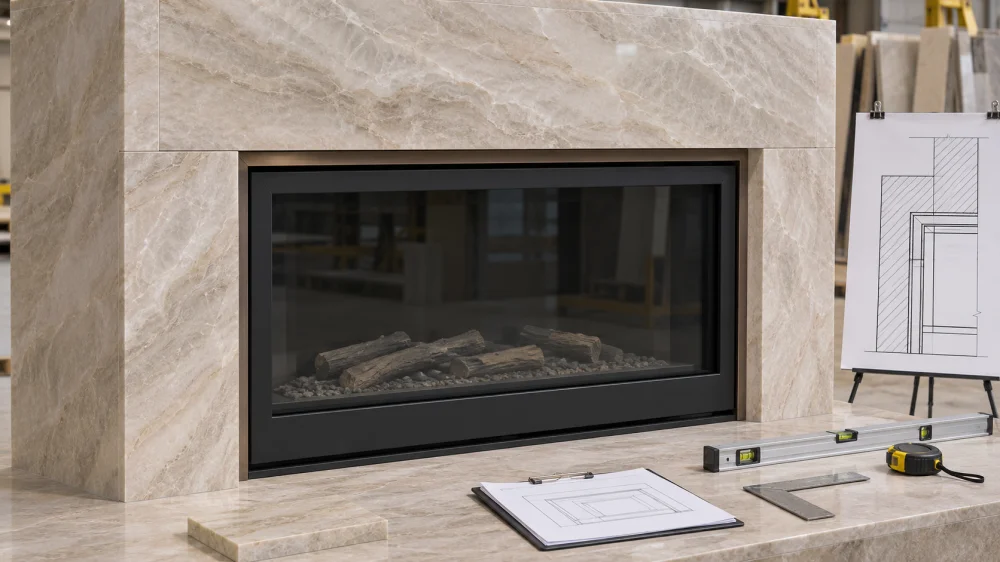
Show the proposed:
Check the relationship at finished stone thickness, not only as an outline on a flat elevation.
For example, a thick mitred stone return can occupy additional depth near the appliance trim even though the front elevation appears correctly spaced.
An annotated photograph can indicate that the left jamb needs adjustment.
It should not become the controlling measurement for the fireplace opening.
The Quartzite fabricator annotated-photo guide explains how to use photos to communicate design intent while keeping verified dimensions, cutouts and fabrication geometry on the current approved drawings.
Where the project is complex, create a short coordination record identifying each critical interface, its governing appliance-manual reference, the responsible reviewer and its current approval status.
Do not ask the Quartzite supplier to interpret gas, electric or fire-safety requirements that belong to the appliance manufacturer, qualified installer or responsible project designer.
Do not assume so.
Natural stone is generally noncombustible, but a specific appliance may restrict contact with its body, trim, glass, door frame, air outlet or other parts.
Even where stone facing is allowed near the opening, the complete installation may involve:
Stone can conduct heat through its thickness.
The Natural Stone Institute’s R-value technical bulletin specifically identifies a stone fireplace surround between a heat source and flammable outer material as an application where thermal conductivity must be considered.
That does not establish a universal temperature limit or a universal installation method for all commercial Quartzite varieties.
The responsible design team should establish the actual heat exposure, required material properties and suitability of the full assembly.
Natural Quartzite and resin-bound engineered quartz surfaces are different product categories.
Installation guidance for an engineered quartz slab should not be transferred automatically to natural Quartzite.
Likewise, the heat-related properties of natural stone should not be used to claim that any unspecified adhesive, backing material or fabricated joint is suitable for a fireplace surround.
Evaluate the actual stone and the complete proposed construction.
The fireplace surround may include components beyond the stone immediately adjacent to the opening.
These elements can materially change the installation.

A projecting stone mantel can change the geometry above the fireplace.
The installation must be reviewed against the manufacturer’s mantel guidance, which may distinguish between combustible and permitted noncombustible components and may depend on projection or location.
The stone mantel’s own structural support and anchorage also require separate coordination.
A noncombustible mantel is not automatically exempt from every appliance restriction.
A stone hearth can be decorative, part of a specified floor-protection assembly or both.
Some appliances require a particular hearth arrangement; others use different installation details.
The presence of a Quartzite floor slab does not automatically establish the required floor-protection performance.
The hearth geometry, underlying materials and any specified protection must be reviewed as an assembly.
Where timber cabinetry, shelving or decorative wall panels meet the Quartzite surround, review their proximity to the appliance independently of the stone.
Do not assume that placing a narrow band of Quartzite between the fireplace and timber automatically makes the entire adjacent construction acceptable.
A television or display above a fireplace may be subject to heat exposure and manufacturer limitations even when the stone surround itself is suitable.
Any heat-management system proposed to alter the installation should be approved for the actual fireplace model and coordinated with the responsible fireplace professional.
A fireplace surround can look perfectly finished but prevent the appliance from operating or being serviced as designed.
This is especially important for designs intended to appear almost seamless.
Before approving the stone opening, check whether the proposed cladding obstructs:

Do not conceal a required air outlet behind stone because it disrupts the desired visual symmetry.
If a stone return prevents the fireplace front from being removed, the surrounding geometry needs review before fabrication.
For a representative detail or full-size mock-up, the appliance installer can confirm whether the front and other required service components can be operated or removed with the proposed stone installed.
Where a real appliance is not available at the factory, use a verified dimensional reference and leave the final on-site compatibility confirmation with the appropriate installer.
The stone supplier should not imply that a decorative mock-up alone proves the appliance can be serviced.
Natural Quartzite is a strong architectural material, but a fireplace surround is not equivalent to an ordinary room-temperature feature wall.
Heating and cooling cycles can create thermal gradients between the stone face, edges, back and supporting construction.
The effect depends on the selected stone, exposure and completed assembly.
Review:
Do not invent a universal maximum temperature for Quartzite, or assume one natural-stone variety represents every other variety.
Where the proposed application creates uncertain or severe heat exposure, the responsible designer should obtain appropriate material information or specialist review before authorizing the construction.
Visual composition still matters.
For Taj Mahal Quartzite, the fabricator may coordinate gentle taupe movement across the head panel and side jambs to create a quiet surround.
The Taj Mahal Quartzite product guide discusses full-slab layout and fireplace-piece selection.
However, the slab layout must respond to the approved appliance opening and technical boundaries.
Do not move the opening, reduce a required clearance or obstruct a service area simply to preserve a particular vein.
Appliance Requirement → Approved Stone Geometry → Actual Slab Layout
That is the correct decision order.
Return the affected interfaces for technical review.
A different fireplace model may change:
Do not assume that a replacement appliance is interchangeable because its visible glass opening has a similar width.
The project should compare the previous appliance and the newly selected model using their actual installation instructions.
Where the change affects the stone components, revise the current shop drawing and recheck the cutting layout.
The Quartzite layout approval guide distinguishes customer visual approval from the technical fabrication information and final cutting authorization.
For fireplace work, a visually approved stone layout must not be treated as permission to ignore a changed appliance requirement.
Keep the original decision record and issue a revised approval for the conditions that have changed.
The project should not expect one party to approve all aspects of a fireplace installation.
Responsibilities depend on the contract and jurisdiction, but the following division provides a useful coordination model.
| Decision | Responsible Review | Evidence |
| Appliance Selection and Requirements | Appliance supplier / qualified fireplace installer / responsible designer | Exact model and applicable installation instructions |
| Combustible Clearance and Enclosure | Responsible fireplace and project design team | Reviewed sections and confirmed material zones |
| Stone Geometry and Fabrication | Stone fabricator using approved technical inputs | Current finished-piece drawings and QC requirements |
| Surround Support and Construction | Responsible structural / architectural / installation parties | Approved support, backing and fixing details |
| On-Site Installation and Commissioning | Qualified appliance installer and relevant site trades | Installation verification, inspection and commissioning records where required |
The specific appliance installation, safety compliance and commissioning must remain with qualified professionals and the applicable authority.
HRST STONE can coordinate fabricated Quartzite components against the approved drawings, but should not claim to approve the fireplace manufacturer’s safety requirements or the complete installed appliance.
Once the technical envelope and stone layout are approved, fabrication quality control can focus on the actual finished pieces.
Where relevant, verify:
Use measuring tools at defined inspection points. Do not invent appliance clearances or fabrication tolerances for a generic QC photograph.

Before final stone installation, the site team should check that the installed appliance, framing and backing match the current coordinated drawings.
After the stone is installed, the qualified fireplace installer should confirm the appliance-specific requirements within their scope.
Particular attention should be given to:
Maintain the final appliance model, manual revision, stone drawings and relevant approval records in the handover documents.
Confirm the exact fireplace model, applicable installation instructions, agreed facing boundary, combustible-material restrictions, backing and support details, ventilation requirements and service access.
Then finalize the Quartzite cutting layout and factory inspection basis.
Buyer Next Step: Send HRST STONE the appliance manufacturer’s current installation manual together with the coordinated fireplace elevation, sections and current Quartzite slab references. Identify the professional responsible for confirming appliance clearances before cutting release.
Natural Quartzite may be suitable as noncombustible fireplace facing where the selected gas appliance permits that arrangement. However, the exact model’s installation instructions, required facing boundaries, heat exposure, backing materials, mantel restrictions and service requirements must be reviewed before fabrication and installation.
No. Noncombustibility of the visible stone does not remove requirements for combustible framing, concealed materials, fireplace trims, ventilation, heat management or service access. The entire assembly must follow the applicable appliance instructions and project requirements.
There is no universal clearance for every fireplace. Use the current installation manual for the exact appliance model and its specified measurement reference. Confirm the permitted facing termination and any required separation or trim boundary with the responsible fireplace professional.
No. Gas and electric fireplaces have different installation and operating configurations, and requirements also vary by individual model. Electric units may still require unobstructed heater outlets, electrical access and specified clearances even when no combustion vent is present.
Only if the proposed mantel position, projection, construction and support satisfy the specific appliance and project requirements. A stone mantel is not automatically exempt from manufacturer restrictions merely because its visible material is noncombustible.
Some appliances require ventilation through specified openings and access to removable glass, safety screens, controls or service components. Stone facing that obstructs these functions may prevent correct operation or maintenance, even if the finished surround looks visually acceptable.
Review the new appliance manual and compare its dimensions, framing, facing boundaries, clearances, heat-management options and access requirements with the existing stone drawings. Revise affected components before cutting or installation rather than automatically transferring the earlier approval.
Send the confirmed fireplace manufacturer and model, current installation manual, approved appliance configuration, fireplace elevations and sections, selected Quartzite or slab references, finish, surround dimensions, mantel and hearth design, backing and support information, project quantity and destination. Confirm that the qualified fireplace installer or responsible designer has reviewed the technical requirements.