하문 HRST 스톤 CO., LTD
Opening: 24 Hours
cristallo-quartzite-backlighting-warm-vs-cool-white-cover

Cristallo Quartzite Backlighting: Warm vs Cool White LEDs

Post navigation

빠른 요약

For Cristallo Quartzite backlighting, warm white and cool white LEDs do not simply make the stone brighter or darker—they change how its crystalline structure, warm mineral areas, grey zones, and translucency are perceived. Warm white around 2700K–3000K generally emphasizes cream, ivory, beige, and warmer mineral tones, while neutral-to-cool white around 3500K–5000K can make the slab appear cleaner, cooler, and more crystalline. There is no universal best color temperature. The final choice should be made with the actual Cristallo Quartzite slab, intended LED system, cavity depth, diffuser, brightness level, surrounding room lighting, and a full-size or project-relevant backlighting mock-up.

Cristallo Quartzite backlighting can transform a translucent natural stone surface from a pale crystalline slab into a luminous architectural feature. However, the final appearance depends on much more than placing LED lights behind the stone.

The LED color temperature can change the perceived background color, crystalline depth, warm mineral areas, grey structure, and overall atmosphere of the installation.

This creates one of the most common design questions for backlit Cristallo Quartzite:

Should the project use warm white or cool white LEDs?

The answer is not simply “3000K is better” or “4000K is brighter.” Color temperature, LED spectrum, brightness, slab thickness, natural translucency, cavity depth, diffuser design, LED spacing, room lighting, and the specific slab all interact.

A better selection process is:

Actual Slab → Lighting Intent → CCT Comparison → Diffusion & Distance → Brightness Adjustment → Mock-Up → Final Approval.

Is Warm or Cool White LED Better for Cristallo Quartzite?

Neither is universally better.

Warm white lighting generally pushes the visual character of Cristallo Quartzite toward cream, ivory, champagne, and warm beige tones. Cooler lighting tends to emphasize pale grey, icy white, crystalline structure, and a cleaner contemporary appearance.

The correct choice depends on what the designer wants the finished surface to communicate.

LED Direction Typical Visual Effect Often Suits
2700K Warm White Warmer, softer, more golden or creamy appearance Residential, hospitality, intimate luxury interiors
3000K Warm White Warm but usually less amber than 2700K Luxury kitchens, bars, reception counters, feature walls
3500K Neutral White Balances warm mineral areas with a cleaner crystalline appearance Contemporary residential and commercial interiors
4000K Neutral / Cool White Cleaner white-grey appearance with stronger icy character Modern retail, commercial, minimalist and cooler interior palettes
5000K Cool White Very cool, crisp and potentially more clinical depending on the stone and room Special design intents requiring a distinctly cool appearance

These are visual starting points rather than universal prescriptions. The same nominal LED color temperature can produce different results behind different Cristallo slabs.

How Does Warm White LED Change Cristallo Quartzite?

Warm white LEDs typically reinforce the warmer wavelengths already present in the lighting environment.

When used behind Cristallo Quartzite, this can visually emphasize:

  • Cream and ivory crystalline zones
  • Subtle beige mineral areas
  • Warm translucent clouds
  • Fine champagne or pale golden undertones
  • Softer transitions between crystalline regions

This is often desirable when Cristallo is installed in an interior that already uses warm materials such as:

  • White oak
  • Walnut
  • Warm beige cabinetry
  • Bronze or brass detailing
  • Warm plaster walls
  • 2700K–3000K general room lighting

Warm backlighting can make the stone feel more atmospheric and less icy.

However, excessive warmth can also reduce the pale crystalline character that made the buyer choose Cristallo in the first place. On a slab with significant warm mineral zones, very warm lighting can exaggerate those areas and shift the overall appearance further toward yellow or amber.

This is why 2700K and 3000K should be evaluated separately rather than being treated as identical “warm white.”

cristallo-quartzite-3000k-3500k-4000k-mockup

How Does Cool White LED Change Cristallo Quartzite?

Neutral-to-cool white lighting can produce a noticeably different visual reading.

It may emphasize:

  • Milky white crystalline structures
  • Ice-grey translucent areas
  • Fine crystal networks
  • Cool mineral shadows
  • Sharper separation between translucent and opaque zones

For a modern kitchen, luxury retail wall, minimalist reception desk, or contemporary bar, this can make Cristallo appear cleaner and more architectural.

But cooler is not automatically better.

If the LED source is too cool relative to the slab and surrounding room lighting, the stone may appear:

  • Overly blue
  • Grey or cold
  • Disconnected from warm surrounding finishes
  • More clinical than luxurious

A 4000K test can therefore be useful even if the final design is expected to use 3000K or 3500K. It gives the project team a clear visual reference for how far the slab can shift toward a cooler crystalline appearance.

3000K vs 4000K for Backlit Cristallo Quartzite

For many projects, the practical decision is not between extreme warm and extreme cool light. It is between approximately 3000K and 4000K.

Visual Question 3000K 4000K
Overall Mood Warm, soft, residential or hospitality-oriented Cleaner, cooler, more contemporary
Cream / Beige Areas Usually more pronounced Usually more restrained visually
White Crystal Areas Softer ivory-white appearance Cleaner white to pale grey appearance
Interior Pairing Warm woods, bronze, beige, cream palettes Cool grey, black, white, stainless steel, minimalist palettes
Potential Risk Stone may appear more yellow than expected Stone may appear colder or greyer than expected

For a project that has not yet committed to a lighting direction, testing 3000K, 3500K, and 4000K on the same slab is often more informative than trying to choose from product specifications alone.

cristallo-quartzite-3000k-vs-4000k-backlighting

Why the Actual Cristallo Slab Matters More Than the Stone Name

Natural Cristallo Quartzite can vary substantially from slab to slab.

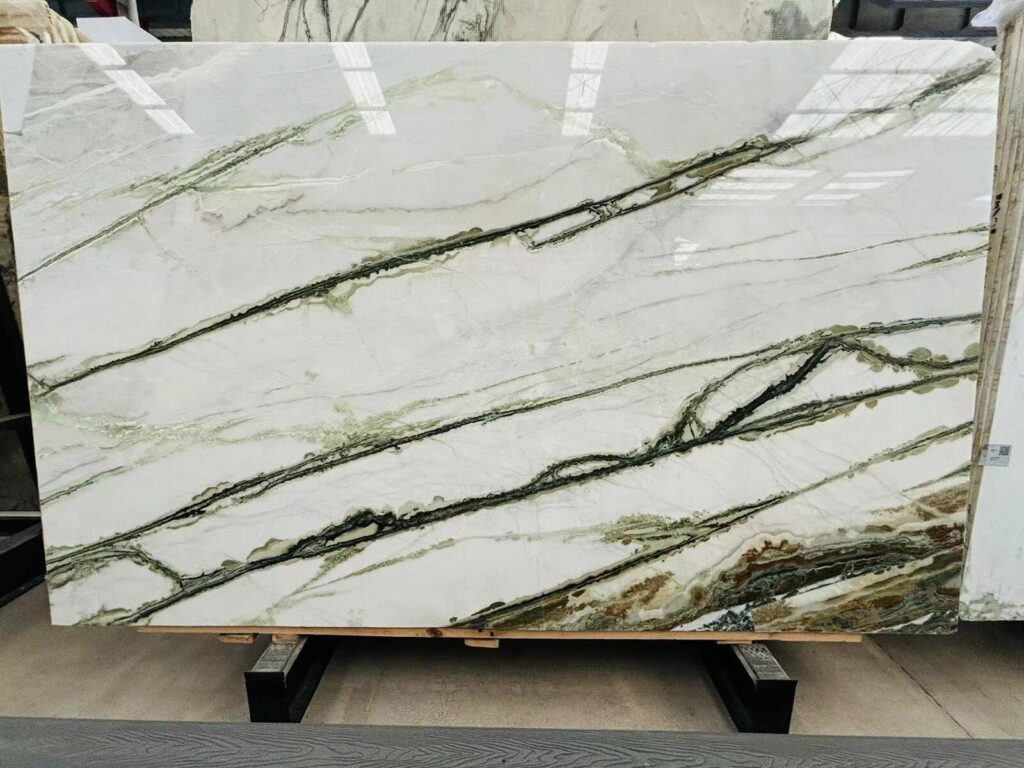
One slab may contain a large translucent milky-white crystalline field. Another may have more grey structure, warmer ivory areas, darker mineral zones, or more opaque sections.

As a result, two slabs sold under the same commercial material name may respond differently to exactly the same LED panel.

Backlighting can make differences that are subtle under front lighting become much more visible.

It may reveal:

  • Differences in translucency
  • Internal crystal structures
  • Previously subtle mineral clouds
  • Darker inclusions
  • Natural fissures
  • Thickness variation
  • Local opaque regions

Therefore:

A showroom photograph of Cristallo Quartzite should not be used as the final backlighting reference for a different slab.

The actual selected slab is the correct starting point.

Does Stone Thickness Affect Cristallo Backlighting?

Yes. Thickness affects how much light can pass through a translucent natural stone and how the internal structure appears.

A thicker section generally creates a different transmission condition from a thinner section, but the effect cannot be predicted from thickness alone because translucency varies across the slab itself.

The project team should therefore evaluate the intended finished thickness rather than testing only a thin decorative sample and assuming the fabricated panel will look the same.

This becomes especially important when the project contains:

  • Mitered edges
  • Laminated build-ups
  • Reinforcement
  • Backing materials
  • Mesh or resin-treated areas
  • Different stone thicknesses within the same feature

Anything added behind the stone may affect the final transmitted-light appearance and should be considered during mock-up review.

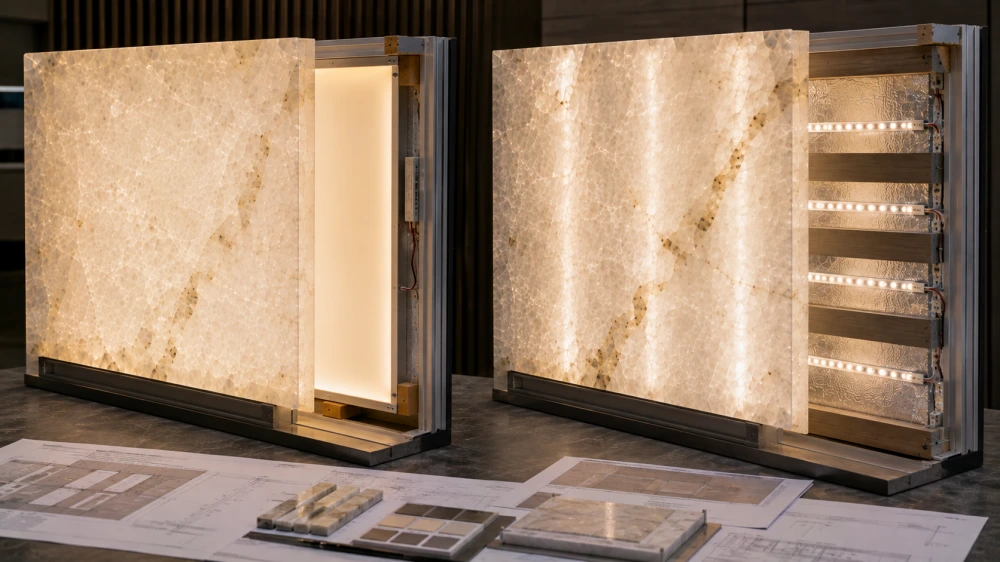
Why LED Distance Matters Behind Cristallo Quartzite

Color temperature is only one part of the backlighting system.

If individual LEDs or LED strips are positioned too close to the stone without adequate diffusion, the viewer may see:

  • Hotspots
  • Bright lines
  • Dark gaps
  • Uneven luminous patches
  • Visible LED-module patterns

Increasing the distance between the light source and stone can provide more space for light to mix before it reaches the back of the slab.

However, deeper cavities also affect construction depth, brightness requirements, access, support design, and installation.

There is therefore no universal cavity depth that works for every Cristallo project.

The correct relationship is:

LED Layout + Cavity Depth + Diffuser + Stone Translucency = Perceived Lighting Uniformity.

cristallo-quartzite-led-distance-diffusion-hotspot-control

LED Panel vs LED Strips for Cristallo Quartzite

Both approaches can be used in backlit stone systems, but they create different design challenges.

Lighting Approach Potential Advantage Review Point
LED Light Panel Designed to provide broad-area illumination Check actual uniformity, brightness, panel joints, serviceability and color consistency
Closely Spaced LED Strips Flexible layout and potentially easier local adjustment Control strip lines, spacing, cavity depth and diffusion
LED Modules Can suit custom shapes and distributed illumination Check module pattern visibility and spacing

The best system is the one that produces the approved appearance with the actual project assembly—not the one that sounds most advanced in a catalogue.

Why a Diffuser Can Be Important

A diffuser or light-mixing layer can help reduce the direct visual imprint of individual LED sources.

Its role is particularly important where the stone is highly translucent and the light cavity is shallow.

A backlighting assembly may therefore be considered as several layers:

Stone → Support / Mounting System → Diffusion Space or Layer → LED Source → Reflective / Structural Backing.

The actual build-up depends on the engineering and lighting system.

The diffuser should not be selected independently of brightness. A system can become more uniform while also losing light output through additional layers.

Uniformity and brightness therefore need to be balanced rather than optimized separately.

How Bright Should Backlit Cristallo Quartzite Be?

There is no single correct brightness for all Cristallo Quartzite installations.

A luxury bar front in a dim hotel lounge may require a very different perceived brightness from a reception feature wall in a bright lobby.

The project should consider:

  • Ambient room light
  • Viewing distance
  • Stone translucency
  • Feature size
  • Daytime conditions
  • Nighttime conditions
  • Reflections from adjacent surfaces
  • Desired visual hierarchy

A useful backlit feature should look intentional in the actual room, not merely impressive in a dark testing area.

Should Cristallo Quartzite Backlighting Be Dimmable?

For many premium installations, dimming can be valuable because it gives the project team more control over the relationship between the stone feature and the surrounding lighting.

Dimming may help when:

  • Day and night ambient-light levels are very different
  • The backlit surface is intended as feature lighting rather than task lighting
  • The installation forms part of a restaurant, bar, hotel, or hospitality environment
  • The designer wants several lighting scenes
  • The maximum LED output appears too aggressive after installation

However, the LED driver, dimming protocol, controls, LED source, and electrical design need to be coordinated as a system.

The project should also verify that dimming does not create unacceptable flicker, color shift, or uneven behavior.

Why CRI Matters Even When the LEDs Are Behind the Stone

CCT describes whether the light appears warmer or cooler. It does not fully describe how accurately the light source renders colors.

That is why two LED systems marked “3000K” can still make the same piece of Cristallo look different.

For visually demanding stone installations, the buyer and lighting designer should consider color quality in addition to the nominal Kelvin value.

A higher-quality light source can help the stone’s subtle mineral colors appear more natural and controlled.

The most important practical lesson is:

Do not specify a backlighting system by Kelvin alone.

Evaluate the actual LED product with the actual stone.

Can Two 3000K LED Products Make Cristallo Look Different?

Yes.

A nominal CCT such as 3000K is useful, but it does not fully define the spectral character of the light.

Differences in LED product design, color consistency, color rendition, diffusion, output, and the complete lighting assembly can change the visual result.

This is especially important with translucent stone because the light is not merely falling onto the surface—it is passing through different minerals and thicknesses within the stone.

For procurement, record the actual LED product or approved lighting system used during mock-up rather than recording only “3000K.”

Should the Backlighting Match the Room’s General Lighting?

Usually the two lighting conditions should at least be reviewed together.

For example, a Cristallo bar illuminated from behind at 4000K inside a room dominated by 2700K decorative lighting may appear noticeably cooler than the surrounding environment.

That contrast may be intentional.

But if it is not intentional, the stone can look disconnected from the interior palette.

A backlighting mock-up should therefore be reviewed under the intended ambient-light condition where possible.

Do not evaluate only:

Stone + Backlight.

Evaluate:

Stone + Backlight + Room Lighting + Surrounding Materials.

How Should a Cristallo Backlighting Mock-Up Be Made?

A useful mock-up should reproduce the project conditions closely enough to answer the actual design question.

Record at least:

  • Actual Cristallo Quartzite slab or representative project piece
  • Stone thickness
  • Surface finish
  • Viewing face
  • Backing and reinforcement condition where relevant
  • LED product
  • LED CCT
  • LED layout
  • Cavity depth
  • Diffuser or light-mixing material
  • Brightness / dimming setting
  • Ambient room-light condition
  • Viewing distance
  • Reviewer
  • Date

If the project is deciding between warm and cool white, change only the necessary lighting variable where practical.

Otherwise, the team may accidentally compare a 3000K system with one brightness and diffusion setup against a 4000K system with an entirely different setup.

Worked Example: 3000K vs 4000K Cristallo Feature Wall

Consider a hypothetical Cristallo Quartzite feature wall in a luxury residential interior.

The selected slab has:

  • Large milky-white translucent crystalline areas
  • Soft cool-grey zones
  • Limited warm ivory mineral areas
  • Fine internal crystal structure

The surrounding interior uses warm white oak cabinetry and approximately warm-neutral room lighting.

Mock-Up A — 3000K

The ivory and cream areas appear warmer. The white crystals remain visible but acquire a softer tone. The slab integrates more naturally with the warm timber palette.

Mock-Up B — 4000K

The crystalline areas appear cooler and cleaner. Grey zones become more prominent, and the slab feels visually sharper and more contemporary.

Neither mock-up is technically “correct.”

The designer must choose which interpretation better supports the intended room.

If the team wants the crystalline character of 4000K but finds it slightly too cool, a 3500K test may become the next logical comparison.

cristallo-quartzite-led-panel-vs-led-strips

Common Cristallo Quartzite Backlighting Mistakes

Common Mistake Why It Creates Risk Better Approach
Choosing CCT from a catalogue The actual slab can shift the perceived color dramatically Test the real stone
Assuming all 3000K LEDs look identical LED color characteristics can differ beyond the nominal CCT Approve the actual LED product
Placing LED strips too close to the stone Individual strips or hotspots may become visible Coordinate spacing, depth, and diffusion
Testing only in a dark room The installed project may have much stronger ambient lighting Review realistic day and night conditions
Ignoring slab variation Different slab areas can transmit light differently Review the actual slab and cutting layout
Specifying only Kelvin CCT alone does not define color quality, brightness, uniformity, or system behavior Specify and approve the complete lighting system
Approving stone before checking the backlit layout Opaque zones or dark mineral areas may fall in critical visible positions Coordinate slab selection, cutting layout, and backlighting together

Cristallo Quartzite Backlighting Buyer Checklist

Before approving a backlit Cristallo Quartzite feature, confirm:

  • Actual Slab: Has the specific slab or project-relevant stone been reviewed?
  • Translucency: Which areas transmit more or less light?
  • 두께: Is the mock-up using the intended finished thickness?
  • Finish: Is the intended polished, honed, or other finish represented?
  • CCT: Have the relevant warm, neutral, or cool white options been compared?
  • LED Product: Is the actual lighting system identified rather than only a Kelvin number?
  • Color Quality: Has the color rendition of the LED source been considered?
  • LED Spacing: Is the layout sufficiently uniform?
  • Cavity Depth: Is there enough distance for effective light mixing?
  • Diffusion: Is a diffuser or light-mixing layer needed?
  • Brightness: Has the installation been reviewed at realistic output levels?
  • Dimming: Is dimming required and compatible with the selected LED system?
  • Ambient Light: Has the stone been reviewed with the project’s room lighting?
  • Cutting Layout: Are translucent, opaque, and dark mineral areas positioned intentionally?
  • Access: Can the lighting system be serviced after installation?
  • Approval: Is the final stone + lighting combination documented?

Buyer FAQ

1. What color temperature is best for backlit Cristallo Quartzite?

There is no universal best color temperature. Approximately 2700K–3000K usually creates a warmer cream or ivory appearance, while approximately 3500K–4000K produces a more neutral-to-cool crystalline appearance. The correct choice should be confirmed using the actual slab and project lighting conditions.

2. Is 3000K or 4000K better for Cristallo Quartzite?

3000K is often better when the design wants a warm luxury atmosphere and coordination with wood, bronze, beige, or warm interior lighting. 4000K can work better when the goal is a cleaner, cooler, more crystalline appearance. A side-by-side mock-up is more reliable than choosing from the Kelvin value alone.

3. Will every Cristallo Quartzite slab look the same when backlit?

No. Natural variation in crystal structure, mineral distribution, translucency, fissures, and opaque zones means different slabs—or different areas of one slab—can respond differently to the same backlight.

4. Can LED strips create visible hotspots behind Cristallo Quartzite?

Yes. If the light sources are too close to the stone or too widely spaced, individual bright lines or hotspots may become visible. Cavity depth, LED spacing, diffusion, output, and stone translucency should be tested as one system.

5. Does CRI matter for backlit quartzite?

Yes. Color temperature describes the warm or cool appearance of the light, while color rendition addresses how the light affects the appearance of colors. Two LEDs with the same nominal CCT can still produce different visual results on the same Cristallo slab.

6. Should Cristallo Quartzite backlighting be dimmable?

Dimming can be useful for premium residential, hospitality, bar, reception, and feature-wall projects because the preferred brightness can change with ambient lighting and time of day. The LED source, driver, control system, and dimming behavior should be coordinated before installation.

7. Should the LED color match the rest of the room lighting?

Not necessarily, but the relationship should be intentional. A cooler backlit stone feature inside a very warm-lit room can create strong visual contrast. Review the Cristallo backlighting together with the surrounding lighting and finishes before final approval.

8. What should a Cristallo backlighting mock-up include?

Use the actual or representative project stone at the intended thickness and finish, together with the proposed LED product, color temperature, LED spacing, cavity depth, diffuser, brightness setting, and realistic ambient-light condition. Record the approved setup so the final installation can follow the same visual basis.

마지막 메모

The best LED color temperature for Cristallo Quartzite cannot be selected from the stone name or Kelvin number alone. Warm white can emphasize cream, ivory, and warmer minerals, while cooler white can emphasize icy crystalline and pale-grey characteristics. But color temperature is only one part of the system. The actual slab, thickness, translucency, LED product, color quality, spacing, cavity depth, diffuser, brightness, dimming, cutting layout, and surrounding room lighting all affect the final appearance. For a visually important project, approve the complete stone-and-lighting mock-up before fabrication and installation rather than relying on a generic backlit Cristallo photograph.

관련 상품

문의하기