Quartzite Slab Quotes: Gross Area, Net Area, and Minimum Charge
Post navigation
Riepilogo rapido
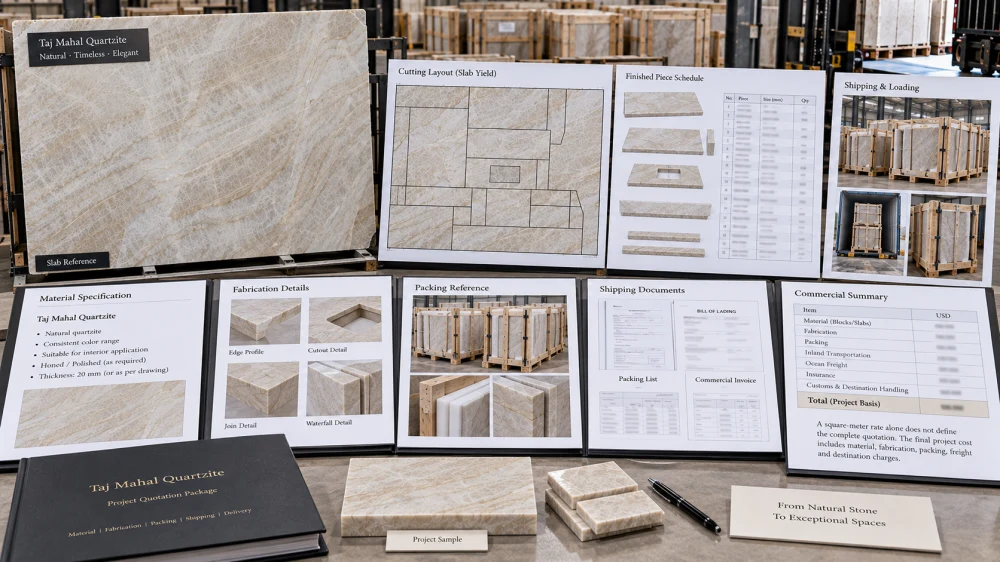
A Quartzite slab quote should state what area is being measured and what area is actually being charged. Gross slab area, usable cutting area, finished net area, and chargeable area are different concepts. A minimum charge can also apply even when the project requires less material. Before comparing two quotations, normalize the material, slab quantity, measurement basis, fabrication, packing, freight, currency, and delivery terms—not just the price per square meter.
A project needs 12 m² of finished Natural Quartzite.
Supplier A quotes 15 m².
Supplier B quotes 12 m².
Supplier C shows 12 m² of finished pieces but applies a higher minimum charge.
Which Quartzite slab quote is actually cheaper?
You cannot answer from those area figures alone.
First determine what each number means.
The useful comparison is:
Required Finished Area → Actual Material Consumption → Quoted Area Basis → Minimum Charge → Fabrication Scope → Packing → Freight → Comparable Total
Four Area Terms Buyers Should Keep Separate
The biggest quotation mistake is treating every square-meter figure as if it represented the same thing.
Area Term
Practical Meaning
Domanda dell’acquirente
Superficie lorda della lastra
Overall area represented by the slab dimensions or the supplier’s stated slab-area basis
Am I buying the complete slab?
Area utilizzabile delle lastre
Area that can practically contribute to the approved cutting layout after project-specific constraints are considered
How much of the slab is useful for my pieces?
Finished Net Area
Calculated area of the required finished components under the stated measurement basis
How much finished stone is in my drawing?
Chargeable Area
Area or quantity the supplier actually uses for the commercial calculation
Which quantity is multiplied by the quoted rate?
These quantities may sometimes be equal.
Often they are not.
What Is Gross Area in a Quartzite Slab Quote?
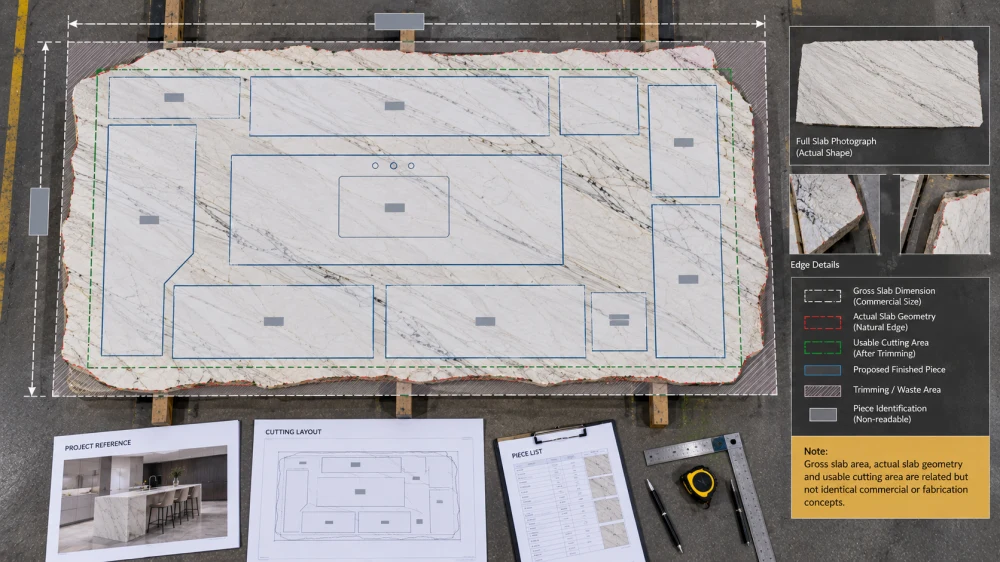
For a slab transaction, gross area commonly refers to the area represented by the slab dimensions or the supplier’s stated measurement basis.
For a simple rectangular illustration:
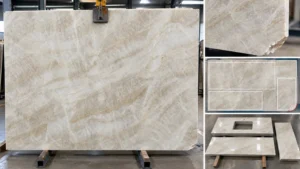
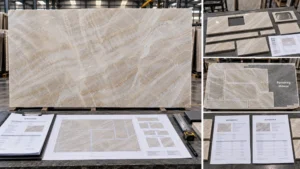
mont-blanc-quartzite-gross-slab-usable-area
Slab Length × Slab Width = Gross Slab Area
But this does not mean every square centimeter of that gross rectangle can become a finished countertop.
Natural Quartzite slabs may have:
irregular perimeter geometry;
areas excluded by the approved layout;
natural features that affect a particular piece position;
edge trimming requirements;
visual priority zones;
movement-direction constraints; and
other slab-specific layout limitations.
This is why gross slab area should not automatically be treated as usable cutting yield.
Net area is not useful unless the quotation defines what “net” means.
One quotation may use net area to describe the sum of finished rectangular pieces.
Another may calculate finished component area differently.
A third supplier may avoid the term completely and instead quote:
complete slabs;
finished pieces;
linear-meter processing;
per-piece fabrication;
material consumption; or
a complete project package.
Quotation Rule
Never compare two “net area” figures until both suppliers have explained how the area is calculated and which commercial items are included in that figure.
Finished Area Is Not the Same as Raw Material Consumption
Suppose the finished drawings contain a certain number of square meters of countertops, wall panels, vanity tops, or other components.
The factory may need more raw slab area than the finished net area because the pieces must actually fit inside real slabs.
“How much waste does the factory want to charge me for?”
It is a consequence of fitting the required finished geometry into actual natural-stone slabs under the approved project constraints.
What Is a Minimum Charge?
A minimum charge is a commercial rule under which the supplier charges at least a stated minimum amount, quantity, slab count, processing quantity, or other agreed commercial basis even when the immediate project requirement is smaller.
There is no single universal Natural Quartzite minimum charge.
Depending on the supplier and scope, a minimum may relate to:
a complete slab;
a minimum number of slabs;
a minimum material quantity;
a minimum fabrication amount;
a minimum processing charge;
a minimum packing requirement;
a special-order material commitment; or
another clearly stated commercial basis.
The quotation should state which one applies.
Minimum Charge Does Not Mean Minimum Order Quantity
These terms can overlap commercially, but they are not automatically the same.
Term
Question It Answers
Quantità minima ordinabile
What is the minimum quantity the supplier will accept as an order?
Minimum Charge
What is the minimum commercial amount or quantity basis that will be charged?
A supplier could theoretically accept a small quantity while still applying a minimum processing or commercial charge.
Always confirm the actual quotation rather than assuming the two terms are interchangeable.
Why Might a Small Project Be Charged for a Full Slab?
This is one of the most important questions for buyers of premium Natural Quartzite.
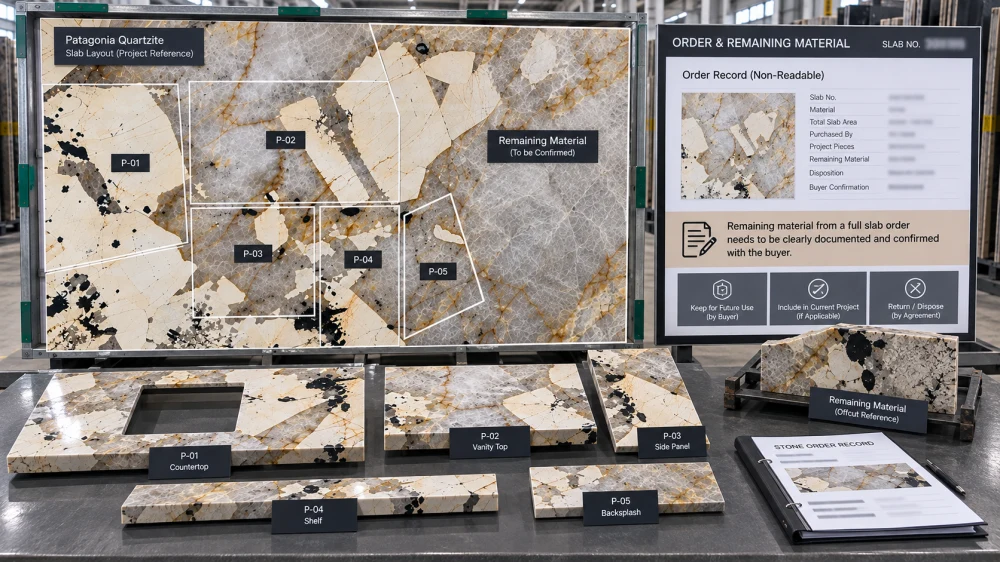
Imagine a project requires only part of one slab.
The supplier may still quote the complete slab if the commercial arrangement requires the buyer to purchase that slab rather than only the area physically converted into finished pieces.
That does not automatically mean the unused material is “waste.”
Ask what happens to the balance.
Possible commercial arrangements can include:
the buyer purchases the complete slab and the balance remains part of the order;
the balance is fabricated into spare pieces if agreed and practical;
the balance is packed with the order if agreed;
the supplier retains the balance under an agreed commercial arrangement; or
another written disposition is used.
The quotation should make this clear before payment.
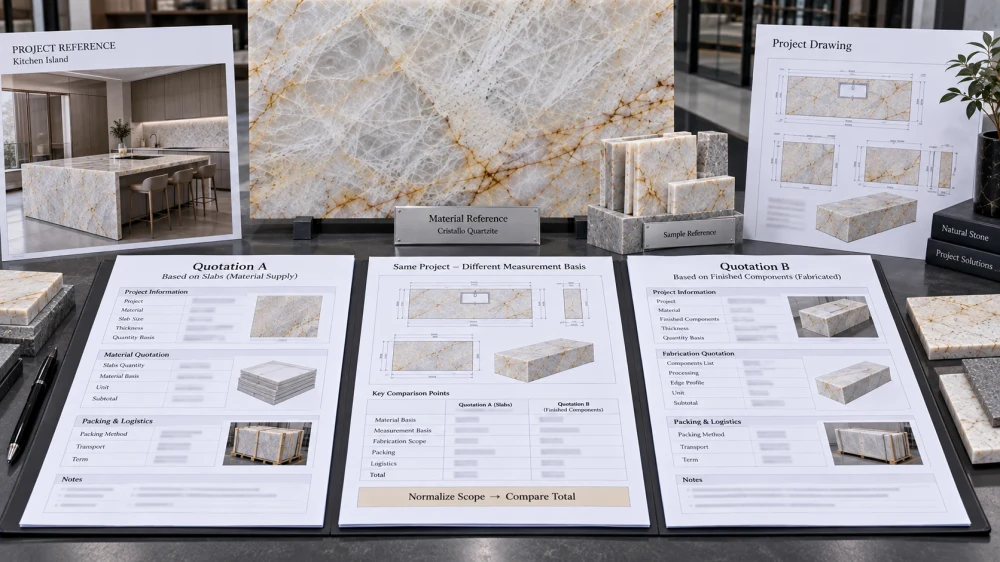
A Lower Price per Square Meter Can Produce a Higher Total
Consider a hypothetical comparison.
One supplier offers a lower material rate but charges complete slabs and excludes fabrication.
Another supplier shows a higher finished-piece rate but includes some fabrication and uses a different chargeable quantity.
The first $/m² can be lower while the completed commercial scope is higher.
This is why procurement teams should compare:
Comparable Total ÷ Comparable Scope
rather than ranking quotations by the first unit rate visible on the page.
Packing and Freight Can Change the Area Economics
Area pricing does not end at the factory invoice.
Raw slabs and finished pieces can require different packing and shipping arrangements.
For a project quotation, confirm whether the price includes:
slab packing or frame requirements;
reinforced export crates for finished pieces;
internal protection;
protezione degli spigoli e degli angoli;
loading;
export documentation;
ocean freight;
destination charges;
duties or taxes where applicable; and
final delivery where quoted.
A quote that looks expensive at the material line can be more complete commercially, while a low material rate may leave several later costs outside the proposal.
Ask for the Quotation Formula in Plain Language
BUYER QUOTATION CHECK
01 — What quantity is my project drawing asking for?
02 — How much raw Quartzite is required?
03 — Am I purchasing complete slabs or only finished pieces?
04 — What does “gross area” mean in this quotation?
05 — What does “net area” mean in this quotation?
06 — What quantity is actually chargeable?
07 — Is there a minimum charge?
08 — What happens to unused slab material?
09 — Which fabrication items are included?
10 — Is packing included?
11 — What Incoterm / delivery scope applies?
12 — What is the final comparable total?
What Should a Clear Quartzite Slab Quote Show?
For an international project, a useful quotation can identify:
material name;
actual slab reference or selection basis where applicable;
The goal is not to make every supplier use the same quotation format.
The goal is to make the commercial basis understandable enough to compare.
FAQ
1. What is gross area in a Quartzite slab quote?
Gross area generally refers to the overall slab-area basis stated in the quotation, often related to the slab dimensions. It should not automatically be interpreted as usable cutting area or finished project area. Confirm the supplier’s exact measurement method in the quotation.
2. What is net area in a Quartzite quote?
Net area may refer to the calculated area of finished pieces or another supplier-defined measurement basis. Because the term is not sufficiently precise by itself, buyers should ask exactly how net area is calculated and whether waste, fabrication, cutouts, edges, or other items are included or excluded.
3. Why can finished Quartzite area be smaller than the chargeable area?
Finished pieces must be cut from actual slabs. Slab dimensions, piece geometry, cutting allowances, orientation, visual selection, seams, cutouts, matching requirements, and other layout constraints can make raw material consumption greater than the final finished area. A separate minimum charge can also affect the commercial quantity.
4. What does minimum charge mean on a Quartzite quotation?
It means the supplier applies a stated minimum commercial amount, quantity, slab count, processing basis, or other defined charge even when the immediate requirement is smaller. There is no universal minimum charge for all Natural Quartzite suppliers or projects, so the basis should be stated in writing.
5. If I pay for a full Quartzite slab, do I own the remaining offcut?
Do not assume either way. Confirm the commercial arrangement before ordering. The quotation or order record should state what happens to unused material, including whether it is shipped, fabricated into spares, stored, retained, or otherwise handled.
6. Is minimum charge the same as MOQ?
Not necessarily. MOQ describes the minimum quantity a supplier is willing to accept as an order, while a minimum charge describes the minimum commercial amount or quantity basis that will be charged. The actual quotation should define both if they apply.
7. How should I compare two Quartzite slab quotes?
Normalize the material, thickness, finish, slab quantity, finished area, chargeable quantity, minimum charge, fabrication scope, packing, freight, currency, quotation validity, and delivery terms. Compare the same completed commercial scope rather than only the headline price per square meter.
Regola del preventivo finaleDo not compare Quartzite quotations until every area figure has a commercial meaning. Keep the chain visible: Finished Requirement → Actual Slab Consumption → Gross / Net Measurement Basis → Chargeable Quantity → Minimum Charge → Fabrication → Packing → Freight → Comparable Total.
For project-based Natural Quartzite quotations, HRST STONE can review current drawings, finished dimensions, actual slab requirements, cutting layouts, fabrication scope, packing requirements, and shipping destination before preparing the commercial scope. Send Josh the material name, dimensions, quantities, finish, drawings, edge and cutout requirements, packing requirements, and delivery destination so the quotation can clearly separate material, fabrication, packing, and logistics.
Hi, I am the author of this article. I have been working in the field of Natural Stone for more than 15 years. If you need customized Natural Stone services, please feel free to contact me.
Cina Marmo, granito, quarzite, produttore e fornitore di agata - PIETRA HRST
Benvenuti su HRST STONE!
Salve, vorrei saperne di più sui vostri prodotti. Potreste fornirmi informazioni su prezzi, quantità minima d’ordine, opzioni di personalizzazione e campioni?