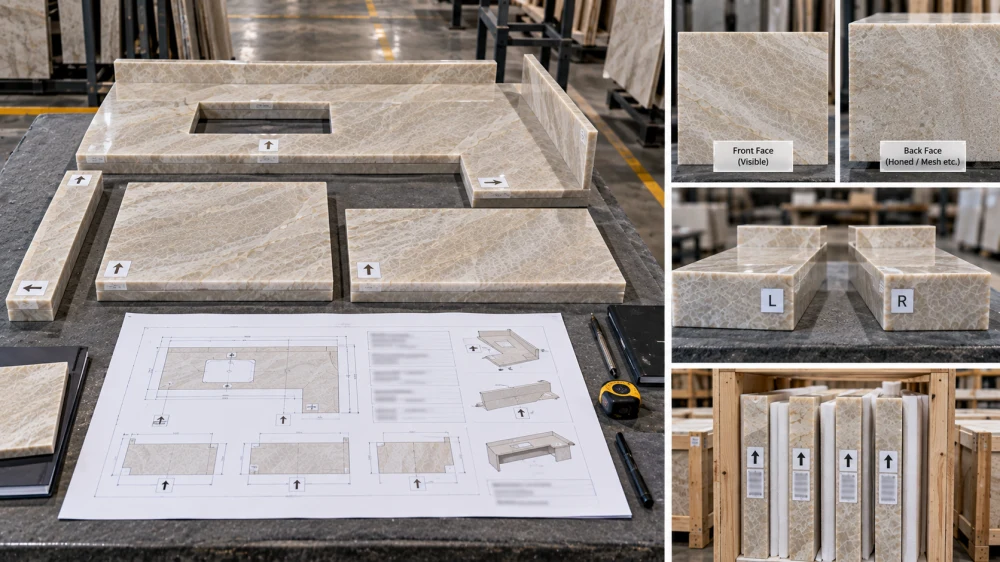
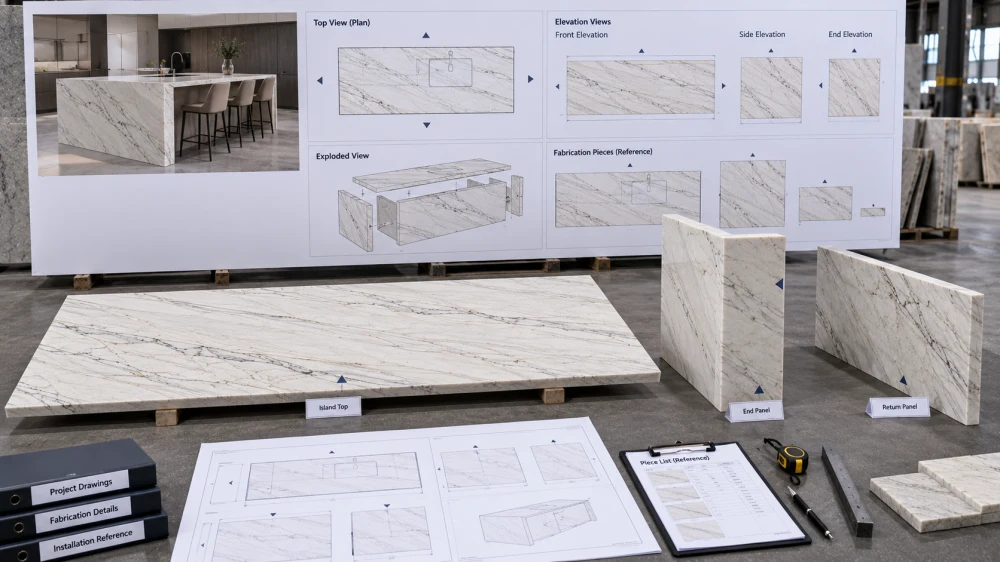
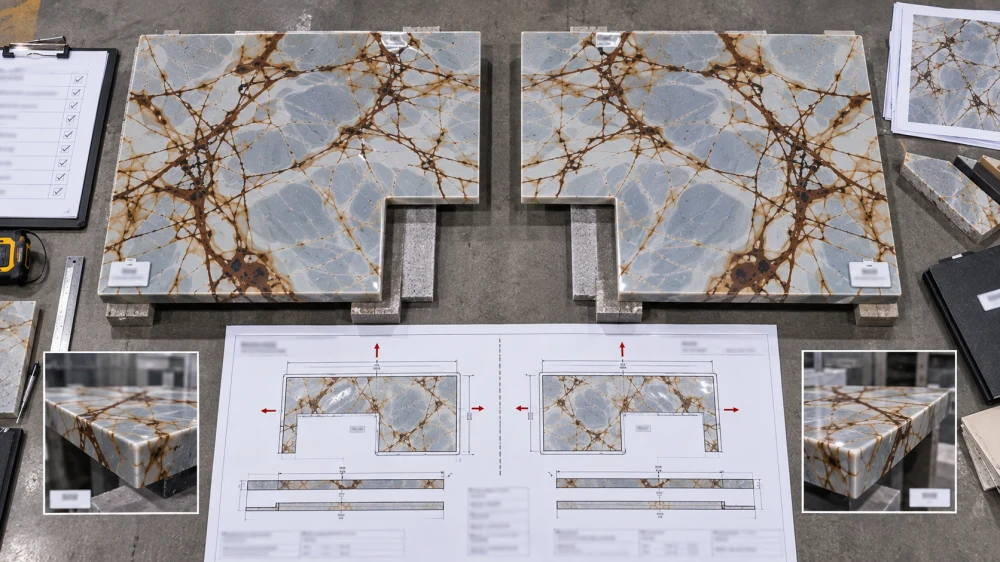
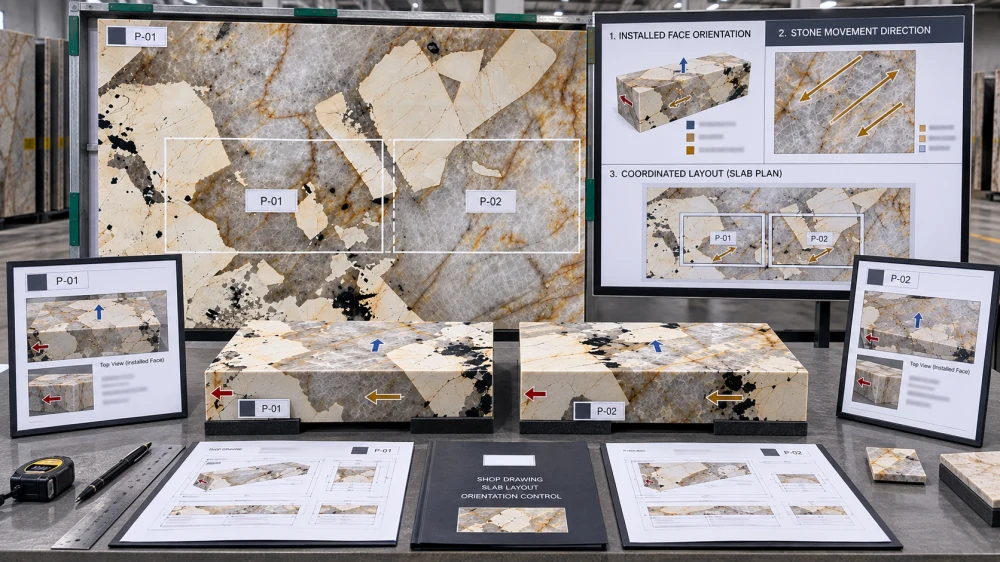
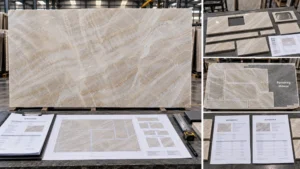
Come etichettare le facce frontale, posteriore e superiore delle pietre di quarzite
Post navigation
Riepilogo rapido
Front, Back, and Top labels on Quartzite pieces should describe an approved project orientation, not an assumed direction. First define the viewing reference and installation position. Then connect each face label to a stable piece ID, current drawing revision, visible faces, orientation marks, and actual slab layout where relevant. Carry the same references through fabrication, QC, packing, and handover so a correctly fabricated piece is not accidentally flipped, mirrored, rotated, or installed in the wrong orientation.
A fabricated Quartzite piece is photographed in the factory and marked:
FRONT
That sounds clear—until someone asks:
Front when viewed from where?
For a kitchen island, “front” might mean the seating side, the working side, or simply the side facing the person who created the drawing.
For a wall panel, “top” may be obvious after installation but less obvious while the panel is lying horizontally in the factory.
For two mirrored vanity returns, one piece may look almost identical to the other until it is rotated or turned over.
This is why Quartzite piece face labels should be treated as part of a controlled orientation system rather than informal factory notes.
Start With the Viewing Reference
Before writing FRONT, BACK, LEFT, RIGHT, or TOP on any drawing or component, define the project reference.
Reference View: Looking toward island from dining side
Front: Dining / seating side
Back: Working side
Top: Finished horizontal countertop surface
Drawing Revision: Current approved project revision
The wording can differ from project to project.
What matters is that FRONT has one defined meaning throughout the drawing package and production record.
Front, Back, and Top Are Not Universal Stone Terms
There is no reason to assume that every architect, fabricator, installer, supplier, or project manager will interpret these labels in exactly the same way.
A project may instead use:
Room Side / Wall Side;
Public Side / Service Side;
Inside / Outside;
Finished Face / Concealed Face;
North / South / East / West;
Top / Bottom;
Left / Right; or
another project-specific orientation convention.
Use whichever terminology creates the least ambiguity for the actual application.
Orientation Rule
Never assume that the word FRONT is self-explanatory. Define the reference view once, then use that same convention on drawings, fabrication records, QC photographs, packing labels, and handover information.
Give Every Important Piece a Stable Piece ID
A face label without a piece ID can become disconnected from the rest of the project.
Ad esempio:
TOP
is much less useful than:
Piece I-01 — TOP FACE
A practical traceability chain is:
Slab Reference → Cutting Position → Piece ID → Face Orientation → Fabrication → QC → Crate → Installation Location
The same piece ID should remain recognizable across the relevant project records.
The site’s Quartzite cutting-plan guide explains why actual slab references and finished-piece IDs should remain connected through cutting, QC, packing, and installation.
Build a Face-Label Legend Into the Shop Drawing
Do not leave the factory to invent a legend after cutting begins.
Put the orientation convention directly into the controlled drawing package.
Mark
Project Meaning
What to Confirm
F
Front according to defined project view
Reference viewing direction
B
Back according to defined project view
Whether face is visible or concealed
T
Top when piece is in final installed orientation
Installed orientation
VF
Visible / finished face if used by project
Which surface remains exposed
Arrow →
Project-defined orientation or stone-movement direction
Exact arrow meaning in drawing legend
These are examples, not universal industry symbols. The approved project legend should control their meaning.
Visible Face and Front Face Are Not Always the Same Thing
This distinction is important.
A rectangular wall panel may have:
one visible finished face;
one concealed back face;
a defined top edge;
a left edge; and
a right edge.
Calling the visible surface “front” may work well.
But consider a kitchen island waterfall panel.
Its main visible surface may be the outside vertical plane, while “front” could refer to the seating side of the complete island.
Therefore, for complex components, use separate information for:
Installed Orientation + Visible Face + Piece Direction
rather than forcing every requirement into the word FRONT.
Top Means Installed Top, Not Factory Table Position
A vertical wall panel may lie flat during cutting.
A waterfall panel may be stored horizontally.
A backsplash may be rotated 90 degrees for edge polishing.
Its TOP label should still refer to its intended installed orientation.
This prevents temporary factory position from changing the project meaning.
Why Mirrored Pieces Need Separate IDs
Two components can have identical dimensions and still not be interchangeable.
A vein-direction arrow communicates a project-defined visual or directional intent.
They are related, but they are not substitutes.
For example, a wall panel can be installed with the correct TOP orientation while its intended stone movement is still reversed.
IL Quartzite vein-direction symbols guide explains why directional arrows should be tied to piece IDs, visible faces, seams, actual slab layouts, and a defined drawing legend.
Show Face Labels on the Actual Slab Layout
For visually sensitive pieces, the shop drawing alone is not enough.
Once actual Quartzite slabs are selected, transfer the important orientation information into the slab-layout review.
A useful relationship is:
Board Number → Piece ID → Visible Face → Top Direction → Vein Direction → Cutting Position
This is especially valuable for:
statement kitchen islands;
waterfall ends;
feature walls;
bookmatched compositions;
reception counters;
fireplace surrounds;
stairs; and
mobili in pietra su misura.
Label Multi-Face Pieces More Carefully
Some components expose more than one surface after installation.
A thickened island edge, mitered box, pedestal, reception counter, table base, or fireplace surround may have several visible faces.
In these cases, FRONT / BACK / TOP alone may be insufficient.
The drawing can identify individual visible surfaces, for example:
Face Reference
Meaning
VF-1
Primary visible face
VF-2
Secondary visible return
T
Installed top orientation
CF
Concealed face if the project uses this notation
Again, the codes themselves are project-defined. Their value comes from using them consistently.
Face Labels Should Control Edge Finishing Too
Orientation affects more than appearance.
If the wrong side is interpreted as visible, the factory could finish the wrong edge.
For each piece, coordinate face orientation with:
polished or honed exposed edges;
mitered edges;
bordi smussati;
backsplash interfaces;
wall-side edges;
finished returns;
concealed edges; and
other project-specific fabrication details.
A drawing should therefore make it possible to answer both:
Which way does the piece face?
e:
Which edges receive the specified fabrication?
Use Orientation-Specific QC Photographs
QC photographs become much more useful when another person can understand the piece without being physically present in the factory.
For important components, a useful QC set can include:
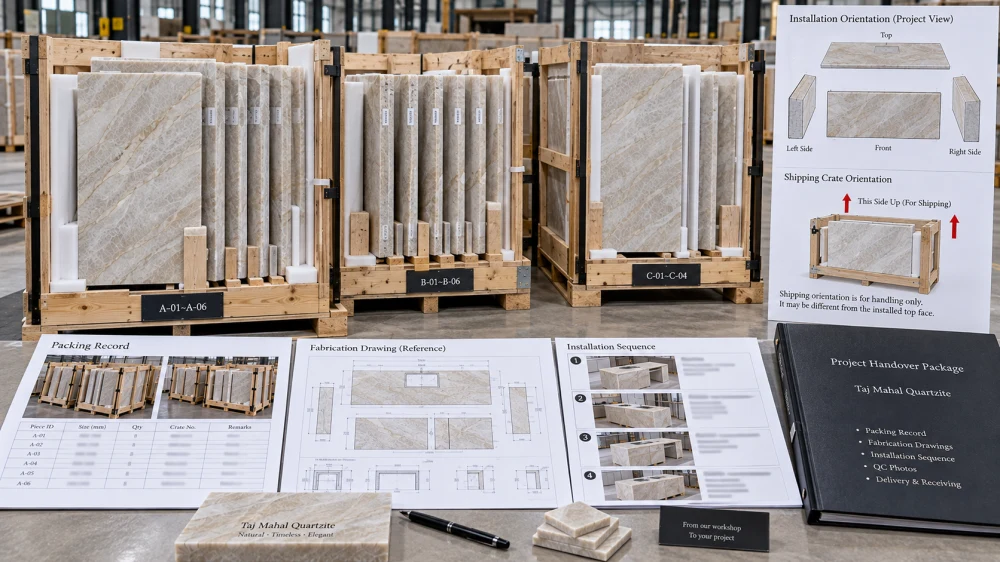
cristallo-quartzite-piece-orientation-final-qc
complete finished-piece view;
piece ID;
TOP indication;
FRONT or project-defined viewing direction;
visible-face indication;
finished-edge close-ups;
le posizioni degli intagli;
adjacent-piece reference where relevant; and
current drawing revision.
The orientation marks should be clear enough to interpret but should not permanently mark a finished visible surface in an unacceptable way.
Do Not Lose Orientation During Packing
A piece can leave fabrication correctly and still create confusion at the receiving site if its identity is lost during packing.
The packing stage should preserve the project reference:
Piece ID → Orientation → Crate → Project Area → Installation Position
Where practical, crate documentation can show:
crate number;
piece IDs inside;
project zone;
handling orientation where relevant;
installation sequence where required; and
references to the current packing list.
The label on the crate supports the project record. It should not become a substitute for the approved shop drawing.
Do Not Use “This Side Up” as a Substitute for TOP FACE
These instructions can mean different things.
TOP FACE describes the component’s intended installed orientation.
THIS SIDE UP may describe how a crate or component should be positioned during handling or transport.
A vertically installed wall panel might be packed horizontally.
Therefore, installation orientation and shipping/handling orientation should remain separate instructions.
Carry the Same Labels Into Site Handover
The installer should not need to reconstruct piece orientation from factory photographs or chat messages.
For projects with many similar components, the handover record can preserve:
Drawing Location → Piece ID → Crate → Face Orientation → Adjacent Piece → Installation Sequence
This becomes especially useful for large wall-panel sets, stairs, multi-piece reception counters, fireplaces, bathrooms, and projects where several components have similar dimensions.
Common Face-Label Errors
Error
Perché ciò crea rischi
Better Control
Writing FRONT without defining the view
Different teams may use different reference directions
Define reference view in drawing legend
Giving mirrored pieces the same ID
Left and right pieces can be exchanged
Assign separate stable IDs
Using TOP based on factory table position
Temporary production position can change
TOP always follows installed orientation
Using one arrow for several meanings
Vein direction and installation direction may be confused
Define every symbol in the legend
Relabelling only at packing
Packing record may conflict with fabrication record
Carry the original piece ID through production
Face-Orientation Release Gate
Before cutting or releasing orientation-sensitive Quartzite pieces, confirm:
quartzite-piece-orientation-packing-handover
□ Current drawing revision confirmed
□ Reference viewing direction defined
□ Face-label legend defined
□ Every important component has a stable piece ID
□ Front / Back / Top meaning is unambiguous
□ Visible faces identified
□ Mirrored left / right pieces separately identified
□ Vein-direction notation separately defined where required
□ Finished edges coordinated with orientation
□ Actual slab layout reviewed where visually important
□ QC photographs preserve orientation references
□ Packing labels preserve piece IDs
□ Shipping orientation is not confused with installed TOP
□ Final approval revision recorded
FAQ
1. Why should Quartzite pieces be labelled Front, Back, and Top?
Face labels help preserve the approved orientation of a fabricated piece through cutting, edge finishing, QC, packing, receiving, and installation. They are particularly useful for directional stone, mirrored pieces, waterfalls, wall panels, returns, and components with several similar dimensions.
2. What does Front mean on a Quartzite shop drawing?
Front should mean whatever the approved project legend defines it to mean. It might refer to the main viewing side, room side, seating side, outside face, or another project-specific reference. The viewing direction should be defined rather than assumed.
3. Is the visible face always the Front face?
No. A component may have several visible surfaces, and the project’s Front direction may describe the orientation of the complete assembly rather than one stone surface. For complex pieces, identify the visible faces separately from Front, Back, and Top orientation.
4. How should mirrored Quartzite pieces be labelled?
Give each mirrored component its own stable piece ID and identify its installed orientation, visible face, finished edges, and left or right position where applicable. Do not rely only on identical dimensions or assume that one cutting instruction can simply be flipped.
5. Is a Top label the same as a “This Side Up” shipping label?
No. Top should normally describe the piece’s intended installed orientation. “This Side Up” may be a transport or handling instruction. A component can be packed in a different physical orientation from the way it will ultimately be installed.
6. Should face labels and vein-direction arrows both appear on Quartzite drawings?
They can when both are relevant. Face labels communicate component orientation, while vein-direction arrows communicate a separately defined visual or directional intent. The drawing legend should explain both so one symbol is not asked to perform two different functions.
7. Should Front, Back, and Top labels remain on the packing record?
The packing record should preserve enough information to connect the crate and finished piece back to the approved orientation record. The stable piece ID is especially important. Packing labels support the shop drawings but should not replace them.
Final Orientation RuleDo not label a Quartzite piece FRONT, BACK, or TOP until the project has defined the viewing reference. Then keep the chain consistent: Viewing Direction → Piece ID → Face Legend → Visible Face → Slab Layout → Fabrication → QC → Packing → Installation Handover.
For project-based Natural Quartzite fabrication, HRST STONE can coordinate actual slab references, CAD/shop drawings, cutting layouts, piece IDs, visible-face notation, vein-direction references, fabrication details, QC photographs, packing identification, and export documentation for the confirmed stone scope. Send Josh the current drawings, dimensions, quantities, finish, visible faces, edge requirements, matching requirements, and delivery destination before final cutting release.
Hi, I am the author of this article. I have been working in the field of Natural Stone for more than 15 years. If you need customized Natural Stone services, please feel free to contact me.
Cina Marmo, granito, quarzite, produttore e fornitore di agata - PIETRA HRST
Benvenuti su HRST STONE!
Salve, vorrei saperne di più sui vostri prodotti. Potreste fornirmi informazioni su prezzi, quantità minima d’ordine, opzioni di personalizzazione e campioni?