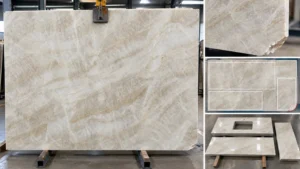
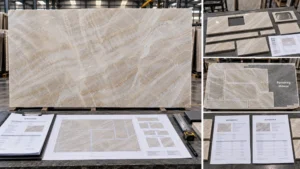
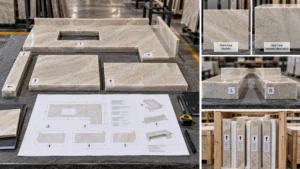
Perché un test di graffiatura da solo non può confermare la presenza di quarzite naturale
Post navigation
Riepilogo rapido
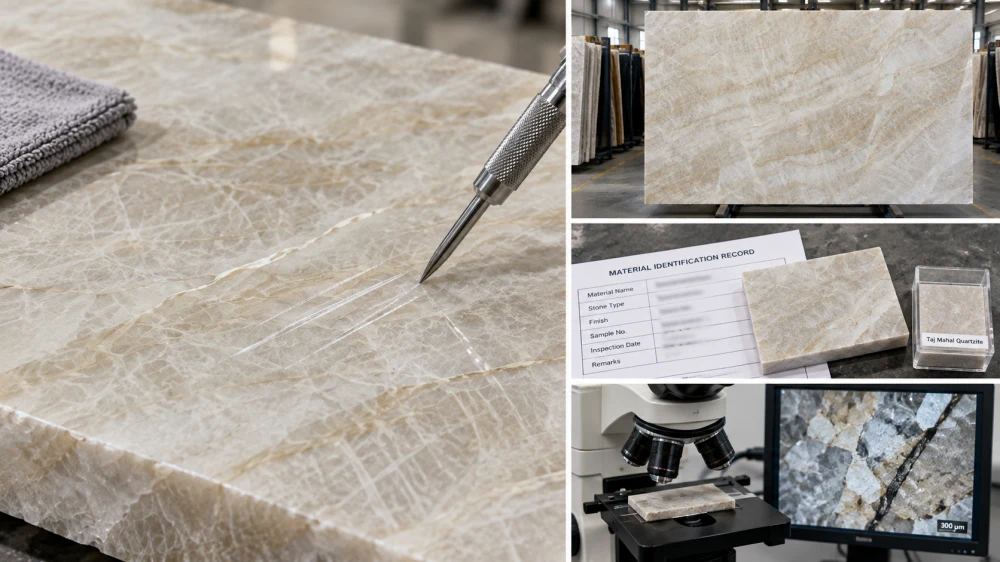
A quartzite scratch test can provide a useful surface observation, but it cannot by itself confirm that a slab is geologically Natural Quartzite. The result can be influenced by the test object, pressure, surface finish, treatment, test location, and interpretation. For purchasing decisions, separate commercial trade names from geological classification and connect any test evidence to an identified sample or slab. Where geological identity matters, petrographic or other appropriate technical review provides stronger evidence than an improvised scratch demonstration alone.
A supplier shows a slab sold as Natural Quartzite and demonstrates that a metal object does not easily scratch the polished surface.
Does that prove the slab is Natural Quartzite?
No—non da solo.
UN quartzite scratch test can tell you something about what happened at one surface location under one test condition. It does not independently establish the geological classification of the entire slab.
This distinction matters because buyers are often trying to answer several different questions at once:
Is this stone relatively hard?
Is it really Natural Quartzite?
Is it actually marble or another natural stone?
Does the commercial name accurately describe the geological material?
Will it perform as expected in my application?
Those are related questions, but they are not the same question—and one scratch demonstration cannot answer all of them.
What Does a Quartzite Scratch Test Actually Observe?
A scratch test is fundamentally a hardness-related observation.
It asks whether one material can visibly scratch another under the conditions used for the test.
That can be useful as an initial screening observation, but the result depends on more than the stone name.
whether the object is actually cutting the surface or leaving material on it;
the stone’s surface finish;
resin, sealer, wax, or another surface treatment;
the exact mineral grain contacted;
the test location; and
how the resulting mark is interpreted.
That makes an informal scratch demonstration very different from a complete geological identification process.
One Test, Several Different Questions
Domanda dell’acquirente
Can a Scratch Test Answer It Alone?
Better Evidence
Did this test object visibly scratch this location?
It can provide an observation
Controlled observation with documented conditions
Is the slab geologically Natural Quartzite?
No
Appropriate geological / petrographic evidence
What minerals make up the stone?
No
Mineralogical or petrographic examination where required
Will the stone etch?
No
Separate representative evaluation appropriate to that question
What is its water absorption or flexural strength?
No
Relevant physical-property test data
Hardness Is Not the Same as Rock Identity
This is the most important concept in the article.
Hardness Observation ≠ Geological Classification
A material behaving as relatively hard at one test location does not, by that observation alone, establish the complete mineral composition, texture, geological history, or rock classification of the slab.
Natural Quartzite is associated with quartz-rich metamorphic rock, but a buyer should not turn that general geological relationship into a shortcut such as:
“It resisted this scratch, therefore it must be Quartzite.”
That conclusion asks a simple field observation to answer a much broader identification question.
The Mohs Scale Is Useful—but Often Misused
Hardness discussions frequently refer to the Mohs scale.
The Mohs scale is useful for comparing the relative scratch hardness of minerals. It does not mean that every polished natural-stone slab can be reliably classified by scratching it once with a common object.
A slab is a rock, not a single ideal mineral crystal.
Natural stone can contain:
different mineral constituents;
accessory minerals;
veins or bands;
altered zones;
filled or repaired areas;
surface treatments; and
natural variation across the slab.
So even when hardness is relevant, the buyer still needs to understand exactly what was tested.
Why Informal Scratch Demonstrations Can Be Misleading
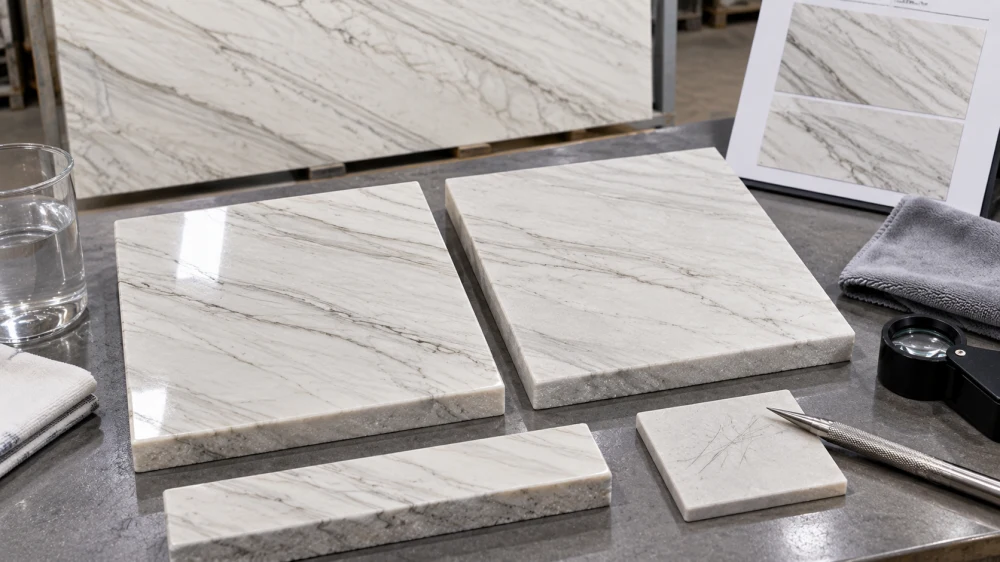
Test Object
The object itself may not have a known or consistent hardness.
Pressure
Different force can produce different-looking marks.
Finitura della superficie
Polished, honed, treated, or repaired surfaces may behave differently.
Test Location
One point may not represent every mineral zone in a variable natural slab.
mont-blanc-quartzite-scratch-test-variables
A Mark on the Surface Is Not Always a Scratch
Another practical problem is interpretation.
After rubbing a metal object against stone, a visible line may be interpreted immediately as damage to the stone.
But a visible mark can require closer examination to determine what actually happened at the interface.
For buyer control, the lesson is simple:
Do not build a material-classification decision around a poorly documented mark whose cause has not been established.
Trade Name and Geological Name Are Not the Same Evidence
Natural stone is commonly bought and sold under commercial names.
But a commercial name is not automatically a geological classification.
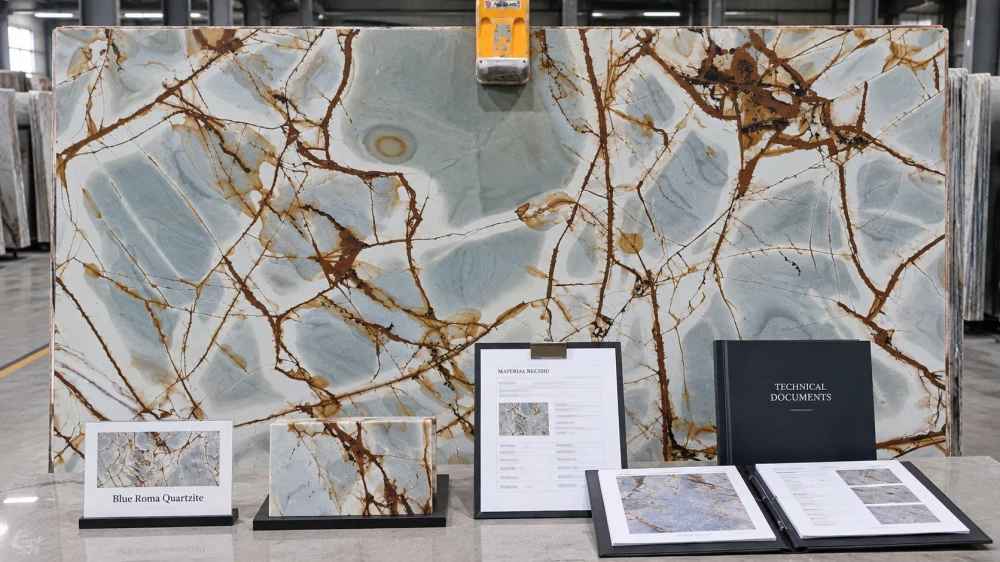
A controlled specification can therefore keep these records separate:
Commercial Material Name: purchasing / supplier reference
Slab or Lot Reference: actual material being offered
Classificazione geologica: record where verified or required
Dati tecnici dei test: record separately according to the project requirement
This prevents a trade label or a scratch demonstration from being asked to prove more than it actually supports.
Il quarzite naturale non è quarzo ingegnerizzato
This distinction should also remain explicit in RFQs, specifications, and purchase records.
Quarzite naturale is natural stone.
Engineered Quartz is a manufactured composite surface.
The similarity of the words “quartz” and “quartzite” does not make them interchangeable materials.
For general purchasing context, our Guida all’acquisto di piani di lavoro in quarzite naturale explains why actual slab review, fabrication planning, natural variation, and material category should be considered separately rather than treating Natural Quartzite like a manufactured quartz surface.
What Can Petrographic Examination Add?
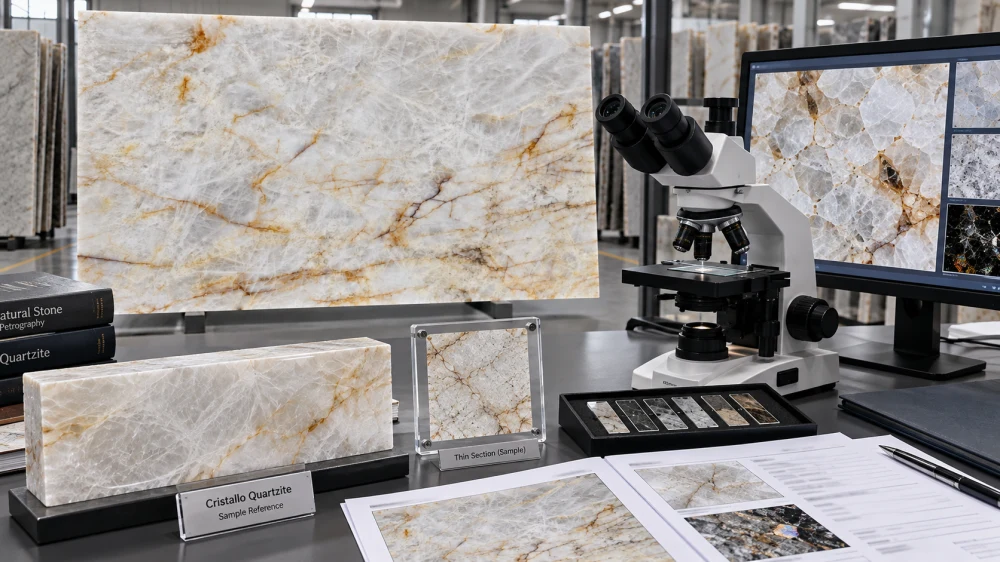
If geological identity matters to the project, petrographic examination can provide a different type of evidence from a scratch observation.
Depending on the laboratory method and report scope, petrography may describe:
cristallo-quartzite-petrographic-material-review
minerals observed in the submitted sample;
rock classification;
grain relationships;
texture;
fabric or directional structure;
accessory minerals;
alteration; and
fractures or microfractures observed in the examined section.
This is much closer to the geological identification question than an improvised surface scratch demonstration.
But a Petrographic Report Also Has Limits
Replacing “scratch test proves everything” with “petrographic report proves everything” would create another problem.
A petrographic report describes the sample examined.
It does not automatically prove that every slab sold under the same commercial name has identical:
mineral proportions;
visual character;
fracture distribution;
accessory minerals;
physical properties; or
fabrication behavior.
Nostro Natural Quartzite petrographic report guide explains this distinction in more detail: petrography can describe mineralogy, texture, fabric, and geological classification of the tested sample, while actual slab review and separate physical testing still answer different purchasing questions.
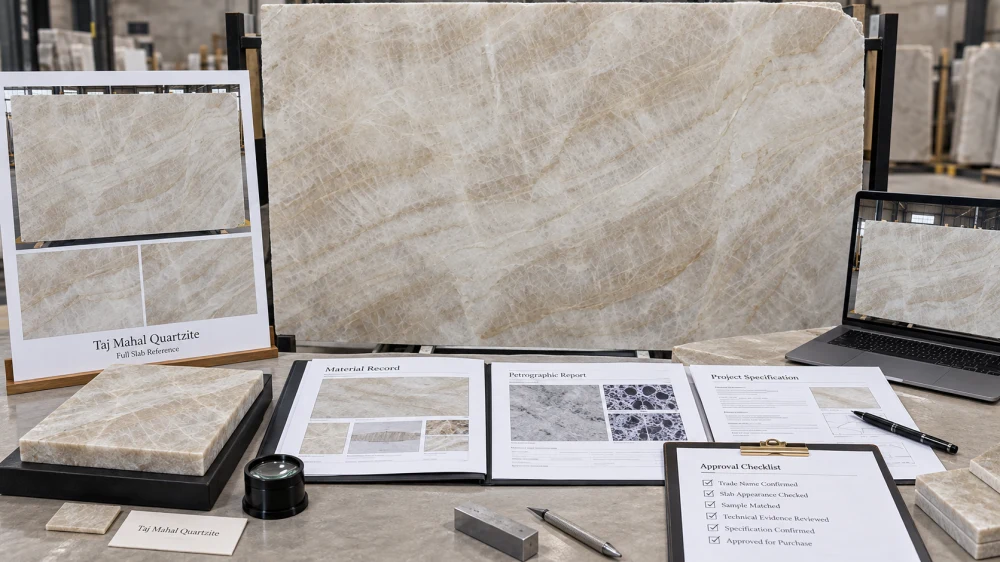
The Missing Link Is Sample Identity
A technically impressive report has limited purchasing value if nobody can establish what material was actually tested.
Is there a block, lot, bundle, or other material reference where available?
Can the tested sample reasonably be connected to the slabs being offered?
Evidence Principle
The strength of a technical document depends not only on what it says, but also on whether the tested sample can be traced to the material being purchased.
Different Tests Answer Different Questions
A buyer should start with the project question rather than asking for “a test report” generically.
Current full-slab photographs / videos / physical review
Will the required pieces fit this slab?
Actual slab dimensions + cutting layout
Do Not Turn the Buyer Into a Field Geologist
A purchaser does not need to identify a rock scientifically by performing improvised destructive tests on finished slabs.
A more controlled buyer workflow is:
01 — Define the Question
Are you checking trade-name accuracy, geological classification, surface performance, or a project specification?
02 — Identify the Material
Record the supplier, commercial name, slab or lot reference, photographs, and sample reference.
03 — Review Existing Evidence
Check supplier records, technical documents, samples, and any available laboratory information.
04 — Identify the Evidence Gap
Determine what the existing documents still cannot answer.
05 — Use the Appropriate Technical Route
Where classification or performance is important, use a suitable qualified laboratory or technical review rather than treating an informal scratch demonstration as final proof.
What Should a Buyer Record Before Approving Natural Quartzite?
□ Actual slab / bundle / lot references recorded where available
□ Current slab photographs reviewed
□ Representative sample identified where used
□ Geological classification evidence reviewed if required
□ Sample identity checked against technical reports
□ Physical-property data reviewed separately where the specification requires it
□ Open questions recorded before final material approval
When Is a Scratch Observation Still Useful?
The answer is not that scratch observations have no value.
They can be useful as one limited piece of information.
For example, an unexpected surface response may give a buyer or fabricator a reason to ask additional questions about:
the material description;
surface treatment;
the tested location;
the representative sample; or
whether further technical review is appropriate.
The mistake is not observing the surface.
The mistake is treating that observation as a complete identification certificate.
FAQ
1. Can a scratch test prove that a slab is Natural Quartzite?
No. Un test di graffiatura può fornire un’osservazione della superficie relativa alla durezza, ma non è in grado di stabilire in modo autonomo la classificazione geologica dell’intera lastra. L’identità del materiale dovrebbe essere corroborata da informazioni tracciabili sul materiale e da adeguati elementi tecnici, laddove la classificazione rivesta importanza.
2. Why can a Quartzite scratch test give misleading results?
Il risultato può essere influenzato dall’oggetto di prova, dalla pressione, dalla finitura superficiale, dal trattamento, dalla posizione di prova, dalle variazioni mineralogiche e dall’interpretazione del segno. Una dimostrazione informale può pertanto risultare utile per una prima valutazione, ma non deve essere considerata come prova autonoma dell’identità della roccia.
3. Does high scratch resistance mean a stone must be Quartzite?
No. La resistenza ai graffi descrive un comportamento legato alla durezza in condizioni specifiche. La classificazione geologica dipende inoltre dalla composizione minerale, dalla tessitura, dalla struttura e da altre caratteristiche che una semplice osservazione dei graffi superficiali non è in grado di rivelare.
4. Il quarzite naturale è uguale al quarzo ingegnerizzato?
No. Il quarzite naturale è una pietra naturale, mentre il quarzo ingegnerizzato è una superficie composita prodotta industrialmente. I documenti di approvvigionamento dovrebbero indicare chiaramente la categoria di materiale prevista.
5. What evidence is more useful when geological Quartzite identity matters?
Appropriate petrographic or other qualified geological examination can provide information about the tested sample’s mineral composition, texture, fabric, and rock classification. The buyer should also confirm that the tested sample can be connected to the material being offered.
6. Does a petrographic report prove that every slab in a shipment is identical?
No. A petrographic report describes the sample examined. Natural stone can vary between quarry areas, blocks, slabs, and batches, so the report should be read together with sample identity and current slab review.
7. Should buyers perform scratch tests on finished Quartzite slabs themselves?
Avoid treating improvised or destructive testing on a finished surface as the default purchasing method. Define the question first, review traceable material information, and use representative samples or qualified technical review where additional verification is required.
Final Identification RuleUse a scratch observation for what it actually shows: a limited surface response under specific conditions. Do not turn it into proof of geological identity. When confirming Natural Quartzite matters to a project, connect the commercial name, actual slab or lot, representative sample, technical evidence, and the specific question the project needs answered.
For Natural Quartzite sourcing, HRST STONE can coordinate actual slab references, full-slab photographs, representative samples, fabrication information, available supplier documentation, and project records around the material being offered. Where formal geological classification or project-specific technical performance must be verified, the appropriate qualified laboratory or technical professional should provide that determination.
Hi, I am the author of this article. I have been working in the field of Natural Stone for more than 15 years. If you need customized Natural Stone services, please feel free to contact me.
Cina Marmo, granito, quarzite, produttore e fornitore di agata - PIETRA HRST
Benvenuti su HRST STONE!
Salve, vorrei saperne di più sui vostri prodotti. Potreste fornirmi informazioni su prezzi, quantità minima d’ordine, opzioni di personalizzazione e campioni?