Ordini di quarzite Rush: quali approvazioni non possono ancora essere saltate?
Post navigation
Riepilogo rapido
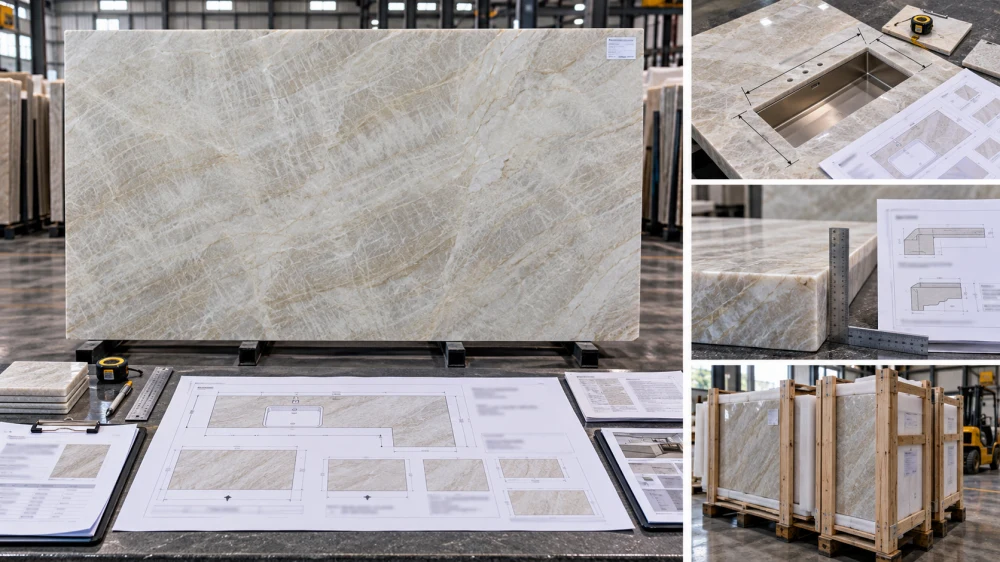
A Quartzite rush order can compress communication and review time, but it should not remove the approvals that control irreversible work. Before cutting, confirm the actual slab or material reference, governing drawing revision, critical dimensions, visible layout, finish, edges, cutouts, and third-party interfaces. Before shipment, confirm piece identity, quantity, QC status, packing, and destination. The safest rush workflow removes waiting between decisions rather than removing the decisions themselves.
The site programme moves forward.
The Quartzite is suddenly needed earlier.
The buyer asks the supplier to “rush everything.”
What can actually be accelerated?
UN Quartzite rush order should not be managed by deleting approval steps at random. The better approach is to identify which decisions protect irreversible work, then shorten the time between those decisions.
The working principle is:
Compress Waiting Time → Not Decision Control.
What Makes a Quartzite Order a Rush Order?
A rush request can come from many situations:
an earlier installation date;
a delayed material decision;
a late drawing revision;
a replacement requirement;
a construction programme change;
a shipping deadline;
another trade waiting for the stone; or
a client requesting earlier completion.
The first step is to record the actual trigger and target.
“Urgent” is not enough.
The project should identify what date or event matters and which parts of the stone scope are affected.
Start by Separating Compressible Time from Non-Skippable Decisions
Project Activity
Can Time Be Compressed?
Can the Decision Be Skipped?
Response / coordination time
Often yes
Not applicable
Slab / material approval
Review may be accelerated
No, where material selection is required
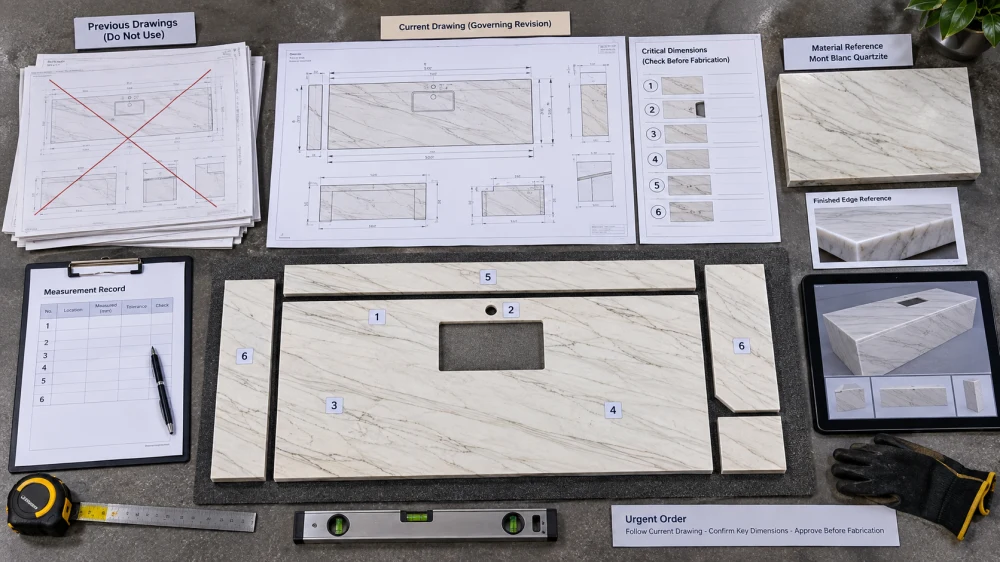
Revisione dei disegni
Yes, through a short review route
No governing revision should remain unclear
Critical dimensions
Verification can be prioritized
No where fabrication depends on them
Visible layout / orientation
Approval turnaround can be shortened
No where appearance depends on placement
QC documentation
Can be prepared immediately
Required checks should not disappear because of urgency
Approval 1: Confirm the Actual Quartzite Material
The rush order still needs an identified material basis.
Depending on the project, that may mean:
approved physical sample;
identified slab numbers;
approved slab photographs or videos;
reserved slab group;
replacement-material approval; or
another project-specific material reference.
A commercial name alone should not silently become approval of any slab carrying that name.
Natural Quartzite varies from slab to slab, so the approval record should identify what actual material is being released.
Approval 2: Lock the Governing Drawing Revision
Rush orders are especially vulnerable to drawing confusion because several people may be working simultaneously.
Visible Layout / Orientation Approved Where Required
+
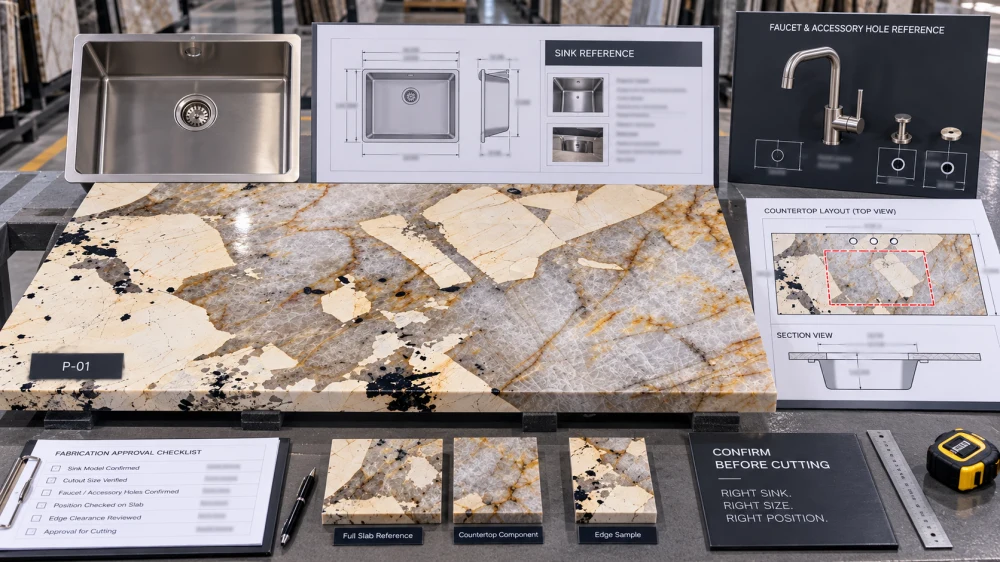
Cutouts / Interfaces Confirmed
+
Finish / Edge Scope Confirmed
↓
Named Cutting Release
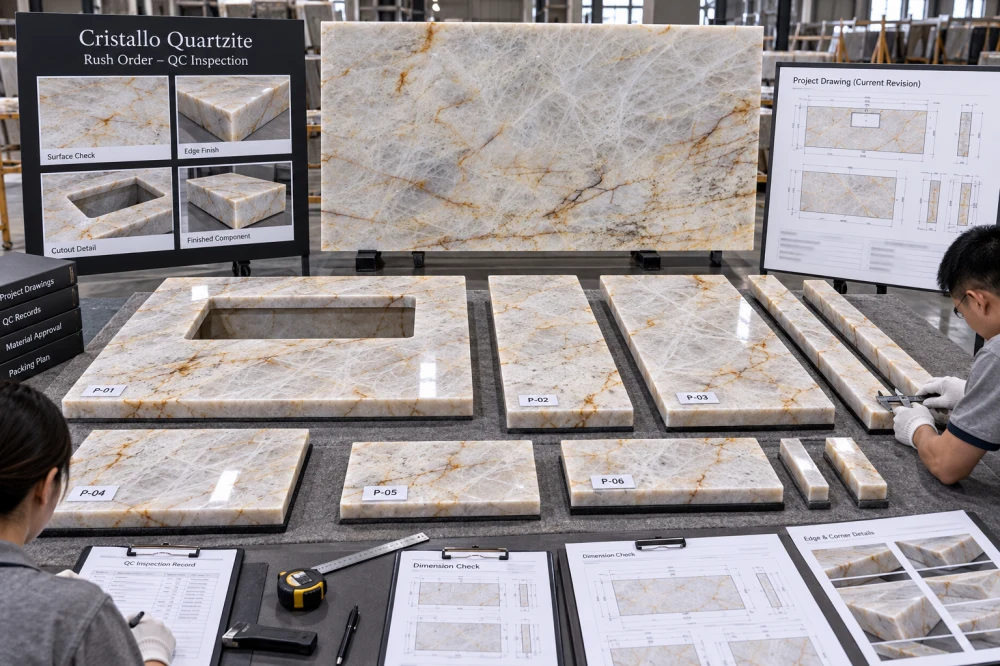
Approval 8: Rush Production Still Needs Traceable QC
Reducing waiting time does not require abandoning inspection records.
For the confirmed scope, project QC can still connect:
Source Slab → Cutting Plan → Piece ID → Dimensions → Surface / Edge → Cutouts → Dry-Lay Where Required → Packing
The exact inspection scope depends on the product and project.
For a rush order, one advantage of stable piece IDs is that issues can be discussed by component rather than through vague messages such as “the second long piece.”
Can Dry-Lay Approval Be Skipped on a Rush Order?
Not every Quartzite order requires the same dry-lay process.
But if the project has already identified dry lay as an approval requirement because sequence, joints, movement, orientation, or overall visual relationships matter, urgency alone is not a good reason to silently remove it.
This allows the buyer to focus on the information that affects release rather than receiving an unstructured collection of factory photographs.
Approval 9: Shipment Release Is Different from Cutting Release
Finishing fabrication does not automatically mean the order is ready to ship.
Before shipment, confirm the project-specific release items that apply, such as:
la quantità dei pezzi;
identificativi dei pezzi;
QC status;
approved issue resolution;
packing list;
piece-to-crate relationship;
quantità di casse;
destination;
shipping marks where required; and
commercial / logistics documentation status.
A cutting approval and a shipment approval answer different questions.
What Can Actually Make a Quartzite Rush Order Faster?
The most useful acceleration usually comes from reducing handoff time.
Esempi includono:
one governing drawing instead of several competing revisions;
one named decision owner for each approval;
actual slab references instead of generic material photos;
a short approval matrix instead of scattered email chains;
clear piece IDs;
parallel preparation of non-blocked work;
predefined photo / QC requirements;
rapid escalation of blocked decisions; and
separate cutting and shipment release gates.
The goal is not fewer controls.
It is fewer unnecessary pauses between the controls that matter.
Rush Order Release Checklist
BEFORE CUTTING
□ Rush trigger and target identified
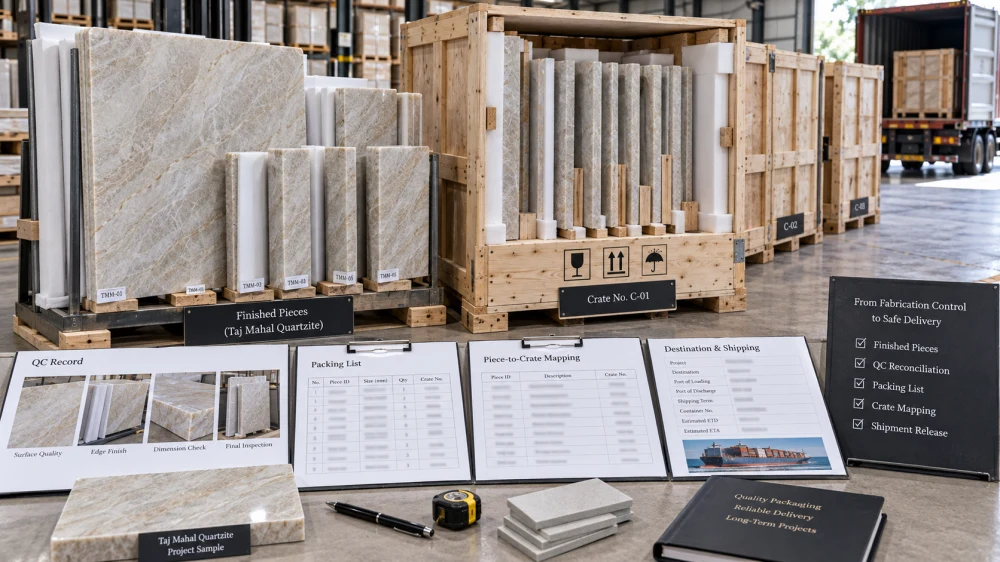
quartzite-rush-order-packing-shipment-release
□ Actual material / slab reference confirmed
□ Governing drawing revision confirmed
□ Critical dimensions confirmed
□ Visible layout / orientation approved where required
□ Finish and visible edges confirmed
□ Cutouts and third-party interfaces confirmed
□ Open issues identified
□ Named cutting release recorded
BEFORE SHIPMENT
□ Piece IDs and quantities reconciled
□ Required QC completed
□ Open issues resolved or formally dispositioned
□ Packing list reconciled
□ Piece-to-crate relationship recorded where required
□ Destination confirmed
□ Shipment release recorded
FAQ
1. Can a Quartzite rush order skip slab approval?
If the project requires actual slab selection or appearance approval, urgency should not be treated as automatic permission to skip it. The review can be accelerated, but the material being released should still be clearly identified.
2. Which approval is most important before cutting Quartzite?
There is no single universal approval for every project. Before cutting, the release should normally bring together the project-specific material reference, governing drawing, critical dimensions, required layout or orientation, finish and edge scope, cutouts, interfaces, and named authorization relevant to the affected pieces.
3. Can fabrication start while some Quartzite approvals are still open?
Non-conflicting preparation may sometimes proceed in parallel, but unresolved information should not be silently assumed. The project should identify which open approval blocks which operation so work can continue only where the missing decision does not affect it.
4. Can a rush order skip dry-lay approval?
Not every project requires dry lay. However, if dry lay is already an agreed approval step because sequence, seams, orientation, or overall visual relationships matter, urgency alone should not automatically remove that requirement.
5. Is “looks good” enough to release Quartzite for cutting?
Not necessarily. A visual comment may approve one aspect of the material while dimensions, drawings, cutouts, interfaces, or other fabrication inputs remain unresolved. A cutting release should identify the scope and governing information being authorized.
6. Does cutting approval also approve shipment?
No. Cutting release authorizes an earlier production decision. Shipment release should separately consider the completed pieces, quantities, QC status, issue resolution, packing information, destination, and applicable logistics documentation.
7. What should I send a supplier for a Quartzite rush order?
Send the actual material or slab references available, current governing drawings, dimensions, quantities, finish, visible-area priorities, cutouts and third-party information, target date, open approvals, delivery destination, and the name or role responsible for each key decision.
Final Rush-Order RuleA Quartzite rush order should remove idle time, not remove the decisions that protect irreversible work. Use the sequence Material → Drawing → Critical Dimensions → Layout → Interfaces → Cutting Release → QC → Packing → Shipment Release, and show clearly which unresolved approval blocks which next action.
For urgent Natural Quartzite projects, HRST STONE can coordinate actual slab references, CAD/shop drawings, cutting layouts, piece identification, fabrication records, QC photographs, dry-lay documentation where required, packing records, and export preparation for the confirmed stone scope. Send Josh the material, slab references, current drawings, dimensions, quantity, finish, target date, open approvals, and delivery destination so the unresolved stone-related decisions can be identified before production release.
Hi, I am the author of this article. I have been working in the field of Natural Stone for more than 15 years. If you need customized Natural Stone services, please feel free to contact me.
Cina Marmo, granito, quarzite, produttore e fornitore di agata - PIETRA HRST
Benvenuti su HRST STONE!
Salve, vorrei saperne di più sui vostri prodotti. Potreste fornirmi informazioni su prezzi, quantità minima d’ordine, opzioni di personalizzazione e campioni?