
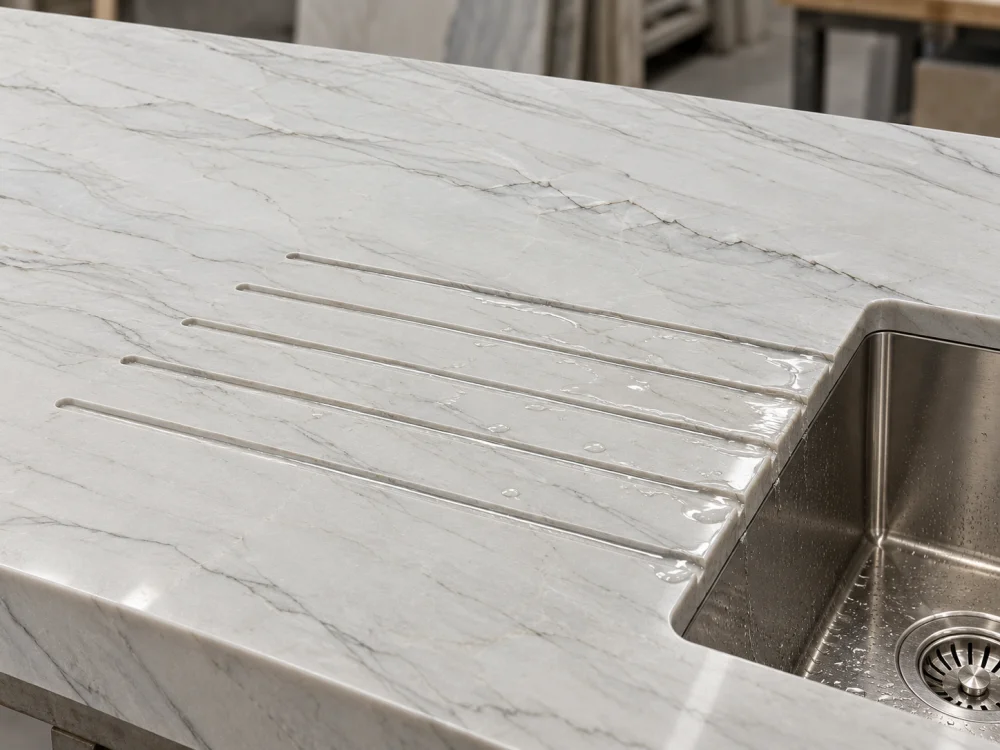
Drainer grooves can look like a very small countertop detail.
Several parallel channels are machined beside an undermount sink.
Water moves toward the bowl.
The countertop remains visually continuous.
On a drawing, the detail can appear straightforward.
In Natural Quartzite, however, each groove removes material from the finished surface and exposes a newly fabricated strip through the actual geological structure of the slab.
The result has to work in several ways at once.
The grooves need to relate correctly to the sink.
The fabricated surfaces need to be finished acceptably.
Water should move as intended rather than collect unpredictably.
The detail should remain practical to clean.
The groove zone should also be reviewed as part of the complete countertop geometry rather than as decorative lines added after the sink cutout has already been approved.
Ecco perché Scanalature drenanti nella quarzite: cosa verificare prima su un campione should begin with a fabricated sample.
The key question is:
What does the sample need to prove before the same groove detail is cut into the actual project slab?
A drainer groove is not only a visual feature.
Its primary practical purpose is to help manage water beside the sink.
The project should therefore define the intended use before discussing the groove count or appearance.
Some projects expect the grooves to guide water toward the sink after glasses, dishes, produce, or utensils are placed beside the bowl.
If that is the design intent, the sample should test actual water movement.
Do not approve the grooves only because they look evenly spaced in a photograph.
Grooves and a fully recessed or sloped drainboard are not necessarily the same detail.
A project may use:
These conditions should not be treated as interchangeable.
The groove orientation should relate to the actual sink position.
The sample should make clear:
Do not approve a drainer-groove sample only from appearance. Add water and observe what actually happens: where it moves, where it slows, where it remains, and how easily the area can be wiped clean afterward.
Un acquirente potrebbe chiedere:
“How deep should Quartzite drain grooves be?”
Or:
“How many millimeters apart should they be?”
Those questions should go back to the responsible fabricator together with the actual material, slab thickness, sink, countertop geometry, support conditions, machining method, and required appearance.
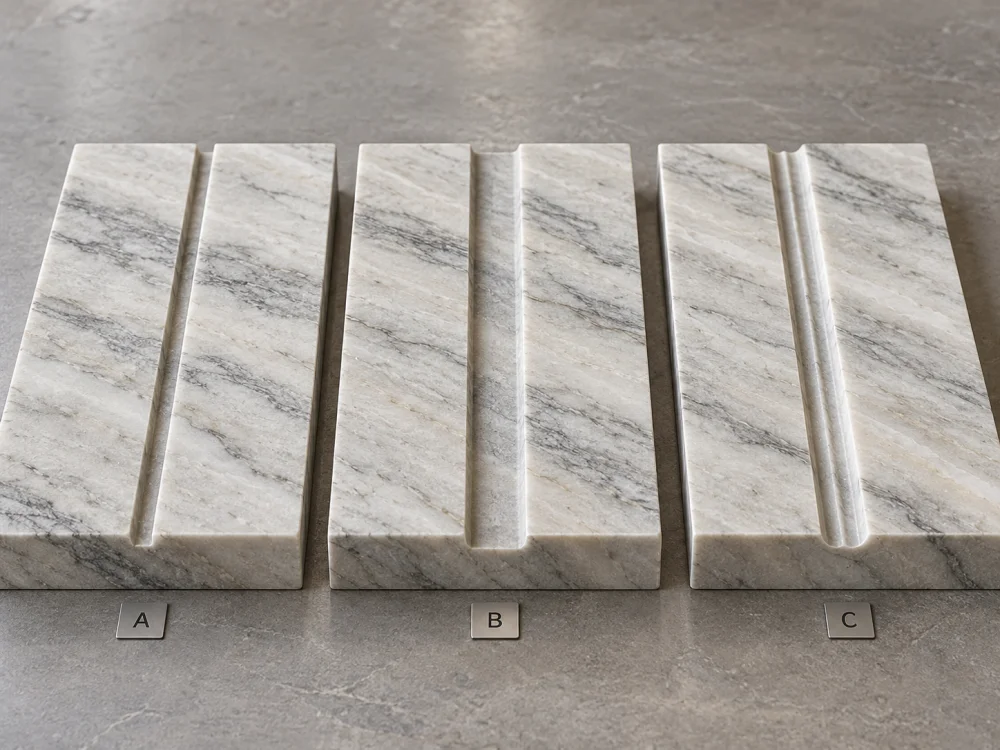
Groove depth affects several things at once.
A deeper groove may create a more obvious drainage channel, but it also removes more Natural Quartzite from the countertop surface.
The sample should allow the fabricator to review:
This article deliberately does not prescribe one universal Quartzite depth.
A narrow V-like detail, wider rounded channel, or another machined profile can behave differently during fabrication and cleaning.
Profile also changes how light catches the groove.
On pale Quartzite, a narrow shadow can make the groove appear darker than the surrounding face even when the stone colour itself is unchanged.
Spacing affects the visual rhythm and the amount of stone remaining between adjacent grooves.
The correct spacing should be considered together with:
Grooves do not necessarily need to extend across the complete countertop depth.
The project should determine the start and end locations in relation to:
Engineered Quartz, Sintered Stone, Porcelain, and Natural Quartzite have different material structures and different fabrication guidance.
If another product manufacturer publishes a maximum groove depth or minimum groove spacing, that number applies within the scope of that product guidance.
It should not automatically become the specification for a Natural Quartzite countertop.
| Groove Variable | What the Sample Should Check |
| Depth | Water movement, remaining stone, visual depth and finished machining quality |
| Width | Water path, cleaning access, profile appearance and tool finish |
| Spacing | Visual rhythm and stone remaining between adjacent grooves |
| Length | Relationship with sink, countertop depth and actual wet-use zone |
| Profile | Fabrication finish, cleaning behavior, shadow and visual character |
Drainer grooves should not be designed independently from the sink.
Confirm the actual:
IL Ordini di quarzite con lavelli forniti dal proprietario: evitare la mancanza di specifiche guide explains why an approximate sink size or product photograph should not become irreversible stone-cutting information.
The transition between the groove and sink zone should be visible on the sample.
Recensione:
The sink area may also include:
Place all of those items on the same coordination drawing.
IL Ritagli per lavelli in quarzite: perché i dettagli angolari richiedono l’approvazione del fabbricante guide explains why a sink opening must be reviewed together with the stone remaining around it, nearby holes, seams, edge conditions, actual slab position, and fabrication method.
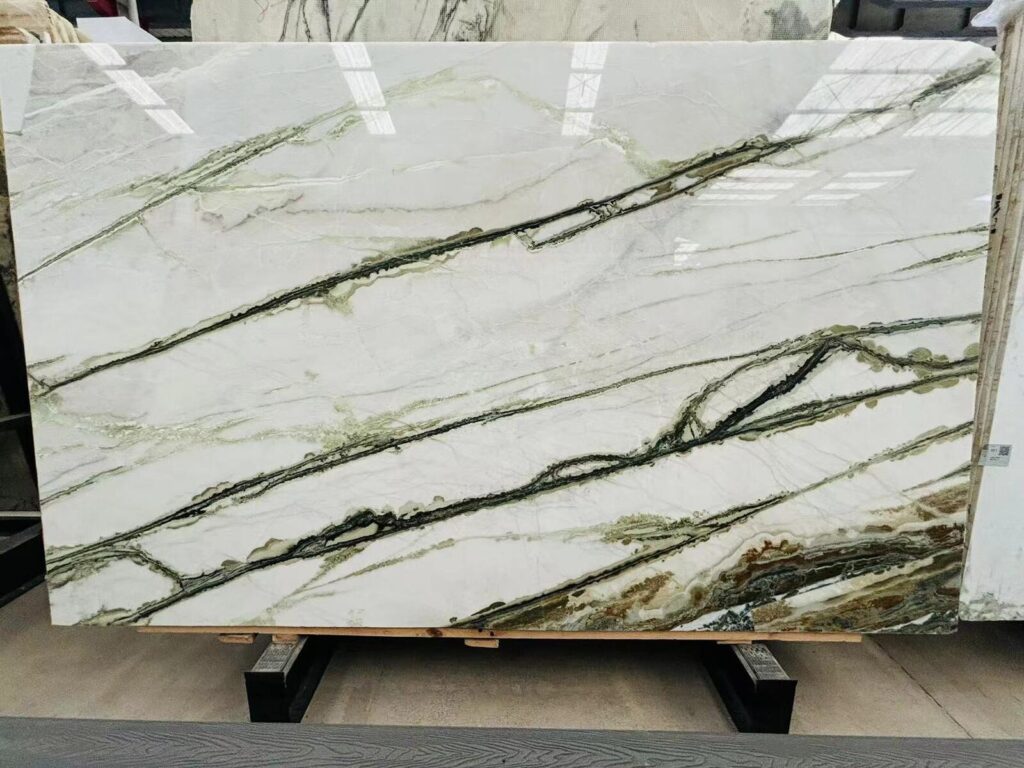
Natural Quartzite is not a homogeneous sheet.
A groove may begin in one quiet mineral area and cross several different zones before reaching the sink.

A taupe, grey, brown, or darker mineral band may become more visible once machined.
The groove may reveal the same mineral from another angle and produce a different local colour or texture.
A crystalline area can respond differently to machining and reflected light than a quieter surrounding field.
The worked groove may appear brighter, more granular, or otherwise visually different through that zone.
If a groove crosses an identified filled, repaired, or resin-treated condition, review the sample or slab layout before assuming that machining will produce the same appearance as untouched stone.
Do not automatically classify the condition as unacceptable.
First establish:
A generic sample proves the fabrication concept.
It does not prove that every part of the selected slab will machine identically.
Before production, locate the drainboard zone on the actual slab.
A useful review can show:
Actual Slab → Sink Cutout → Drainer-Groove Zone → Major Natural Features → Finished Countertop Outline.
The sample approves the tested groove concept. The actual slab layout still needs to confirm which natural mineral zones the production grooves will cross.
A drainer groove creates a new fabricated surface.
That surface should be reviewed rather than assumed to look identical to the original factory-finished slab face.
A newly routed groove may initially show:
The final sample should represent the intended finished condition, not only the first CNC pass.
On a polished Natural Quartzite countertop, the groove usually interrupts the broad flat reflection of the main surface.
Even when carefully finished, the curved or angled groove surface receives light differently.
A slight visual difference therefore does not automatically prove that the groove was fabricated from a different stone.
On a honed surface, the relationship is different.
The lower-sheen countertop may reduce the contrast between the main face and groove, but texture and local machining quality can still become visible.
The start and termination of each groove deserve close review.
Look for:
Where appearance is important, include the full groove length in the sample rather than testing only a short central section.
A dry sample answers only part of the question.
Drainer grooves are designed for a wet-use location.

Apply a controlled amount of clean water to the sample and observe:
A visually attractive groove can still retain water if the countertop plane, groove profile, or local machining creates low points.
Do not assume drainage from the CAD geometry alone.
Natural stone often appears visually different when wet.
The grooves may temporarily look darker than the surrounding dry face.
Record that as a wet-condition observation rather than immediately calling it a stain.
After the water test, allow the sample to dry appropriately before evaluating any remaining visual change.
A useful record distinguishes:
Dry Before Test → Wet During Test → Dry After Test.
If a darker, duller, cloudy, or otherwise changed area remains, document what is visible before assigning a cause.
A simple groove drainage test is not the same as a laboratory water-absorption test.
Its purpose is to review the project detail and observable water behavior.
Do not convert the result into a numerical absorption rating or claim that every slab of that Quartzite will perform identically.
A drainer groove creates a narrow three-dimensional surface that can collect:
The sample should therefore be reviewed for practical cleaning as well as drainage.
A very narrow or deep profile may be more difficult to wipe than a broader, smoother profile.
This does not establish one universal groove size.
It means cleanability belongs in the sample decision.
Pay particular attention where the groove terminates near the sink.
If the termination geometry traps residue, the project may want to modify the fabricated detail before production.
Do not test the sample with increasingly aggressive household chemicals simply because the grooves are difficult to clean.
The project’s selected stone, finish, treatments, and approved care products should control the cleaning test.
IL Guida definitiva alla manutenzione della quarzite naturale explains why daily cleaning, stain investigation, sealing, and restoration should remain separate decisions rather than being combined into one generic “stone cleaner” rule.
If a penetrating treatment or sealer is being considered, test and approve it according to the actual stone, finish, product instructions, and project requirements.
Do not assume that grooves automatically require a particular sealer or that sealing makes the draining zone maintenance-free.
Fabricate → Finish → Inspect Dry → Add Water → Observe Flow → Observe Ponding → Clean → Allow to Dry → Reinspect Appearance. Record each state instead of judging only the wet photograph.
The grooves remove material from a countertop zone that may already contain a large sink opening.
This makes the complete geometry important.

The responsible fabricator should understand:
The buyer does not need to invent universal structural limits.
The buyer does need to make sure these conditions are visible to the person responsible for fabrication review.
Do not approve:
Sink cutout on Drawing A.
Drainer grooves on Sketch B.
Faucet holes in an email.
Seam on another revision.
Bring the complete sink-side geometry onto the current fabrication drawing.
Different manufacturers of other countertop materials publish their own reinforcement rules around grooves and sink areas.
That demonstrates that groove machining can affect how a countertop zone is evaluated.
For Natural Quartzite, the actual support and reinforcement question should be resolved by the responsible fabricator or other appropriate project professional using the actual geometry and material.
A useful drainer-groove sample does not need to reproduce the entire kitchen.
It does need to reproduce the important variables.
Where practical, include:
| Test Question | Cosa registrare |
| Can it be machined cleanly? | Profile consistency, tool marks, chipping and groove-end quality |
| Does water move as intended? | Direction, local ponding and sink transition |
| Does the groove finish look acceptable? | Dry visual relationship with the approved countertop face |
| How does the stone react across mineral zones? | Colour, texture and fabrication observations along the groove |
| Can the grooves be cleaned practically? | Residue removal and access with the approved cleaning method |
| Does wetting create a temporary visual change? | Dry-before, wet and dry-after photographs |
A sample cut from one Quartzite offcut does not automatically prove:
Write the approval boundary clearly.
The sample is the beginning of fabrication approval, not the end.
Record the approved:
Use the dimensions resolved by the responsible fabricator for the actual project.
Before cutting, show:
Finished Countertop Outline → Sink Opening → Faucet / Accessory Holes → Drainer-Groove Zone → Actual Quartzite Pattern → Seams / Edges.
This is the moment to identify whether an unexpected natural feature crosses the groove zone.

Do not photograph only one perfect groove.
Recensione:
If the sink changes, groove layout changes, countertop thickness changes, slab allocation changes materially, or the fabricator proposes a different profile, repeat the affected approval rather than assuming the original sample remains current.
They may be feasible, but the detail should be reviewed for the specific Natural Quartzite, slab thickness, sink zone, groove geometry, fabrication method, support condition, and intended finish. A representative fabricated sample is useful before production when the detail is visually or technically important.
This article does not prescribe one universal depth. Published groove limits for Engineered Quartz, Sintered Stone, and other countertop products are product-specific and should not automatically be transferred to Natural Quartzite. The responsible fabricator should determine the project geometry using the actual material, thickness, sink area, machining method, and surrounding countertop conditions.
Observe whether water enters the grooves, travels toward the sink, collects in local low points, remains between grooves, or stops before reaching the sink zone. Also compare the stone dry before the test, wet during the test, and dry afterward so temporary darkening is not automatically confused with staining.
They can intersect natural mineral zones because Quartzite is geologically variable. Review the actual slab layout and how the proposed groove path crosses those areas. If a significant fissure, filled condition, repair, or complex mineral zone lies within the machining path, escalate it to the responsible fabricator before production.
Not necessarily. A groove exposes and finishes the stone at another angle, and its curved or angled profile reflects light differently from the broad flat countertop. The final sample should show the intended groove finish so the project can approve the actual face-to-groove relationship.
Cleaning depends on the actual profile, width, depth, finish, use, residue, and approved care method. This is one reason cleanability should be tested on the fabricated sample rather than assumed from a rendering. Avoid promising that one groove geometry or cleaning product is best for every Quartzite.
Send Josh the Natural Quartzite material, current slab references where available, countertop drawings, finished dimensions, thickness, quantities, sink manufacturer and exact model, current sink template or technical information, mounting and reveal requirement, faucet and accessory holes, proposed groove location and visual concept, surface finish, nearby seams or edges, support information within the confirmed fabrication scope, and delivery destination. Identify whether a fabricated groove sample and water-flow test are required before production release.
For project-based Natural Quartzite countertops with drainer grooves, HRST STONE can coordinate available slab references, sink-zone drawings, CAD cutting layouts, groove mock-ups, actual-slab positioning, surface-finish review, fabrication photographs, water-flow QC where included in the confirmed scope, piece identification, packing, and export documentation. Send Josh the Quartzite selection, sink information, countertop drawings, required finish, groove concept, dimensions, quantities, and delivery destination for review.