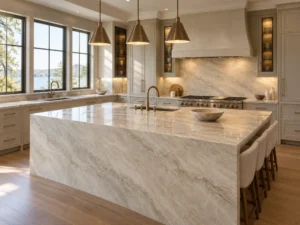
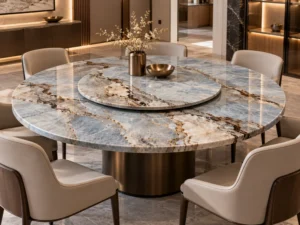
A round Natural Quartzite dining table can create one large geological composition.
Add a stone Lazy Susan at the centre and the visual problem changes.
Now there are two visible Quartzite surfaces:
the fixed dining tabletop
E
the rotating Lazy Susan.
At first, the design may seem straightforward.
Use the same Quartzite.
Place a smaller circular stone piece in the centre.
Try to match the veins.
But a Lazy Susan rotates.
A mineral band that aligns beautifully with the outer tabletop at one position may point in a completely different direction after a quarter turn.
The stone has not changed.
The relationship between the two visible compositions has.
This is the central issue behind Quartzite Dining Tables with Lazy Susans: Matching Two Visible Surfaces.
The correct design question is therefore not:
“Can the two pieces match perfectly?”
Ma piuttosto:
“Can the main tabletop and rotating centre remain visually coordinated even when the Lazy Susan changes orientation?”
The first mistake is treating the Lazy Susan as a small accessory added after the dining tabletop has already been designed.
When it is made from Natural Quartzite, it is another highly visible stone surface.
The outer dining top may preserve:
Because of its size, the main table may be read from several metres away as one complete pattern.
The centre piece is smaller.
Its pattern is therefore read at another scale.
A geological feature that feels balanced across the main tabletop may become too dominant when isolated inside the smaller rotating disc.
Conversely, a quiet slab area can work very well on the Lazy Susan because it allows the larger outer tabletop to remain the visual focus.
The Lazy Susan should still have its own coherent composition.
Chiedere:
Il relativo Scala del motivo della quarzite: lettura di una lastra a distanza d’ambiente guide explains the broader principle: the relevant pattern is the pattern that survives inside the finished-piece outline, not all of the geology visible on the original slab.
Main Tabletop = One Finished Quartzite Composition. Lazy Susan = A Second Finished Quartzite Composition. Approve both individually first, then approve how they work together.
“Match the Lazy Susan to the table” is too vague for fabrication.
There are several possible design intentions.

The main tabletop and Lazy Susan are positioned within the same selected slab where dimensions and usable area allow.
This can help the two pieces share:
They do not need to create permanent vein continuation.
For a large table, the complete furniture package may require more than one slab or may use a centre piece from another related board.
In that case, select slabs with compatible:
Do not assume the commercial stone name guarantees this relationship.
A project may intentionally select one reference position where a major mineral band on the Lazy Susan relates to the outer tabletop.
This can create a strong presentation when the table is photographed or initially arranged.
But the design team must understand:
Once the centre rotates, that alignment changes.
The home position may therefore be a presentation reference—not a permanent visual condition.
Some designs may use a calmer or more dramatic stone zone at the centre on purpose.
Ad esempio:
Outer Table: broad active geological movement.
Lazy Susan: quieter central field.
Or the reverse.
This can work when the difference looks deliberate rather than accidental.
| Matching Strategy | Main Goal | Important Limitation |
| Same-Slab Coordination | Shared tone and geological character | Rotation still changes pattern alignment |
| Related Slabs | Coordinate colour and pattern intensity | Trade name alone does not establish a match |
| Home-Position Alignment | Create one preferred starting composition | Alignment changes as the centre rotates |
| Intentional Contrast | Make centre and outer surface distinct but related | Difference should appear deliberate in all orientations |
This is the most important visual fact in the entire project.
The main tabletop stays fixed.
The Lazy Susan rotates.

Imagine one coffee-brown mineral band crossing the main tabletop from left to right.
At the preferred home position, the Lazy Susan may contain a related line continuing toward the same direction.
Rotate the centre ninety degrees.
The inner mineral line is now perpendicular to the outer movement.
Rotate again.
The relationship changes again.
This does not mean the layout failed.
It means the project should not define success as permanent vein continuation.
During visual approval, review at least several representative orientations.
Ad esempio:
The purpose is not to create a universal angle-testing standard.
It is to confirm that the centre piece still looks intentional when it is no longer aligned with the starting composition.
The Lazy Susan may be fabricated with a defined production orientation.
But after installation, guests can rotate it freely.
Therefore, avoid placing a visually awkward feature that only works when it faces one exact direction.
If the client wants a preferred presentation, define a reference orientation on the drawing or trial-assembly record.
This can help with:
But record clearly that the Lazy Susan is a rotating component.
Pattern continuity can be reviewed at one reference position. Pattern compatibility must work throughout rotation.
The stone layout should include the entire dining-table package.
Do not select the outer tabletop first and then search the leftover slab for the Lazy Susan.

On the actual slab image or physical slab layout, show:
Main Table Outline + Lazy Susan Outline + Pattern Direction + Important Natural Features.
This allows the designer to evaluate how the two compositions relate before material is committed.
If slab yield allows, create several realistic Lazy Susan crop options.
Ad esempio:
Option A — quiet centre field.
Option B — one complete focal feature.
Option C — stronger high-contrast mineral movement.
Review each option against the same outer tabletop layout.
The final visible circular boundary depends on the approved edge profile and fabricated diameter.
If a preferred vein sits extremely close to that boundary, confirm whether it remains visually complete after edge processing.
Two large circular pieces can consume significant usable slab area.
The most visually attractive centre crop may reduce yield or conflict with another important project component.
Visual layout and commercial material utilization should therefore be reviewed together rather than sequentially.
Ad esempio:
T01 — Main Dining Tabletop
LS01 — Lazy Susan
Both IDs should remain connected to:
IL Simboli di direzione delle vene di quarzite per i disegni di cantiere guide explains why visual direction should remain connected to identifiable pieces and actual slab layouts rather than relying on an isolated arrow.
Not every Lazy Susan is built into the table in the same way.
The furniture construction should be defined before the stone edge and centre relationship are approved.

In one common visual configuration, the rotating stone disc sits above the main tabletop on a concealed rotating mechanism.
The outer tabletop remains a complete stone surface below it.
This approach creates questions about:
Another design may place the rotating centre within a circular opening or recessed zone.
This is a very different fabrication condition.
The project must then review:
Do not transfer details from a raised Lazy Susan directly to an inset design.
In some concepts, the designer may hope that the centre circular area can be removed from the main tabletop and reused as the rotating piece.
Whether this is practical depends on:
Even if related stone is retained, exact seamless continuity should not be promised because the finished edges, clearance and subsequent rotation change the visual relationship.
The centre of the table contains more than a pattern relationship.
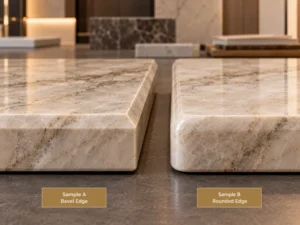
It also contains an edge relationship.
This edge may be highly visible because it sits near eye level when diners are seated.
Recensione:
If the centre is recessed into the table, the main tabletop may also contain a visible circular internal edge.
This creates two adjacent worked stone edges.
Their finish and visual relationship should be reviewed together.
A rotating component generally requires a defined relationship with the surrounding fixed surface.
The exact clearance should come from the approved furniture and hardware design.
This article does not prescribe one universal gap dimension.
From a visual perspective, review whether the gap reads as:
A cut and polished Natural Quartzite edge exposes the stone through another plane.
It may therefore read differently from the broad horizontal polished face.
Review an actual worked sample or first fabricated piece rather than assuming the circular edge will look identical to the tabletop face.
The Lazy Susan must rotate smoothly while supporting its actual stone component and normal table use.
The stone supplier should not invent the hardware specification from the word “Lazy Susan.”
The furniture designer or responsible hardware supplier should confirm the selected mechanism.
Informazioni rilevanti possono includere:
Different rotating mechanisms have different capacities, construction, mounting points and operating behaviour.
The current product documentation for the actual selected fitting should govern the hardware side of the design.
Confirm how the complete furniture assembly carries:
This article deliberately does not prescribe universal stone thickness, bearing capacity, pedestal size or fixing spacing.
Those decisions belong to the actual furniture design and selected hardware system.
If adjustment, replacement or fastening of the rotating mechanism may be required, the table design should account for appropriate access.
Do not approve a beautiful stone configuration that makes the hardware impossible to assemble or service.
IL Tavolo in quarzite blu Roma page follows the same broader furniture principle: actual slab layout, finished dimensions, edge, base, support, fabrication and trial assembly should remain connected before production.
Even when both pieces come from one slab, they may not always appear identical.
A polished main table reflects:
The Lazy Susan may reflect the same room from a slightly different height or angle.
Its appearance can therefore shift as it rotates.
A honed finish usually creates a softer reflected-light response.
Pattern and colour still vary naturally, but reflections may be less sharply defined.
Neither finish is universally better for this furniture type.
The physical Natural Quartzite pattern rotates with the Lazy Susan.
So do the directions from which its polished surface receives and returns reflected light.
A dark-looking area seen from one position may become brighter after the disc turns.
A pendant or chandelier directly above the dining table may create a strong central highlight on the Lazy Susan.
This means a centre sample should be reviewed under representative dining-room lighting rather than only warehouse ceiling light.
Dining furniture is often viewed:
The same stone relationship may read differently from each position.
A Quartzite table with a stone Lazy Susan combines natural-stone fabrication and moving furniture hardware.
A final trial assembly is therefore highly useful.
Verificare:
Verificare:
The final visual review should occur with the rotating centre in its actual position above or within the dining table.
This reveals conditions that isolated stone pieces cannot show.
Confirm that:
If a preferred reference orientation has been approved, mark or document how that position is established during final handover.
Again, this is a presentation reference.
It does not create permanent vein continuity.
□ Actual Natural Quartzite identified.
□ Main tabletop finished shape and dimensions confirmed.
□ Lazy Susan finished diameter and construction confirmed.
□ Raised / surface-mounted / inset condition clearly defined.
□ Main tabletop and Lazy Susan templates positioned on actual slab references before cutting.
□ Matching strategy defined: same-slab, related, home-position alignment, or intentional contrast.
□ Pattern balance reviewed with the Lazy Susan in several rotational positions.
□ Finish confirmed for both stone surfaces.
□ Outer table edge approved.
□ Lazy Susan edge approved.
□ Internal circular edge reviewed where an inset system is used.
□ Gap / reveal defined by the furniture and hardware design.
□ Rotation mechanism identified from current product information.
□ Base, support and fixing interface coordinated.
□ Trial assembly completed where required.
□ Preferred home orientation recorded where applicable.
□ Final QC connects the physical stone pieces to the approved slab layout.
□ Packing protects both circular stone edges and keeps the rotating component controlled during transport.
A strong approval record might say:

“Main tabletop T01 and Lazy Susan LS01 approved from the identified Quartzite slab layout. Both pieces are coordinated for background tone, mineral character and pattern intensity. LS01 has a preferred home orientation shown on the current furniture drawing, but pattern continuation is understood to change during normal rotation.”
Questo è molto più preciso rispetto a:
“Match Lazy Susan veins to table.”
The complete approval sequence can be:
Furniture Design → Main Top Geometry → Lazy Susan Geometry → Actual Slab Selection → Two-Piece Layout → Matching Strategy → Edge / Gap → Rotation Hardware → Base / Support → Fabrication → Trial Assembly → Rotation Review → Final QC → Packing.
For Natural Quartzite furniture, the goal should not be artificial perfection.
The goal is a controlled relationship between two natural surfaces that remains convincing as the centre performs its real function.
Not necessarily. The two surfaces should usually be coordinated for the intended project, but a Lazy Susan rotates, so exact vein continuation cannot remain fixed. Matching may instead focus on background tone, geological character, pattern intensity, finish and visual weight. A preferred home position can be approved separately if the project wants one starting alignment.
Using the same slab can help coordinate tone and geological character when the slab size, usable area and cutting layout allow it. It is not always necessary or possible. Related slabs can also be used when their actual appearance is reviewed together before fabrication.
Do not assume so. Cutting kerf, final diameters, required clearance, edge finishing, stone condition, support and rotating hardware all affect whether this approach is practical. The responsible fabricator and furniture designer should review the actual geometry before cutting.
They can if that is the design intent and the selected slab layout supports it. However, the relationship changes as soon as the Lazy Susan rotates. Therefore, home-position alignment should be treated as one approved presentation state rather than a permanent continuity condition.
The two systems create different fabrication and furniture questions, so this article does not rank one universally easier. A raised centre leaves the main tabletop more visually continuous but introduces height, underside and bearing-concealment questions. An inset centre introduces a circular opening, adjacent worked edges, clearance, support and hardware coordination.
Review the main tabletop and centre piece together, including pattern relationship, edge quality, finish, visible gap, hardware operation, clearance, support, several rotational positions and any approved home orientation. The final trial should connect the physical furniture to the approved drawing and slab layout.
Send Josh the proposed Natural Quartzite material, slab references where available, dining-table drawing, main tabletop shape and finished dimensions, Lazy Susan diameter and intended raised or inset condition, quantity, finish, edge profiles, preferred pattern relationship, base and support drawing, proposed rotating hardware information, home-position requirement if any, delivery destination, and whether trial assembly is required before packing.
For custom Natural Quartzite dining tables with Lazy Susans, HRST STONE can coordinate actual slab selection, full-slab photographs, main-top and centre-disc CAD templates, two-surface pattern layouts, edge samples, visible-gap review, furniture-base coordination within the confirmed stone scope, fabrication QC, trial assembly, piece identification, protective packing, and export documentation. Send Josh the table drawing, Quartzite selection, finished dimensions, Lazy Susan design, finish, edge profiles, base information, rotating-hardware reference, quantity, pattern priorities, and destination before final fabrication release.