Ordini di modifica per la quarzite: registrazione di un nuovo disegno dopo la riservazione delle lastre
Post navigation
Riepilogo rapido
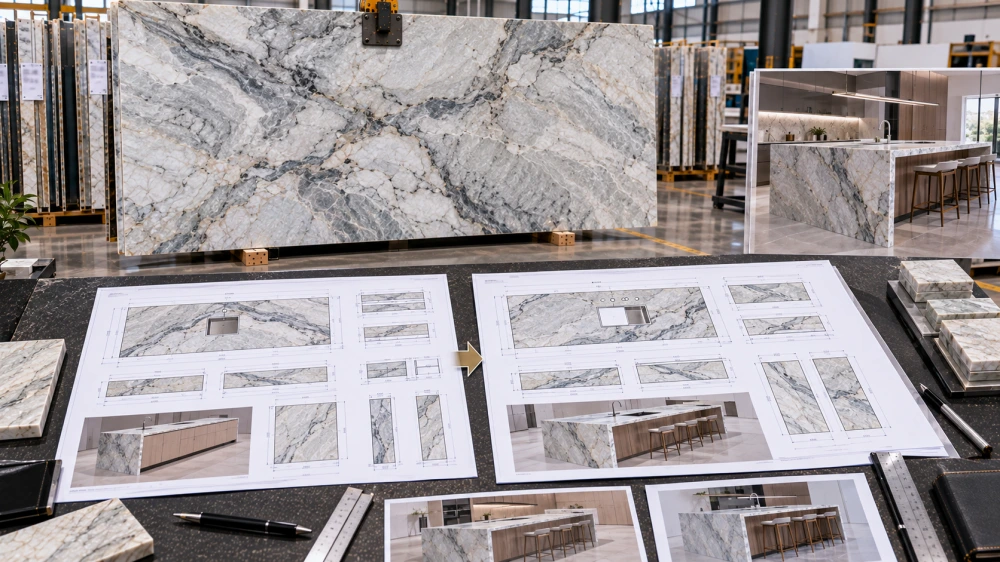
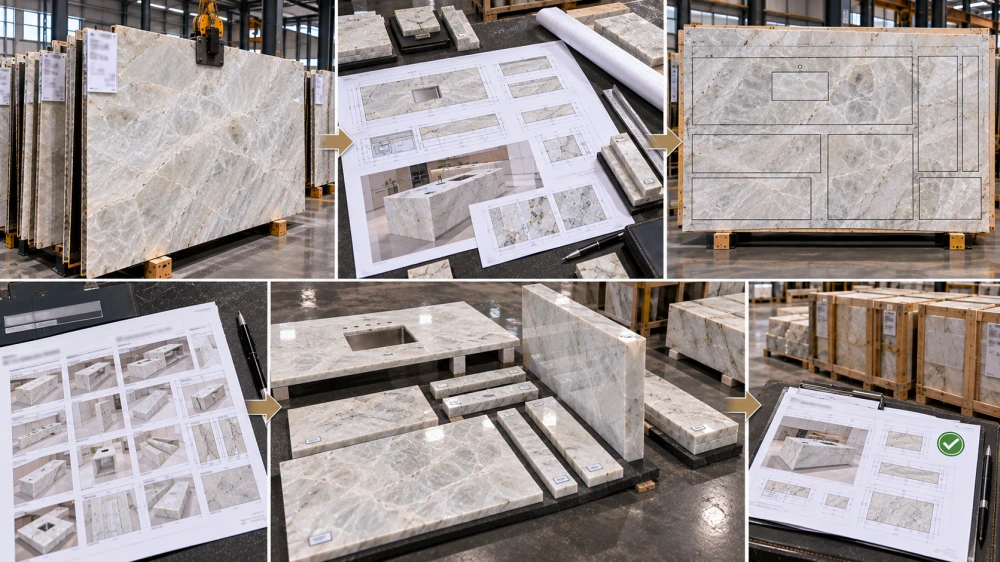
Un ordine di modifica relativo alla quarzite, emesso dopo la prenotazione delle lastre, non dovrebbe limitarsi a sostituire il vecchio disegno e proseguire la produzione. È necessario registrare la nuova revisione del disegno, individuare con precisione le modifiche apportate, verificare quali lastre prenotate e pezzi finiti siano interessati, ricontrollare la disposizione e la resa utile laddove necessario, riaprire le approvazioni visive che non corrispondono più alla nuova geometria e identificare eventuali ripercussioni su preventivo, fabbricazione, imballaggio o programma prima di rilasciare la successiva versione produttiva.
UN ordine di modifica per la quarzite diventa particolarmente importante quando le lastre di quarzite naturale sono già state selezionate e prenotate.
A quel punto, il progetto non riguarda più una pietra generica. Potrebbe essere già collegato a numeri di tavola specifici, fotografie reali delle lastre, un layout di taglio proposto, riferimenti dei pezzi, priorità visive e un preventivo precedente.
Poi arriva un nuovo disegno.
L’isola diventa più lunga. Un lavandino viene spostato. Viene aggiunta una cascata. Cambia l’altezza del paraschizzi. Il mobile lavabo diventa composto da due elementi anziché uno. L’alzata della parete guadagna un altro pannello.
La risposta corretta non è semplicemente:
“Usa il nuovo disegno.”
Il progetto deve stabilire quali cambiamenti apporta il nuovo disegno nel registro della pietra esistente.
Iniziare l’Ordine di Modifica per la Quarzite con un’intestazione di modifica controllata
INTESTAZIONE DEL REGISTRO DI MODIFICA
Progetto: [Riferimento del progetto]
Materiale: [Nome della quarzite naturale]
Lastre prenotate: [Numeri di tavola / riferimenti delle lastre]
Disegno precedente: [Disegno + revisione]
Nuovo disegno: [Disegno + revisione]
Data della revisione: [Data]
Modifica emessa da: [Parte responsabile del progetto]
Stato attuale della produzione: [Prenotazione / Revisione del layout / Rilascio / Fabbricazione / Controllo qualità / Imballaggio]
Questa intestazione impedisce che il nuovo disegno diventi un allegato isolato, senza alcun legame con il materiale già riservato per l’opera.
La prenotazione non significa che le lastre siano state rilasciate per il taglio
Una prenotazione di una lastra e un rilascio per la fabbricazione rispondono a due domande diverse.
Prenotazione: Quali lastre fisiche identificabili sono tenute a disposizione del progetto?
Rilascio per la produzione: Quale disegno approvato, quale layout, dimensioni, orientamento, giunture e istruzioni di fabbricazione autorizzano lo stabilimento a procedere?
Questa distinzione è importante perché le lastre vengono spesso selezionate prima che ogni dettaglio del disegno di officina sia definito.
Nostro Guida alla prenotazione delle lastre di quarzite divide il processo in selezione delle lastre, prenotazione, revisione del layout e rilascio finale per la produzione. Una modifica successiva alla prenotazione non annulla automaticamente il materiale, ma può richiedere al progetto di verificare nuovamente se quelle stesse lastre siano ancora adatte allo scopo rivisto.
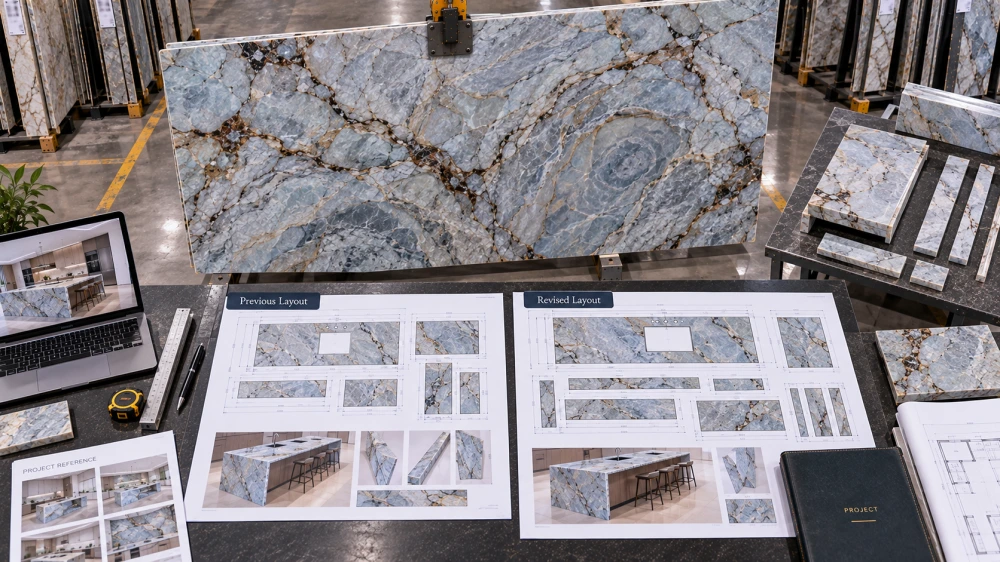
Utilizzare un delta “Prima e Dopo” invece di “Riveduto come disegno”
Un forte ordine di modifica per la quarzite dovrebbe spiegare la differenza tra lo scopo precedente e quello rivisto senza costringere il fornitore a ricostruire due interi pacchetti di disegni, linea per linea.
Articolo
Precedente
Rivisto
Revisione necessaria
Lunghezza dell’isola
Dimensione del disegno precedente
Dimensione del nuovo disegno
Layout + resa delle lastre
Posizione del lavandino
Posizione precedente
Spostato
Ritaglio + zone strette di pietra
Cascata
Non incluso
Added
Extra piece + miter + visual relationship
Backsplash
100 mm
Full height
Additional material + layout
The purpose of the delta is not to calculate the answer immediately. It is to show exactly which project decisions have been reopened.
Nostro Quartzite cutting-plan guide explains why slab identity should continue into finished-piece references rather than disappearing once fabrication planning begins.
Reset Visual Approval Only Where the Change Affects It
A revised drawing does not always require the entire material selection process to restart.
Invece, chiedi:
Does this change alter something that was previously approved visually?
Dimension increases but visual layout remains unchanged
Recheck fit and yield first.
Seam position moves
Recheck the stone relationship at the new seam.
Waterfall added
Reopen orientation, miter relationship, and adjacent slab allocation.
Piece orientation changes
Recheck vein or mineral direction.
Additional piece uses another slab
Review the new slab against the already reserved sequence.
IL Quartzite vein-direction shop-drawing guide recommends tying orientation decisions to an identified drawing or slab-layout revision. If the drawing or layout changes, the previous direction decision should be reviewed rather than silently inherited.
The Timing of the Change Order Matters
The same drawing revision can have very different consequences depending on when it arrives.
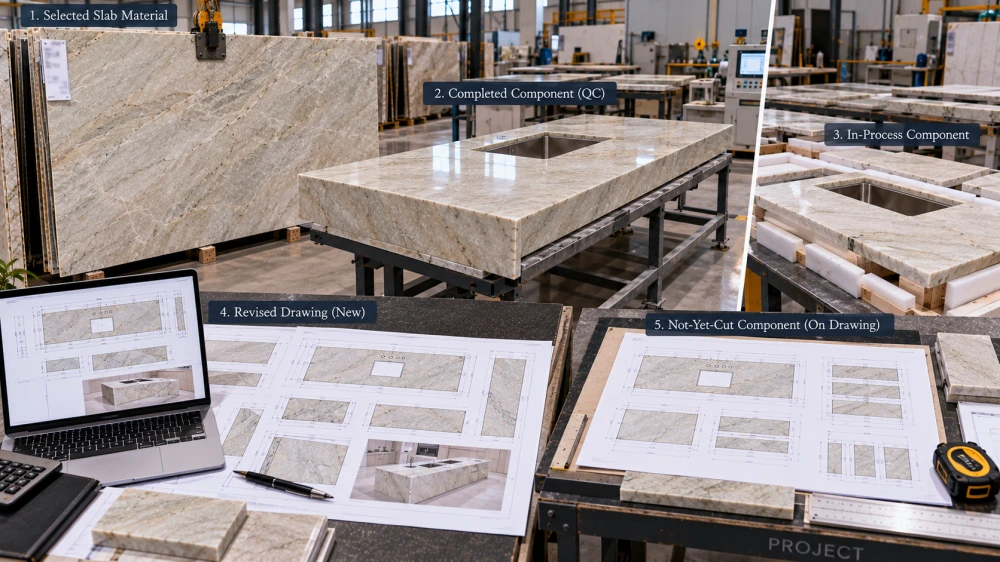
STAGE 1
Slabs Reserved, No Layout Approved
Update the drawing basis and check whether reserved material still fits the revised requirement.
STAGE 2
Layout Approved, Cutting Not Started
Reopen affected layout decisions and issue a revised cutting release.
STAGE 3
Cutting or Fabrication Has Started
Identify completed, in-process, and unaffected pieces before assessing rework or replacement requirements.
STAGE 4
Finished Pieces Have Passed QC
The revision may create replacement pieces rather than a simple drawing correction.
STAGE 5
Packing Has Started
Also review package references, crate allocation, packing list, freight data, and receiving sequence where affected.
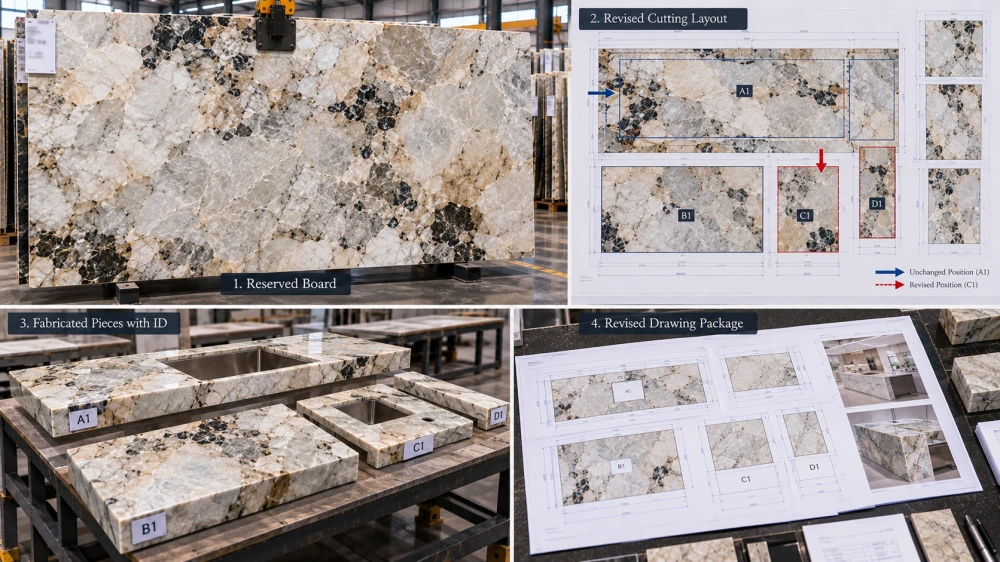
UN ordine di modifica per la quarzite should identify exactly which components are:
unchanged;
changed but not yet fabricated;
already fabricated and still usable;
already fabricated but potentially affected;
newly added; or
cancelled.
This prevents one drawing revision from unnecessarily reopening every component in a large project.
Use an Affected-Piece Register
ID DEL PEZZO
Change Status
Production Status
Next Review
K-01
Dimension revised
Not cut
New layout
K-02
No change
Fabricated
Retain existing record
K-03
New piece
Not started
Material allocation + quote
Recheck Cutouts, Edges, Miters, and Returns
A drawing revision can appear small on paper but create a different fabrication condition.
Esempi includono:
sink moving closer to an edge;
cooktop becoming wider;
backsplash becoming full height;
straight edge becoming a built-up edge;
waterfall being added to an island;
return being added around a column;
seam moving through a different visual area; or
one large component becoming two pieces.
Each change should be checked against the actual stone geometry, rather than assuming the previous fabrication assumptions remain suitable.
Separate the Commercial Change From the Technical Change
A drawing revision may create both.
TECHNICAL / PRODUCTION REVIEWDoes the reserved material still work?
Does the slab layout change?
Are cutouts or seams affected?
Which pieces require new fabrication information?
COMMERCIAL REVIEWDoes material quantity change?
Does fabrication scope change?
Does packing change?
Does the quotation require revision?
The change record should identify these questions first. The supplier can then confirm any project-specific price or lead-time impact rather than the article or buyer assuming one in advance.
What Happens If the Reserved Slabs Are No Longer Enough?
This is one of the most important outcomes a revised layout can reveal.
The project may need to consider:
adding another slab;
changing seam positions;
changing piece allocation;
reducing a secondary visual priority;
using an available reserve slab;
reviewing another slab from the same bundle; or
requesting a new slab selection.
A newly introduced slab should not automatically be treated as visually equivalent simply because it carries the same Quartzite trade name.
Where the project depends on a specific multi-slab composition, review the additional board against the already reserved set before production release.
Approval Reset Map
Do not ask everyone to “reapprove the project.” Ask each reviewer to confirm only the decision affected by the change.
Material Review → Are the reserved slabs still the correct material set?
Layout Review → Does the revised geometry still fit the intended slab allocation?
Visual Review → Did seam, direction, waterfall, or focal-area relationships change?
Fabrication Review → Are the new cutouts, edges, miters, or pieces understood?
Commercial Review → Does the revised scope require a new quotation or logistics basis?
Issue a Controlled Quartzite Change Order Record
The final record does not need to be complicated.
It should identify:
change-order number;
date;
previous drawing revision;
new drawing revision;
reserved slab board numbers;
affected piece IDs;
before-and-after changes;
layout impact;
visual review status;
fabrication status;
commercial status;
open items;
responsible reviewer; and
next release condition.
Do Not Delete the Old Drawing From the Project History
Superseded drawings should no longer control production, but they should remain identifiable in the project record.
The team may later need to understand:
which slabs were originally reserved;
why a slab layout changed;
why an extra piece was fabricated;
why a quotation was revised;
which approval applied before the change; or
which components were already completed.
A controlled history is more useful than simply replacing “Revision 03” with “Revision 04” in the same folder and losing the sequence of decisions.
□ Previous revision marked superseded for production
□ Reserved slab board numbers confirmed
□ Affected pieces identified
□ Revised slab layout checked where required
□ Usable yield rechecked
□ Cutouts, edges, seams and miters updated
□ Visual approval reopened where necessary
□ Commercial impact confirmed or listed as pending
□ Production status of existing pieces recorded
□ New release decision recorded
FAQ
1. Does a new drawing automatically cancel a Quartzite slab reservation?
No. Una prenotazione di lastre e una revisione del disegno sono documenti di progetto distinti. Il disegno rivisto deve essere confrontato con i numeri delle tavole prenotate per verificare se le stesse lastre e la stessa quantità risultano ancora idonee al nuovo ambito di lavoro.
2. When does a Quartzite change order require a new slab layout?
Un nuovo layout dovrebbe essere preso in considerazione quando la revisione modifica le dimensioni finiture, le quantità dei pezzi, le giunture, gli intagli, l’orientamento, le cadute, i ritorni, le facce visibili o qualsiasi altra condizione che influisca sulla posizione dei pezzi sulle lastre riservate.
3. Do previously approved Quartzite slab photos need to be approved again?
Non necessariamente. Se le lastre fisiche rimangono invariate, la scelta del materiale potrebbe comunque restare valida. Tuttavia, qualsiasi approvazione visiva legata a una vecchia posizione di taglio, a una giuntura, a un orientamento, a una relazione a cascata o a una ripartizione dei pezzi dovrebbe essere riesaminata qualora tali condizioni siano cambiate.
4. What if fabrication already started before the revised drawing arrives?
Registrare quali pezzi sono completati, in produzione, non interessati o potenzialmente interessati. In questo modo, il progetto può distinguere un aggiornamento del disegno da eventuali rifiniture, sostituzioni di pezzi o nuove lavorazioni, anziché trattare ogni componente come non avviato.
5. Does a Quartzite change order automatically change the price?
Non automaticamente. Innanzitutto verificare se sono variati la quantità dei materiali, i lavori di fabbricazione, l’imballaggio, il trasporto o altre voci incluse nel preventivo. Qualsiasi adeguamento di prezzo dovrà poi essere confermato sulla base delle effettive esigenze riviste del progetto.
6. What should I send HRST STONE when issuing a drawing revision after slab reservation?
Invia i riferimenti delle lastre riservate, i disegni precedenti e quelli revisionati, un elenco chiaro delle modifiche, gli ID dei pezzi interessati, le dimensioni e le quantità riviste, le modifiche agli intagli e ai bordi, le priorità visive, lo stato attuale della fabbricazione e la destinazione di consegna. Indica eventuali questioni commerciali o di programma che richiedono ancora una conferma.
Final Change-Control RuleOnce Natural Quartzite slabs have been reserved, a new drawing should never enter production as an isolated replacement file. Connect the revision back to the reserved board numbers, affected pieces, current slab layout, fabrication status, previous approvals, quotation scope, and next release decision. The goal is not to restart the project after every change; it is to reopen only the decisions that the change actually affects.
For project-based Natural Quartzite orders, HRST STONE can coordinate reserved slab references, revised shop drawings, cutting-layout review, piece identification, fabrication QC, dry-lay records, packing information, and revised quotation scope according to the confirmed project requirements. Send Josh the previous and current drawings together with the affected piece list and reserved slab references when a design change occurs.
Hi, I am the author of this article. I have been working in the field of Natural Stone for more than 15 years. If you need customized Natural Stone services, please feel free to contact me.
Cina Marmo, granito, quarzite, produttore e fornitore di agata - PIETRA HRST
Benvenuti su HRST STONE!
Salve, vorrei saperne di più sui vostri prodotti. Potreste fornirmi informazioni su prezzi, quantità minima d’ordine, opzioni di personalizzazione e campioni?