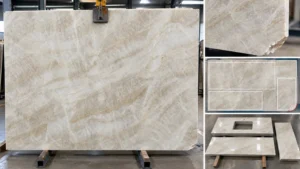
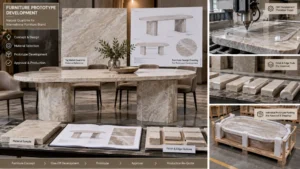
Riepilogo rapido: I pannelli di marmo curvi segmentati sono la soluzione più utilizzata per realizzare superfici in pietra curve nei progetti architettonici. Suddividendo una curva in più segmenti piani, questo metodo bilancia costi, efficienza di fabbricazione e praticità di installazione, mantenendo al contempo una forte continuità visiva.
Introduzione: Perché i pannelli di marmo curvi segmentati dominano i progetti reali
Nella costruzione reale, i pannelli di marmo curvi segmentati sono molto più comuni rispetto agli elementi in pietra interamente lavorati a CNC. Sebbene i pannelli di marmo curvi a CNC offrano una geometria senza giunti, sono spesso limitati da costi, sprechi di materiale e tempi di lavorazione. Al contrario, i pannelli di marmo curvi segmentati rappresentano una soluzione pratica e scalabile, applicabile a un’ampia gamma di progetti architettonici.
I pannelli di marmo curvi segmentati sono ampiamente utilizzati in hotel, centri commerciali, edifici per uffici e grandi complessi residenziali. Consentono ai progettisti di ottenere superfici curve senza richiedere un’eccessiva rimozione di materiale. Questo li rende particolarmente adatti a applicazioni a grande raggio, dove la lavorazione a CNC sarebbe inefficiente.
Se non si ha familiarità con l’intero sistema di lavorazione della pietra curva, è possibile consultare prima:
guida alla fabbricazione di pannelli curvi in marmo. Questo articolo spiega come i pannelli di marmo curvi segmentati si inseriscono nel processo completo di fabbricazione.
Per comprendere come vengono preparate le lastre piatte prima della segmentazione, è possibile fare riferimento anche a:
lastre piatte di marmo a pannelli curvi in pietra.
Per i progetti che richiedono un confronto ad alta precisione, qui vengono spiegati i metodi CNC:
pannelli curvi in marmo CNC.
Che cosa sono i pannelli di marmo curvi segmentati
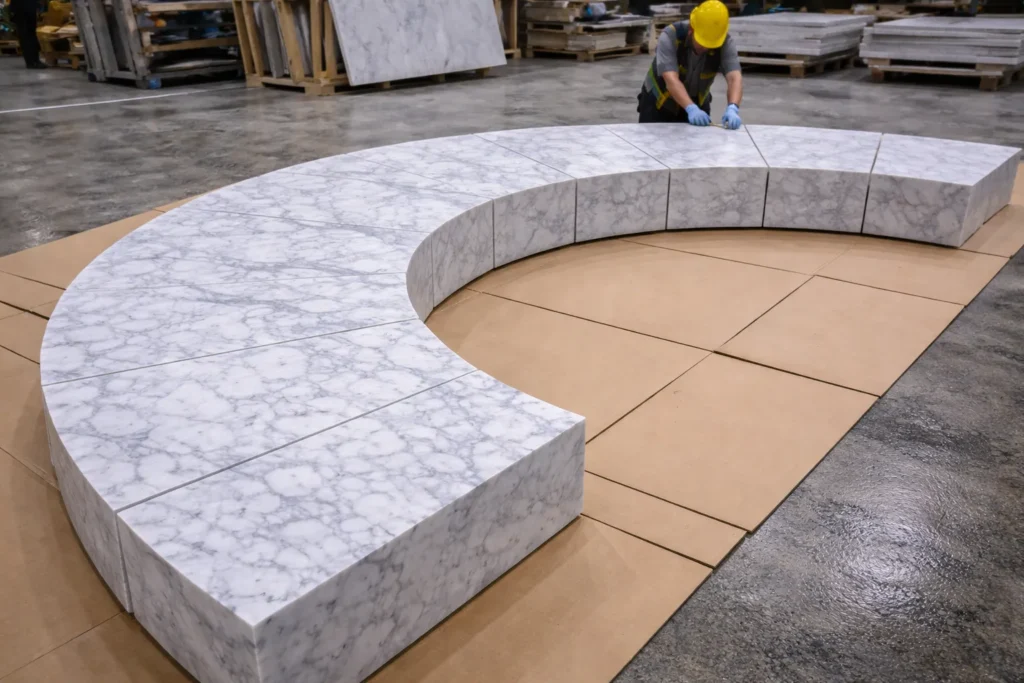
I pannelli di marmo curvi segmentati si ottengono suddividendo una superficie curva in più pezzi di pietra piatti. Ogni segmento viene tagliato con una leggera regolazione angolare in modo che, una volta installati tutti insieme, formino una curva continua. Questo metodo non richiede piegature né una pesante rimozione di materiale, risultando quindi più efficiente rispetto ad altre tecniche di fabbricazione.
Il successo dei pannelli di marmo curvi segmentati dipende dalla precisione con cui ogni segmento viene progettato e fabbricato. Anche piccoli errori di angolazione o dimensione possono accumularsi su più pannelli, causando spazi visibili o una curvatura irregolare. Pertanto, una pianificazione e una fabbricazione precise sono essenziali.
Perché i pannelli di marmo curvi segmentati sono convenienti
Uno dei principali vantaggi dei pannelli di marmo curvi segmentati è l’efficienza dei costi. A differenza della lavorazione a CNC, che rimuove un grande volume di materiale, la segmentazione utilizza lo spessore standard delle lastre con un minimo spreco. Ciò riduce sia il costo del materiale sia i tempi di lavorazione.
Inoltre, i pannelli di marmo curvi segmentati sono più facili da trasportare perché ogni pezzo è più piccolo e meno soggetto a rotture. Questo riduce i rischi logistici e consente soluzioni di imballaggio più flessibili. Per progetti su larga scala, questi fattori possono influire in modo significativo sul costo complessivo del progetto.
Controllo delle giunzioni: il fattore più critico
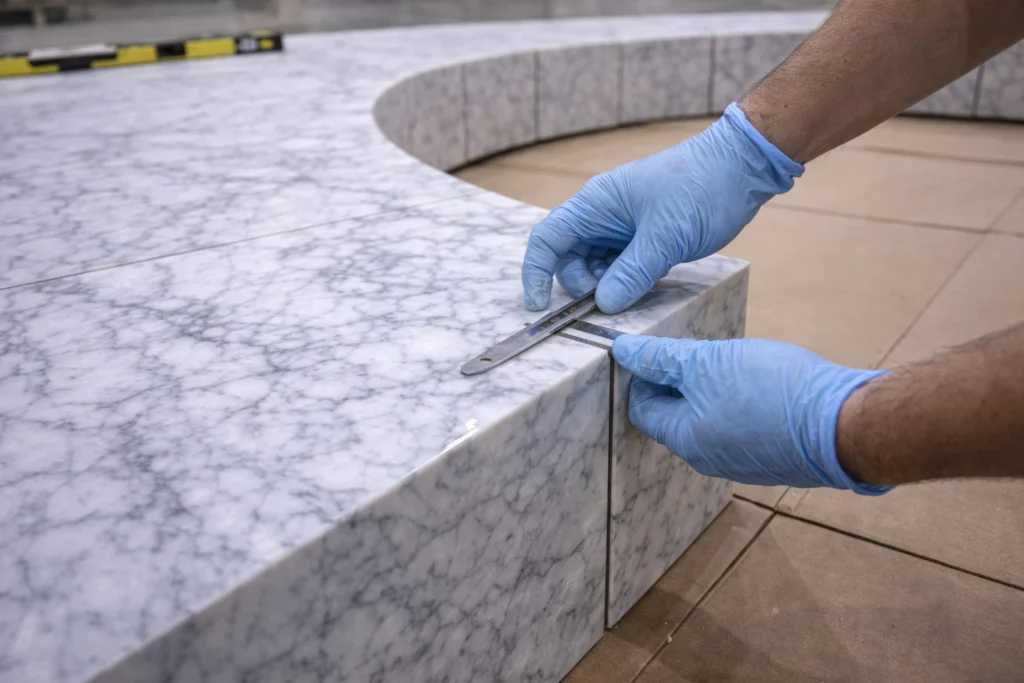
L’aspetto più importante dei pannelli di marmo curvi segmentati è il controllo delle giunzioni. Le giunzioni devono essere progettate con cura per garantire che siano visivamente minimi, pur mantenendo la stabilità strutturale. La larghezza e l’allineamento delle giunzioni determinano se la superficie finale appare liscia o frammentata.
Il controllo delle giunzioni inizia in fase di progettazione. Il numero di segmenti deve essere calcolato in base al raggio e alla distanza di visione. Segmenti più piccoli creano un effetto visivo più uniforme ma aumentano la complessità della fabbricazione. Segmenti più grandi riducono i costi ma possono far apparire la curvatura sfaccettata.
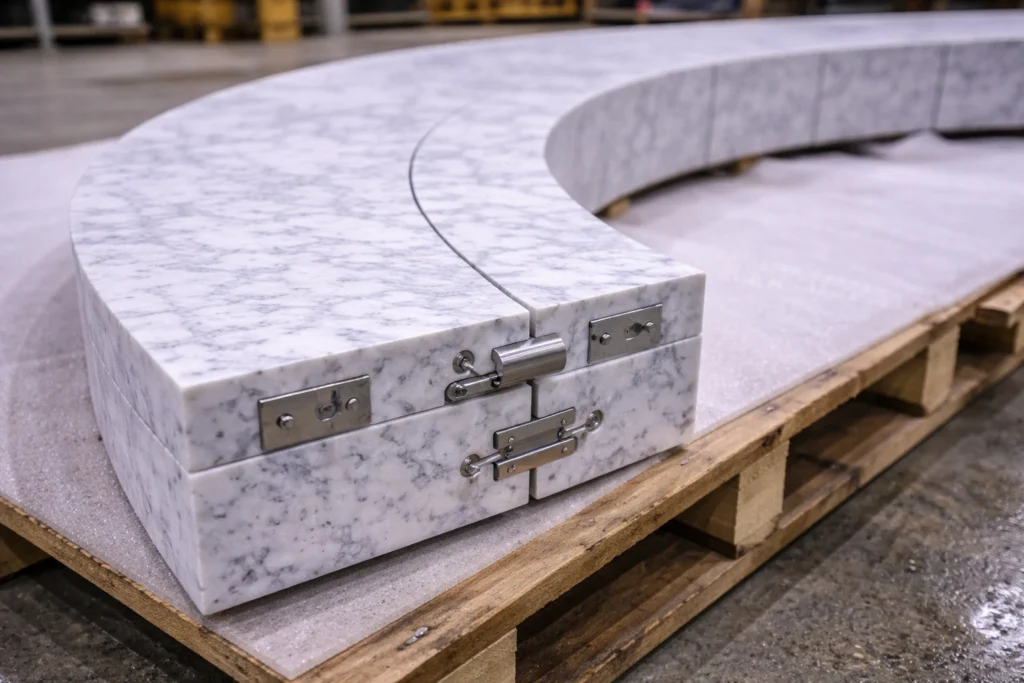
Durante la fabbricazione, ogni segmento deve essere tagliato con angoli precisi per corrispondere al raggio complessivo. Anche lievi deviazioni possono provocare errori cumulativi che influenzano l’installazione finale. Pertanto, le fabbriche eseguono spesso test di posizionamento a secco prima dell’imballaggio per verificare l’allineamento.
| Larghezza delle giunzioni |
Effetto visivo |
Impatto sui costi |
Uso consigliato |
| Piccolo (≤100 mm) |
Curvatura molto liscia |
Costo elevato |
Interni di lusso, distanza di visione ravvicinata |
| Medio (100–300 mm) |
Aspetto equilibrato |
Costo moderato |
Hotel, interni commerciali |
| Grande (≥300 mm) |
Faccettatura visibile |
Basso costo |
Facciate esterne, visione a lunga distanza |
Processo di fabbricazione dei pannelli di marmo curvi segmentati
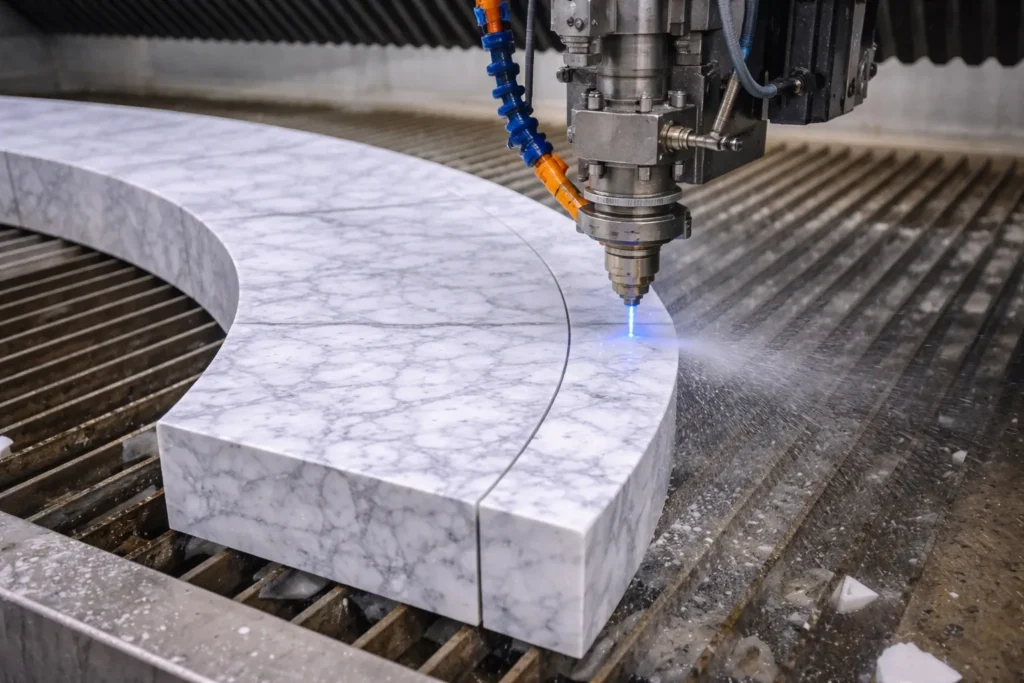
La fabbricazione dei pannelli di marmo curvi segmentati inizia con la modellazione digitale. La superficie curva viene suddivisa in segmenti tramite software di progettazione. A ciascun segmento viene assegnato un angolo e una dimensione specifici in base alla sua posizione all’interno della curva.
Una volta finalizzata la progettazione, le lastre vengono tagliate in singoli pezzi. Ogni pezzo viene lavorato secondo l’angolo richiesto. La finitura dei bordi è fondamentale perché le linee di giunzione devono essere uniformi su tutti i segmenti. Dopo il taglio, i pannelli vengono etichettati e organizzati in base alla sequenza di installazione.
Prima della spedizione, le fabbriche eseguono di norma un montaggio a secco per assicurarsi che tutti i segmenti siano correttamente allineati. Questo passaggio è essenziale per prevenire problemi di installazione in cantiere.
Strategia di installazione dei pannelli di marmo curvi segmentati
L’installazione dei pannelli di marmo curvi segmentati richiede una sequenza accurata. I pannelli devono essere installati nell’ordine corretto per mantenere la curvatura prevista. Una sequenza errata può portare a disallineamenti e a evidenti incongruenze.
Anche i sistemi di ancoraggio devono essere progettati per sostenere saldamente ogni segmento. Poiché i pannelli sono disposti lungo una curva, la distribuzione del carico differisce rispetto alle installazioni su superfici piane. Un ancoraggio adeguato garantisce che i pannelli rimangano stabili nel tempo.
Durante l’installazione, le giunzioni devono essere regolate con attenzione per mantenere una distanza costante. Questo richiede manodopera qualificata e misurazioni precise. Anche un lieve disallineamento può compromettere il flusso visivo della curva.
Prestazioni visive dei pannelli di marmo curvi segmentati
Quando eseguiti correttamente, i pannelli di marmo curvi segmentati possono raggiungere un alto livello di continuità visiva. Le giunzioni diventano meno evidenti con l’aumentare della distanza di visione, creando l’impressione di una superficie curva liscia.
Le condizioni di illuminazione influenzano anche le prestazioni visive. In ambienti ben illuminati, le linee di giunzione possono diventare più visibili, richiedendo un controllo più rigoroso della larghezza delle giunzioni. In condizioni di illuminazione più soffusa, l’effetto della segmentazione è meno pronunciato.
Material selection plays a role as well. Uniform marble tends to hide joints more effectively than highly veined materials. Therefore, material choice should be aligned with design expectations.
Common Problems in Segmented Curved Marble Panels
One common issue is joint misalignment, which occurs when segments are not fabricated or installed correctly. This can result in uneven spacing or visible gaps between panels. Another issue is inconsistent curvature, which may occur if segment angles are not calculated accurately.
Transport damage is another risk. Because segmented curved marble panels consist of multiple pieces, improper packaging can lead to edge damage. This can affect joint quality during installation.
These problems can be minimized through proper planning, quality control, and communication between factory and installation teams.
| Problem |
Cause |
Solution |
| Joint misalignment |
Incorrect angle cutting |
Dry layout before shipment |
| Visible gaps |
Poor installation control |
Adjust joint spacing on site |
| Curvature inconsistency |
Wrong segment calculation |
Recalculate radius segmentation |
| Edge damage |
Improper packaging |
Use reinforced packing |
When to Choose Segmented Curved Marble Panels
Segmented curved marble panels are ideal for projects with large-radius curves and budget constraints. They are also suitable for projects requiring flexibility in installation and replacement. Compared to CNC methods, segmentation offers a more practical solution for large-scale applications.
However, for small-radius or high-precision projects, CNC curved marble panels may still be the better choice. The decision should be based on project requirements, budget, and design expectations.
| Project Condition |
Segmented Panels Suitability |
| Large radius wall |
Highly suitable |
| Small radius curvature |
Not recommended |
| Budget-controlled projects |
Best solution |
| High-end seamless design |
Limited suitability |
Pre-Production Planning and Technical Review
Before producing segmented curved marble panels, it is important to review design drawings, confirm segment dimensions, and evaluate material selection. Early technical review helps prevent errors that could affect fabrication and installation.
If your project involves segmented curved marble panels, you can directly
Contattaci for technical support and fabrication evaluation.
FAQ
1. What are segmented curved marble panels?
Sono superfici curve formate dall’assemblaggio di numerosi segmenti piani di marmo.
2. Why are segmented curved marble panels widely used?
Perché bilanciano costo, efficienza di fabbricazione e prestazioni visive.
3. Are joints visible?
Possono essere ridotti al minimo con una progettazione e un’installazione adeguati.
4. Are they cheaper than CNC panels?
Sì, perché riducono gli scarti di materiale e i tempi di lavorazione.
5. Do they require special installation?
Sì, la corretta sequenza e l’allineamento delle articolazioni sono fondamentali.
Nota finale / Conseguenze pratiche
Punto chiave pratico: Segmented curved marble panels offer the best balance between cost and performance for most architectural projects, but their success depends on precise joint control and proper installation strategy.
Riferimenti