Quarzit-Plattenangebote: Bruttofläche, Nettofläche und Mindestbestellmenge
Post navigation
Kurze Zusammenfassung
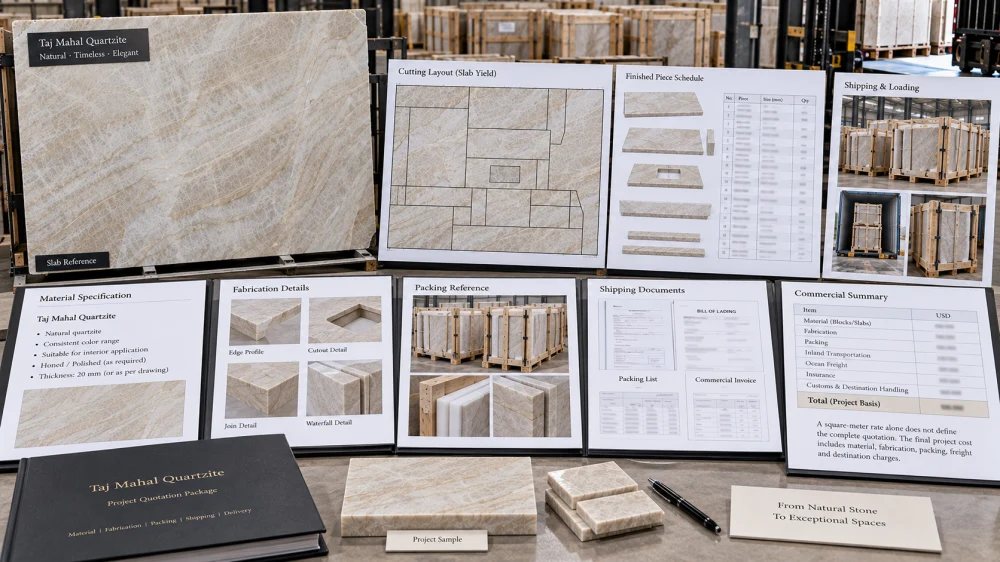
Ein Angebot für eine Quarzitplatte sollte angeben, welche Fläche gemessen wird und welche Fläche tatsächlich berechnet wird. Brutto-Plattenfläche, nutzbare Schnittfläche, fertige Nettofläche und abrechenbare Fläche sind unterschiedliche Konzepte. Auch bei einem Projekt, das weniger Material erfordert, kann ein Mindestauftrag gelten. Bevor Sie zwei Angebote miteinander vergleichen, sollten Sie Material, Plattenmenge, Maßbasis, Fertigung, Verpackung, Fracht, Währung sowie Lieferbedingungen – nicht nur den Preis pro Quadratmeter – aufeinander abstimmen.
Ein Projekt benötigt 12 m² fertigen Naturquarzit.
Lieferant A bietet 15 m² an.
Lieferant B bietet 12 m² an.
Lieferant C zeigt 12 m² fertiger Stücke, wendet jedoch einen höheren Mindestauftrag an.
Welches Angebot für eine Quarzitplatte ist tatsächlich günstiger?
Allein anhand dieser Flächenangaben lässt sich das nicht beantworten.
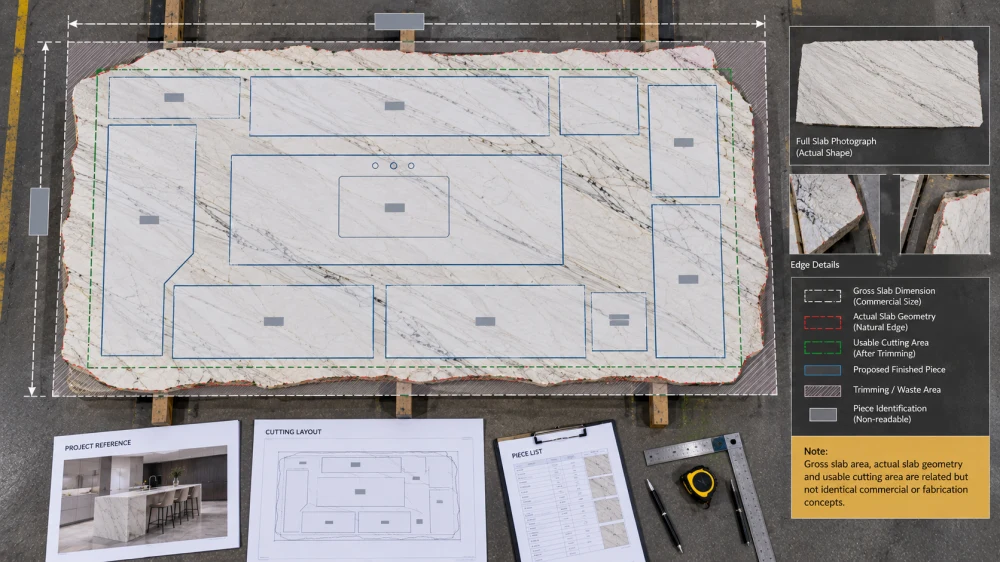
Vier Flächenbegriffe, die Käufer unbedingt voneinander trennen sollten
Der größte Fehler bei Angeboten besteht darin, jede Quadratmeterzahl so zu behandeln, als würde sie dasselbe ausdrücken.
Flächenbegriff
Praktische Bedeutung
Käuferfrage
Gross Slab Area
Gesamtfläche, die durch die Plattendimensionen oder die vom Lieferanten angegebene Flächenbasis repräsentiert wird
Kaufen wir die gesamte Platte?
Nutzbarer Plattenbereich
Fläche, die nach Berücksichtigung projektspezifischer Einschränkungen praktisch zum genehmigten Zuschnittplan beitragen kann
Wie viel von der Platte ist für meine Teile nutzbar?
Fertige Nettofläche
Berechnete Fläche der erforderlichen fertigen Komponenten gemäß der angegebenen Maßbasis
Wie viel fertiger Stein befindet sich in meiner Zeichnung?
Abrechenbare Fläche
Fläche oder Menge, die der Lieferant tatsächlich für die kommerzielle Abrechnung heranzieht
Welche Menge wird mit dem angegebenen Satz multipliziert?
Diese Mengen können manchmal gleich sein.
Oft sind sie es jedoch nicht.
Was ist die Bruttofläche in einem Quarzitplattenangebot?
Bei einer Plattentransaktion bezeichnet die Bruttofläche üblicherweise die Fläche, die durch die Plattendimensionen oder die vom Lieferanten angegebene Maßbasis repräsentiert wird.
Die Nettofläche ist nur dann sinnvoll, wenn das Angebot klar definiert, was “netto” bedeutet.
Ein Angebot kann die Nettofläche verwenden, um die Summe fertiger rechteckiger Teile zu beschreiben.
Ein anderes Angebot könnte die Fläche fertiger Komponenten anders berechnen.
Ein dritter Lieferant könnte den Begriff ganz vermeiden und stattdessen folgendes anbieten:
complete slabs;
finished pieces;
linear-meter processing;
per-piece fabrication;
material consumption; or
a complete project package.
Quotation Rule
Never compare two “net area” figures until both suppliers have explained how the area is calculated and which commercial items are included in that figure.
Finished Area Is Not the Same as Raw Material Consumption
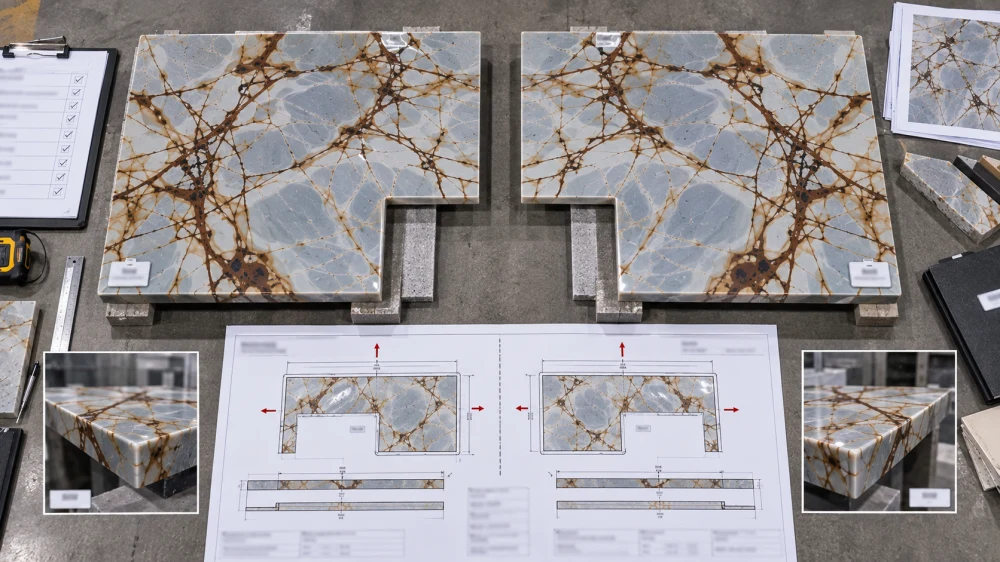
Suppose the finished drawings contain a certain number of square meters of countertops, wall panels, vanity tops, or other components.
The factory may need more raw slab area than the finished net area because the pieces must actually fit inside real slabs.
“How much waste does the factory want to charge me for?”
It is a consequence of fitting the required finished geometry into actual natural-stone slabs under the approved project constraints.
What Is a Minimum Charge?
A minimum charge is a commercial rule under which the supplier charges at least a stated minimum amount, quantity, slab count, processing quantity, or other agreed commercial basis even when the immediate project requirement is smaller.
There is no single universal Natural Quartzite minimum charge.
Depending on the supplier and scope, a minimum may relate to:
a complete slab;
a minimum number of slabs;
a minimum material quantity;
a minimum fabrication amount;
a minimum processing charge;
a minimum packing requirement;
a special-order material commitment; or
another clearly stated commercial basis.
The quotation should state which one applies.
Minimum Charge Does Not Mean Minimum Order Quantity
These terms can overlap commercially, but they are not automatically the same.
Term
Nicht automatisch annehmen
Mindestbestellmenge
What is the minimum quantity the supplier will accept as an order?
Mindestgebühr
What is the minimum commercial amount or quantity basis that will be charged?
A supplier could theoretically accept a small quantity while still applying a minimum processing or commercial charge.
Always confirm the actual quotation rather than assuming the two terms are interchangeable.
Why Might a Small Project Be Charged for a Full Slab?
This is one of the most important questions for buyers of premium Natural Quartzite.
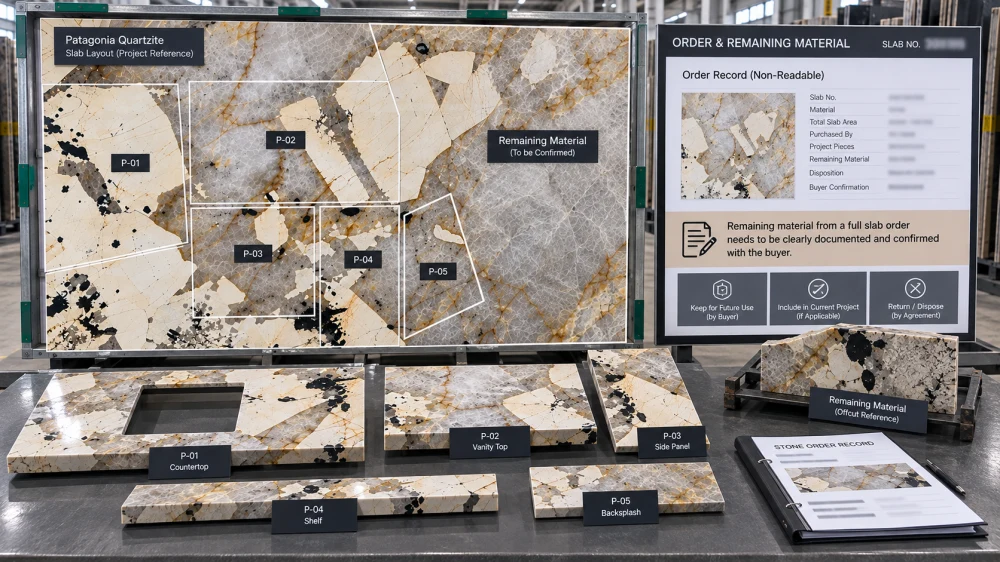
Imagine a project requires only part of one slab.
The supplier may still quote the complete slab if the commercial arrangement requires the buyer to purchase that slab rather than only the area physically converted into finished pieces.
That does not automatically mean the unused material is “waste.”
Ask what happens to the balance.
Possible commercial arrangements can include:
the buyer purchases the complete slab and the balance remains part of the order;
the balance is fabricated into spare pieces if agreed and practical;
the balance is packed with the order if agreed;
the supplier retains the balance under an agreed commercial arrangement; or
another written disposition is used.
The quotation should make this clear before payment.
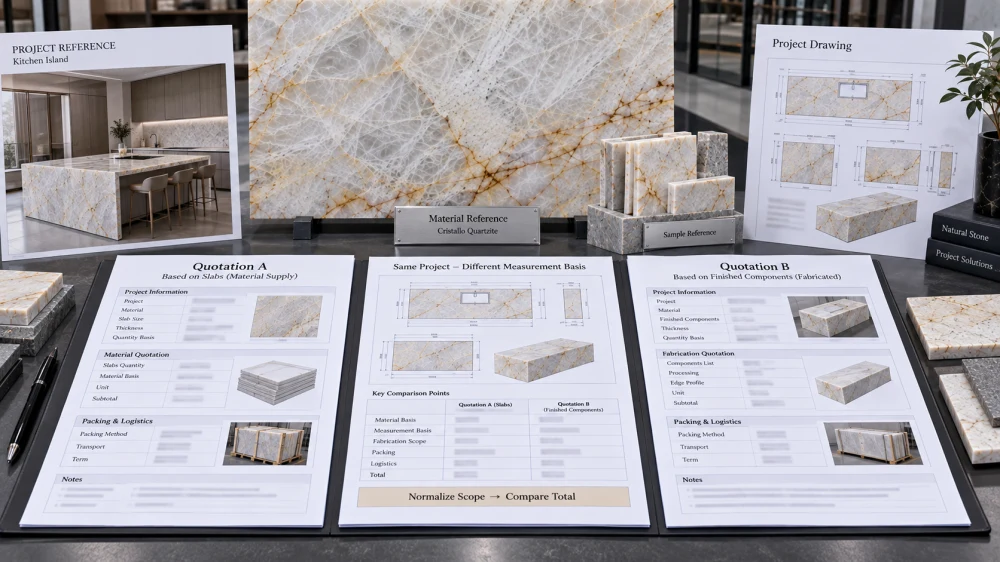
A Lower Price per Square Meter Can Produce a Higher Total
Consider a hypothetical comparison.
One supplier offers a lower material rate but charges complete slabs and excludes fabrication.
Another supplier shows a higher finished-piece rate but includes some fabrication and uses a different chargeable quantity.
The first $/m² can be lower while the completed commercial scope is higher.
This is why procurement teams should compare:
Comparable Total ÷ Comparable Scope
rather than ranking quotations by the first unit rate visible on the page.
Packing and Freight Can Change the Area Economics
Area pricing does not end at the factory invoice.
Raw slabs and finished pieces can require different packing and shipping arrangements.
For a project quotation, confirm whether the price includes:
slab packing or frame requirements;
reinforced export crates for finished pieces;
internal protection;
Schutz von Kanten und Ecken;
loading;
export documentation;
ocean freight;
destination charges;
duties or taxes where applicable; and
final delivery where quoted.
A quote that looks expensive at the material line can be more complete commercially, while a low material rate may leave several later costs outside the proposal.
Ask for the Quotation Formula in Plain Language
BUYER QUOTATION CHECK
01 — What quantity is my project drawing asking for?
02 — How much raw Quartzite is required?
03 — Am I purchasing complete slabs or only finished pieces?
04 — What does “gross area” mean in this quotation?
05 — What does “net area” mean in this quotation?
06 — What quantity is actually chargeable?
07 — Is there a minimum charge?
08 — What happens to unused slab material?
09 — Which fabrication items are included?
10 — Is packing included?
11 — What Incoterm / delivery scope applies?
12 — What is the final comparable total?
What Should a Clear Quartzite Slab Quote Show?
For an international project, a useful quotation can identify:
Materialbezeichnung;
actual slab reference or selection basis where applicable;
The goal is not to make every supplier use the same quotation format.
The goal is to make the commercial basis understandable enough to compare.
FAQ
1. What is gross area in a Quartzite slab quote?
Gross area generally refers to the overall slab-area basis stated in the quotation, often related to the slab dimensions. It should not automatically be interpreted as usable cutting area or finished project area. Confirm the supplier’s exact measurement method in the quotation.
2. What is net area in a Quartzite quote?
Die Nettfläche kann sich auf die berechnete Fläche fertiger Teile oder auf eine andere, vom Lieferanten festgelegte Maßbasis beziehen. Da der Begriff an sich nicht hinreichend präzise ist, sollten Käufer genau erfragen, wie die Nettfläche berechnet wird und ob Verschnitt, Fertigungstoleranzen, Ausschnitte, Kanten oder andere Bestandteile einbezogen oder ausgeschlossen werden.
3. Why can finished Quartzite area be smaller than the chargeable area?
Fertige Teile müssen aus den jeweiligen Rohplatten geschnitten werden. Die Plattendimensionen, die Geometrie der Teile, die Schnittzugaben, die Ausrichtung, die optische Auswahl, die Fugen, Ausschnitte, Abgleichanforderungen sowie weitere Layout‑Beschränkungen können dazu führen, dass der Rohmaterialverbrauch größer ist als die endgültige fertige Fläche. Zudem kann eine separate Mindestabrechnungsmenge die handelsübliche Menge beeinflussen.
4. What does minimum charge mean on a Quartzite quotation?
Das bedeutet, dass der Lieferant einen festgelegten Mindestbetrag, eine Mindestmenge, eine Mindeststückzahl, eine Mindestverarbeitungsmenge oder eine andere festgelegte Gebühr in Rechnung stellt, selbst wenn der unmittelbare Bedarf geringer ist. Für alle Anbieter von natürlichem Quarzit oder für alle Projekte gibt es keinen einheitlichen Mindestbetrag; daher sollte die entsprechende Grundlage schriftlich festgehalten werden.
5. If I pay for a full Quartzite slab, do I own the remaining offcut?
Gehen Sie weder in die eine noch in die andere Richtung davon aus. Klären Sie die kommerzielle Vereinbarung vor der Bestellung ab. Das Angebot oder die Auftragsunterlage sollte klar festlegen, wie mit nicht verbrauchtem Material umzugehen ist, einschließlich der Frage, ob es versendet, zu Ersatzteilen weiterverarbeitet, gelagert, zurückgehalten oder anderweitig behandelt wird.
6. Is minimum charge the same as MOQ?
Nicht unbedingt. MOQ gibt die Mindestmenge an, die ein Lieferant als Auftrag akzeptiert, während eine Mindestgebühr den minimalen geschäftlichen Betrag oder die minimale Mengenbasis angibt, die in Rechnung gestellt wird. Das tatsächliche Angebot sollte beide Aspekte klar definieren, sofern sie Anwendung finden.
7. How should I compare two Quartzite slab quotes?
Standardisieren Sie das Material, die Dicke, die Oberflächenbeschaffenheit, die Anzahl der Platten, die fertige Fläche, die abrechnungsfähige Menge, den Mindestauftrag, den Fertigungsumfang, die Verpackung, den Frachtversand, die Währung, die Gültigkeit des Angebots sowie die Lieferbedingungen. Vergleichen Sie dabei den vollständig ausgearbeiteten Leistungsumfang und nicht nur den bloßen Preis pro Quadratmeter.
Regel für das endgültige AngebotDo not compare Quartzite quotations until every area figure has a commercial meaning. Keep the chain visible: Finished Requirement → Actual Slab Consumption → Gross / Net Measurement Basis → Chargeable Quantity → Minimum Charge → Fabrication → Packing → Freight → Comparable Total.
For project-based Natural Quartzite quotations, HRST STONE can review current drawings, finished dimensions, actual slab requirements, cutting layouts, fabrication scope, packing requirements, and shipping destination before preparing the commercial scope. Send Josh the material name, dimensions, quantities, finish, drawings, edge and cutout requirements, packing requirements, and delivery destination so the quotation can clearly separate material, fabrication, packing, and logistics.
Hi, I am the author of this article. I have been working in the field of Natural Stone for more than 15 years. If you need customized Natural Stone services, please feel free to contact me.