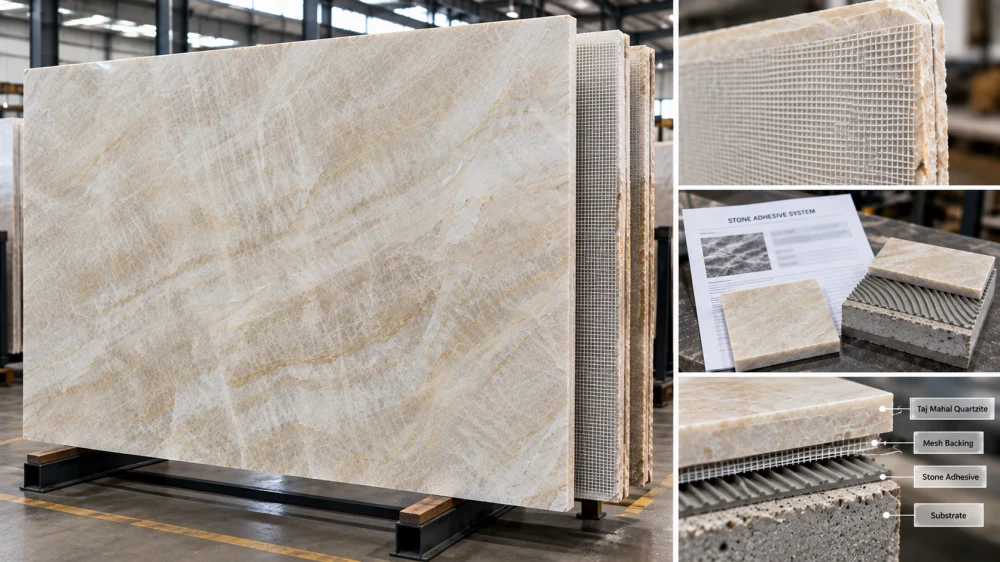
Quarzitplatten mit Netzrückseite sollten vor der Verlegung als vollständige Haftfläche geprüft werden. Gehen Sie nicht davon aus, dass der Klebstoff direkt an natürlichem Quarzit haftet, dass alle Rückensysteme identisch sind oder dass das Netz automatisch entfernt oder belassen wird. Ermitteln Sie den tatsächlichen Zustand der Plattenrückseite, die vorhandene Unterlage oder Harzschicht, das vorgesehene Klebstoffsystem, den Untergrund, die Anforderungen an die Oberflächenvorbereitung, die Einbausituation sowie die zuständigen Systemhinweise. Wenn die Kompatibilität unklar ist oder die Folgen eines Fehlers erheblich sein könnten, führen Sie vor der Freigabe des Projekts entsprechend kontrollierte Proben oder Mock-ups durch.
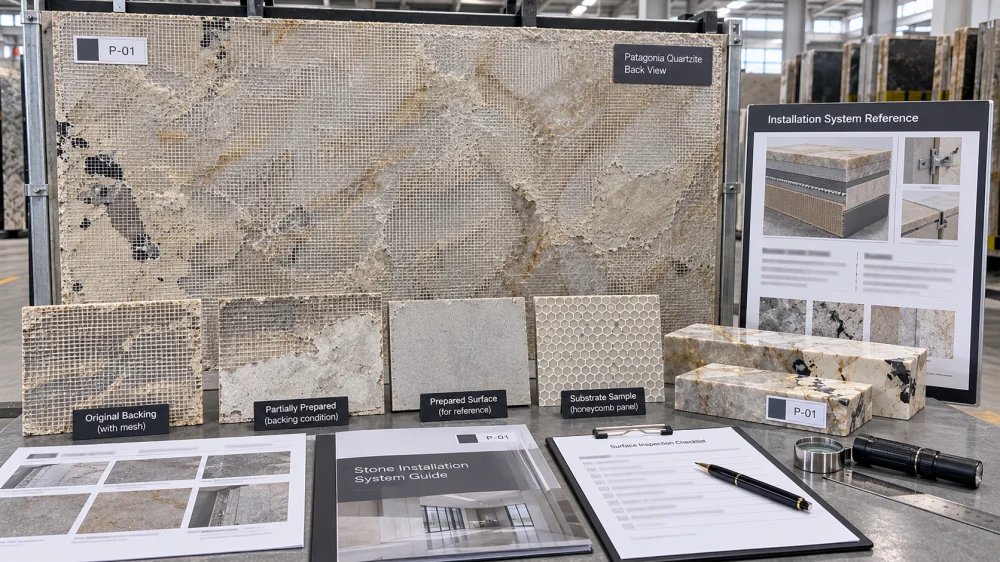
Ein Verarbeiter erhält eine Platte aus natürlichem Quarzit, bei der auf der Rückseite ein Netz oder eine andere Verstärkung sichtbar ist.
Die Vorderseite sieht wie der im Projekt spezifizierte Stein aus. Doch die tatsächlich zu verklebende Oberfläche kann völlig anders beschaffen sein.
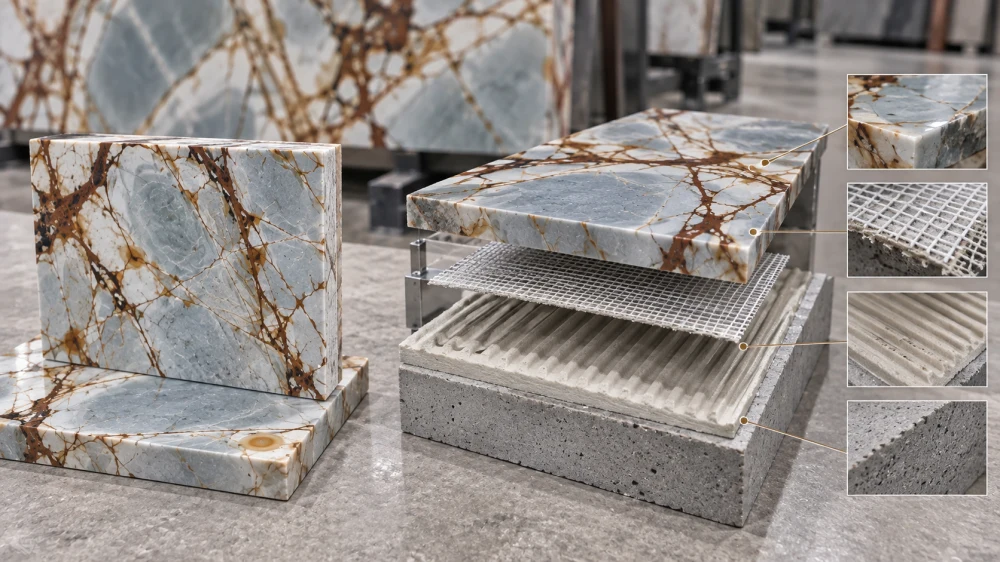
Der Klebstoff kann in Kontakt kommen mit:
Natürlichem Quarzit → Harz → Netz → einer weiteren Rückenschicht
anstatt mit blankem Stein.
Das ändert die Fragestellung.
Statt zu fragen:
“Welcher Klebstoff eignet sich für Quarzit?”
sollte das Verlege-Team fragen:
“An welche Oberfläche kleben wir tatsächlich und unterstützt das vorgesehene Verlegesystem diesen Zustand?”
Platten aus Naturstein können während der Bearbeitung zur Handhabung, Stabilisierung oder aus anderen produktionsbedingten Gründen mit einer Rücklage oder Verstärkung versehen werden.
Die genaue Ausführung kann variieren.
Ein Käufer oder Verarbeiter kann auf folgende Situationen stoßen:
Das Vorhandensein eines Netzes signalisiert dem Verarbeiter daher, dass eine Rücklage existiert. Es erklärt jedoch nicht von selbst dessen chemische Zusammensetzung, Abdeckung, Haftfestigkeit, die vorgesehene Verlegeart oder die Kompatibilität mit einem bestimmten Klebstoff.
Jede Schnittstelle in dieser Kette ist von Bedeutung.
Wenn der Klebstoff nicht auf frisch vorbereiteten Stein, sondern auf die bestehende Rücklage trifft, wird die Kompatibilität mit diesem Rückenzustand relevant.
Wenn das Verlegeverfahren einen weiteren Weg der Oberflächenvorbereitung erfordert, muss dieser vor Beginn der Installation festgelegt werden.
Der bloße Steinnamen reicht nicht aus, um diese Fragen zu beantworten.
Beginnen Sie nicht mit einer allgemeinen Aussage wie “Quarzit mit Netzrückseite”.”
Starten Sie mit dem tatsächlich gelieferten Material.
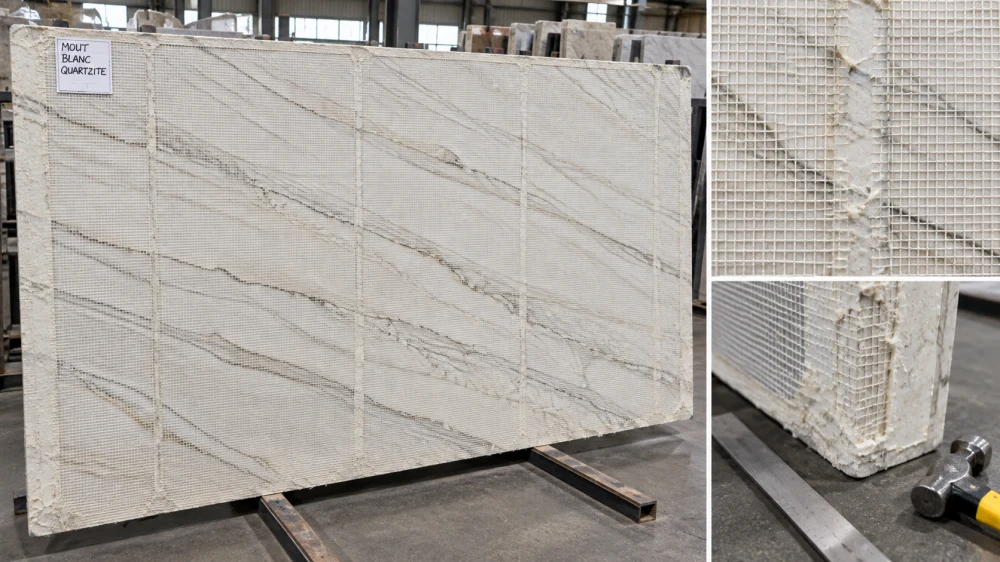
Dokumentieren Sie:
So entsteht eine projektspezifische Zustandsaufnahme, statt anzunehmen, dass jede unter demselben Namen „natürlicher Quarzit“ verkaufte Platte dieselbe Rückseitenbehandlung aufweist.
Dies ist die zentrale Frage des Verlegers.
The approved preparation exposes a stone surface for bonding.
The proposed adhesive contacts an existing factory-applied backing condition.
Preparation may expose more than one material or condition across the bond area.
These should not automatically be treated as equivalent substrates.
Our article on Quartzite resin treatments and adhesive selection makes the same broader point: adhesive decisions should start with the actual surface being bonded, existing treatment, bond purpose, and current product guidance—not the commercial stone name alone.
A common question is:
“Should we grind off the mesh before installation?”
There should not be a universal answer based only on the words “mesh-backed Quartzite.”
Removal could change:
Likewise, leaving the backing untouched should not automatically be assumed acceptable for every adhesive system.
Do not remove or retain a Quartzite backing system by habit. First identify the supplied condition and confirm the required preparation through the responsible installation system and current technical guidance.
Knowing the back of the Quartzite is only half of the interface.
The other half is the receiving substrate.
The installation team should identify the actual substrate defined by the project rather than simply writing “wall” or “floor.”
Relevant questions include:
For facade applications in particular, bonding should not be isolated from the complete approved fixing concept. Our Natural Quartzite facade fixing guide explains why stone panels, fixing concepts, project drawings, interfaces, and responsible design professionals need to be coordinated as one system rather than treated as a generic slab-installation detail.
Once the actual two sides of the bond have been identified, review the current technical information for the proposed adhesive system.
The responsible installer should check project-relevant requirements such as:
A product description such as “for natural stone” should not automatically be interpreted as approval for every mesh, resin, backing, substrate, panel size, environment, or installation configuration.
| Known Condition | Gehen Sie nicht davon aus | Confirm Instead |
| Slab has mesh backing | All mesh-backed slabs use the same system | Actual backing condition and available supplier information |
| Adhesive says “for stone” | It is compatible with every backing | Current manufacturer guidance for the actual interface |
| Mesh is visible | It must automatically be removed | Approved surface-preparation route |
| Small sample bonded successfully | Every slab and site condition is therefore approved | What the trial represented and what decision it supports |
Mesh or resin may have been applied during slab processing or reinforcement.
The installation adhesive has another function.
These should not be merged into one generic idea of “glue.”
Zum Beispiel:
Each can involve different materials, surfaces, purposes, and responsible parties.
A full slab may arrive with one backing condition, but the finished component may not remain identical after fabrication.
Cutting, edge fabrication, openings, local reinforcement, handling provisions, or other approved fabrication operations can create different conditions across the back of the finished piece.
Before installation, review the actual fabricated component—not only a photograph of the original slab.
This becomes particularly important around:
A small sample is useful for answering limited questions.
It cannot automatically reproduce every condition of a large fabricated panel.
Differences can include:
This is especially important for feature walls and other large-format applications. Large Natural Quartzite panels should be coordinated with the approved project installation concept rather than extrapolating an entire assembly from a small sample alone.
A controlled trial or mock-up may be useful when:
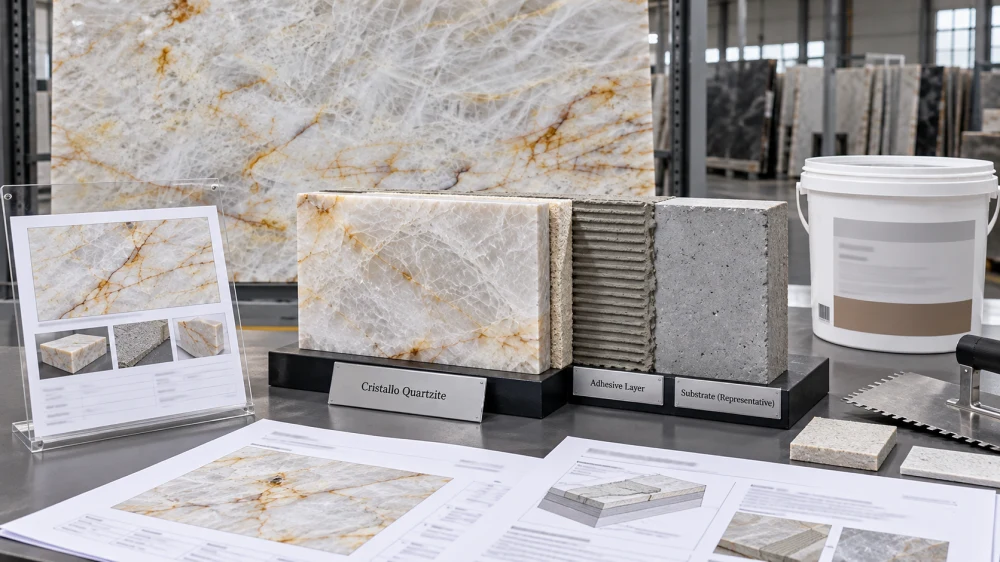
Actual Quartzite → Actual Backing Condition → Intended Surface Preparation → Proposed Adhesive → Representative Substrate → Required Cure → Review → Recorded Decision
The closer the mock-up is to the actual interface, the more relevant the observation can be.
But a successful trial should still be documented according to what it actually represents rather than converted into a universal guarantee.
“Test passed” is not enough information for a project record.
Dokumentieren Sie:
This makes the trial traceable to the actual installation decision.
A bonding trial can help evaluate the particular interface represented by the test.
Es begründet nicht automatisch:
Those questions belong to the appropriate project designers, system providers, installers, engineers, manufacturers, or other qualified responsible parties.
| Entscheidung | Information Needed |
| Supplied stone condition | Slab / component reference, front and back photographs, available treatment information |
| Adhesive compatibility | Actual bonding surface, substrate, preparation and current system documentation |
| Surface preparation | Approved installation-system procedure for the actual condition |
| Panel support / fixing | Current project drawings, system requirements and responsible technical review |
| Installation release | Approved system information, resolved open items and named responsible party |
The approved installation basis should be reviewed if the actual delivered or fabricated material differs from the condition previously assessed.
Beispiele hierfür sind:
The purpose is not to create unnecessary delay. It is to prevent an approval made for one interface from being reused for a materially different one.
Before bonding mesh-backed Quartzite, confirm:
□ Correct Quartzite slab / finished component identified
□ Backing condition photographed and recorded
□ Actual bonding surface identified
□ Required backing preparation confirmed
□ Actual project substrate identified
□ Proposed adhesive system identified
□ Current manufacturer / system documentation reviewed
□ Environmental and application limitations checked
□ Trial or mock-up completed where required
□ Trial conditions and limitations recorded
□ Mechanical fixing / structural requirements separately resolved where applicable
□ Responsible party has released the installation method
The Natural Quartzite supplier can help make the interface clearer by providing available information about the material being shipped.
Nützliche Aufzeichnungen können umfassen:
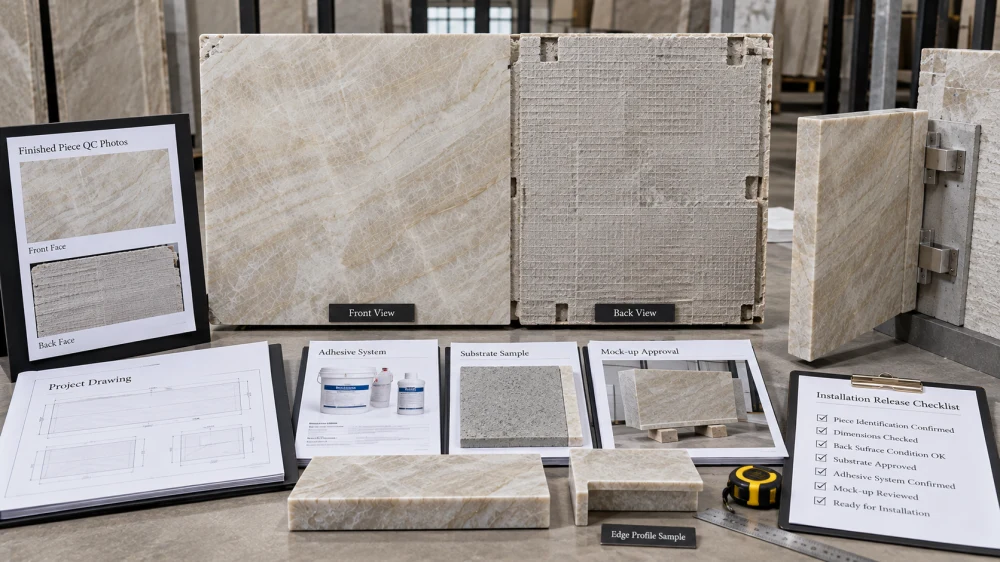
The stone supplier should not replace the adhesive manufacturer, installation-system provider, structural designer, or qualified installer when those parties are responsible for final system suitability.
Eine mit Netz verstärkte Quarzitplatte ist eine natürliche Quarzitplatte, die an einem Teil oder an der gesamten Rückseite mit einem Netz oder einem anderen Verstärkungssystem versehen ist. Die konkrete Ausführung der Rückenverstärkung kann variieren; daher sollten Verarbeiter den tatsächlich gelieferten Zustand dokumentieren, statt davon auszugehen, dass alle mit Netz verstärkten Platten identisch sind.
Nicht automatisch. Ob die Unterlage beibehalten, vorbereitet oder verändert werden soll, hängt von der tatsächlichen Beschaffenheit der Unterlage, dem vorgeschlagenen Klebstoffsystem, dem Untergrund, der Verlegemethode sowie den aktuellen Empfehlungen der zuständigen Fachstellen ab. Entfernen Sie das Netz nicht allein deshalb, weil es sichtbar ist.
Dies lässt sich weder allein anhand des Quarzitnamens noch anhand des Vorhandenseins eines Netzwerks feststellen. Identifizieren Sie zunächst, mit welchem Material die Klebstoffverbindung tatsächlich in Kontakt treten wird, und prüfen Sie, ob das vorgeschlagene System sowie die Oberflächenvorbereitung für diese Grenzfläche geeignet sind.
Not necessarily. Mesh reinforcement, resin associated with the backing, localized repairs, slab-surface resin treatment, fabrication adhesive, and installation adhesive can perform different functions. Record the actual condition instead of grouping all of them under the word “resin.”
Die Verlegungsbefestigung verbindet zwei Seiten einer Fuge. Die Quarzit-Rückseite bildet die eine Seite, das Projektuntergrundmaterial die andere. Daher müssen die Klebstoffverträglichkeit, die Oberflächenvorbereitung, die Umgebungsbedingungen sowie die Verlegeanforderungen jeweils an beiden Seiten überprüft werden.
Ein repräsentativer Versuch oder eine Musterprobe kann angebracht sein, wenn die Untergrundbeschaffenheit, die Kompatibilität, die Oberflächenvorbereitung, das optische Erscheinungsbild oder die Verlegebedingungen unklar sind oder wenn die verantwortlichen Projektbeteiligten eine Überprüfung wünschen. Dokumentieren Sie genau, welche Materialien und Bedingungen der Versuch abbildet.
Nein. Ein Haftversuch liefert lediglich Informationen über die von diesem Test abgebildete Schnittstelle und die jeweiligen Bedingungen. Fragen der strukturellen Auslegung, der mechanischen Befestigung, der Eignung des Untergrunds, der Bewegungsfähigkeit, der Abdichtung, der einschlägigen Normen sowie umweltbedingter Lasten und weiterer systembezogener Aspekte bedürfen – soweit zutreffend – einer gesonderten projektspezifischen Prüfung.
For project-based Natural Quartzite supply, HRST STONE can document slab identity, front and back conditions, visible mesh or reinforcement, fabrication details, finished-piece references, QC photographs, and packing records. Final adhesive selection, surface preparation, fixing design, and installation method should be confirmed for the actual project condition by the responsible installer, adhesive or installation-system provider, designer, engineer, or other qualified project party as applicable.
© HRST STONE / XIAMEN HRST STONE CO., LTD. Alle Rechte vorbehalten.