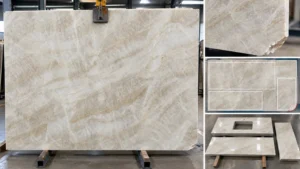
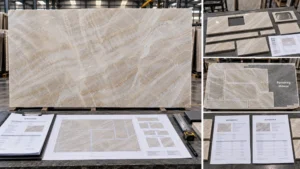
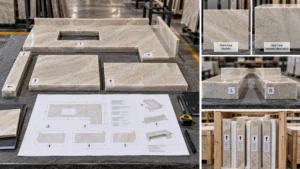
Wie man eine aufgearbeitete Quarzitprobe mit der ursprünglichen Oberfläche vergleicht
Post navigation
Kurze Zusammenfassung
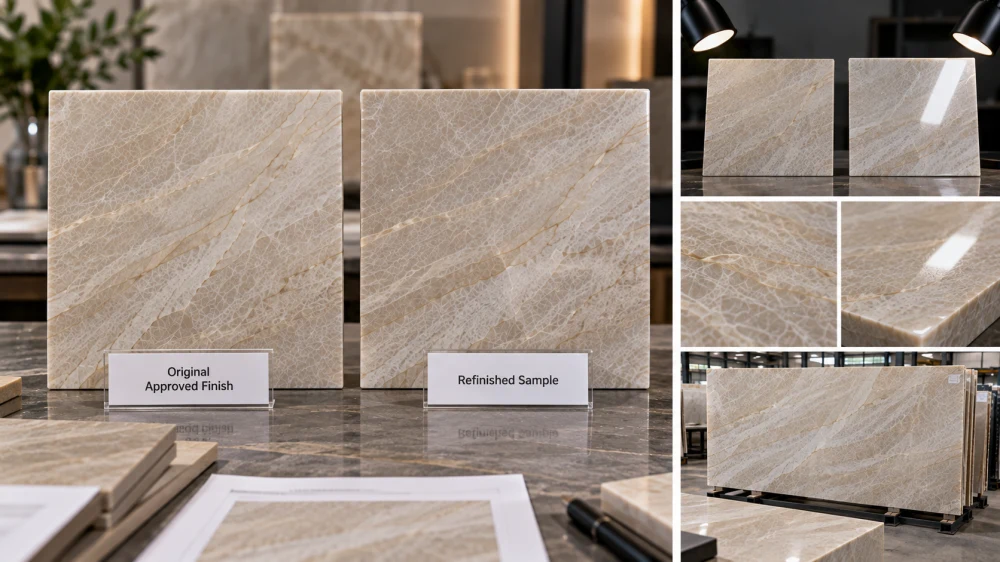
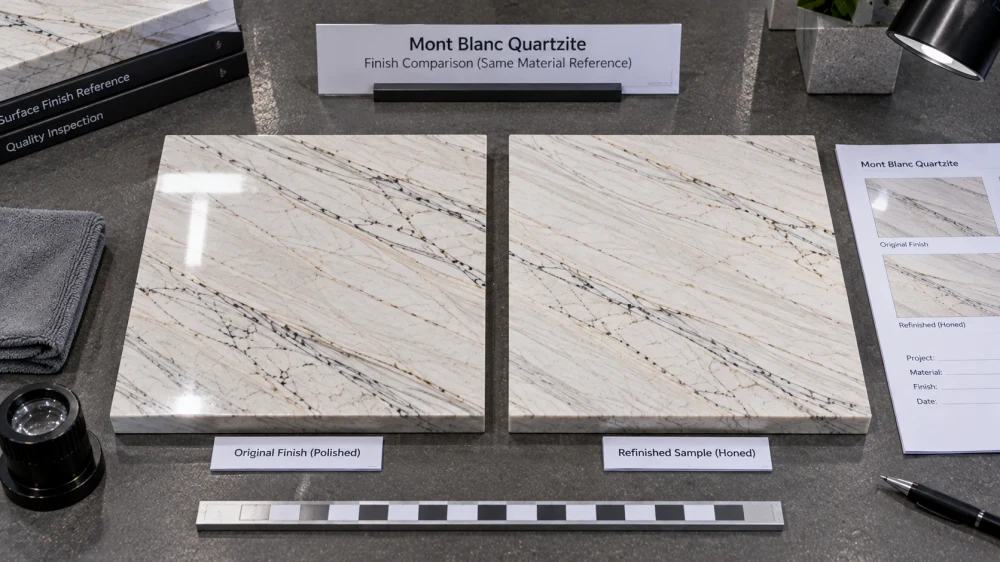
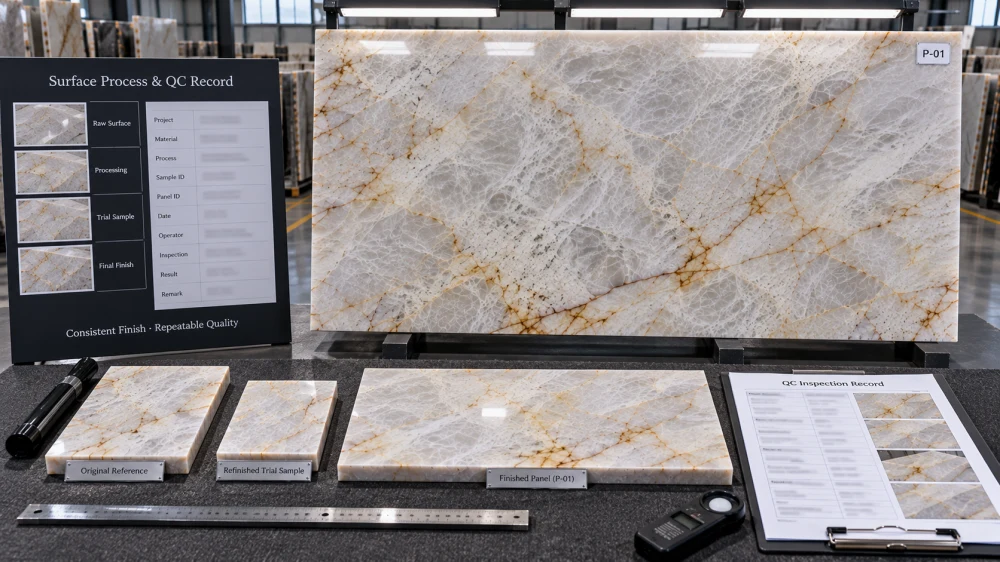
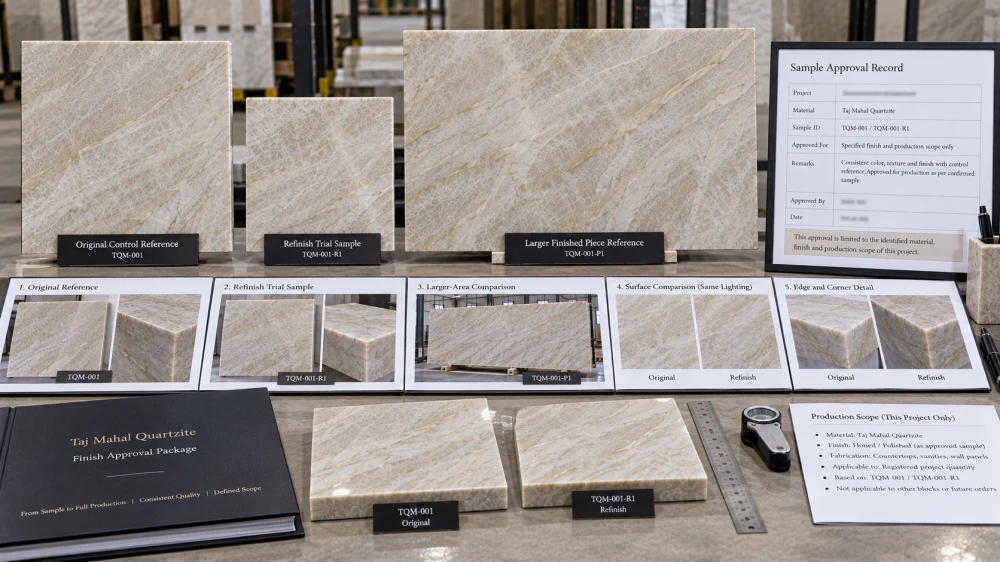
Compare a refinished Quartzite sample with the original reference under the same clean, dry, lighting, viewing, and orientation conditions. Do not judge only by whether both samples are called polished, honed, brushed, or leathered. Review sheen, reflected-light behavior, color depth, texture, clarity, visible marks, edge-to-face consistency, and the intended application. Record exactly which original reference and refinished sample were approved, because a small sample comparison does not automatically approve every slab or every finished piece.
A Quartzite project has an approved finish.
Later, a sample is refinished because the original surface needs to be reproduced, adjusted, repaired, or matched during fabrication.
The new sample looks close.
But is it close enough to release the rest of the work?
A useful comparison should not depend on memory or on one photograph. The project team should compare the refinished Quartzite sample directly with an identified original reference under controlled conditions.
The review sequence is:
Original Reference → Refinished Sample → Same Viewing Conditions → Sheen → Color Depth → Texture → Surface Uniformity → Larger-Area Relevance → Approval Boundary
First Confirm What “Original Finish” Means
Before comparing surfaces, identify the reference.
“Match the original finish” is too vague if the project has several possible originals.
The reference might be:
the original approved control sample;
a retained sample from the selected slab;
an approved mock-up;
a previously approved finished component;
a defined area of an actual slab; or
another project-specific reference agreed in writing.
Record enough information so another reviewer can identify the same reference later.
Original Finish: Project-approved finish description
Refinished Sample: Sample / Piece ID
Proposed Process: Recorded fabrication process
Review Scope: Area / pieces to which the decision may apply
Compare Like with Like Wherever Possible
The strongest comparison uses two surfaces that minimize unrelated variables.
If possible, compare the refinished area with an original reference from the same material selection and a reasonably comparable stone zone.
This matters because Natural Quartzite can vary in:
background tone;
mineral concentration;
crystalline character;
veining or movement;
local porosity;
natural fissures;
resin or reinforcement condition; and
other slab-specific features.
If two samples come from visibly different stone zones, part of the apparent difference may come from the material rather than the refinishing process.
Do Not Compare a Wet Sample with a Dry Sample
Surface condition can distort the comparison before finish quality is even considered.
Both references should be reviewed under an agreed condition.
For a normal visual comparison, check whether both surfaces are:
clean;
dry;
free from temporary polishing residue;
free from loose dust;
free from temporary protective film;
not intentionally wetted to deepen the color; and
ready for the intended approval review.
Comparison Rule
Do not approve a finish match when one surface is wet, dirty, freshly coated, covered by temporary residue, or otherwise being viewed in a different condition from the reference surface.
Use the Same Lighting for Both Samples
Finish is partly perceived through reflected light.
A surface can appear more polished, flatter, darker, lighter, richer, or more textured simply because the lighting changed.
Place the original and refinished references side by side where practical.
Then review them under the same:
light source;
light direction;
approximate intensity;
viewing distance;
viewing angle;
sample orientation; and
surrounding visual environment.
This does not require a complicated laboratory setup for every aesthetic approval.
It requires enough consistency that the team is comparing the stone rather than comparing two different viewing environments.
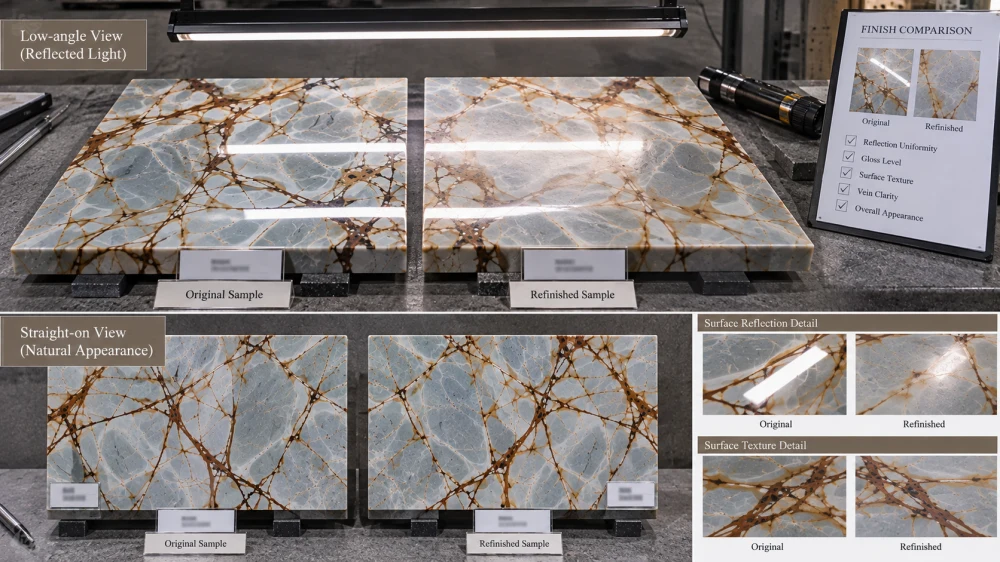
Do Not Judge a Quartzite Finish from One Viewing Angle
A finish can appear similar when viewed straight on but noticeably different when light moves across the surface.
Review the pair from several controlled positions:
Front View → Low-Angle View → Reflected-Light View → Close Surface View → Normal Project Viewing Distance
Low-angle observation can be particularly useful for seeing differences in sheen, polishing transitions, surface waviness, localized dull areas, or texture that are less obvious in a straight-on photograph.
Compare Sheen Before Comparing Color
One of the first checks should be reflected-light behavior.
Does the refinish create visible processing bands?
Does the surface change abruptly near an edge or repaired area?
A finish may have the correct general category but still show a visibly different sheen.
For example, two surfaces can both be described as honed while one reads significantly flatter or more reflective than the other.
Then Compare Color Depth and Mineral Definition
Surface finish can change how the same stone is perceived.
A higher-reflection surface can make some colors and mineral structures appear deeper or more visually pronounced, while a lower-reflection finish can make the overall appearance softer.
During the comparison, look at:
background color depth;
contrast between mineral zones;
clarity of crystalline areas;
dark-mineral intensity;
warm or cool visual shift;
vein definition; and
overall visual depth.
The purpose is not to demand artificial uniformity from Natural Quartzite.
It is to determine whether the refinishing process has introduced an unacceptable visual difference from the agreed reference.
Separate Natural Stone Variation from Finish Variation
This is one of the hardest parts of a finish comparison.
Suppose the refinished sample looks slightly darker than the original.
Possible explanations may include:
different surface sheen;
different stone zone;
different mineral concentration;
different lighting;
different surface condition;
residual moisture or processing residue; or
a combination of factors.
Do not automatically attribute every visual difference to the refinishing operation.
Control the variables first.
Texture Matters Even When Color Looks Correct
A photograph taken from above may make two samples look almost identical in color.
Touch and low-angle light may reveal a different surface.
Depending on the specified finish, review:
smoothness;
micro-texture;
directional processing marks;
brush character;
leathered relief;
local depressions;
edge transitions; and
consistency across the reviewed area.
Aesthetic texture should be compared against the approved project reference rather than against a generic idea of what every Quartzite surface should feel like.
Use a Comparison Matrix Instead of “Looks Good”
Review Item
Original Reference
Refinished Sample
Decision
Overall sheen
Record observation
Record observation
Accept / Adjust / Review
Reflection uniformity
Record observation
Record observation
Accept / Adjust / Review
Color depth
Record observation
Record observation
Accept / Adjust / Review
Mineral / vein definition
Record observation
Record observation
Accept / Adjust / Review
Surface texture
Record observation
Record observation
Accept / Adjust / Review
Processing marks
Record observation
Record observation
Accept / Adjust / Review
Edge-to-face transition
Record observation
Record observation
Accept / Adjust / Review
Should You Measure Gloss?
For some projects, a visual comparison between approved physical references may be sufficient.
For others, especially where a contractual finish requirement or tighter production control is needed, the responsible parties may choose to use an agreed measurement method or instrument in addition to visual review.
The important point is not to invent a universal gloss number for Natural Quartzite.
If a numerical sheen or gloss criterion is required, define:
the measurement method;
instrument;
measurement geometry where relevant;
measurement locations;
sample condition;
acceptable project range; and
who approves the criterion.
A number without a defined method is not a complete acceptance criterion.
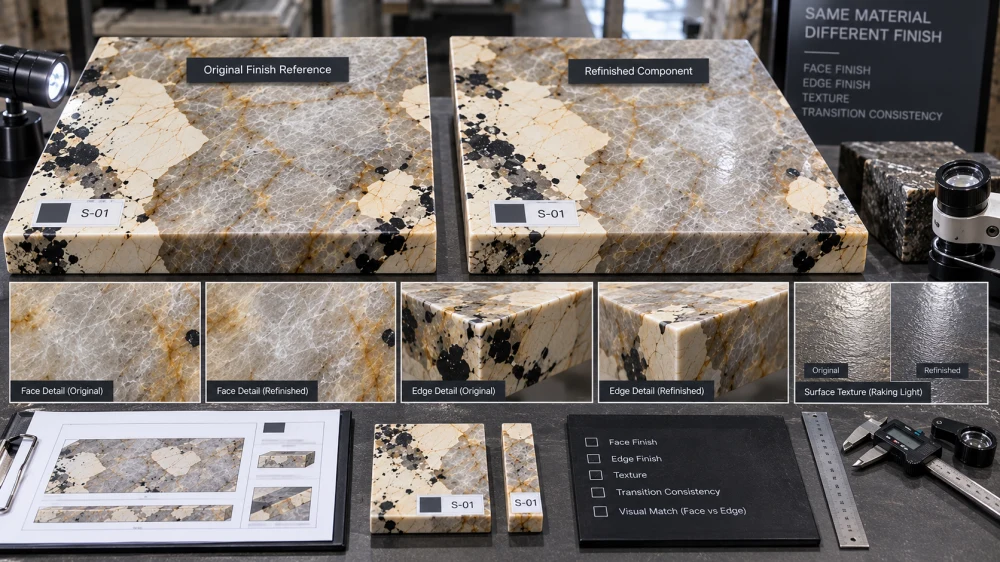
Compare the Face and the Edge Separately
Countertops, vanity tops, stairs, tables, reception counters, and other fabricated components often expose both a large face and one or more finished edges.
A refinished face may match the original reference while the edge reads differently because it was processed using a different sequence, tool, direction, or access condition.
Check separately:
Main Face → Straight Edge → Profiled Edge → Miter / Return → Local Refinished Area
Only the surfaces that are relevant to the finished project need to be included, but they should not be assumed to match automatically.
A Small Sample Can Hide Large-Area Finish Variation
A 100 × 100 mm or similarly small sample can be useful for developing a finish.
But it does not reproduce every condition of a large island, wall panel, or long countertop.
Large surfaces can reveal:
polishing bands;
changes in sheen across processing passes;
directional texture;
localized dull areas;
surface waviness;
variation between mineral zones; and
transitions between factory-finished and locally refinished areas.
Do Not Let Refinish Approval Become a Blanket Slab Approval
This is the most important approval boundary in the article.
Approving one refinished sample may establish that a proposed surface process produces an acceptable result on the material reviewed.
It does not automatically prove that:
every slab will look identical;
every mineral zone will respond identically;
every large component will have identical sheen;
every previously treated area will respond the same way;
every edge will match the face automatically; or
the result will appear identical under every site lighting condition.
Natural Quartzite remains slab-specific.
The approval should therefore say what it actually releases.
Write the Approval Boundary Before Bulk Refinishing
REFINISH APPROVAL RECORD
□ Original reference ID recorded
□ Refinished sample ID recorded
□ Material / slab relationship recorded
□ Proposed finish process recorded
□ Samples reviewed clean and dry
□ Same lighting and viewing conditions used
□ Overall sheen compared
□ Color depth compared
□ Texture compared
□ Processing marks reviewed
□ Face / edge relationship checked where relevant
□ Larger-area review completed if required
□ Photographs retained
□ Named approver recorded
□ Pieces / slabs covered by approval identified
□ Re-review trigger defined
When Should the Finish Be Reviewed Again?
A previous sample approval should be reconsidered when a meaningful variable changes.
Beispiele hierfür sind:
a different slab group;
a visibly different mineral zone;
a different finishing sequence;
different equipment or process where relevant;
a change from face processing to edge processing;
a change from small sample to large panel;
a previously treated or repaired area;
a different specified finish; or
another condition outside the recorded approval scope.
The goal is not to create unnecessary approvals.
It is to avoid extending one controlled sample result to materially different conditions without review.
What Should the Supplier Provide for a Refinish Review?
For the confirmed stone and fabrication scope, useful evidence may include:
quartzite-refinish-sample-final-approval-record
original reference sample identification;
refinished sample identification;
actual slab or piece reference;
finish description;
record of the proposed refinishing process;
side-by-side photographs;
reflected-light photographs;
close surface photographs;
relevant edge photographs;
larger-area review where required; and
written approval and release scope.
The project team should separately define any contractual appearance tolerance, instrument-based requirement, site acceptance procedure, maintenance requirement, or specialist technical criterion that applies.
FAQ
1. How should I compare a refinished Quartzite sample with the original finish?
Identify the original reference and refinished sample, place them under the same clean, dry, lighting, orientation, and viewing conditions, and compare sheen, reflection, color depth, mineral definition, texture, processing marks, and relevant edge-to-face relationships. Record the result rather than relying on memory.
2. Should a refinished Quartzite sample be compared wet or dry?
For a normal visual finish comparison, both samples should be reviewed under the same agreed surface condition. Comparing a wet surface with a dry one can distort color depth, contrast, and sheen and make the finish comparison unreliable.
3. Can two honed Quartzite samples still look different?
Yes. The word honed describes a finish category but does not by itself guarantee identical sheen, texture, color depth, processing marks, or visual response across different samples. Compare the actual project references under controlled conditions.
4. Is a photograph enough to approve a refinished Quartzite finish?
Photographs are useful for documentation and remote review, but camera exposure, white balance, reflections, compression, and screen settings can affect appearance. Where finish matching is visually critical, photographs should support rather than automatically replace the agreed physical or representative sample review.
5. Should gloss be measured when comparing Quartzite finishes?
It can be useful when the project requires a numerical sheen criterion, but the method, instrument, measurement locations, sample condition, and acceptable range should be defined. There is no single universal gloss value that should be applied to every Natural Quartzite finish.
6. Can one approved refinished sample release all Quartzite slabs for production?
Not automatically. The approval should identify which material, slab group, finish process, component type, and production scope it covers. Natural stone variation and changes in processing or scale may require another review.
7. When should a Quartzite refinish sample be reviewed again?
Re-review is appropriate when a meaningful variable changes, such as the slab group, mineral zone, finishing process, finished surface type, edge condition, sample-to-panel scale, or another condition outside the original approval boundary.
Final Finish-Matching RuleDo not approve a refinished Quartzite surface because it “looks close” in one photograph. Keep the comparison controlled: Original Reference → Refinished Sample → Same Surface Condition → Same Lighting → Sheen → Color Depth → Texture → Scale-Up Check → Written Approval → Defined Production Scope.
For project-based Natural Quartzite fabrication, HRST STONE can coordinate actual slab and sample references, finish-sample preparation, CAD/shop drawings, fabrication records, QC photographs, larger-area finish review, piece identification, packing, and export documentation for the confirmed stone scope. Send Josh the material name, original finish reference, proposed finish change, dimensions, quantities, drawings, visible surfaces, and delivery destination before bulk refinishing or fabrication release.
Hi, I am the author of this article. I have been working in the field of Natural Stone for more than 15 years. If you need customized Natural Stone services, please feel free to contact me.