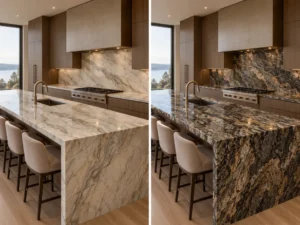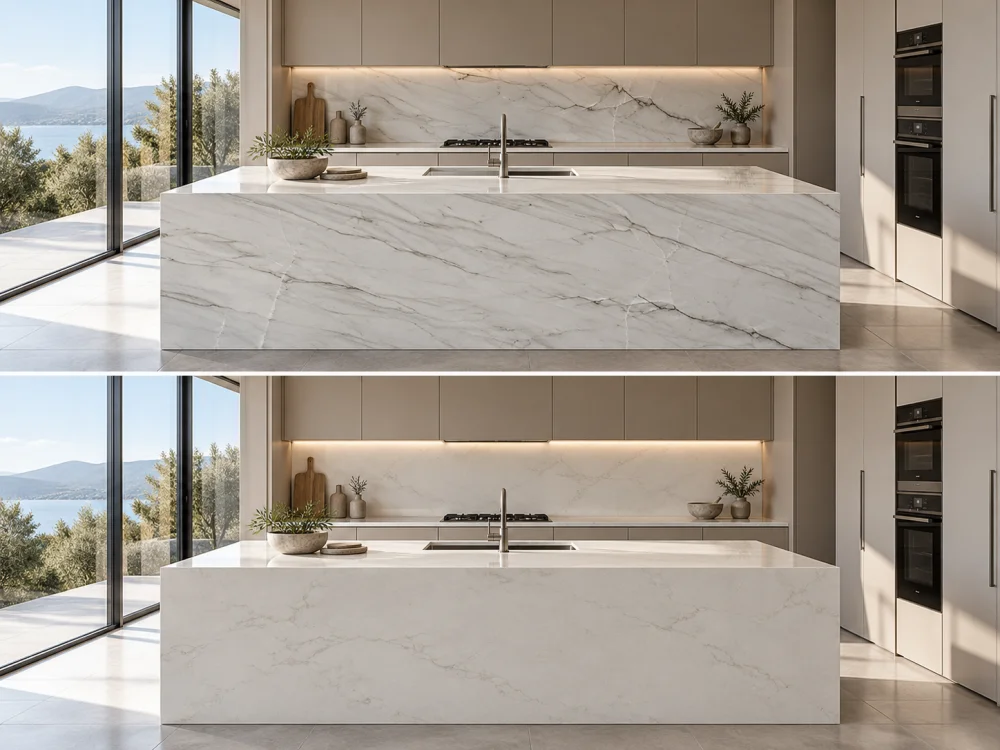
Natural Quartzite vs Engineered Quartz in Sunlit Indoor Kitchens becomes a different material decision from the same comparison in a darker interior room.
A kitchen with large south- or west-facing windows can receive intense daylight across the island for part of the day. Another countertop run may remain in soft reflected light. Under-cabinet lighting may dominate in the evening. A polished surface can reflect the sky, cabinetry, windows, or surrounding floor finishes.
The same countertop can therefore look different at 9:00 a.m., 1:00 p.m., and 5:00 p.m. without the material itself having changed.
This matters when comparing Natural Quartzite and Engineered Quartz because the two materials should not be judged only from samples placed beneath showroom ceiling lights.
The useful question is:
How does the actual proposed material behave visually in the daylight conditions of this kitchen, and does the selected product remain appropriate for that exposure and use?
The first step is to separate three ideas that are often mixed together:
These are related but they are not the same question.
A pale countertop beside a large window may appear brighter than the same material in an interior showroom.
Warm daylight, reflected timber, painted cabinetry, flooring, and nearby walls can influence the way neutral stone colors are perceived.
A pale Natural Quartzite that appears relatively grey under one artificial light may reveal warmer cream or greige movement in another setting.
An Engineered Quartz sample may also appear warmer, cooler, brighter, or more uniform depending on its position relative to the windows and surrounding finishes.
A kitchen can be very bright without every countertop receiving direct sunlight.
One section may sit directly inside a sun path while another receives only diffuse daylight.
For material review, identify these areas separately.
Do not describe the entire kitchen simply as “sunny.”
Bright Room ≠ Direct Sun Everywhere. Map Direct Sun → Indirect Daylight → Interior Shade → Artificial-Light Conditions before judging the complete countertop palette.
A single material comparison at midday does not necessarily describe the room throughout the day.

Where daylight is a major design feature, review several representative conditions.
Morning daylight may reach one side of the kitchen while leaving an island or perimeter run more evenly illuminated.
Use this period to observe background color, subtle undertones, and the relationship between the countertop and cabinetry before strong reflections become dominant.
Midday light can create a brighter overall room and stronger reflections on polished surfaces.
This is a useful time to inspect whether the countertop becomes visually washed out, whether strong natural veins remain legible, and whether glare makes a pale surface look different from its physical sample.
Low-angle sun can be particularly revealing.
It may create strong bright zones, long shadows, and grazing reflections across the countertop.
A polished surface can reflect windows or outdoor scenery. This should not automatically be interpreted as a change in stone color.
Observe the surface from normal standing height as well as from the kitchen entrance.
The kitchen should also work when daylight disappears.
Compare the selected materials under the actual or representative ceiling, pendant, and under-cabinet lighting.
A combination that looks balanced in daylight may read differently beneath warmer artificial light.
This does not mean one condition is more accurate. The design needs to work across the conditions that matter to the project.
| Viewing Condition | What to Observe | Do Not Assume |
| Morning daylight | Background tone, undertone, cabinet relationship | That this represents the strongest sun condition |
| Strong midday light | Brightness, reflections, pattern visibility | That glare is a material color change |
| Low-angle direct sun | Grazing reflections, contrast, highly exposed zones | That every kitchen zone receives the same exposure |
| Evening artificial light | Warm/cool relationship and task-light appearance | That daylight approval automatically covers night conditions |
Natural Quartzite contains geological variation across each slab.
A small sample can introduce the material family and finish, but it cannot establish the appearance of a complete island or a long sunlit perimeter countertop.
Use the kitchen drawing together with the actual proposed slab layout.
Identify which portions of the slab will become:
Now connect those areas to the room’s daylight pattern.
A strongly veined or crystalline area placed directly inside the main sun path may appear more visually active than a quieter slab zone placed in indirect light.
That is a layout consideration, not necessarily a material problem.
A polished surface can produce strong reflections and visual depth. A honed finish generally creates a more diffuse visual response.
Do not approve a polished sample and assume that a honed finished countertop will look identical in strong daylight.
If the project is sensitive to glare or subtle undertone differences, use the actual proposed finish in the comparison.
A Quartzite slab with restrained background tones but several broad dark mineral bands may read quiet in a small sample and much more expressive across a large island.
Conversely, a close-up of one dramatic feature can make a slab appear more active than the complete board.
The article ألواح الكوارزيت: عرض عمودي مقابل عرض أفقي: لماذا يتغير الشكل المعروض explains why viewing angle, reflections, pattern scale, and application orientation should remain connected when evaluating Natural Quartzite.
Engineered Quartz should not be treated as one universal product.
Different manufacturers use different formulations, pigments, resins, finishes, product instructions, warranties, and exposure recommendations.
For a sunlit indoor kitchen, the project should therefore identify the exact proposed product before making claims about long-term direct sunlight exposure.
An indoor countertop behind glazing is not the same exposure condition as an uncovered exterior countertop.
At the same time, do not automatically assume that prolonged direct indoor sunlight is irrelevant to every Engineered Quartz product.
Where a countertop sits in strong sun for long periods, review the current manufacturer guidance for the exact selected color and product.
بدلًا من السؤال:
“Is Engineered Quartz UV-resistant?”
ask:
“Is this exact selected product approved by its manufacturer for the intended indoor location and the level of direct sunlight this countertop receives?”
That question keeps the decision connected to verifiable product information.
A sample may look excellent in direct sunlight during a short design review.
That confirms a visual observation under that condition.
It does not automatically establish long-term color stability, warranty coverage, or other product performance.
Those issues should be confirmed from the selected product’s current technical and care information.
A meaningful visual comparison should control as many variables as practical.

Do not photograph the Natural Quartzite sample beside a sunny window and compare it with an Engineered Quartz sample photographed under warehouse LEDs.
Where practical, set both identified samples beside the intended cabinet, backsplash, flooring, and metal references.
Keep them in the same orientation.
If they will become horizontal countertops, review them horizontally rather than only upright on a sample board.
A useful review may include:
The winner at one location may not look the same elsewhere because the light is different.
This is why the project should approve the complete kitchen strategy, not only one attractive photograph.
If one sample sits in a bright sun patch while the other remains partially shaded, the comparison becomes difficult to interpret.
For color-sensitive decisions, first compare both under equivalent illumination.
Then deliberately move them into the direct-sun condition to understand how each reads there.
This separates controlled color comparison from the project’s more extreme lighting condition.
2. Same orientation.
3. Same cabinet and wall references.
4. Same daylight condition.
5. Same proposed finish.
Then move both candidates together into the stronger direct-sun condition and repeat the observation.
A sunlit kitchen should not be treated as one uniform light environment.
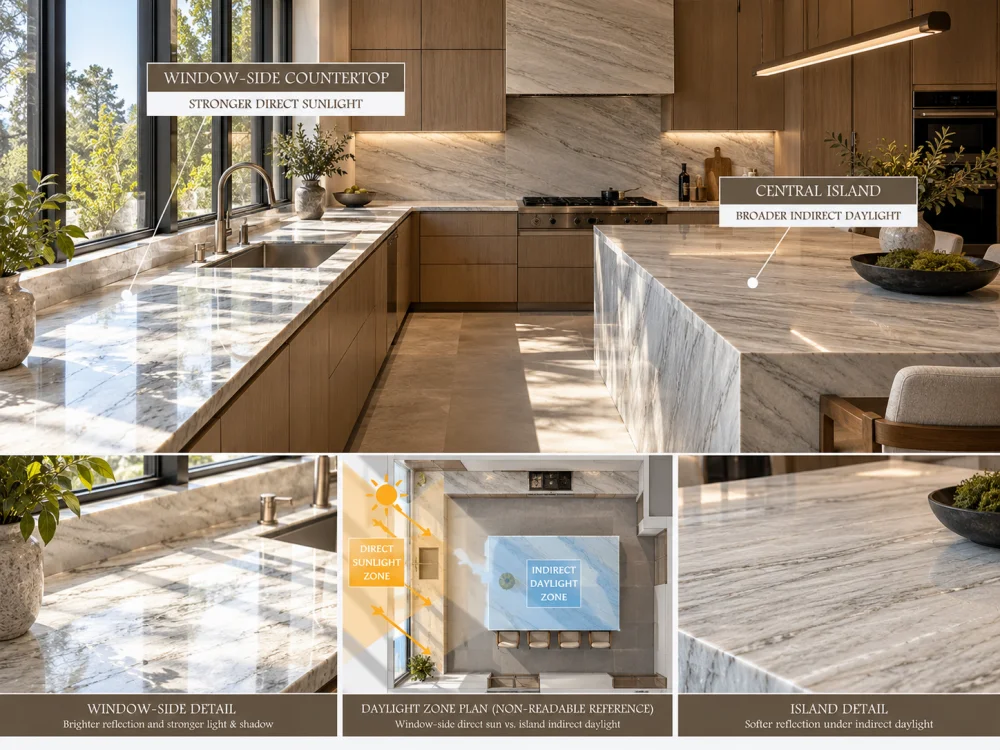
This area may receive the most direct sunlight or strongest reflected daylight.
المراجعة:
An island can receive daylight from several directions.
Its broad horizontal surface may also reflect large portions of the windows and ceiling.
Because it is often the largest uninterrupted piece of stone, pattern scale becomes especially important.
A Natural Quartzite slab should therefore be reviewed at full-board scale before the island crop is approved.
An Engineered Quartz option with large printed movement should likewise be reviewed from suitable large-format product information rather than only a small chip.
A waterfall introduces a vertical plane into the same material composition.
The top and vertical end receive light differently.
If the design depends on visual continuity, review the proposed Natural Quartzite slab allocation or Engineered Quartz graphic relationship on both planes.
A vertical backsplash faces the room more directly than the horizontal worktop.
It may therefore make pattern and undertone differences easier to see.
Where the kitchen is predominantly white, the related كوارتزيت إنفنيتي الأبيض في مطبخ أبيض على أبيض: مقارنة النغمات الخفية guide explains why daylight, cabinet whites, stone background color, and vein contrast should be evaluated separately.
Strong daylight creates one of the easiest conditions for misreading a countertop.
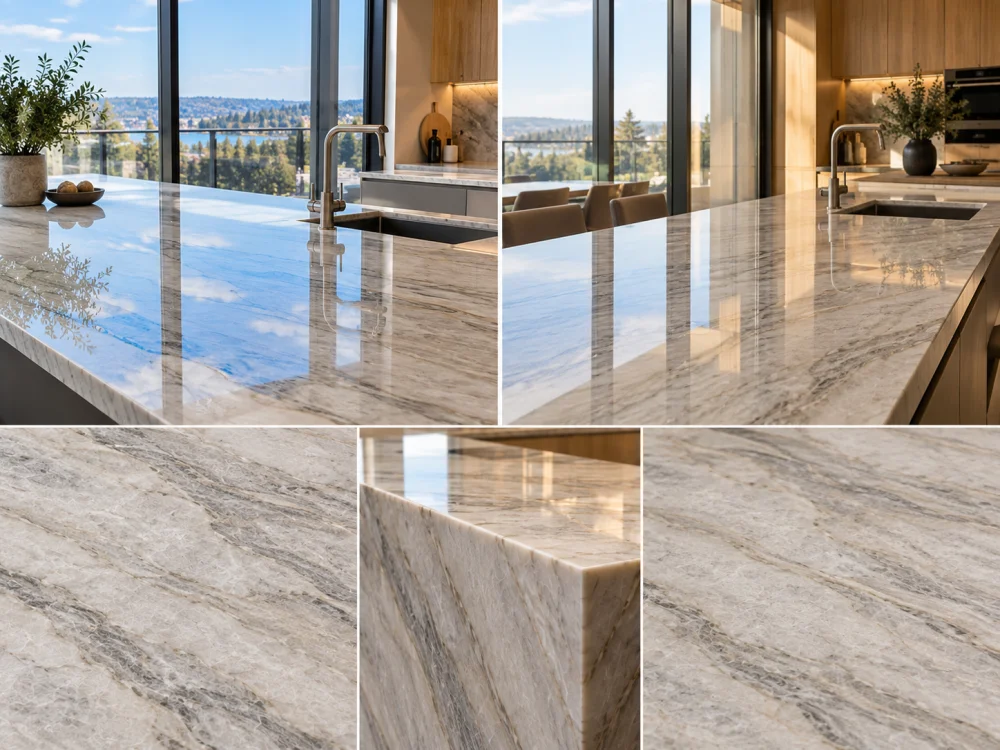
A polished surface may reflect:
This reflected color can influence photographs dramatically.
If a blue-grey area appears only from one camera or viewing angle and changes as the viewer moves, reflection may be contributing to the effect.
Likewise, a bright white stripe that follows a window reflection is not necessarily part of the material pattern.
Low-angle light can make reflected lines and local surface variation highly visible.
A visually distorted reflection can identify an area worth examining, but it does not by itself establish a dimensional flatness defect.
If a measurable flatness issue is suspected, the responsible fabricator or project professional should evaluate it using the applicable project method and requirement.
Automatic exposure and white balance can make a sunlit countertop look substantially different from the same surface in person.
For remote material approval, document the lighting condition and keep close-up photographs connected to wider room views.
ال صالات عرض ألواح الكوارتزيت: ما الذي ينبغي إحضاره إلى موعد الاختيار guide also explains why physical adjacent-material samples and complete slab references are more useful than relying on isolated screen images for color-sensitive decisions.
The goal is not to find one lighting condition that makes a material look best.
The goal is to understand whether the selected material relationship remains acceptable through the important conditions the kitchen will experience.
| Approval Area | الكوارتزيت الطبيعي | Engineered Quartz |
| Material identity | Actual slab / board reference | Exact selected manufactured product |
| Daylight appearance | Review actual slab zones and finish | Review actual sample / large-format pattern information |
| Direct-sun area | Review appearance and slab allocation | Review appearance plus current product-specific exposure guidance |
| التشطيب والحافة | Review actual stone finish and worked edge | Review selected finish and fabricated edge detail |
| Final decision | Slab + layout + lighting relationship accepted | Product + lighting relationship + applicable product guidance accepted |
A useful approval statement might read:
“Material relationship reviewed under representative daylight, stronger direct-sun conditions, and evening artificial lighting. Selected Natural Quartzite slab zones / Engineered Quartz product accepted for the stated kitchen design. Product-specific exposure requirements, final stone layout, edges, seams, and current fabrication drawings remain subject to the relevant project confirmation.”
This is more useful than simply recording “Quartzite approved” or “Quartz approved.”
Natural Quartzite may be preferred when the designer values geological movement, slab-specific composition, and the way natural variation changes across a large sunlit island.
Engineered Quartz may be preferred when the project values the specific visual characteristics of a manufactured product and that exact product is appropriate for the intended indoor conditions.
Neither statement makes one material universally superior.
The final choice should consider:

For color-sensitive kitchens, the strongest decision comes from reviewing actual materials in the space they must live in.
The material itself does not need to change for its appearance to look different. Direct daylight, reflections, viewing angle, surrounding colors, and surface finish can change which tones and natural features become most noticeable. Review the actual proposed slab under representative kitchen lighting.
Do not make a category-wide assumption. Indoor window exposure differs from outdoor use, and product guidance can vary. Check the current care, warranty, and exposure recommendations for the exact Engineered Quartz product being considered, particularly where prolonged direct sunlight reaches the countertop.
Yes, when direct sun is a meaningful condition in the finished kitchen, but first compare both materials under the same controlled daylight condition. Then move both together into the stronger direct-sun area so one material is not being compared in sunlight while the other remains shaded.
Reflected sky, landscaping, cabinetry, flooring, wall colors, and the daylight itself can influence perceived color. Compare the material from several angles and with adjacent physical finish samples before treating the observation as an intrinsic stone or product color.
Not universally. A polished surface produces a different reflection pattern from honed or matte finishes. Whether that reflection is desirable depends on the material, window position, design intent, and actual room. Review the proposed finish under representative daylight rather than using a general rule.
They may need separate visual review when their daylight conditions, viewing angles, or slab areas differ substantially. A window-side perimeter top can experience different reflections and direct sunlight from a central island even when both use the same material.
Send Josh the Natural Quartzite material name, current kitchen plan and elevations, window positions, countertop and island dimensions, requested finish, cabinet and backsplash references, relevant daylight photographs, quantities, visual priorities, and delivery destination. Identify which countertop areas receive strong direct sun and which remain primarily in indirect daylight.
For project-based Natural Quartzite kitchens, HRST STONE can help coordinate available full-slab photographs, board references, stone layouts, CAD/shop drawings, directional review, finished-edge details, visual QC records, packing, and export documentation according to the confirmed project scope. Send Josh the kitchen drawings, countertop dimensions, window and lighting context, finish requirements, quantities, visual priorities, and delivery destination for review.