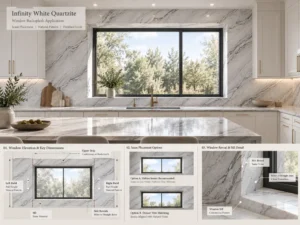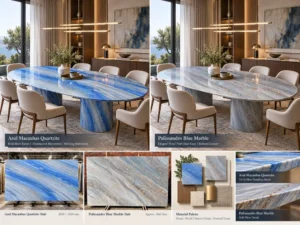

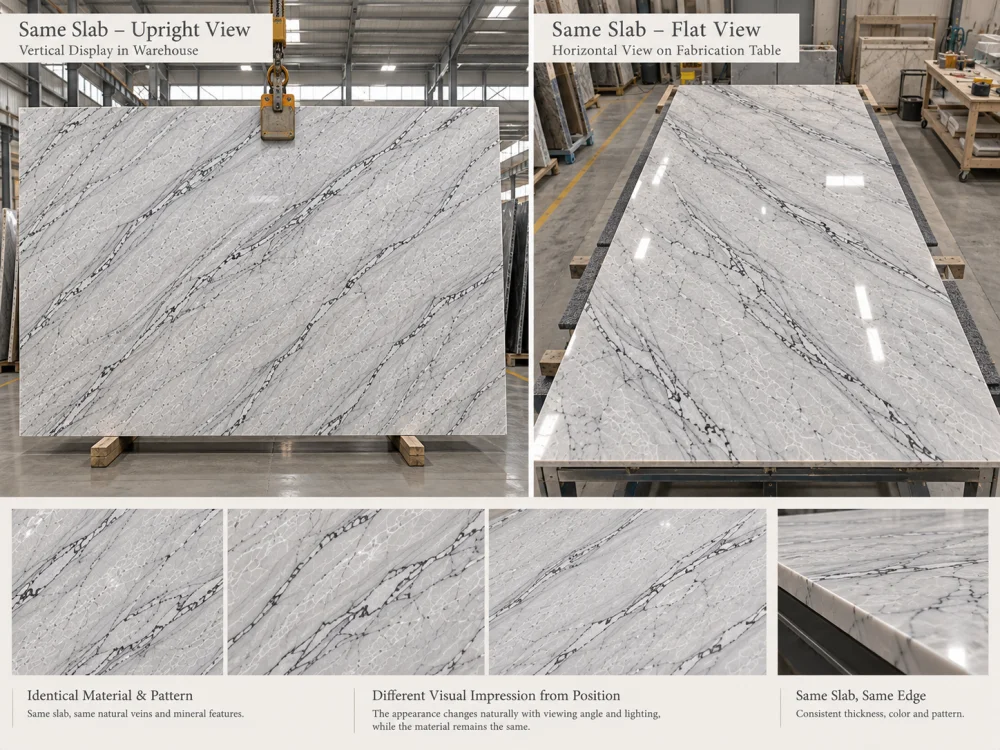
ملخص سريعقد يبدو الكوارتزيت الطبيعي مختلفًا عند عرضه منتصبًا في مستودع الألواح ومستويًا على طاولة التصنيع. لكن الحجر نفسه لم يتغير بالضرورة؛ فما تغيّر هو اتجاه الضوء، وانعكاسات السطح، وزاوية الرؤية، والمسافة، وكذلك علاقة المشاهد بالنمط الطبيعي. يساعد العرض المنتصب المشترين على قراءة اللوح الكامل كتكوين عمودي، بينما يساعدهم العرض المستوٍ على تخيّل التطبيقات الأفقية وفحص مناطق محددة من الأعلى. ولا يكفي أي من الوضعين وحده لتحديد كل استخدام نهائي. قارن نفس اللوح المحدد ضمن ظروف موثقة، واستخدم سطح المشروع المقصود لتحديد أي وجهة نظر أكثر أهمية.
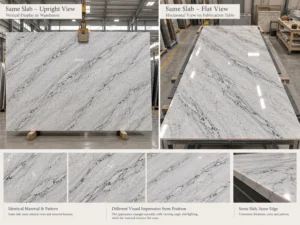
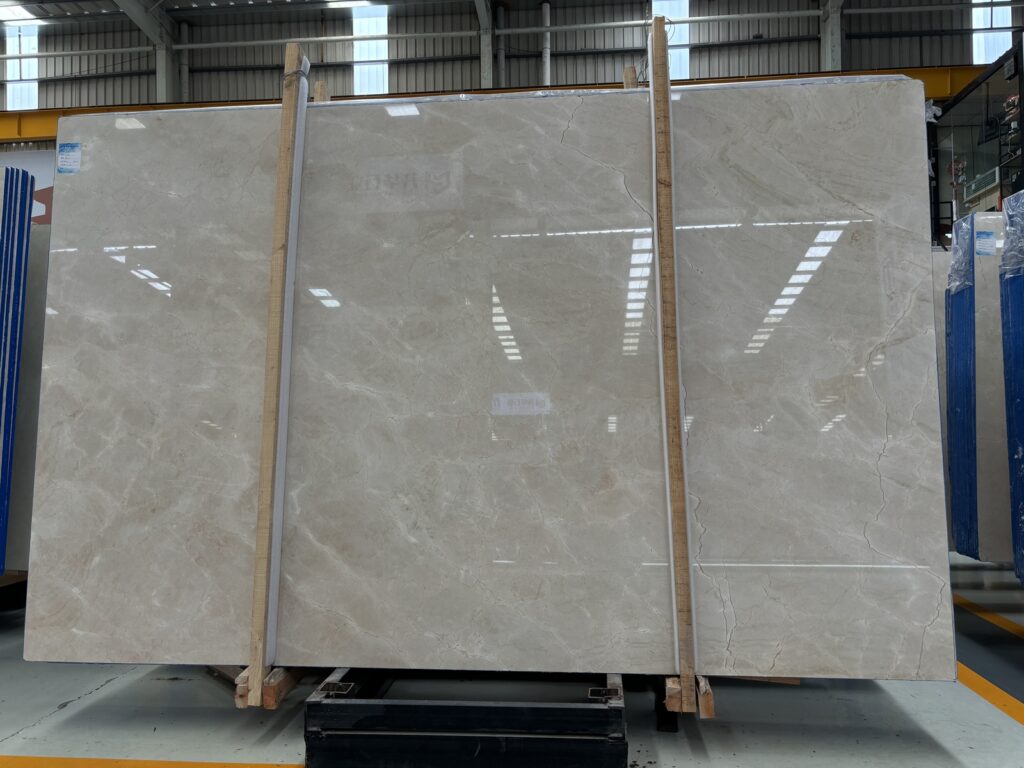
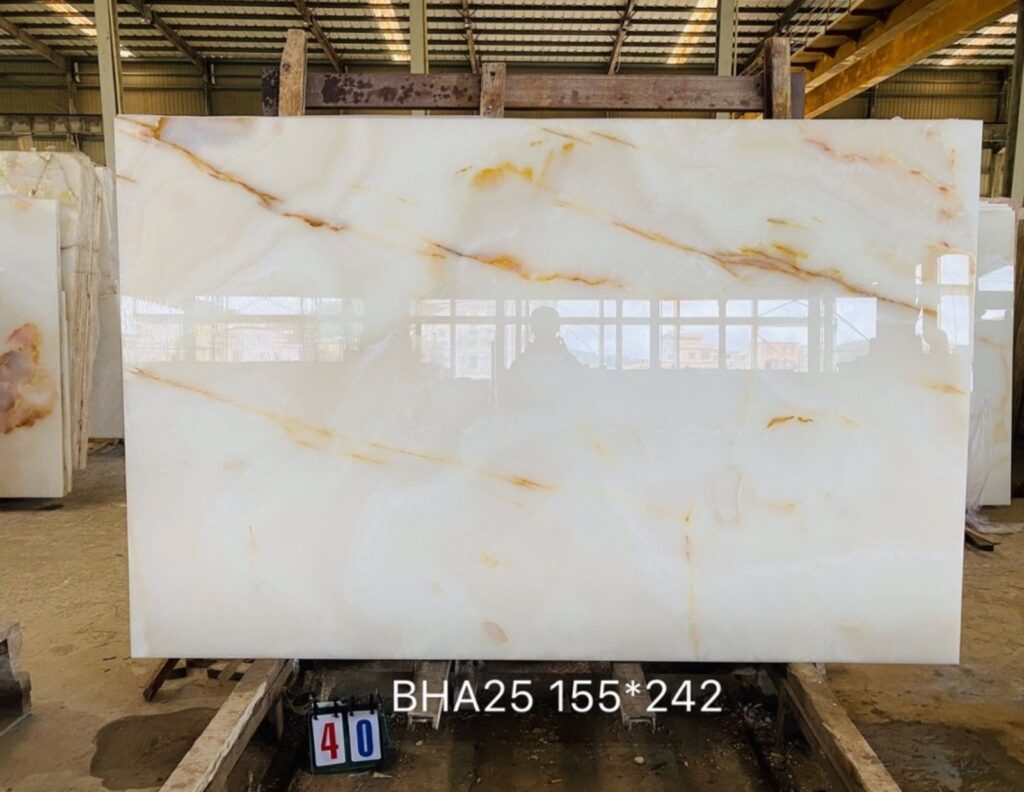
يقف مشترٍ أمام لوح كبير من الكوارتزيت الطبيعي معروض بشكل شبه عمودي في مستودع الحجارة. يبدو الحركة درامية، ومن السهل تمييز المناطق البلورية، ويُقرأ التكوين بأكمله كجدار مميز من الناحية المعمارية.
لاحقًا، يُوضع اللوح نفسه أفقيًا لمراجعة التصنيع. يعكس السطح الآن أضواء السقف، ويتقدم المشاهد إليه من زاوية مختلفة، وتبدو بعض المعالم المعدنية أكثر بروزًا بينما تبدو أخرى أقل أهمية.
هل تغيّر الحجر؟
ليس بالضرورة. فقد ينتج الاختلاف الظاهر عن ظروف المشاهدة لا عن تغيّر في المادة نفسها.
الفهم ألواح الكوارتزيت منتصبة أم مستوية مفيد بشكل خاص عندما يتم اختيار اللوح في صالة العرض، لكنه سيصبح في النهاية جزيرة مطبخ أو سطح طاولة أو طاولة طعام أو لوحة حائط أو سطح استقبال.
يحدد وضع عرض اللوح كيفية تفاعل المشاهد مع سطحه.
عند عرض اللوح منتصبًا، غالبًا ما يواجه شخصًا يقف على بعد عدة خطوات. ويمكن للمشاهد إدراك ارتفاعه وعرضه الكاملين من خلال رؤية مباشرة نسبيًا لسطحه.
وعند وضع اللوح نفسه مستوٍ، قد يقف المشاهد بجانبه وينظر إليه من زاوية مائلة. تصبح بعض أجزاء اللوح أقرب إلى العينين من غيرها، وقد تنعكس الإضاءة السقفية على السطح بشكل مختلف.
هذه الفروق تؤثر على الإدراك حتى وإن بقيت تشطيبات الحجر وأبعاده ونمطه الجيولوجي دون تغيير.
| عامل المشاهدة | العرض المنتصب | العرض المستوٍ |
| الوضعية النموذجية للمشاهد | الوقوف أمام اللوح | الوقوف بجانب اللوح أو فوقه |
| النمط العام | غالبًا ما يكون أسهل في القراءة كتكوين عمودي واحد | قد يُنظر إليه كسطح أفقي أو من منظور مائل |
| الإضاءة | يتفاعل الوجه العمودي مع اتجاهات الإضاءة في صالة العرض | قد تُحدث التركيبات السقفية والنوافذ انعكاسات مختلفة |
| سياق الاستخدام المفيد | الجدران المميزة، ألواح الجدران، الأسطح العمودية للأثاث | أسطح الطاولات، الجزر، الطاولات، المكونات الأفقية |
| القيد الرئيسي | لا يتنبأ تلقائيًا بسطح نهائي أفقي | لا يتنبأ تلقائيًا بتركيب عمودي |
هذا اختلاف في العرض، وليس تصنيفًا لدقة الفحص. فكل من الوضعين يمكن أن يكون مفيدًا عندما يجيب عن سؤال محدد.
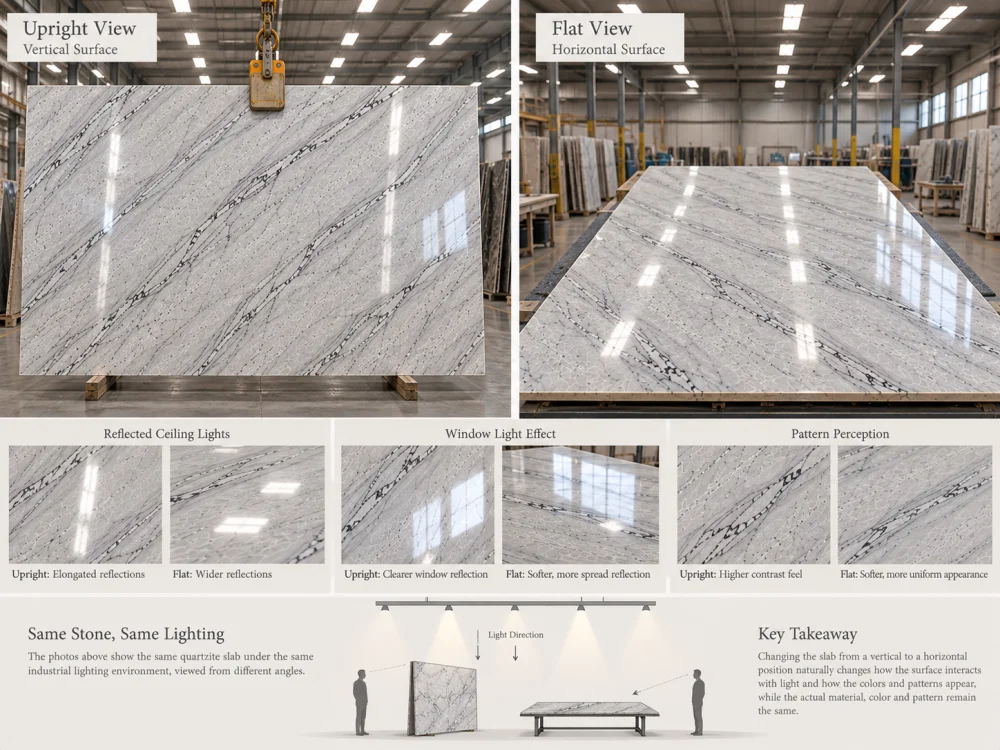
تُعدّ الإضاءة أحد أقوى الأسباب التي تجعل اللوح نفسه من الكوارتزيت المصقول يبدو مختلفًا في وضعين.
عندما يكون اللوح منتصبًا، قد تُضيء التركيبات السقفية وجهه بزاوية معينة. وقد يرى المشاهد قسمًا واسعًا ومتصلًا نسبيًا من الحجر، حسب ترتيب المستودع.
أما عند وضع اللوح مستوٍ، فقد تُحدث نفس التركيبات انعكاسات مرئية على السطح الأفقي. وهذه الانعكاسات قد تبرز مناطق معينة، أو تخفي أجزاء من النمط المعدني، أو تغيّر التباين الظاهر بين المعالم الجيولوجية الفاتحة والمظلمة.
قد يعكس السطح المصقول النوافذ، وأضواء السقف، والألواح المجاورة، أو الألوان المحيطة. أما التشطيبات المصقولة والمخدوشة فقد توزع الانعكاسات بشكل مختلف، وإن كان المظهر الفعلي يعتمد على السطح وظروف الإضاءة.
تخيل لوحًا باهتًا من الكوارتزيت بحركة رمادية ناعمة. في ظل ظروف مشاهدة واحدة، يبدو خلفيته هادئًا ومتجانسًا نسبيًا. وفي ظروف أخرى، تُحدث تركيبات السقف المنعكسة بقعًا مضيئة تتنافس مع النمط الطبيعي.
ليست البقع المضيئة بالضرورة مناطق معدنية أفتح؛ فقد تكون ضوءًا منعكسًا.
وبالمثل، قد ينشأ منطقة تبدو أغمق جزئيًا بسبب الإضاءة المحيطة أو الزاوية التي يرى بها المشاهد السطح.
للقرارات المتعلقة بالألوان، قارن الحجر تحت إضاءة مراقبة وتمثيلية، واستخدم مراجع مادية عند الحاجة. فصورة صالة العرض وحدها لا تكفي لتحديد مطابقة دقيقة للون الغرفة النهائي.
يمكن للضوء الذي يمر بزاوية ضحلة على السطح أن يجعل الانعكاسات والتغييرات البصرية المحلية أكثر وضوحًا. وهذا مفيد لرصد منطقة تستحق اهتمامًا أدق.
ومع ذلك، فإن الخط المنعكس الذي يبدو منحنيًا أو متقطعًا لا يثبت وحده وجود عيب في الاستواء. فمسألة الاستواء الأبعادي تتطلب طريقة قياس مناسبة ومرجعًا خاصًا بالمشروع.
الفرق المفيد بسيط: الملاحظة البصرية تحدد ما ينبغي فحصه؛ أما القياس التقني فيحدد حالة قابلة للقياس.
غالبًا ما يحتوي الكوارتزيت الطبيعي على معالم جيولوجية بمختلف المقاييس. فبعض الألواح تضم أشرطة واسعة أو حقول بلورية؛ فيما تتميز أخرى بعروق أصغر، أو تجمعات معدنية غير منتظمة، أو تباينات قوية بين المناطق المتجاورة.
عند مشاهدة لوح منتصب من على بعد عدة خطوات، يميل العين إلى تجميع هذه التفاصيل في تكوين أكبر.
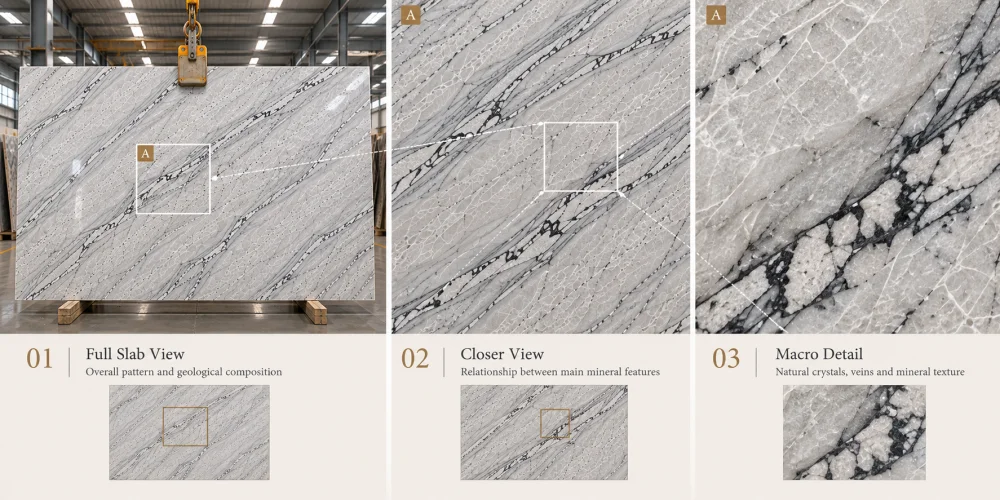
Move closer, and the individual veins, mineral boundaries, crystals, and localized variations become more prominent.
A flat slab introduces another viewing relationship. Someone standing beside a large board may be close to one end while the far end is viewed at a greater distance and a different perspective angle.
This can make the near portion visually dominant, even when the overall pattern is more balanced from a direct overhead view.
Whole-Slab Distance: Step far enough away to see the complete board. Use this view to understand the overall movement, dominant mineral areas, and general composition.
Working Distance: Move closer to examine the portions likely to become important finished surfaces. For a kitchen island, this may include the planned countertop crop and waterfall areas.
Detail Distance: Inspect a specific feature, finish, or local area that needs clarification. Keep the detail connected to its position on the full slab.
No single distance should be treated as sufficient for every decision.
Viewing Scale Rule
Whole Slab → Finished-Surface Area → Local Detail. Review all three scales when the project decision depends on both overall movement and particular natural features.
The finished use of the stone should guide the presentation review. A slab selected for a wall does not need to be evaluated in exactly the same way as one selected for a horizontal dining table.
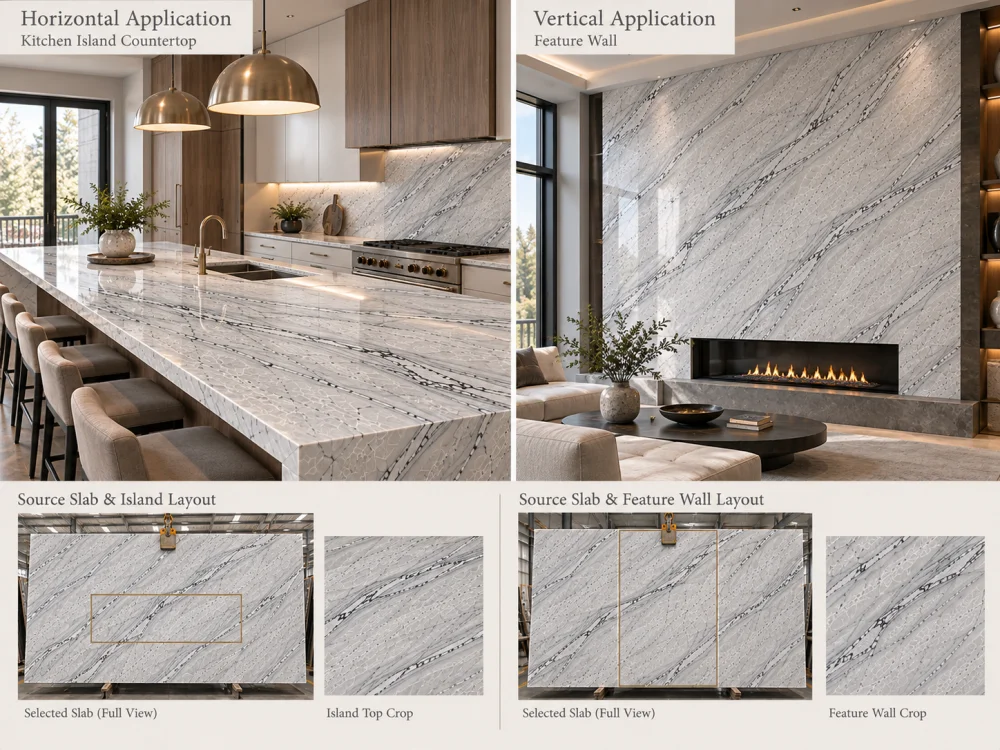
For a vertical feature wall, an upright slab presentation can provide a useful first impression of how the material reads as a large vertical composition.
However, the finished wall may be viewed from a greater distance, illuminated by different fixtures, or divided into several panels. The showroom view is therefore a reference, not a complete installation simulation.
For a kitchen island, the horizontal appearance becomes more important. A flat presentation may help reviewers consider how broad mineral features occupy a top surface.
Yet a person using the kitchen rarely views the entire countertop from directly overhead. Standing-height views and realistic room perspectives remain useful.
Where an island includes waterfall ends, the project contains both horizontal and vertical faces. Neither upright nor flat presentation alone describes the complete finished composition.
For a large table, the stone is experienced mainly from seated and standing positions around its perimeter.
A flat review can help the team examine the proposed tabletop crop, but it should be supplemented by an appropriate perspective view that considers the table’s actual dimensions and viewing height.
Bathroom vanities may combine a horizontal top with a vertical backsplash or front apron. The same stone can be experienced differently across these surfaces because their orientations and light exposure differ.
In these projects, it is more useful to identify the main finished planes than to declare one warehouse presentation universally preferable.
When a project requires both views, the comparison should preserve the identity of the stone and distinguish presentation effects from changes in the material itself.
Begin with the same identified slab and confirm which face and finish are being examined. If the slab cannot be safely moved or repositioned, use existing documented views or suitable controlled references rather than attempting an unnecessary handling operation.

Record the complete visible slab, its identification, presentation angle, approximate viewing distance, and lighting conditions.
Observe the overall direction of movement, relative size of mineral areas, and the way the pattern reads from the front.
Where a properly supported horizontal review is available, examine the same visible face and identify the changes in perspective, reflection, and visual emphasis.
Do not assume the lighting is identical merely because the review takes place in the same building. Rotating the slab changes how its surface faces the available light.
Connect the observations to the project drawing. If the stone will become a countertop, focus on the proposed horizontal finished area. If it will become a wall, evaluate the intended vertical composition.
For mixed-plane work, review each principal finished face separately and then consider the complete assembly.
This process is a comparison of visual evidence, not an instruction to repeatedly move large stone slabs. Slab handling must be carried out only by appropriately equipped personnel using suitable supports and established safety procedures.
Remote buyers may receive one photograph of a slab upright in a warehouse and another of the same slab lying flat on a fabrication table.
It is tempting to compare the photographs as though they were controlled images of the same scene. In practice, several variables may have changed simultaneously.
The camera may have moved closer. A wide-angle lens may exaggerate perspective. The slab may face a different light source. Automatic exposure or white balance may alter the apparent brightness or tone.
Even a correctly identified slab can therefore appear different across two photographs.
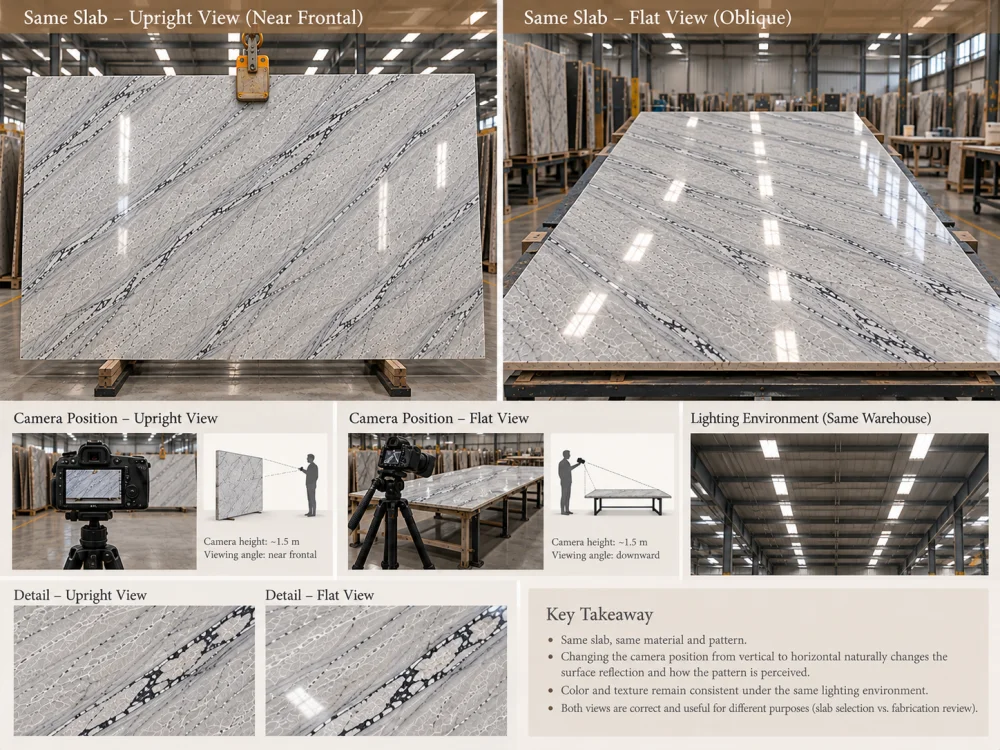
Before concluding that the material has changed, check whether the images show the same board, the same finished face, and the same surface finish.
Then ask for the available lighting and viewing information. If the difference matters to a material decision, request a targeted clarification rather than treating one photograph as automatically more truthful.
The related Quartzite slab showroom selection guide explains how complete slab photographs, board identification, and targeted details can support a more useful material review.
A change in appearance between upright and flat presentation does not automatically indicate a defect. Equally, a visually attractive slab display does not establish that every technical requirement has been met.
Consider three different observations.
Observation A: The natural veins appear more prominent when the slab is upright. This may be a matter of viewing distance, pattern scale, or perspective.
Observation B: The polished surface shows a strong reflected line when the slab is flat. This may be a reflection effect that warrants further review if it raises a specific concern.
Observation C: A local area appears different under another lighting condition. The team may need to examine whether the difference belongs to the stone itself, the surface finish, or the viewing environment.
None of these observations alone establishes a measurable defect, a petrographic classification, or a fabrication acceptance result.
Natural Quartzite should also be distinguished from engineered quartz. A commercial material name does not replace confirmation of the actual product being offered.
If a project raises a dimensional or material-condition question, record the relevant slab area and request the appropriate technical review. Keep that question separate from the aesthetic comparison of upright and flat views.
A useful slab-viewing record does not need to become a long production checklist. It should simply preserve the conditions needed to understand the visual decision.
If several people are reviewing the material, their comments should remain connected to the same slab evidence. The Quartzite slab selection with multiple decision makers guide explains how to distinguish visual preferences from technical and approval decisions.
The key point is that an upright display and a flat display are two different ways of observing the same natural material. A meaningful decision uses the view that answers the project’s question and recognizes what that view cannot prove.
The surface interacts differently with lighting, reflections, viewing distance, and perspective. The natural stone pattern may be unchanged even though certain features become more or less prominent.
Not universally. Upright viewing can help with the overall vertical composition, while flat viewing may be useful for horizontal applications. The better review is the one that matches the decision being made.
A properly supported flat review can be helpful where available, but it is not always necessary or practical. The project can also use actual slab photographs, a proposed cutting layout, and realistic finished-island views to evaluate the horizontal composition.
Changing presentation position does not by itself change the stone’s intrinsic color. It can change perceived appearance because the surface faces the light and viewer differently. Surface reflections and photographic settings may contribute further differences.
No. A photograph can document visual observations, but it cannot replace a defined dimensional measurement where flatness must be verified against a project requirement.
Confirm the slab identity, visible face, finish, presentation position, lighting, and camera conditions. Request complete slab views and targeted details that answer the actual project question.
Record the material and board reference, the viewing positions considered, important lighting and distance conditions, the intended application, the specific visual decision, and any issues requiring further review.
Review Natural Quartzite for Its Intended ApplicationFor an international Quartzite project, HRST STONE can help coordinate available full-slab photographs, identified material references, proposed stone layouts, relevant CAD/shop drawing information, and visual inspection records according to the confirmed scope. Send Josh the material name, project application, required dimensions, quantities, surface finish, and delivery destination to discuss the next review steps.
حقوق الطبع والنشر © HRST STONE / XIAMEN HRST STONE CO., LTD. جميع الحقوق محفوظة.