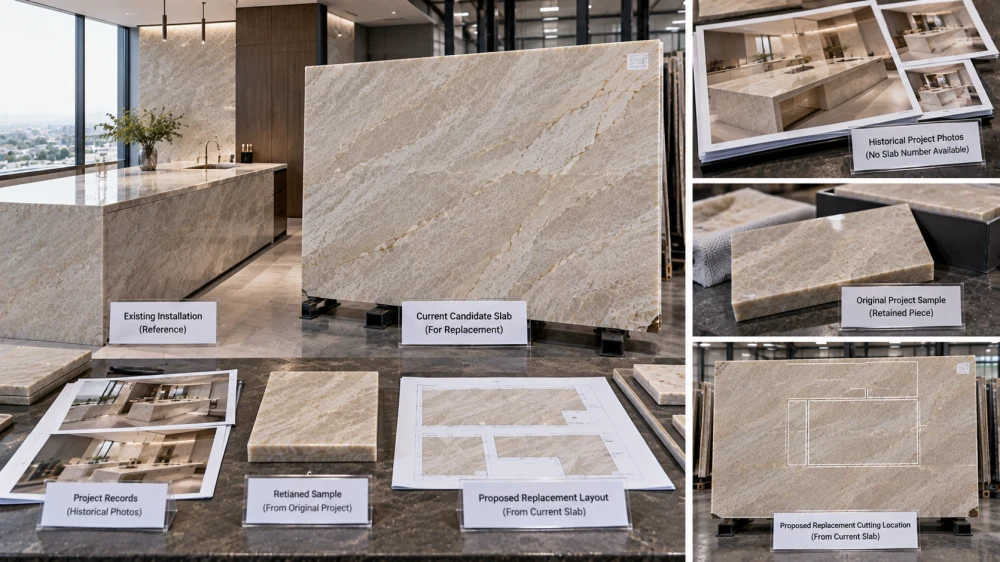
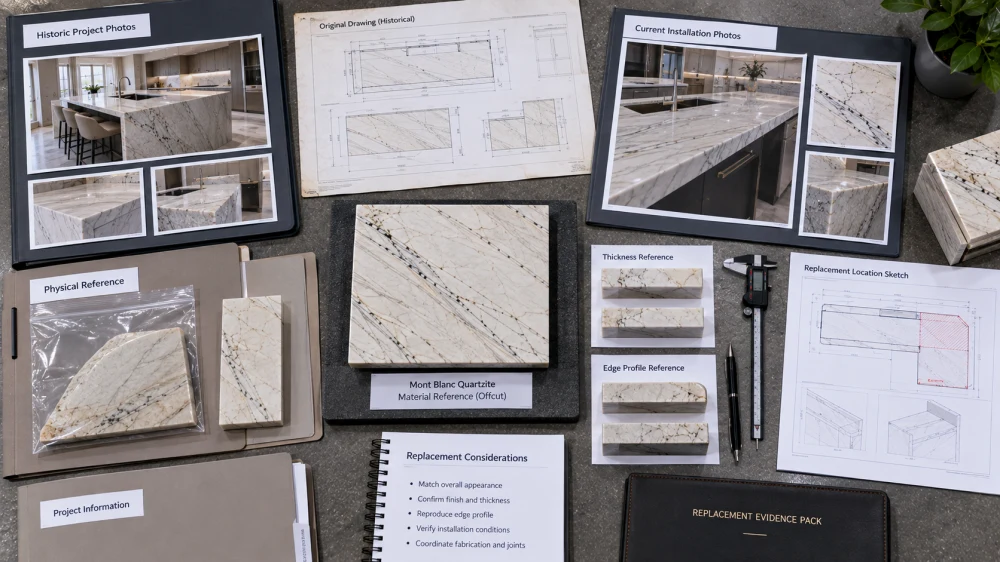
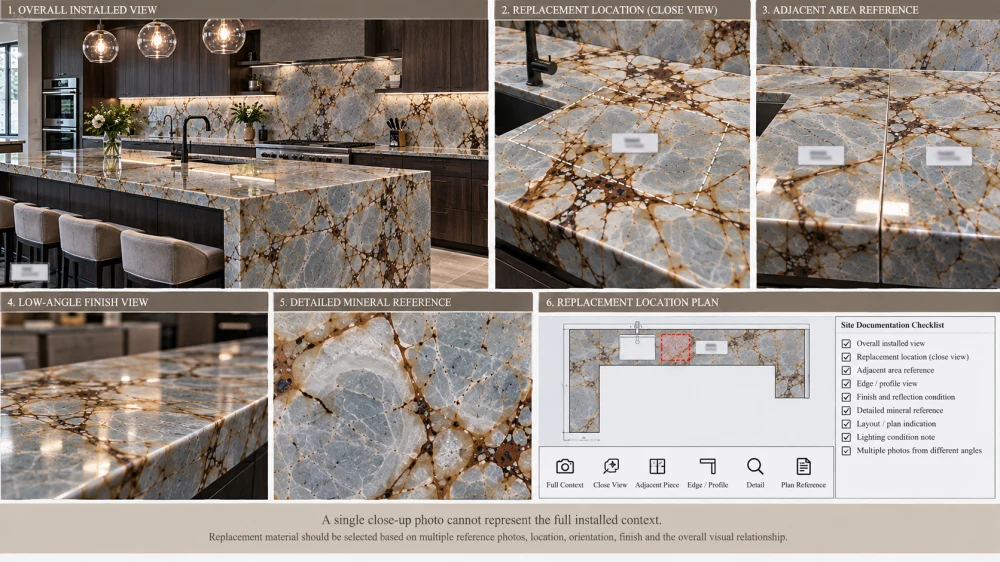
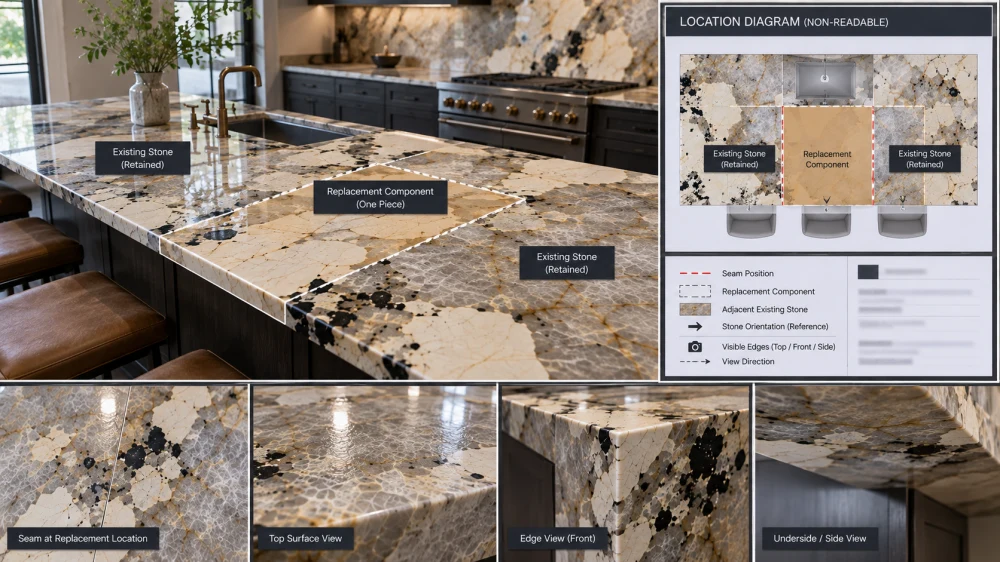
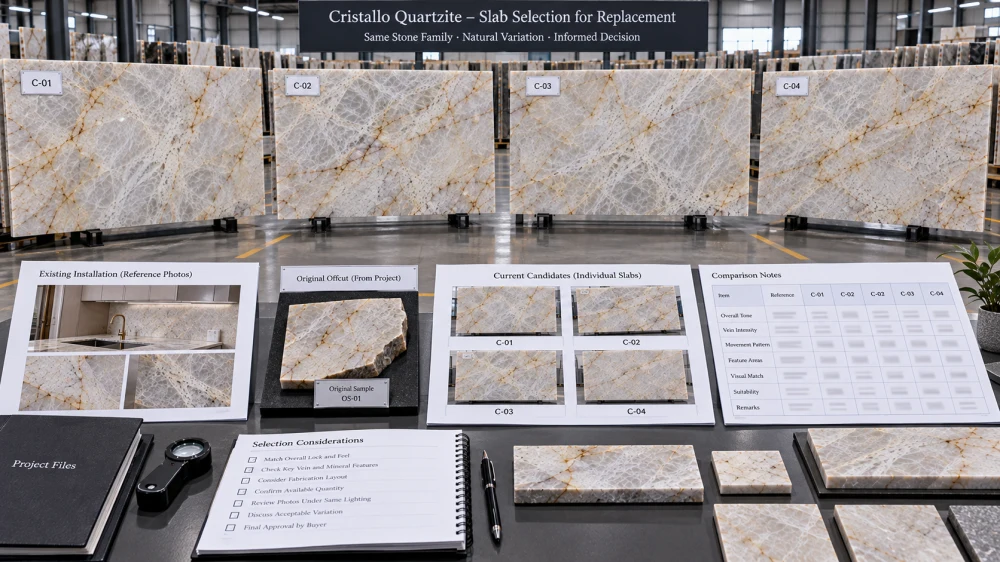
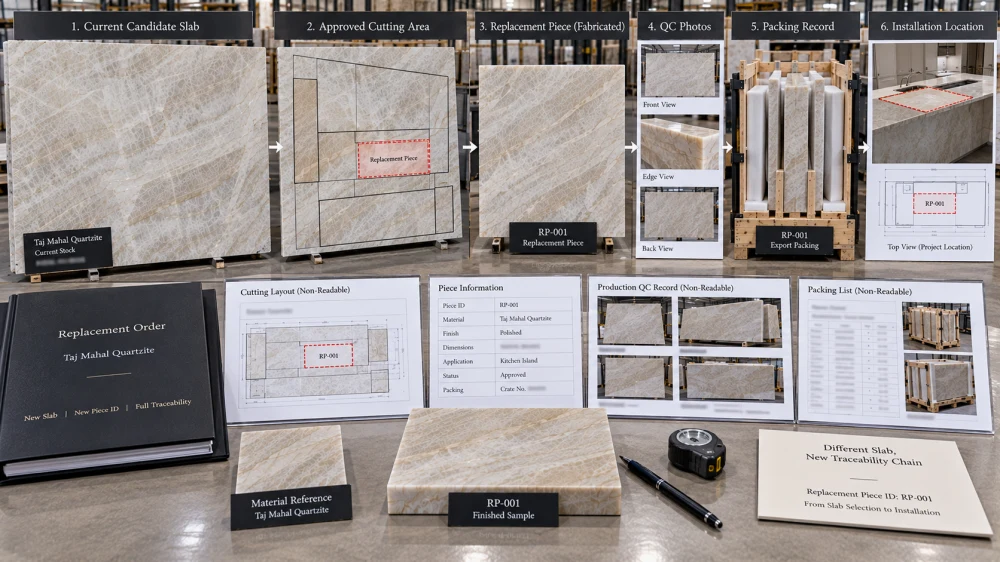
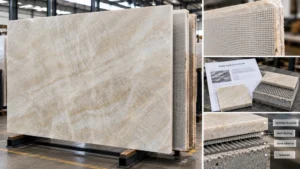
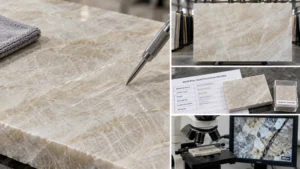
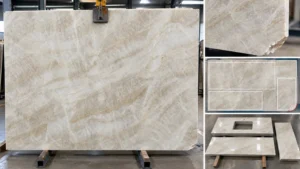
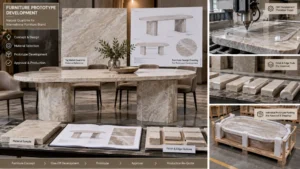
A Quartzite replacement order can still be evaluated when the original slab number is missing, but the process changes. Instead of claiming an exact slab match, rebuild the material record from the best available evidence: installed-surface photographs, original drawings, invoices, finish information, thickness, orientation, retained samples or offcuts, and the exact replacement location. Then compare identified candidate slabs against that evidence and obtain written approval for the replacement basis before cutting.
A Natural Quartzite countertop was installed several years ago.
Now one section needs to be replaced.
The original slab number is gone.
The supplier may have changed inventory, the fabricator may no longer have the cutting record, and the buyer may have only a few photographs and an old material name.
That does not automatically make a Quartzite replacement order impossible.
طلب-استبدال-كوارزيت-بدون-رقم-بلاطة-أصلية
But it changes the question.
The project is no longer asking:
“Can you send another piece from slab TM-218?”
It is asking:
“What evidence do we still have, and how can we use it to select and approve the most appropriate current replacement material?”
What Is Lost When the Original Slab Number Is Missing?
A slab number is a traceability reference.
It connects a physical slab to photographs, reservation records, cutting layouts, finished pieces, QC evidence, and other project documents.
If that identifier is missing, the buyer may still know the commercial stone name, but the physical identity of the original slab is no longer directly established.
Information Available
What It Can Help Establish
What It Does Not Prove Alone
الاسم التجاري للأحجار
Likely material family / historic purchasing reference
Original physical slab identity
Old installation photograph
Visible tone, movement and installed context
Exact color under controlled conditions
Original invoice
Material name, supplier or order reference where recorded
Exact slab unless separately identified
Retained sample
Physical comparison reference
Complete visual range of the original slab
Original offcut
Strong physical evidence from the original material where provenance is known
Automatic match to every area of the installed slab
Trade Name Is Not the Same as Original Slab Identity
This distinction becomes critical in replacement work.
A commercial name such as Taj Mahal Quartzite, Blue Roma Quartzite, Mont Blanc Quartzite, or Patagonia Quartzite can help the supplier search the relevant material family.
But Natural Quartzite is slab-specific.
Different slabs sold under the same commercial name may vary in:
For an older replacement project where that information has already been lost, the team must reconstruct the best available visual and technical reference instead.
Start With an Evidence Recovery Pack
Before asking a supplier to find “something similar,” collect everything still available.
The point is to identify what evidence exists before choosing new material.
Rank the Evidence by How Directly It Relates to the Original Stone
All evidence should not be treated as equally strong.
A useful project hierarchy is:
Confirmed Original Offcut → Confirmed Original Sample → Dated Original Slab / Fabrication Photos → Current Installed Surface → Original Project Documents → Commercial Name → Memory / Verbal Description
This is not a universal legal hierarchy.
It is a practical way to stop a weak clue from silently becoming an “exact match” reference.
For example, “the homeowner remembers it as creamy white” may be useful context, but it should not override a retained physical offcut from the original installation.
Photograph the Existing Quartzite as a Replacement Reference
If no original slab image survives, the installed stone becomes one of the most important visual references.
Photographs remain supporting evidence. Camera settings, lighting, screen rendering, age, maintenance, and surface condition can affect how the installed stone appears.
Map Exactly Where the Replacement Piece Will Sit
Matching importance depends heavily on location.
A replacement panel installed alone across a room creates a different visual problem from a 300 mm piece inserted directly between two existing pieces.
Replacement Relationship
Visual Review Priority
Directly touches existing Quartzite
Tone, movement, finish, thickness, edge and seam relationship
Separated by sink, appliance or architectural break
Overall visual compatibility plus local interface conditions
Different wall / room / elevation
Project-defined visual relationship rather than assumed direct continuity
Highly visible continuation of movement
Orientation, mineral scale and transition become especially important
Recover the Finish, Thickness, and Edge Information Separately
Finding a visually similar slab is only part of the replacement task.
The new component may still look wrong if its fabrication does not relate correctly to the existing work.
Record where possible:
stone thickness;
finished build-up;
نهاية السطح؛;
visible sheen;
شكل الحافة؛;
miter or laminated edge condition;
backsplash or return relationship;
visible underside where relevant; and
orientation of the major stone movement.
If the existing finish has aged, been refinished, sealed, or maintained differently over time, the project should decide whether the new piece is expected to match the present installed appearance or another retained original reference.
Search for the Old Slab Number Before Abandoning Traceability
“The buyer does not have the slab number” does not necessarily mean the number no longer exists anywhere.
Before switching completely to visual reconstruction, search historic records.
Useful places include:
supplier order records;
fabricator cutting plans;
رسومات المحل؛;
slab reservation forms;
full-slab photographs;
QC photographs;
packing lists;
crate records;
piece labels;
email approval records; and
project cloud folders.
If a valid original slab reference is recovered, preserve it with the replacement-order record.
What If the Original Slab Is No Longer Available?
Even when the original slab number is recovered, the physical slab may have been fully fabricated or the remaining material may no longer exist.
The next step is then candidate selection.
Ask the supplier to identify current slabs under their own current board numbers rather than presenting them as the original material.
Replacement Rule
A new candidate slab should receive its own current identity. Do not reuse the missing original slab number, and do not describe a visually similar slab as though it were the original physical slab.
Compare Candidate Slabs Against the Existing Installation
Once current candidate slabs are identified, compare them against the strongest available reference set.
the actual area available for the replacement piece.
Do not judge only from a small chip if the finished replacement will use a large visible area.
Use the Cutting Layout to Choose the Best Area of the Candidate Slab
A candidate slab does not need to resemble the existing installation equally across its entire surface for every project.
The more useful question can be:
Can the required replacement component be positioned in an appropriate area of this candidate slab?
This is where the replacement drawing and actual slab photograph should be reviewed together.
The team can evaluate:
which area will become the finished piece;
اتجاه الحركة؛;
visible mineral features;
edge relationships;
القطع الفراغية؛;
seam position; and
adjacent existing stone.
This converts a vague “find a similar slab” request into a specific finished-piece selection decision.
Exact Match and Acceptable Replacement Are Different Claims
This distinction should be written clearly.
Without the original slab or a directly traceable remaining piece, the supplier should not casually promise an exact match.
Instead, the project can define an approval basis such as:
candidate reviewed against retained original offcut;
candidate reviewed against installed surface photographs;
candidate reviewed against original project photographs;
candidate selected for overall visual compatibility;
specific slab area approved for the replacement component; or
another written project-specific basis.
The buyer or responsible design party then decides whether that basis is acceptable for the actual location.
What If No Candidate Is Visually Close Enough?
Do not force an “exact match” narrative.
The project may need to consider alternatives.
Depending on the design and site conditions, options for the responsible project team to evaluate can include:
reviewing additional slabs;
using a different area of a candidate slab;
replacing a larger connected section;
moving the transition to a more logical architectural break;
using a deliberately coordinated rather than falsely identical material;
revising seam placement; or
another project-specific design solution.
The stone supplier can provide material evidence and fabrication information, but design acceptance and site decisions should remain with the responsible project parties.
Give the Replacement Piece a New Traceability Chain
The original traceability may have been lost.
The replacement order should not repeat that mistake.
For new work, carrying source slab numbers into finished-piece identification provides much stronger traceability than relying only on the material name.
Replacement Approval Gate Before Cutting
REPLACEMENT RELEASE CHECK
□ Replacement location identified
□ Current dimensions confirmed or status recorded
□ Existing visible faces documented
□ Existing finish recorded
□ Thickness / edge condition reviewed
□ Historic evidence collected
□ Original slab number searched where practical
□ Current candidate slab number recorded
□ Full candidate slab reviewed
□ Proposed replacement area shown on slab
□ Orientation reviewed
□ Adjacent existing material considered
□ Acceptance basis written
□ Named approver recorded
□ Cutting release recorded
التعليمات
1. Can a Quartzite replacement order be matched without the original slab number?
لا يزال من الممكن إجراء التقييم، لكن لا ينبغي أن يفترض الإجراء وجود تطابق دقيق بين اللوح الأصلي واللوح البديل. يجب جمع أقوى الأدلة المتاحة، وتحديد اللوحات المرشحة الحالية، ومقارنتها بالمواد المركبة وموقع الاستبدال، والحصول على موافقة خطية بشأن أساس الاستبدال المختار.
2. Is the Quartzite trade name enough to find the original slab?
لا. يمكن للاسم التجاري أن يعرّف عائلة المادة أو المرجع التاريخي للشراء، لكنه لا يحدّد بشكل فريد اللوح الفعلي. يتطلب تحديد الهوية الأصلية للوح رقمًا للوحة أو سجلًا آخر قابل للتتبع يربط المادة بالعمل المُركَّب.
3. What evidence is most useful when the original Quartzite slab number is missing?
يمكن أن يكون قطع أصلي مؤكد أو عينة محتفظ بها مفيدًا بشكل خاص. كما يمكن أن تساهم الصور التاريخية للألواح وعمليات التصنيع، وصور التركيب الحالية، والمخططات، والفواتير، وسجلات التعبئة، ومعلومات التشطيب، وسماكة اللوح، وتفاصيل الحواف، بالإضافة إلى الموقع الدقيق للاستبدال، في عملية مراجعة الاستبدال.
4. Can photographs guarantee that a new Quartzite slab will match the installed stone?
No. Photographs are useful visual evidence, but lighting, camera settings, screen rendering, surface condition, maintenance, and natural stone variation can affect appearance. Use current slab evidence and an agreed approval process rather than treating photographs as a guarantee of exact matching.
5. Should a replacement Quartzite piece have a new slab number?
The candidate source slab should retain its own current slab or board identifier. The replacement component should also receive a project-specific piece ID linked to that source slab, cutting layout, QC record, and packing record.
6. What should I do if no current Quartzite slab matches closely enough?
The responsible project team can review additional slabs or consider changes such as selecting a different slab area, replacing a larger connected section, moving a transition to an architectural break, or using an intentionally coordinated material. The appropriate choice depends on the actual installation and design requirements.
7. What should be approved before cutting a Quartzite replacement piece?
Confirm the replacement location, dimensions, visible faces, finish, thickness and edge condition where relevant, current candidate slab identity, proposed cutting area, orientation, visual comparison basis, named approver, and the scope of the cutting release.
Final Replacement RuleWhen the original slab number is missing, do not replace traceability with guesswork. Rebuild the decision from evidence: Historic Records → Installed Surface → Replacement Location → Physical Sample / Offcut → Current Candidate Slab → Proposed Cutting Area → Visual Approval → New Piece Traceability → Cutting Release.
For a Natural Quartzite replacement order, HRST STONE can review the material information available, current installation photographs, retained samples or offcuts, drawings, replacement dimensions, finish requirements, and current candidate slabs. Once a replacement basis is agreed, the selected slab, proposed cutting area, replacement piece ID, fabrication QC, and packing records can be kept connected through the new order. Send Josh the available historic records, current photographs, dimensions, finish, quantity, replacement location, and delivery destination for review.
Hi, I am the author of this article. I have been working in the field of Natural Stone for more than 15 years. If you need customized Natural Stone services, please feel free to contact me.