Recortes para pias de quartzito: por que os detalhes de canto precisam da aprovação do fabricante
Post navigation
Resumo Rápido
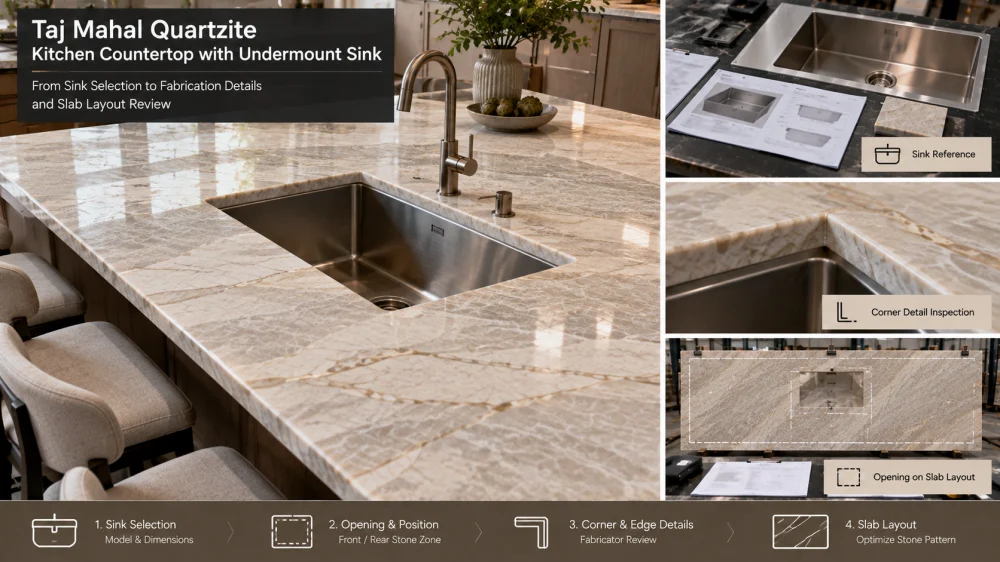
Os recortes de pia em quartzito não devem ser definidos apenas com um raio de canto genérico ou uma dimensão aproximada da pia. O fabricante responsável precisa do modelo atual da pia, das informações do fabricante ou de um template aprovado, do tipo de montagem, dos requisitos de abertura, do desenho da bancada, do layout real da laje, da geometria da pedra próxima, das exigências relativas às bordas visíveis, do contexto de suporte e de outros insumos específicos do projeto para a fabricação. A geometria do canto é parte integrante da abertura completa — não um valor isolado que deva ser copiado de outro projeto.
Um comprador pode olhar para o desenho da bancada e fazer uma pergunta aparentemente simples:
“Qual raio devemos usar nos cantos da pia?”
No caso do Quartzito Natural, essa pergunta normalmente deve ser encaminhada ao fabricante responsável, juntamente com as informações concretas do projeto.
O motivo não é que os detalhes dos cantos sejam misteriosos. É que a abertura para a pia é uma condição de fabricação interligada.
O canto está inserido dentro de uma abertura. A abertura, por sua vez, está contida em um componente da bancada. Esse componente provém de uma área específica de uma laje natural e interage com a pia, as bordas visíveis, os furos para torneiras, as juntas próximas, as condições de suporte e os requisitos de manuseio.
Ao retirar todo esse contexto e solicitar um único valor universal para o canto, é possível transformar uma decisão de fabricação específica de cada projeto em uma regra sem respaldo técnico.
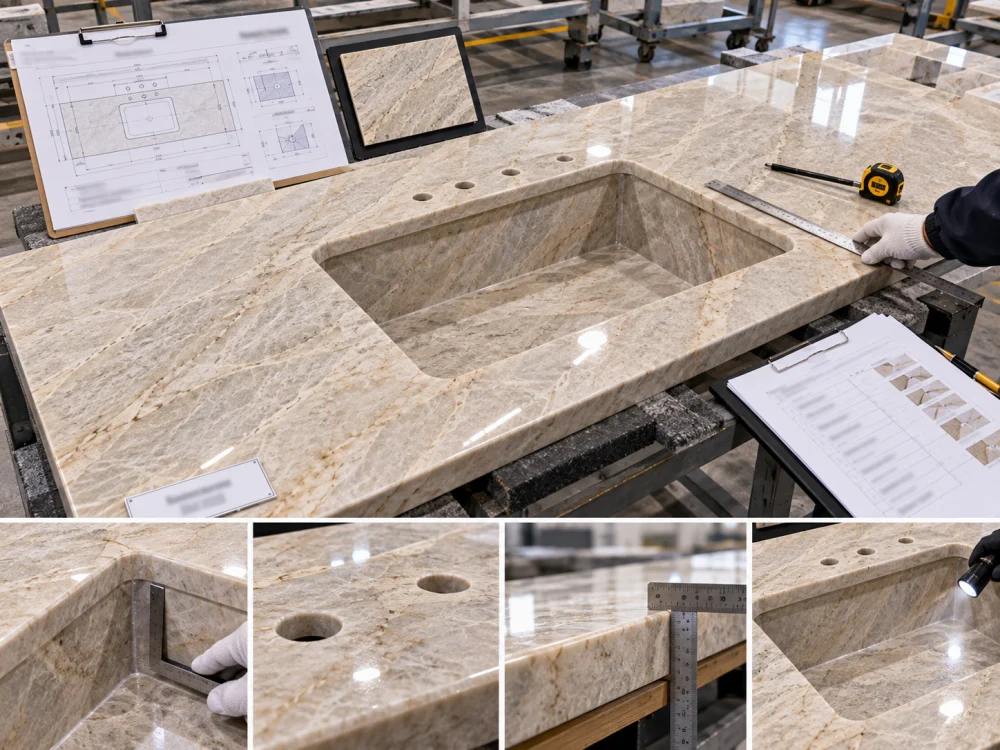
Observe a Abertura Completa antes de Analisar o Canto
ANATOMIA DO RECORTE DA PIA
01 — Pia
cristallo-quartzite-sink-cutout-corner-detail
Fabricante, modelo e versão exatos do produto.
02 — Condição de Montagem
Montagem inferior, montagem superior, acabamento nivelado, arranjo com avental frontal ou outro sistema específico do projeto.
03 — Abertura
A geometria real do recorte na pedra, derivada das informações de fabricação aprovadas.
04 — Cantos
Geometria do canto como parte integrante da abertura completa, e não como um detalhe isolado.
05 — Borda Visível do Recorte
Especialmente relevante quando a montagem inferior expõe a borda da abertura fabricada.
06 — Pedra Circundante
Trilho frontal, trilho traseiro, áreas laterais e pedra remanescente ao redor de furos, juntas ou bordas próximas.
07 — Posição Real da Laje
A localização do componente completo da bancada e do recorte dentro da laje selecionada de Quartzito Natural.
Esta é a escala útil de revisão para Recortes de pia em quartzito.
O Tamanho Total da Pia Não é o Mesmo que o Recorte na Pedra
Um dos erros mais comuns é receber a dimensão total da pia e tratá-la como a abertura da bancada.
TAMANHO TOTAL DA PIA
Descreve as dimensões externas do corpo da pia, do rebordo, da flange ou de outra dimensão do produto definida pelo fabricante.
RECORTE NA PEDRA
Define a abertura que será efetivamente fabricada no Quartzito, de acordo com as informações aprovadas sobre a pia e o projeto.
Essas dimensões não devem ser automaticamente consideradas iguais.
Especialmente no caso de uma pia fornecida pelo proprietário, a equipe de fabricação deve receber as informações exatas do produto, em vez de ser solicitada a deduzir uma abertura irreversível a partir de uma fotografia, de uma dimensão aproximada do catálogo ou de um símbolo genérico de pia.
Para projetos em que a pia é adquirida separadamente da pedra, consulte o guia relacionado sobre Pedidos de quartzito com pias fornecidas pelo proprietário para o pacote mais amplo de especificações que deve ser coordenado antes da fabricação.
Por Que o Canto Não Pode Ser Avaliado Sozinho
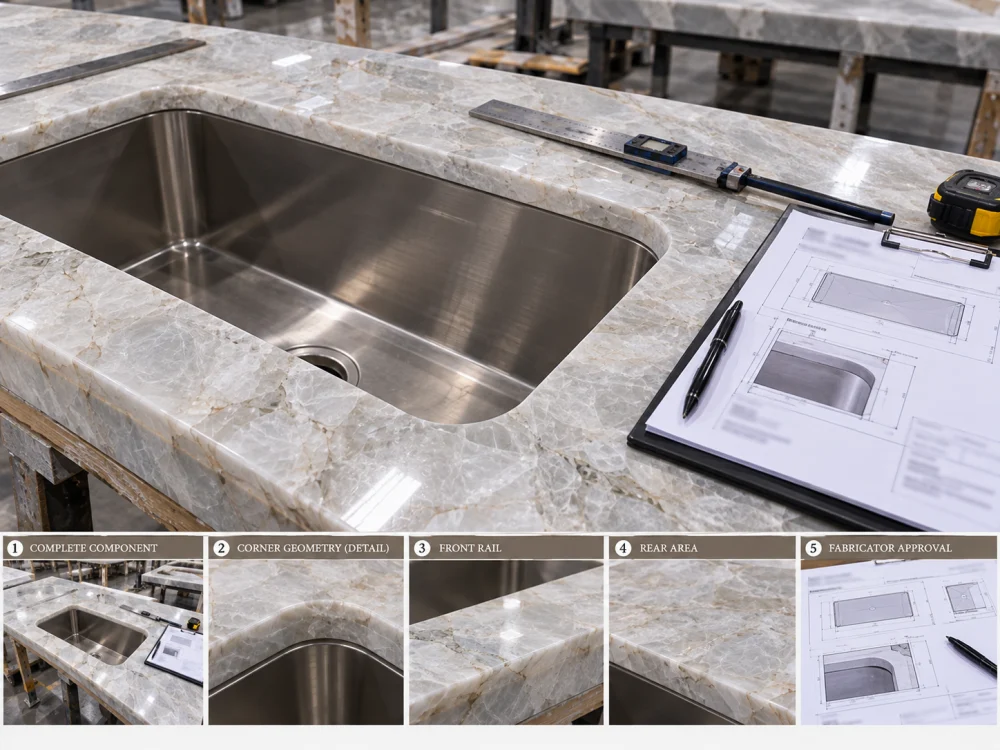
Imagine ampliar um canto da abertura de uma pia de montagem inferior.
O próprio canto pode parecer um pequeno detalhe geométrico, mas o fabricante pode precisar levar em conta sua relação com diversas condições circundantes.
Condição Próxima
Por Que Deve Fazer Parte da Revisão
Template da pia
Define a relação pretendida entre a abertura e a pia real, em vez de uma forma aproximada.
Revelação
Altera a relação visual entre a cuba da pia e a abertura finalizada na pedra, quando aplicável.
Pedra frontal / traseira
A abertura deixa pedra remanescente ao redor; essa geometria deve ser revisada como parte do componente completo.
Furos para torneiras / acessórios
Outras aberturas podem ocorrer na mesma zona da bancada.
Junta ou borda próxima
A abertura da pia deve ser avaliada dentro da geometria do componente finalizado, e não como uma forma isolada.
Natural stone condition
The proposed cutout position should be reviewed against the actual selected slab where material features are relevant.
Corner Radius Is Not a Universal Quartzite Number
A buyer may search for a single recommended minimum radius for every Natural Quartzite sink opening.
This article deliberately does not provide one.
Fabrication Boundary
The appropriate corner geometry should be reviewed by the responsible fabricator against the actual sink information, opening geometry, material, countertop component, machining approach, surrounding stone, support and installation context. A number used on another project should not automatically become the specification for the current one.
The buyer’s job is therefore not to invent a radius.
The buyer should make sure the fabricator receives enough controlled information to make and approve the project-specific fabrication decision.
The Cutout Has Four Corners, but They Do Not Exist in Isolation
On a drawing, it is tempting to focus on C1, C2, C3 and C4 as four identical geometric points.
In the real countertop, their surroundings can differ.
C1 — Front Left
Review in relation to the front stone section, side condition and actual slab position.
C2 — Front Right
Review in relation to the front stone section and any nearby edge, seam or project feature.
C3 — Rear Right
Review together with rear stone geometry, faucet or accessory openings where applicable, and the surrounding layout.
C4 — Rear Left
Review using the same controlled project information and actual component geometry.
The C1–C4 labels are only a communication device. They do not prescribe a fabrication method or imply that different radii are required.
The benefit is that a reviewer can say “check the condition near C3” instead of sending an ambiguous cropped photograph.
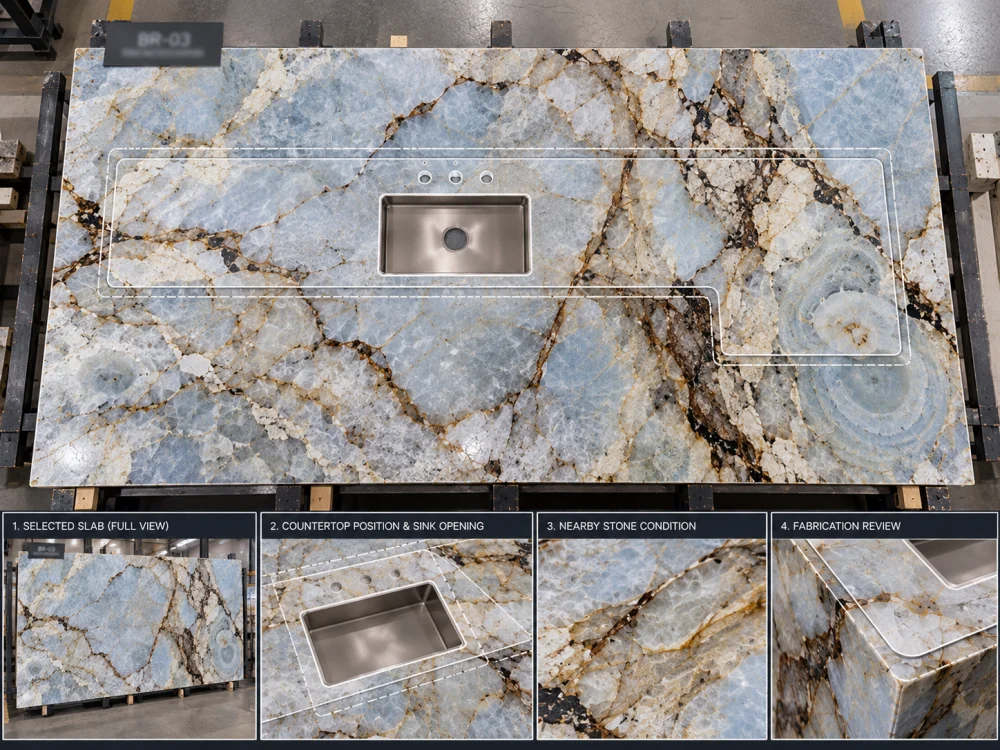
Natural Stone Makes Slab Position Relevant
Natural Quartzite is not a visually or structurally uniform manufactured sheet.
cristallo-quartzite-sink-cutout-corner-detail
The selected slab can contain changing mineral structures, natural fissures, crystalline areas, tonal transitions and other geological features.
That does not mean every visible feature is a defect.
It does mean that the sink cutout should be considered within the actual slab layout when the material condition is relevant to fabrication.
Identified Natural Quartzite slab + proposed finished countertop outline + actual sink cutout position + nearby stone conditions + current drawing revision.
What If a Natural Feature Passes Near a Sink Corner?
Do not classify the condition from a photograph alone and do not automatically assume the entire slab must be rejected.
First locate the feature relative to the finished geometry.
A useful technical review can distinguish:
Condition outside the finished piece
The area may not remain in the fabricated countertop.
Condition inside the finished piece but away from the opening
Its relevance should be reviewed against the actual application and project requirements.
Condition near the sink opening, narrow stone area, seam or other critical geometry
Escalate it to the responsible fabricator for project-specific review before cutting.
This same location-based principle is useful when reviewing repairs or other documented slab conditions: the meaningful question is not only what the condition looks like, but where it falls in relation to the finished component.
The Sink Opening Must Follow the Current Drawing Revision
Consider this sequence:
Drawing R01
Preliminary sink position
↓ Sink Model Changes
↓ Drawing R02
Updated opening information
↓ Layout Review
↓ Drawing R03
Current fabrication proposal
If R03 is current, a screenshot from R01 should not quietly remain the cutting instruction.
This is especially important because the change may affect more than the opening itself. It can affect the countertop layout, faucet-hole position, surrounding stone geometry, slab nesting and other coordinated details.
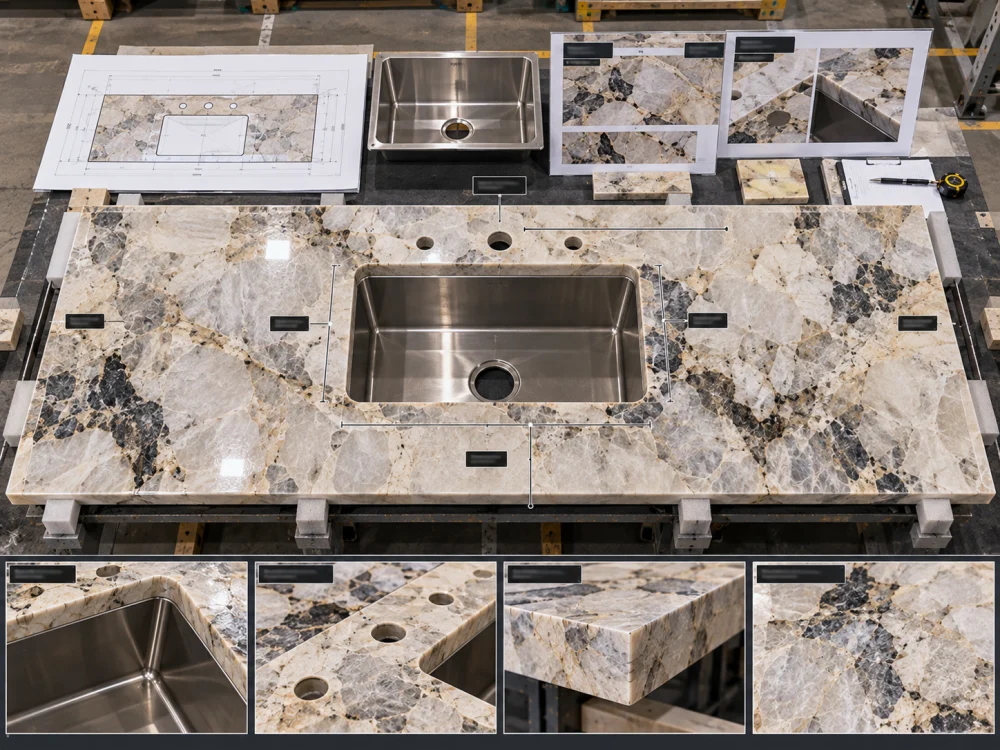
Undermount Sinks Add a Visible Edge Question
With an undermount sink, part of the cut opening may remain visible after installation.
layout da laje para recorte da pia em quartzito blue-roma
The project therefore needs more than an opening outline.
Depending on the approved design and sink system, the fabrication information may need to identify:
the intended reveal relationship;
which cut surfaces remain visible;
the required finish of those visible surfaces;
corner appearance;
sink alignment; and
other applicable interface details.
“Undermount sink” alone does not completely define the finished stone opening.
Watch the Stone That Remains Around the Opening
The opening is only one part of the geometry.
The remaining Quartzite matters too.
FRONT ZONE
Stone between the sink opening and the finished front edge.
REAR ZONE
Stone behind the opening, potentially interacting with faucet and accessory holes.
SIDE ZONES
Stone between the opening and countertop ends, seams or adjacent conditions.
BETWEEN OPENINGS
Stone remaining between a sink and another opening where the design includes more than one cutout.
This is another reason not to specify a sink corner independently from the complete countertop geometry.
Faucet Holes Belong on the Same Coordination Drawing
A sink opening may be approved correctly while a nearby faucet or accessory hole is still missing, outdated or incorrectly positioned.
Where applicable, coordinate:
faucet model information;
number of holes;
hole locations;
soap dispenser or accessory openings;
relação com a pia;
backsplash or rear-edge relationship; and
cabinet / installation interfaces.
The objective is to review the countertop as one fabricated component rather than approving each opening in isolation.
The Fabricator Approval Gate
Instead of giving buyers a universal corner specification, use a controlled release gate.
DO NOT RELEASE THE SINK OPENING UNTIL THE PROJECT HAS RESOLVED THE APPLICABLE INPUTS
Interfaces: Relevant cabinet, support or site information
Destino: Project delivery location for quotation and logistics coordination
HRST can then coordinate the confirmed information into the shop drawing and fabrication review instead of asking the factory to interpret a sink photograph or approximate opening.
Perguntas frequentes
1. Why do Quartzite sink cutout corners need fabricator approval?
Porque o canto faz parte da abertura completa da pia e da geometria final da bancada. O fabricante responsável deve revisar as informações reais da pia, a abertura, a pedra circundante, a posição da laje, quando pertinente, a abordagem de usinagem, o suporte e demais condições de fabricação específicas do projeto antes do corte.
2. What corner radius should be used for a Quartzite sink cutout?
Não existe um raio universal que este guia possa definir para todas as bancadas de quartzito natural. A geometria adequada do canto deve ser determinada pelo fabricante responsável, com base na pia real, nas informações aprovadas sobre o vão, bem como nas condições do material e do projeto.
3. Is the overall sink size the same as the Quartzite cutout size?
Não automaticamente. As dimensões gerais da pia descrevem o produto de pia, enquanto o recorte na pedra define a abertura executada na bancada. Utilize as informações do fabricante ou do projeto aprovadas para a pia real, em vez de converter diretamente uma dimensão geral em uma instrução de corte.
4. Does an undermount sink require a finished Quartzite cut edge?
Uma condição de instalação sob a bancada pode deixar parte da abertura fabricada visível. Portanto, o projeto deve definir o acabamento e os requisitos da superfície aparente previstos, enquanto o fabricante responsável confirma o detalhe de fabricação aplicável.
5. Should the sink cutout be checked against the actual Quartzite slab?
Quando características naturais específicas da laje ou condições de layout puderem influenciar a bancada proposta, verificar o vão em relação à laje realmente selecionada pode ajudar o fabricante a avaliar a geometria final antes do corte.
6. Can a sink rendering or product photograph be used for final Quartzite cutting?
Uma representação visual ou uma fotografia pode transmitir a intenção de projeto, mas não deve substituir as informações de fabricação controladas necessárias para a execução real da abertura. Utilize o modelo exato da pia, as informações técnicas vigentes, o gabarito aprovado, quando aplicável, e o desenho atual da bancada.
7. What happens if the sink model changes after the cutout drawing is approved?
A abertura deve ser revisada novamente antes da fabricação. Não substitua apenas o nome do modelo da pia, continuando a utilizar uma abertura ou um desenho aprovados para um produto diferente.
8. What should I send HRST STONE for a Quartzite sink cutout review?
Envie a Josh as referências de materiais e lajes de quartzito natural, o desenho atual da bancada, as dimensões acabadas, o fabricante e o modelo exatos da pia, os documentos técnicos ou o modelo aplicável, o tipo de montagem, as exigências de friso, os furos para torneira e acessórios, as especificações relativas à borda aparente, as interfaces pertinentes e o destino da entrega.
Project-Specific Cutout Coordination
HRST STONE can coordinate selected Natural Quartzite slabs, CAD/shop drawings, sink information, cutting layouts, fabrication records, QC photographs and export packing around the confirmed project scope. For irreversible sink openings, the current approved fabrication information should remain identifiable before cutting begins.
Hi, I am the author of this article. I have been working in the field of Natural Stone for more than 15 years. If you need customized Natural Stone services, please feel free to contact me.
Fabricante e Fornecedor de Mármore, Granito, Quartzito, Ágata da China - HRST STONE
Bem-vindo à HRST STONE!
Olá, gostaria de saber mais sobre seus produtos. Você poderia compartilhar informações sobre preços, quantidade mínima de pedido, opções de personalização e amostras?