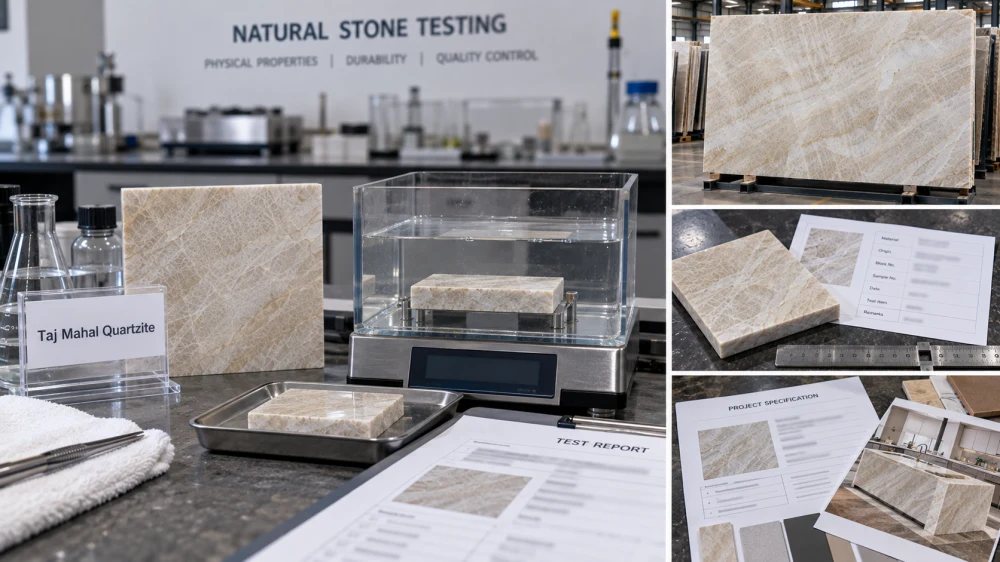
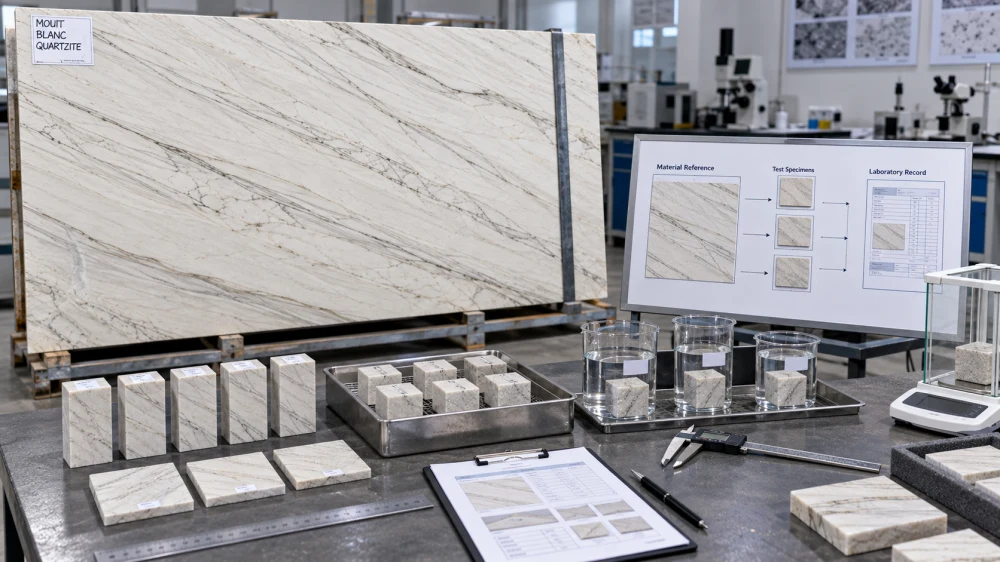
석영암의 수분흡수 결과는 해당 시험 방법과 보고 기준 하에서 시험된 시료가 어떤 성능을 보였는지를 알려줍니다. 이 결과만으로 주문된 모든 판재가 방수, 방오, 내한성에 모두 적합하거나 모든 용도에 사용 가능하다는 단독적인 약속으로 해석되어서는 안 됩니다. 구매 결정이나 기술 제출 관련 의사결정에 이 결과를 활용하기 전에, 시험 방법, 시료의 정체성, 보고된 단위, 시험 일자, 해당 자재와의 관계, 그리고 이 결과가 비교되는 프로젝트의 기준 등을 반드시 확인하시기 바랍니다.
천연 석영암 시험 보고서에는 수분흡수 값이 표시됩니다.
구매자의 경우, 당장 숫자만 보고 다음과 같은 질문을 하게 되는 유혹에 빠지기 쉽습니다:
“이게 좋은 건가요?”
하지만 이러한 질문은 아직 너무 이른 단계입니다.
먼저, 다음 사항을 명확히 한 후에 석영암의 수분흡수 결과를 해석해야 합니다: 무엇이 시험되었는지, 어떻게 시험되었는지, 결과가 어떻게 보고되었는지, 해당 시료가 구매하려는 석재와 관련이 있는지, 그리고 해당 프로젝트가 실제로 검증하려는 요구사항이 무엇인지 등을 파악해야 합니다.
유용한 순서는 다음과 같습니다:
시험 방법 → 시료 → 결과 → 주문 관련성 → 프로젝트 기준 → 기술적 판단
석영암의 수분흡수 시험은 무엇을 측정하는가?
실질적인 구매자 입장에서는, 수분흡수 시험은 정해진 시험 방법의 조건 하에서 준비된 석재 시료가 얼마나 많은 물을 흡수하는지를 보고합니다.
중요한 핵심어는 다음과 같습니다:
석영암-수분흡수-결과-주문
준비된 시료 + 정해진 시험 방법.
결과는 완성된 석재 프로젝트와 물이 상호작용할 수 있는 모든 가능한 방식을 설명하는 것이 아닙니다.
이는 보고서가 나타내는 시료와 시험 절차에 대한 측정된 물리적 특성 결과일 뿐입니다.
단순한 숫자가 아닌 시험 보고서부터 시작하세요
이메일이나 견적서에 복사된 단독적인 값은 추적 가능한 보고서에 비해 그 의미가 훨씬 미약합니다.
결과를 해석하기 전에 다음 사항을 확인하세요:
실험실 이름;
보고서 번호;
시험 일자;
시험 방법;
재료 또는 시료명;
시료 식별 정보;
보고된 시료 정보;
보고된 값;
단위 또는 보고 기준;
주석 또는 제한 사항; 그리고
시험된 시료와 제공되는 재료 간의 관계.
구매자 규칙
석영암의 수분흡수 수치를 그 의미를 부여하는 시험 방법, 시료 정체성, 그리고 보고서와 분리해서는 절대 안 됩니다.
왜 시험 방법이 중요한가?
“수분흡수”는 논의되는 물리적 특성입니다. 시험 방법은 이 특성이 어떻게 평가되고 보고되었는지를 규정합니다.
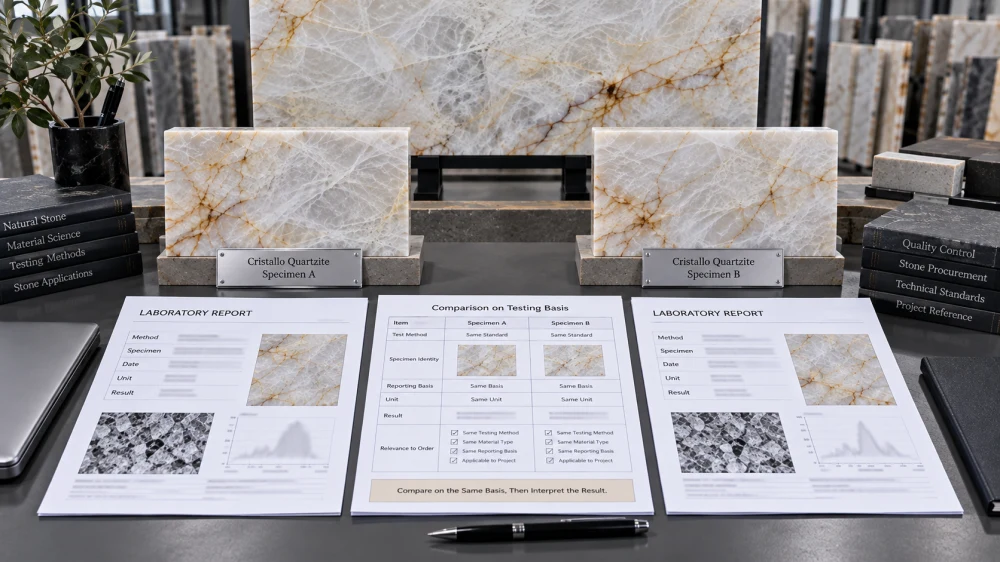
두 개의 보고서를 검토할 때, 두 보고서 모두 “수분흡수”라는 단어를 포함하고 있다고 해서 그것들이 직접적으로 비교 가능하다고 가정해서는 안 됩니다.”
동일한 시험 방법을 사용했는지 확인하세요:
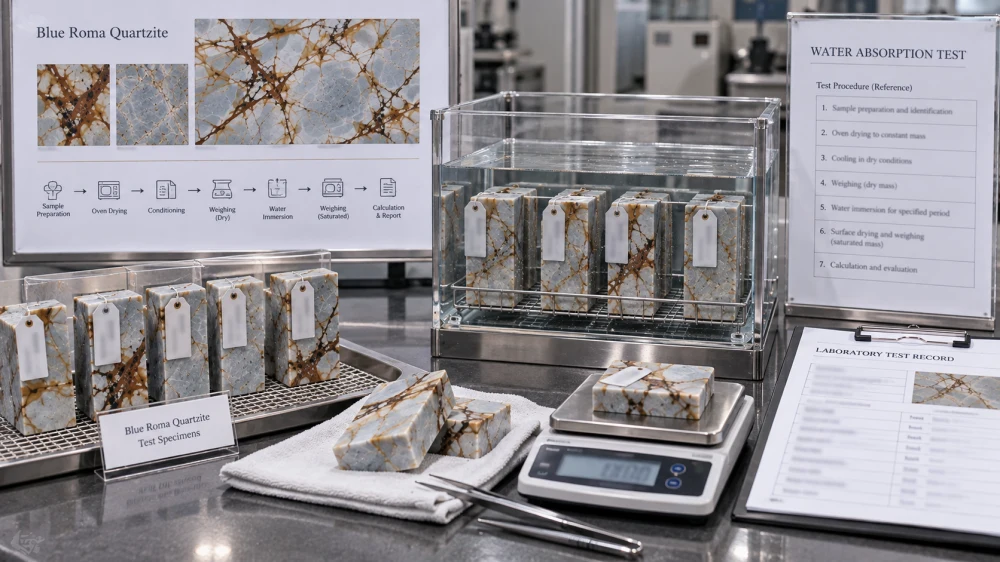
블루-로마-석영암-수분흡수-실험실-시험
시험 방법;
명시된 방법 버전;
시료 준비 기준;
조절 절차;
보고 기준;
단위; 그리고
보고서에 명시된 기타 조건들.
만약 이들 요소가 서로 다르다면, 각 방법이 무엇을 의미하는지 이해하지 못한 채 무분별하게 수치를 순위 매겨서는 안 됩니다.
결과는 보고 기준과 함께 읽어야 합니다
시험 결과 기록
시험 방법: 실험실 보고서에 명시된 바와 같이
시험 시료: 시험된 재료의 식별 정보
Result: Preserve exactly as reported
Unit / Basis: Preserve exactly as reported
보고서 작성일자: Record the actual date
Project Relevance: Establish separately
A buyer should avoid rewriting the laboratory result into stronger language than the report supports.
For example, a reported absorption value should not automatically become:
“waterproof”;
“non-porous”;
“cannot stain”;
“safe for all exterior climates”;
“maintenance-free”;
“suitable for every wet area”; or
“guaranteed for this installation.”
The Tested Specimen Is the Center of the Result
A laboratory does not test the commercial name in the abstract.
It tests specimens.
That makes sample identity one of the most important parts of a Quartzite water absorption review.
Is a block, lot, bundle, quarry or other reference stated?
Can the supplier connect the tested material to the current order?
Is the connection documented or only assumed?
The weaker the traceability between the specimen and the proposed Quartzite order, the narrower the report’s procurement value becomes.
Does One Water Absorption Result Represent Every Quartzite Slab?
자동으로는 아닙니다.
Natural Quartzite is natural stone, and variation can exist between geological zones, blocks, slabs and production lots.
A report therefore needs to be read according to what was actually sampled and tested.
This does not make historical or representative laboratory data useless.
It means the buyer should label it correctly.
Evidence
What It Can Support
Do Not Automatically Claim
Report for an identified specimen
Result for the tested specimen under the stated method
Every future slab has exactly the same value
Report linked to a known lot or material reference
Stronger traceability to the proposed supply
Every location in every slab is identical
Old report with unclear sample relationship
Background technical information with stated limitations
Current order-specific verification
What Does a Lower Water Absorption Result Mean?
When two genuinely comparable specimens are tested under the same relevant method and reporting basis, a lower reported absorption value indicates that the tested specimen absorbed less water under those test conditions.
That is the interpretation to keep.
Do not automatically extend it into:
lower absorption = better stone for every project.
The project may also need to consider:
strength;
abrasion or wear;
마감 처리;
slip requirements;
environmental exposure;
fabrication;
panel or piece geometry;
substrate;
installation system;
joints and detailing;
maintenance; and
other specification requirements.
Water Absorption Is Not the Same as Stain Resistance
This distinction is particularly important for countertop buyers.
A laboratory water absorption value should not be treated as a direct stain-resistance rating.
Staining can involve:
the contaminant;
contact time;
표면 마감 상태;
surface treatment or sealer;
cleaning procedure;
mineral characteristics; and
actual service conditions.
Water absorption data and stain evaluation therefore answer different questions.
Water Absorption Is Not the Same as Strength
A low Quartzite water absorption value does not, by itself, tell the buyer the material’s flexural strength, compressive strength, modulus of rupture, or ability to support a particular fabricated geometry.
Likewise, a strength test does not substitute for water absorption data.
The existing Natural Quartzite petrographic report guide explains the broader evidence principle: geological identification, physical testing and actual slab review are different information layers and should not be asked to replace one another.
Water Absorption Is Not Automatically a Frost-Resistance Result
Exterior projects create another common interpretation error.
Water inside or around natural stone can be relevant to exposure discussions, but a water absorption number alone should not be converted into a complete freeze-thaw or exterior-suitability conclusion.
An exterior project may also depend on:
the applicable specification;
climate and exposure;
stone thickness and geometry;
fixing or installation system;
drainage;
joints;
substrate;
other required physical properties; and
project-specific technical review.
If frost or another environmental performance requirement is important, evaluate the evidence required for that specific question rather than relabeling an absorption test.
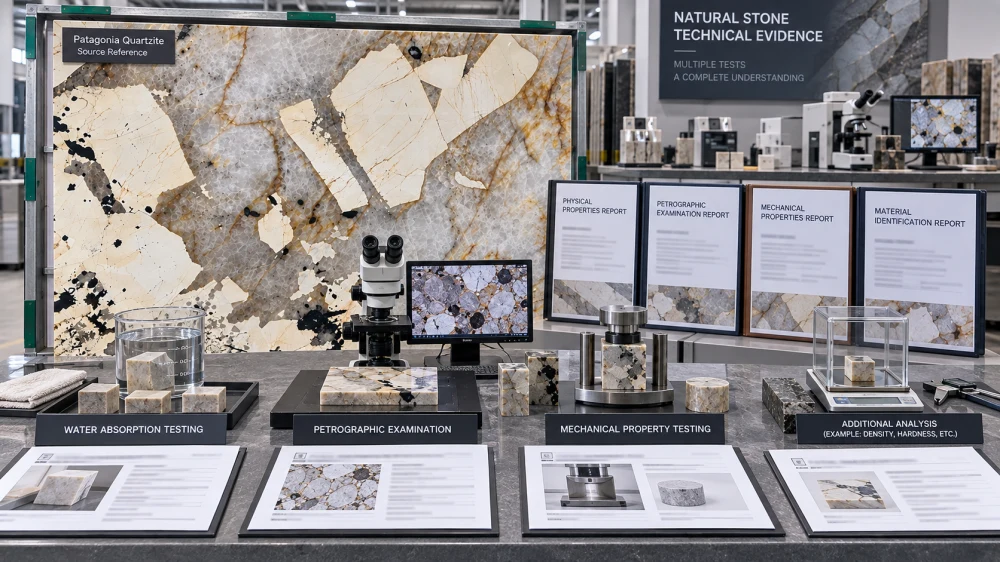
Different Test Documents Answer Different Questions
Evidence
주요 질문
Water absorption test
How did the tested specimens absorb water under the stated method?
Petrographic examination
What minerals, texture, fabric and geological characteristics were observed in the tested sample?
Strength test
How did the tested specimens respond under the stated mechanical test?
Abrasion / wear test
How did the tested material respond under the stated wear-related method?
실제 슬래브 검토
What material is actually being purchased and how does it look?
This separation is also important when writing specifications. Commercial material identity, geological classification, physical test data and actual slab approval serve different procurement functions and should remain separate records.
If two Quartzite suppliers provide different results, do not rank the stones immediately.
First build a comparable-result table.
확인합니다
Report A
Report B
시험 방법
Record exactly
Record exactly
Specimen identity
기록
기록
Reporting basis / unit
기록
기록
Report date
기록
기록
Relationship to current order
Confirmed / unclear
Confirmed / unclear
Reported result
Preserve original value
Preserve original value
If the basis differs materially, label the comparison accordingly instead of creating a false winner from two numbers that may not be directly comparable.
quartzite-water-absorption-report-comparison
The Project Specification Decides Whether the Result Is Acceptable
A laboratory reports a result.
A project specification may define a requirement.
Those are two separate pieces of information.
RESULT ≠ ACCEPTANCE CRITERION
The laboratory result tells you what was measured for the tested specimens. Whether that result satisfies a project requirement depends on the applicable specification, referenced standard, material category, application, and responsible technical review.
This is why a supplier should be careful about answering a technical submittal request with only:
“Our Quartzite absorption is X%, so it is suitable.”
A stronger response attaches the actual report, identifies the material relationship, and lets the relevant project requirement be reviewed against the documented evidence.
Do Not Invent a Universal “Good Quartzite” Threshold
Buyers often want one simple number that separates good Quartzite from bad Quartzite.
That shortcut can be misleading.
The relevant criterion may depend on:
the test method;
the material classification used by the specification;
the applicable standard;
the project type;
의도된 용도;
the jurisdiction or consultant requirement; and
the technical submittal basis.
Use the project’s actual requirement instead of inventing a generic acceptance threshold for every Natural Quartzite order.
When Should a Buyer Request New Testing?
New or project-specific testing may deserve consideration when:
the specification explicitly requires current test data;
the available report cannot be connected adequately to the proposed material;
the existing report uses a method different from the required method;
the consultant or client requests a project-specific submittal;
the material source or supply basis has materially changed;
the existing documentation is incomplete for the decision being made; or
the responsible technical reviewer requests additional evidence.
Before selecting a new specimen, define the test question first.
This avoids paying for a laboratory result that does not answer the project’s actual requirement.
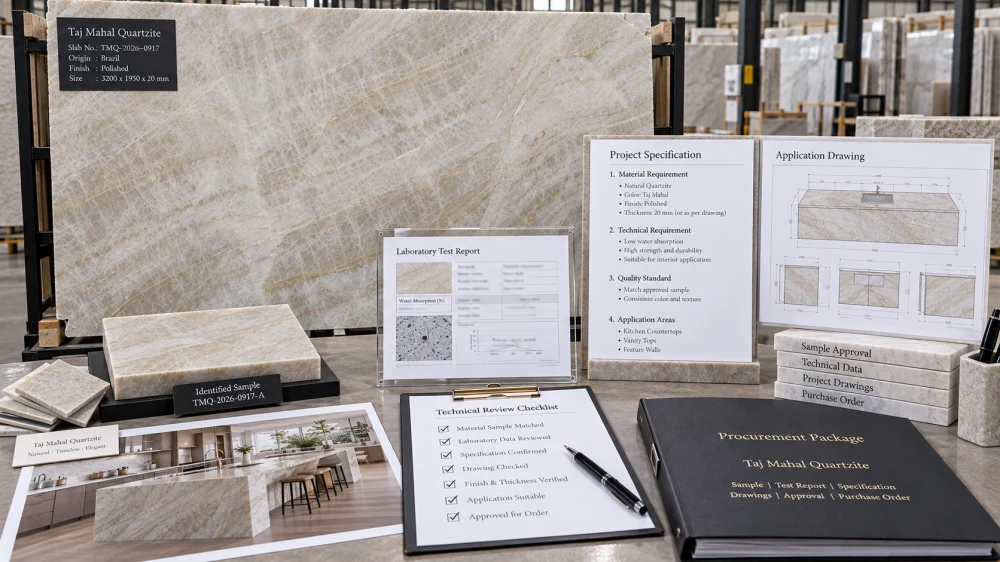
Build a Water Absorption Submittal Pack
For larger architectural or procurement projects, keep the absorption report inside a controlled technical package.
WATER ABSORPTION SUBMITTAL PACK
01 — Commercial material name
02 — Supplier reference
03 — Current slab / lot / sample reference where available
04 — Laboratory report
05 — Test method
06 — Specimen identity
07 — Reported result and unit
08 — Relevant specification requirement
09 — Intended application
10 — Reviewer comments / questions
11 — Approval, rejection, request for clarification, or open status
This creates a much stronger project record than copying one test value into the quotation.
Buyer Review Gate
Before relying on a Quartzite water absorption result, confirm:
1. What does a Quartzite water absorption result mean?
이는 명시된 시험 방법의 조건 및 보고 기준 하에 시험된 석재 시편이 물을 어떻게 흡수하는지를 보고합니다. 결과는 해당 시험 방법, 시편 식별 정보, 시험 단위, 보고일자 및 실험실 문서와 함께 종합적으로 해석되어야 합니다.
2. Is lower water absorption always better for Quartzite?
값이 낮을수록, 해당 시험 조건 하에서 비교 대상 시편이 더 적은 양의 물을 흡수했음을 의미합니다. 그러나 이는 그 돌이 모든 용도에 대해 더 우수하다는 것을 자동으로 의미하는 것은 아닙니다. 왜냐하면 프로젝트의 적합성은 기타 여러 가지 재료적, 설계적, 제작적, 설치적 및 노출 관련 요구사항에 따라 달라질 수 있기 때문입니다.
3. Does low water absorption mean Quartzite is waterproof or stain-proof?
아닙니다. 물 흡수 성능 결과가 자동으로 방수 또는 방오 성능에 대한 주장으로 전환되어서는 안 됩니다. 물 흡수, 오염 흡착, 코팅 처리, 표면 마감 상태, 유지관리 및 최종 제품의 사용 환경은 각각 다른 문제입니다.
4. Does one water absorption report apply to every slab in a Quartzite order?
자동으로 적용되지는 않습니다. 본 보고서는 문서에 명시된 시료 및 범위에만 적용됩니다. 구매자는 시험된 재료가 제공되는 슬래브, 로트, 블록 또는 기타 재료 참조와 어떻게 연관되는지 확인하고, 프로젝트 기록에 해당 제한 사항을 반드시 기재해야 합니다.
5. Can water absorption tell me whether Quartzite is strong enough for my project?
아니요. 수분 흡수율과 기계적 강도는 서로 다른 물리적 특성입니다. 프로젝트에서 굽힘강도, 압축강도, 파단모듈러스 또는 기타 강도 관련 정보가 필요하다면, 해당하는 별도의 시험 데이터와 프로젝트 기준을 검토하시기 바랍니다.
6. Can I compare water absorption results from two Quartzite suppliers?
네, 하지만 먼저 보고서들이 시험 방법, 시료 기준, 단위, 보고 조건 및 항목의 관련성 측면에서 충분히 비교 가능함을 확인하시기 바랍니다. 시험 근거가 상당히 다르거나 불명확한 경우, 두 값에 대해 동등한 증거로 평가하지 마십시오.
7. When should a buyer request a new Quartzite water absorption test?
프로젝트 명세서에 따라 요구되는 경우, 기존 보고서를 제안된 재료와 적절히 연계할 수 없는 경우, 요구되는 시험 방법이 상이한 경우, 이용 가능한 문서가 불완전한 경우 또는 담당 프로젝트 검토자가 보다 직접적으로 관련성이 높은 증거를 요청하는 경우 등에는 새로운 시험이 적합할 수 있습니다.
Final Interpretation RuleDo not ask a Quartzite water absorption number to answer more than it actually measures. Keep the evidence chain intact: Test Method → Identified Specimen → Reported Result → Relationship to the Order → Project Criterion → Technical Review. A precise number without this context can create more certainty than the report actually supports.
For project-based Natural Quartzite procurement, HRST STONE can coordinate current material references, slab photographs, representative sample information, available supplier test documentation, fabrication records, and technical-submittal information associated with the proposed supply. Where a project requires a particular test method, acceptance criterion, engineering interpretation, or application-specific performance determination, the applicable specification and responsible qualified technical parties should control that decision.
Hi, I am the author of this article. I have been working in the field of Natural Stone for more than 15 years. If you need customized Natural Stone services, please feel free to contact me.