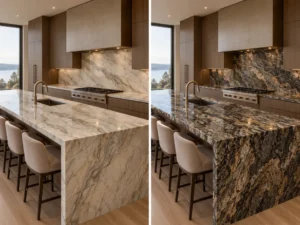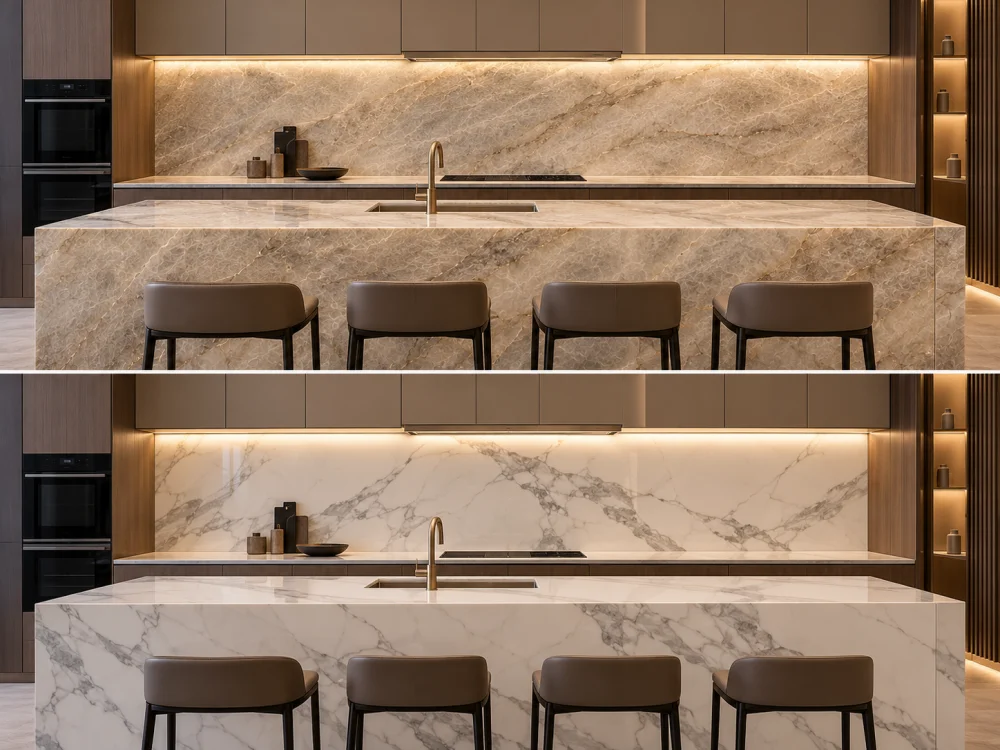
빠른 요약Natural quartzite vs. porcelain slabs for matching a wall and worktop should not be judged by asking which material can imitate the other most closely. A coordinated interior depends on the actual color relationship, pattern scale, direction, finish, edge treatment, joints, lighting, and the way the vertical wall and horizontal worktop are viewed. Natural Quartzite brings slab-specific geological variation, while porcelain slabs follow the visual and technical characteristics of the selected manufactured product. Compare identified materials under the intended room conditions, then approve the wall and worktop as a complete composition rather than as two isolated samples.
Natural Quartzite vs Porcelain Slabs for Matching a Wall and Worktop is not simply a choice between natural and manufactured material.
The real design question is usually more specific:
Should the wall and worktop appear to be one continuous material composition, two closely related surfaces, or deliberately different materials that share the same architectural language?
A kitchen rendering may show a pale worktop flowing visually into a full-height wall. From a distance, both surfaces appear coordinated. But after physical samples arrive, several differences become more obvious.
The Natural Quartzite may contain irregular mineral movement and slab-specific variation. The porcelain slab may show a controlled printed pattern, repeated design logic, or a different relationship between the decorated face and the fabricated edge.
Neither characteristic automatically makes one material better.
The important task is to define what “matching” means for the specific wall-and-worktop design before approving either option.
“Match the wall and worktop” can describe several very different design intentions.
The designer may want the pattern on the horizontal worktop to appear to continue into the vertical wall.
This is a demanding condition because the relationship depends on the actual cutting layout, the position of the wall relative to the worktop, the joint between them, and the orientation of each fabricated piece.
With Natural Quartzite, visual continuation must be developed from the actual slab or slab sequence. A small sample cannot establish where a particular vein or crystalline field will appear across two large finished surfaces.
With porcelain slabs, the selected product may provide a more controlled graphic pattern, but the project should still confirm available slab faces, orientation, pattern sequence, cutting geometry, and manufacturer-specific fabrication information.
Another project may not require the wall and worktop to share one continuous vein.
Instead, the designer may want both surfaces to have compatible background color, pattern scale, warmth, and visual intensity.
This approach can give greater freedom because the wall does not need to behave like an extension of the countertop.
A quietly patterned worktop can be paired with a stronger wall, or a dramatic Quartzite worktop can be balanced by a calmer porcelain wall.
A successful coordinated room does not always require visual similarity.
The wall may deliberately be quieter, lighter, darker, or more uniform than the worktop while still coordinating with cabinetry, flooring, metal finishes, and lighting.
Before material comparison begins, write down which of these relationships the project wants.
Define “Matching” FirstContinuous: The design expects visible pattern movement between wall and worktop.
Coordinated: The materials share tone, scale, or visual character without pretending to be one uninterrupted surface.
Contrasting: The wall and worktop are deliberately different but balanced within the same interior.
One of the most important issues in this comparison is orientation.
The worktop is primarily horizontal. The wall is vertical.
Even when both pieces come from the same Natural Quartzite slab, their visual relationship changes when one surface is rotated into another plane.
A broad diagonal mineral band that looks calm across a large horizontal island may become much more directional when placed vertically behind the worktop.
Likewise, a porcelain graphic that appears balanced on a vertical display board may feel stretched or visually dominant when viewed across a long worktop.
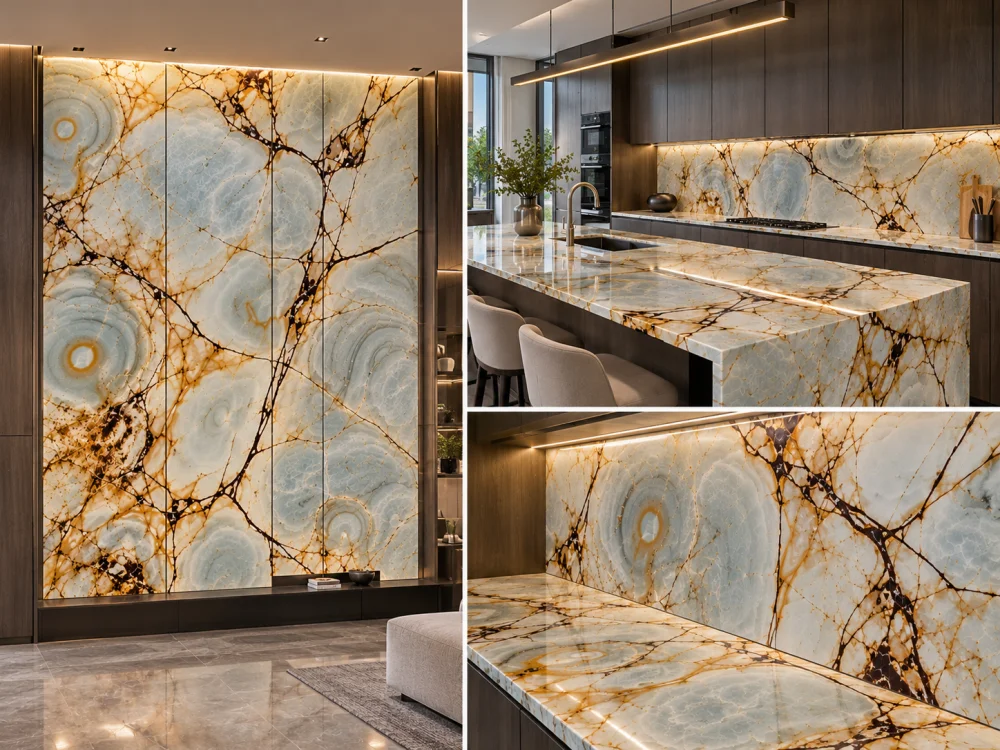
Do not judge the worktop only from directly overhead.
A kitchen user normally sees it from standing height, where the surface is strongly foreshortened. Large parts of the pattern may overlap visually.
The wall is seen more directly and can therefore make the same pattern scale appear stronger.
For this reason, compare:
This is more useful than comparing two flat samples placed side by side on a table.
Under-cabinet lighting may strike the vertical wall at one angle while ceiling light reflects across the horizontal worktop.
A polished Natural Quartzite worktop may therefore show stronger reflections than the wall. The porcelain product may also respond differently depending on its selected surface finish.
Keep finish and lighting conditions identifiable when comparing the two materials.
| Review Area | Wall Surface | Worktop Surface |
| Viewing orientation | More directly frontal | Often viewed obliquely from standing height |
| Pattern reading | Full-height movement can appear more dominant | Long horizontal movement often becomes the main visual axis |
| Typical light interaction | Wall and task lighting | Ceiling, window, and reflected light |
| Key coordination question | How does the wall compose as one elevation? | How does the pattern work around edges, sinks, and long runs? |
The strongest difference between the two choices is not simply appearance. It is how visual continuity is created and controlled.
Natural Quartzite contains geological movement that belongs to each individual slab.
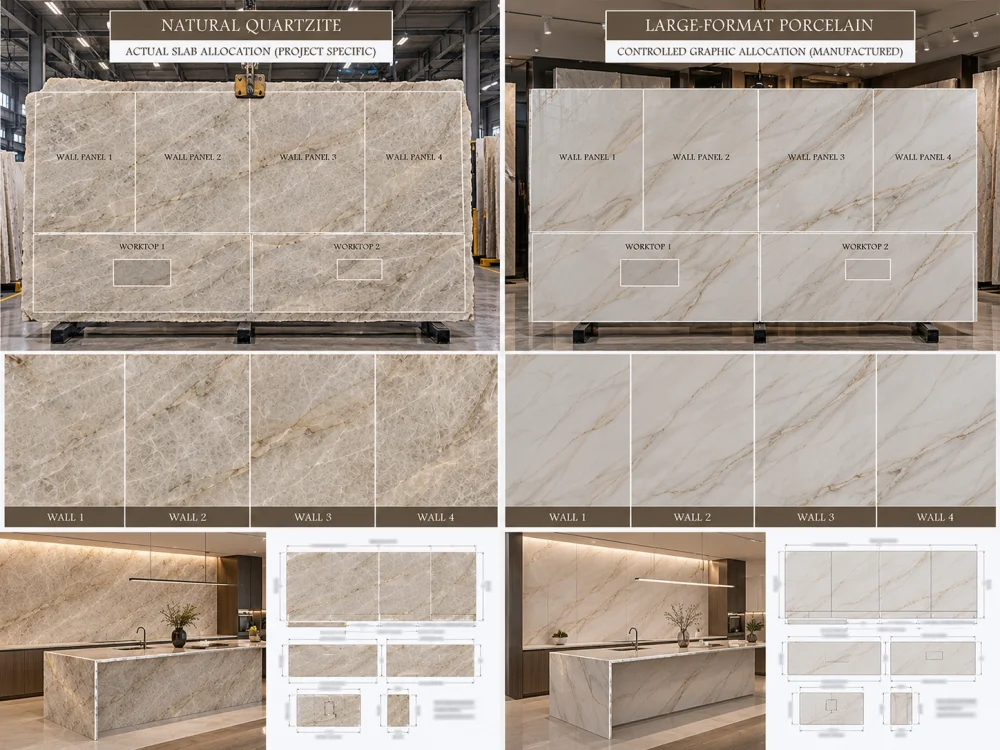
If the designer wants the worktop and wall to relate closely, the stone layout should be developed from current full-slab photographs or actual slab inspection.
The team may position the countertop piece and wall panels within one slab or a coordinated slab sequence, then evaluate how veins, crystalline zones, color transitions, and quieter areas move across the proposed components.
The result does not need to be perfectly continuous to be successful.
In many projects, an intentional break at the worktop-to-wall junction looks more natural than forcing two unrelated mineral areas to appear as though they connect.
Porcelain slabs are manufactured products, so the project should work from the actual selected series, available slab graphics, finish options, and manufacturer information.
Some products may provide several graphic faces or sequencing possibilities. Others may have a more limited visual repeat.
Do not assume that a rendering represents every slab supplied or that a printed marble-style vein can be positioned freely without considering the actual available face.
Where continuity matters, obtain the appropriate product information before finalizing the panel layout.
Natural Quartzite should not be rejected merely because every slab is not graphically identical.
Porcelain should not be judged as unsuccessful simply because it does not reproduce the geological randomness of natural stone.
The design should decide whether it values natural variation, controlled repetition, visual continuity, or deliberate contrast.
That criterion should then guide the comparison.
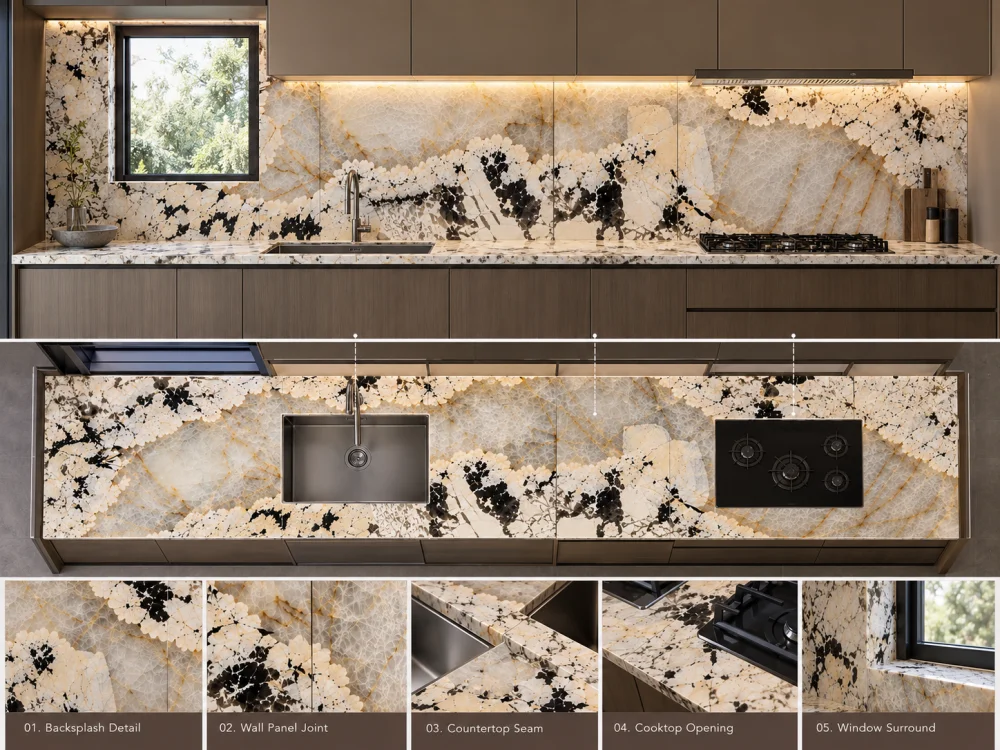
Even two attractive materials can produce a weak finished composition if the cutting layout ignores the architecture.
A wall may contain windows, outlets, shelves, cabinets, extractor equipment, plumbing fixtures, or other interruptions.
The worktop may contain sink and cooktop openings, seams, end panels, or waterfall components.
These features remove or divide parts of the pattern.
Place the wall geometry and worktop geometry on the same coordinated drawing.
Show:
Only after these interruptions are visible should the proposed material pattern be overlaid.
A strongly directional Natural Quartzite may be oriented horizontally on the worktop and vertically on the wall, or the project may seek a more related transition between the two planes.
Neither option should be assumed from the material name alone.
For important stone pieces, directional marks should be linked to piece IDs, visible faces, seams, and actual slab layouts. The existing Quartzite Vein Direction Symbols for Shop Drawings guide provides a useful control method for this type of orientation review.
A joint directly above a countertop seam can sometimes create a clear architectural line.
In another project, stacking both joints may create an unwanted visual break.
The preferred relationship depends on the pattern and room geometry.
Do not establish seams independently and then try to force the material pattern around them afterward.
A full-height wall around a window becomes several visible zones: left field, right field, upper strip, sill, and reveals.
The article on Infinity White Quartzite backsplash seams around windows provides a useful example of why the complete elevation should be resolved before individual joint locations are selected.
A face-only comparison may make Natural Quartzite and a stone-look porcelain slab appear closely related.
The finished edges can tell a different story.
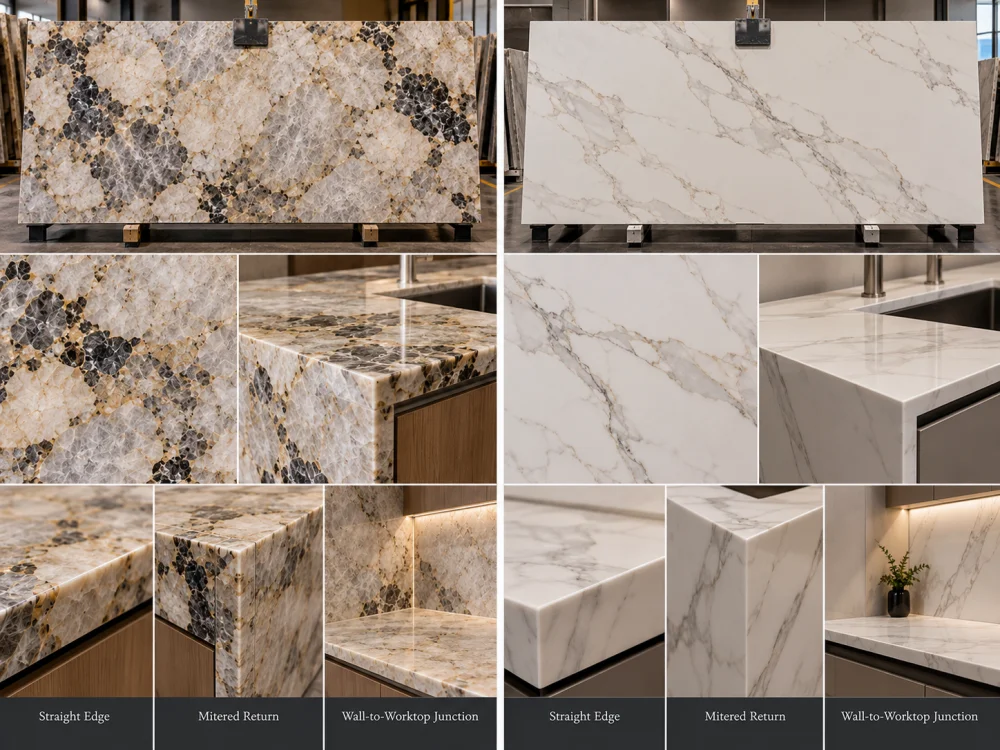
A Natural Quartzite edge exposes the actual stone material through its thickness.
Depending on the stone, finish, edge geometry, and viewing angle, the worked edge may read differently from the broad polished face.
If the design uses a mitred edge, built-up appearance, end return, or exposed side, review a representative fabrication detail rather than approving only the face sample.
The porcelain slab should be reviewed according to the selected product and the manufacturer’s or fabricator’s applicable guidance.
The visual relationship between the decorated face and the fabricated edge depends on the product construction and chosen detail.
Do not transfer a natural-stone edge assumption to porcelain without verifying the selected product.
This small line is one of the most visible areas in a coordinated kitchen.
Review how the vertical panel meets the worktop:
A rendering can communicate the desired appearance, but the actual assembly should be confirmed through the current project detail.
Do Not Approve Only the Face
For a wall-and-worktop composition, review Main Face → Worktop Edge → Wall Return → Junction → Seams. A face sample cannot automatically approve all five conditions.
A controlled mock-up can make this comparison much more useful.
Instead of placing two small flat samples on a desk, reproduce the relationship that the finished room will contain.
Set up a representative vertical wall sample and horizontal worktop sample.

This immediately shows whether the color, pattern scale, finish, and reflectivity remain compatible after the two materials are placed in their real orientations.
If the design relies on a specific transition, include it in the mock-up.
A corner, small return, edge, or seam may reveal more about the final appearance than the center of the sample.
Review the mock-up under room lighting representative of the project where practical.
If under-cabinet lighting is important, include that condition. Also inspect the materials with the task lighting switched off.
A combination that looks perfectly matched under one artificial light may show a different color relationship under daylight or another source.
From the kitchen entrance, the design may read as one coordinated composition.
At working distance, the viewer may notice more difference in texture, edge appearance, joint width, or pattern character.
Both observations can be valid.
The approval record should state what was reviewed rather than simply saying “Quartzite and porcelain match.”
After reviewing actual samples, geometry, edges, lighting, and pattern layout, the project can select a strategy rather than a universal winner.
| 디자인 우선순위 | Natural Quartzite Approach | Porcelain Slab Approach |
| Unique natural movement | Use actual slab composition and natural variation as part of the design | Review whether the selected graphic supports the desired character |
| Controlled visual repeat | Natural variation remains part of the material | Review actual product faces and sequencing options |
| Wall-to-worktop continuity | Develop from actual slab layout | Develop from available product graphics and cutting layout |
| Visible edge importance | Review actual worked stone edge | Review selected-product edge solution |
| Approval basis | Actual slabs + layout + finished-detail review | Actual product reference + layout + manufacturer/fabricator information |
A project can also combine the materials successfully.
For example, Natural Quartzite may become the worktop focal surface while a compatible porcelain slab creates a calmer full-height wall. Another design may use one material for both surfaces.
The decision should be based on the intended architecture, not on an assumption that using one material everywhere is automatically more premium or more coordinated.
If several people are involved, separate visual preference from technical and production approval.
A designer may approve the overall wall-and-worktop relationship while the fabricator still needs to resolve a joint or edge detail.
The Quartzite Slab Selection with Multiple Decision Makers guide explains why material approval, layout approval, and production release should remain identifiable as different decisions.
A useful record might state:
“Wall and worktop material relationship accepted based on Sample Set A and current room lighting review. Natural Quartzite slab allocation, final wall joints, worktop cutting layout, and fabricated edge details remain subject to the current project review.”
That statement is much more useful than simply recording “materials approved.”
They should not be assumed to be visually identical. Natural Quartzite has slab-specific geological variation, while porcelain follows the characteristics of the selected manufactured product. Compare actual materials for background color, pattern scale, direction, finish, edges, and the intended room lighting.
Yes, this can be a valid design strategy when the actual materials are visually coordinated and each product is suitable for its proposed application. Review the junction, pattern relationship, edge conditions, lighting, and project-specific installation requirements.
Using the same selected stone can create a strong visual relationship, but continuity still depends on actual slab allocation, pattern direction, seams, openings, cutting positions, and the transition between horizontal and vertical surfaces.
The two surfaces are viewed at different angles and receive light differently. A vertical wall is often seen more frontally, while a horizontal worktop is viewed obliquely from standing height. This can change the apparent scale and strength of the pattern.
Not automatically. Alignment may create a deliberate architectural line in one design and an unwanted visual break in another. Compare the joint positions together with the actual material pattern and full room elevation.
Use representative vertical and horizontal samples, the intended finish, relevant edge or return details, the wall-to-worktop junction, and representative room lighting. Review the combination from both normal room distance and working distance.
Send Josh the proposed Natural Quartzite material, room elevations, countertop drawings, wall dimensions, quantities, surface finish, edge requirements, openings, joint preferences, adjacent cabinet or flooring references where relevant, comparison porcelain information, and delivery destination.
Project DecisionThe best wall-and-worktop match is not necessarily the pair of samples that looks most similar when placed flat beside each other. Review the materials in their real vertical and horizontal orientations, under the intended lighting, with the important edges, joints, openings, and pattern directions visible. Then decide whether the design needs true continuity, visual coordination, or deliberate contrast.
For project-based Natural Quartzite fabrication, HRST STONE can coordinate available full-slab photographs, slab references, CAD/shop drawings, cutting layouts, pattern-direction reviews, fabricated edge details, dry-lay or visual QC records, export packing, and related documentation according to the confirmed stone scope. Send Josh the current drawings, dimensions, finish requirements, quantities, visual priorities, and delivery destination for review.