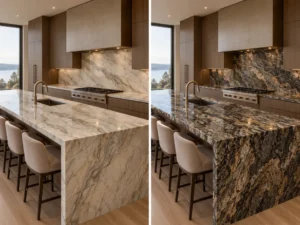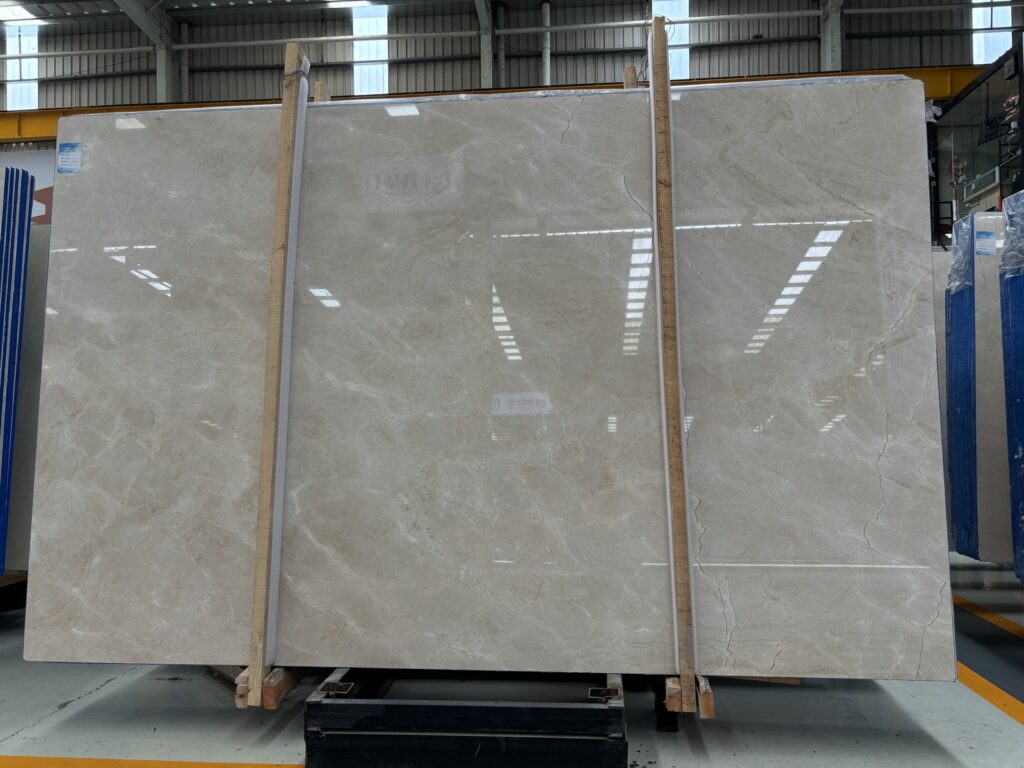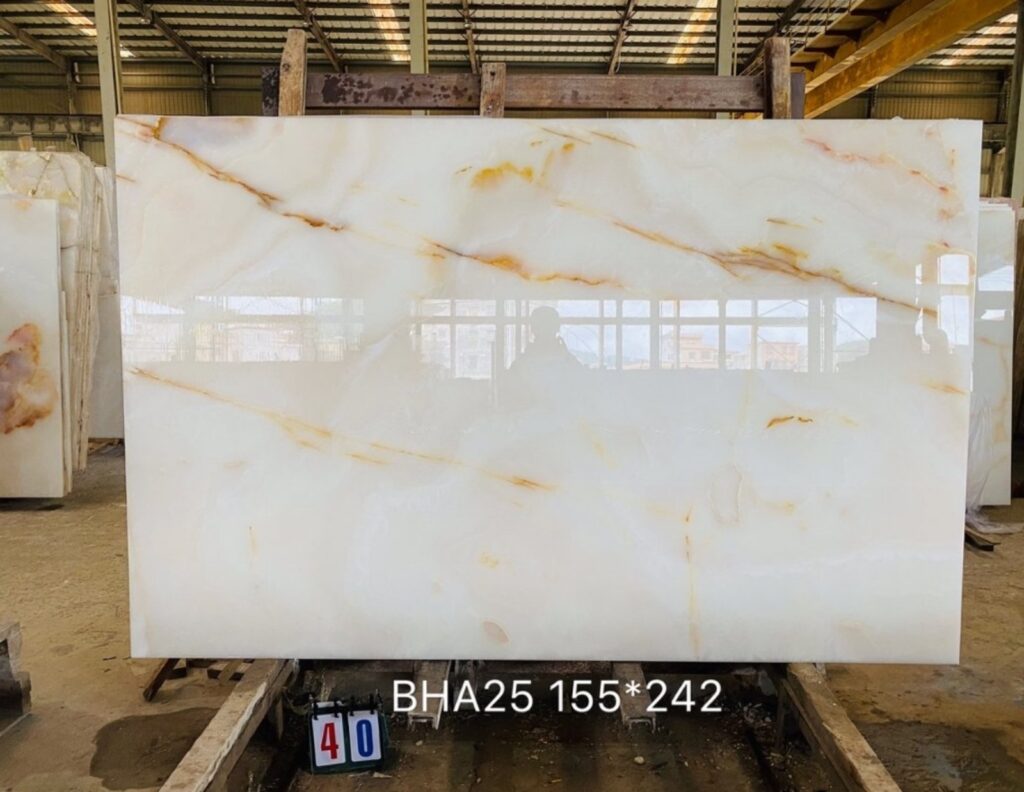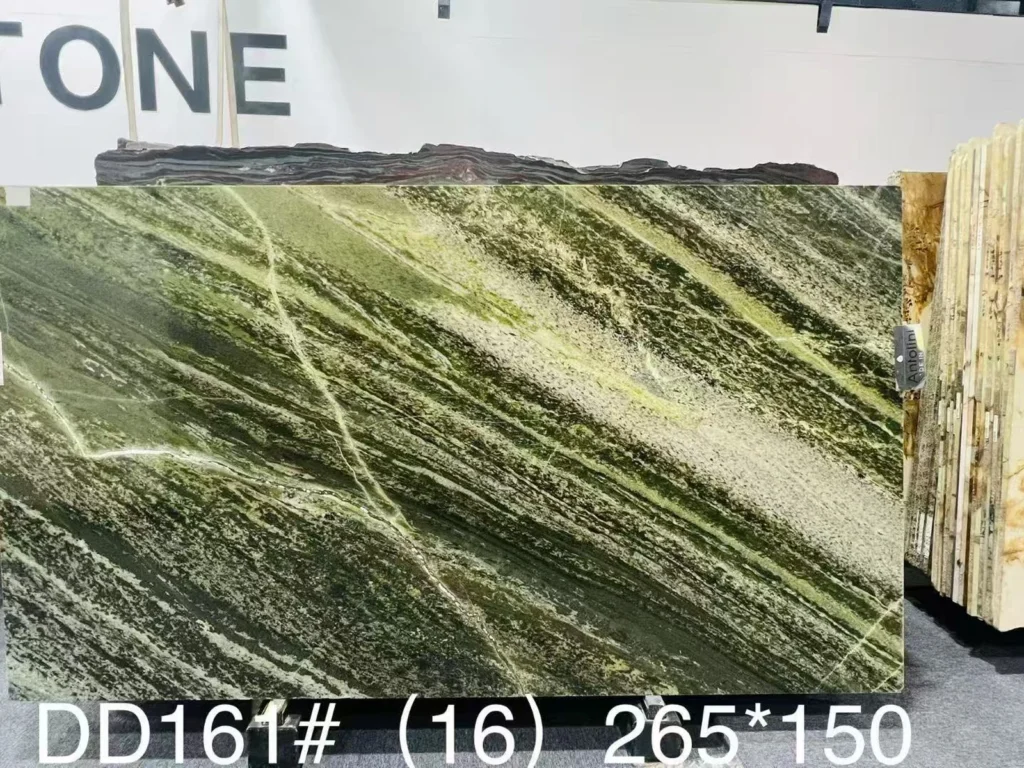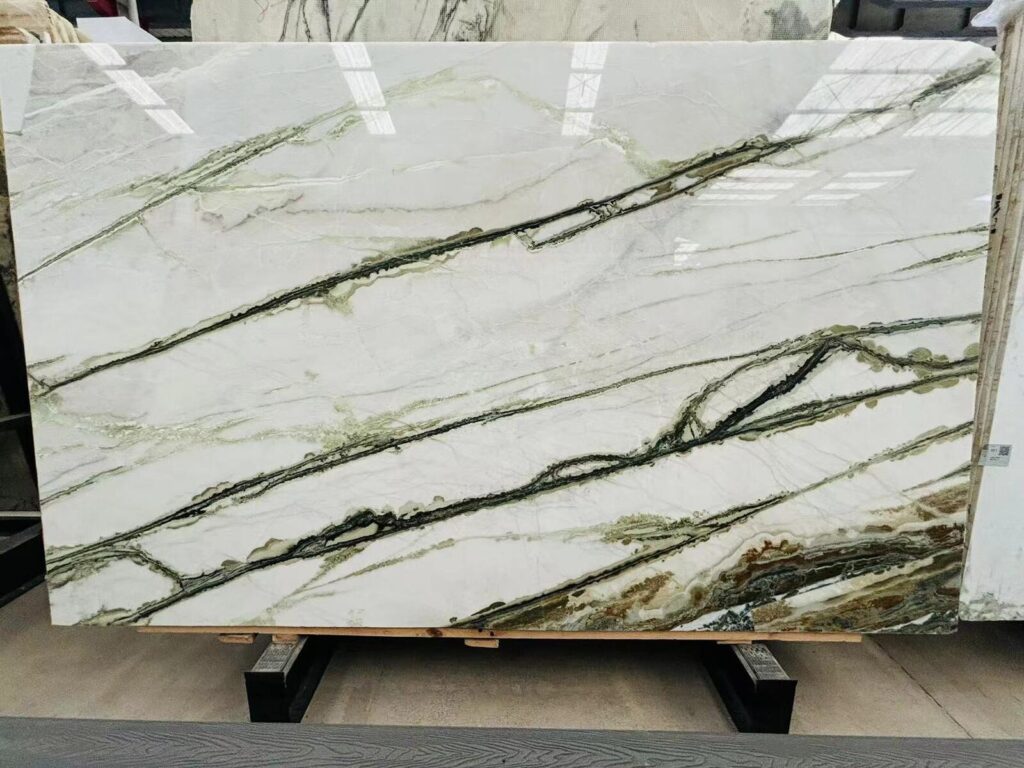
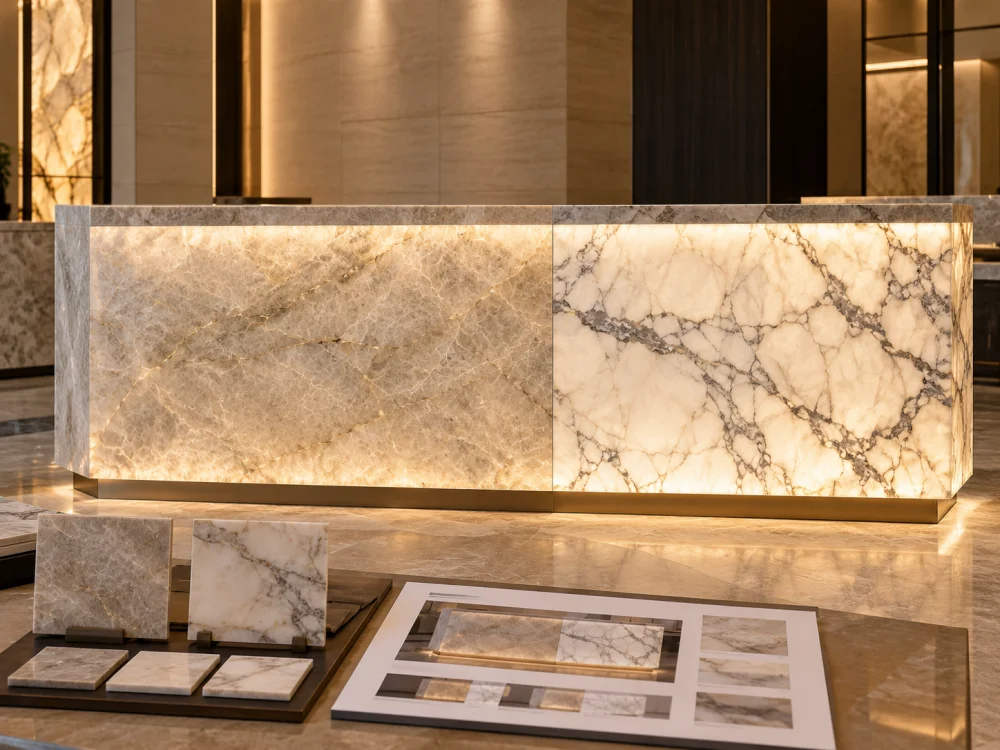
Natural Quartzite vs Marble for a Backlit Reception Front can look like a simple material-selection question. In practice, it is a comparison between two specific natural materials, a lighting system, a panel layout, several visible edges or joints, and the way guests will actually see the completed reception desk.
A designer may receive two attractive samples and prefer the one that glows more strongly when a phone flashlight is placed behind it. That observation may be useful, but it does not yet answer the project question.
The finished reception front may use larger panels. The light source may sit farther behind the stone. The support structure may cast shadows. A seam may cross a translucent area. One panel may look dramatic with the lights on but less convincing in daylight when the backlighting is off.
For this reason, the useful comparison is not “Quartzite or Marble—which is better?”
그것은 다음과 같습니다:
Which identified material produces the intended appearance in this reception-front assembly, and what still needs to be confirmed before fabrication?
The first mistake in a backlit stone comparison is to begin with a category-wide rule.
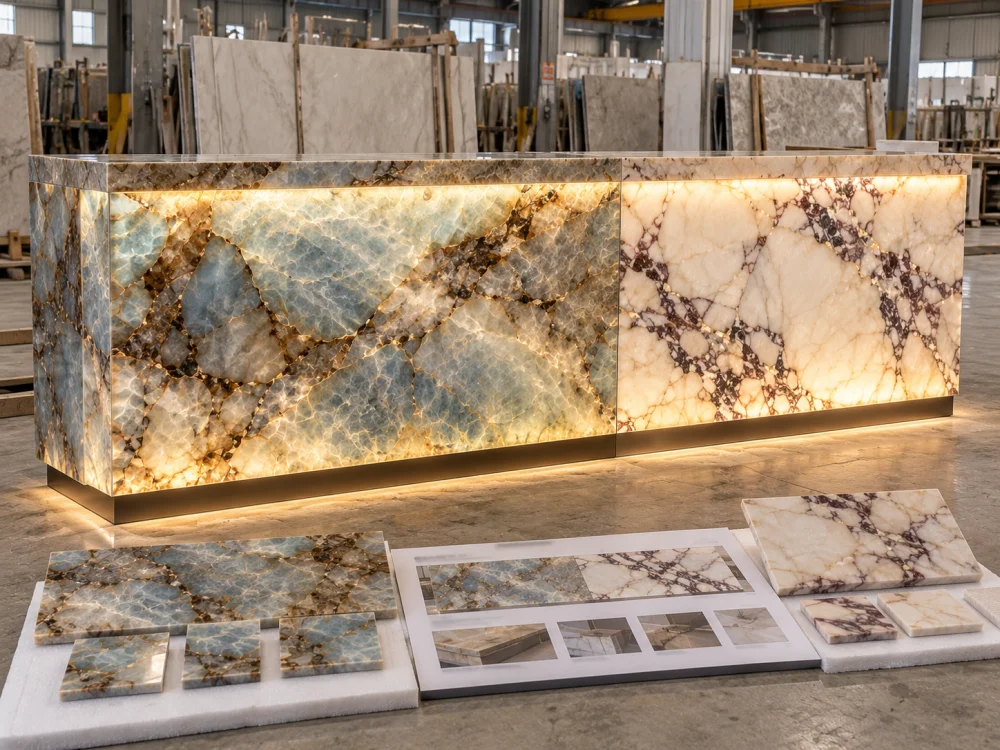
Do not assume that every Natural Quartzite can be backlit. Do not assume that every Marble will transmit light in the same way. Even within one commercial stone name, different slabs or different areas of a slab may respond differently when illuminated from behind.
The project should therefore begin with identified physical material.
예를 들어:
The purpose is not to eliminate natural variation. It is to prevent a general material name from replacing physical evidence.
A small natural quartzite sample may contain a relatively translucent crystalline area while another part of the slab is much denser. A Marble sample can also show local character that does not describe the complete proposed panel.
That is why the first comparison should establish only what the samples genuinely demonstrate.
Compare Actual Material → Same Viewing Condition → Same Lighting Question → Same Project Detail. Do not compare marketing descriptions and treat the result as a fabrication decision.
A backlit reception desk is unusual because the material can be experienced under fundamentally different lighting conditions during the same day.
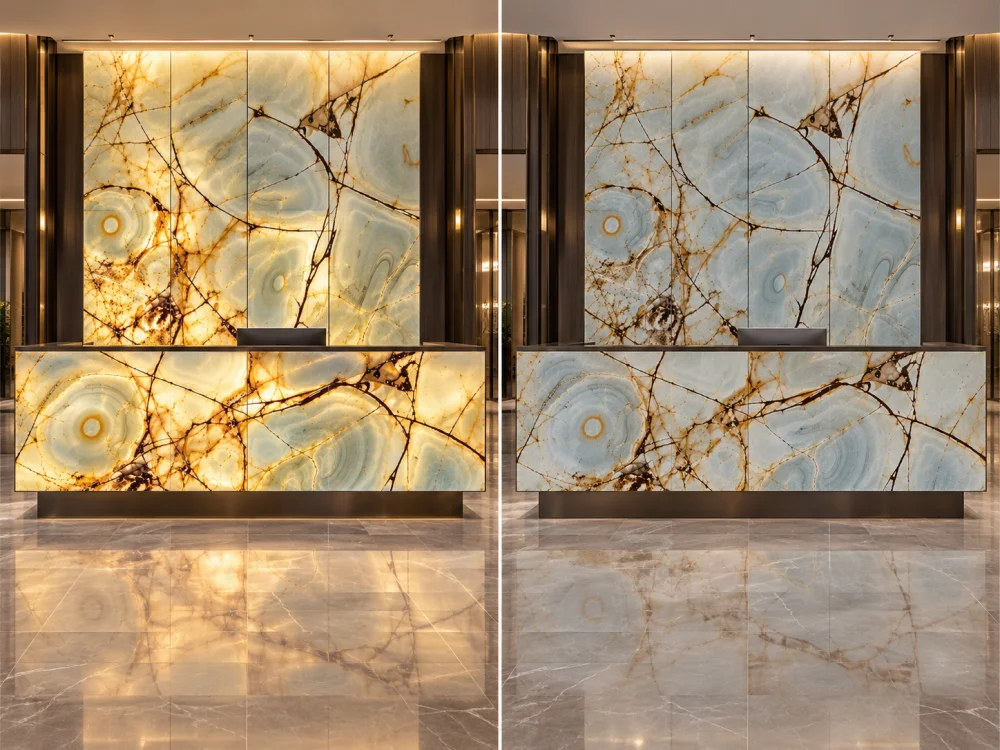
The material that looks strongest when illuminated is not automatically the material that produces the best overall reception front.
This is usually the most dramatic review.
Observe how transmitted light moves through the actual sample or slab area. Look for brighter and darker mineral zones, transitions between translucent and more opaque areas, and whether the stone’s natural pattern remains visually coherent rather than becoming a collection of isolated bright patches.
A strong contrast can be desirable for one design and distracting for another.
The reception desk will usually operate within an architectural environment containing ceiling fixtures, decorative lighting, daylight, reflected floor light, and illuminated signage.
These sources can reduce or change the perceived contrast of the backlit stone.
A mock-up reviewed only in a dark room may therefore exaggerate the effect that guests will see in the actual lobby.
This review is essential.
With transmitted light removed, the stone is read through ambient and reflected light. Its natural background color, mineral distribution, seam relationships, surface finish, and panel-to-panel variation become more important.
A reception front that looks impressive only when fully illuminated may not meet the design intent during daylight, maintenance periods, lighting failure, energy-management cycles, or other lights-off conditions.
For translucent Quartzite projects, the related 크리스탈로 석회암(조명 꺼짐 상태): 왜 주간 승인이 중요한가 guide explores this lights-on versus lights-off review in greater detail.
Do not finish the comparison at sample-board distance.
Stand where a guest is likely to enter the lobby, approach the desk, and wait for service.
At several metres away, the viewer may read broad luminous zones and overall pattern direction. At close range, seams, cut edges, local dark zones, surface reflections, and lighting hotspots become more visible.
The project may therefore need more than one viewing distance.
| Review Condition | 주요 질문 | Do Not Conclude Automatically |
| Backlight on / controlled ambient | Where and how does transmitted light appear? | That the entire production panel will illuminate identically |
| Backlight on / lobby lighting | Does the effect remain useful in the real interior? | That a dark-room mock-up predicts the finished room |
| Backlight off | Does the stone still work as a normal architectural surface? | That illumination will hide every visual issue |
| Normal guest distance | How does the complete reception front read? | That a close-up sample represents the overall composition |
A flat illuminated sample answers only one part of the reception-front design.
The completed desk may include large front panels, end returns, mitred corners, joints between panels, a countertop above, recessed skirting, access panels, or metal framing.
Each condition can change the visual result.
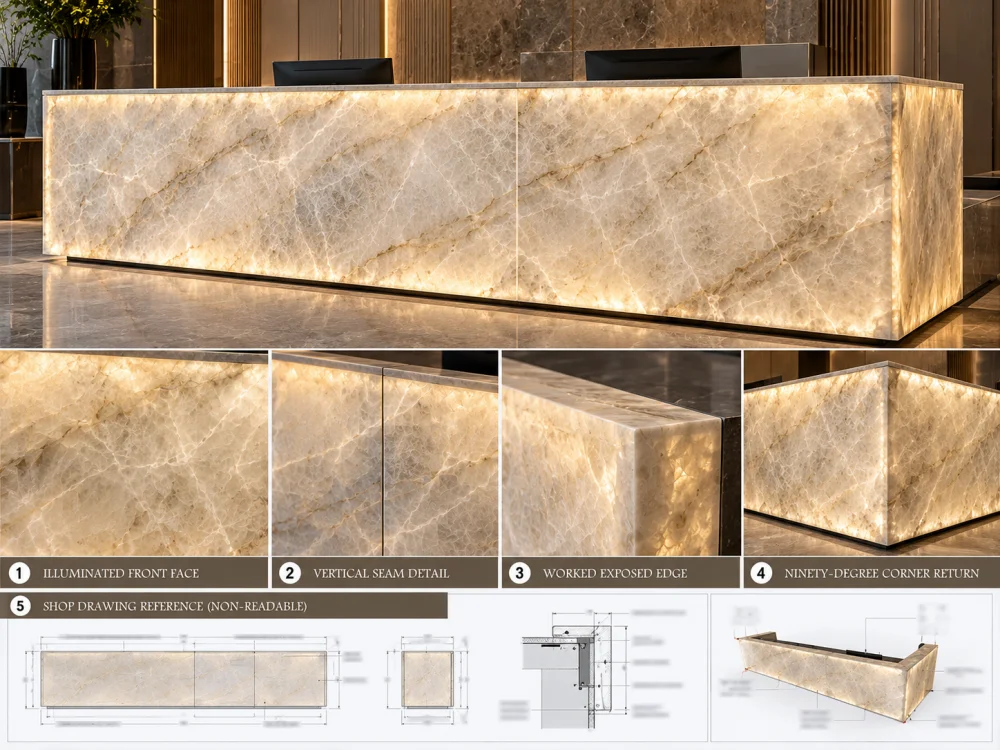
The main face usually carries the strongest visual priority.
Review the natural pattern scale, dominant direction, translucent distribution, and the relationship between brighter and denser areas.
For highly directional Quartzite, orientation should be marked on the current layout rather than left for interpretation during cutting.
Where direction matters, 시공 도면용 석영암 맥맥 방향 기호 explains how piece IDs and directional references can be linked to actual slab layouts.
An illuminated face and a visible cut edge do not necessarily read the same way.
A polished face may show depth through its mineral structure, while the worked edge presents the stone from another direction.
If the reception desk exposes a vertical edge, mitre, laminated edge, or return, review an actual worked sample where the edge appearance matters to the design.
Do not approve a face sample and assume every edge condition is automatically included.
Backlighting can make a joint more noticeable because the light response on one side may differ from the other.
The issue is not simply whether a seam exists. The team should ask:
A perfectly invisible seam should not be promised before the actual material, layout, fabrication detail, and lighting arrangement are confirmed.
A reception front may turn a corner or continue onto an end panel.
The two planes then receive and transmit light differently. A pattern that appears continuous in a flat CAD layout may read differently after one panel turns ninety degrees.
For visually important corners, review the front and return together rather than approving each face in isolation.
A backlit mock-up is most useful when its purpose is defined before it is fabricated.
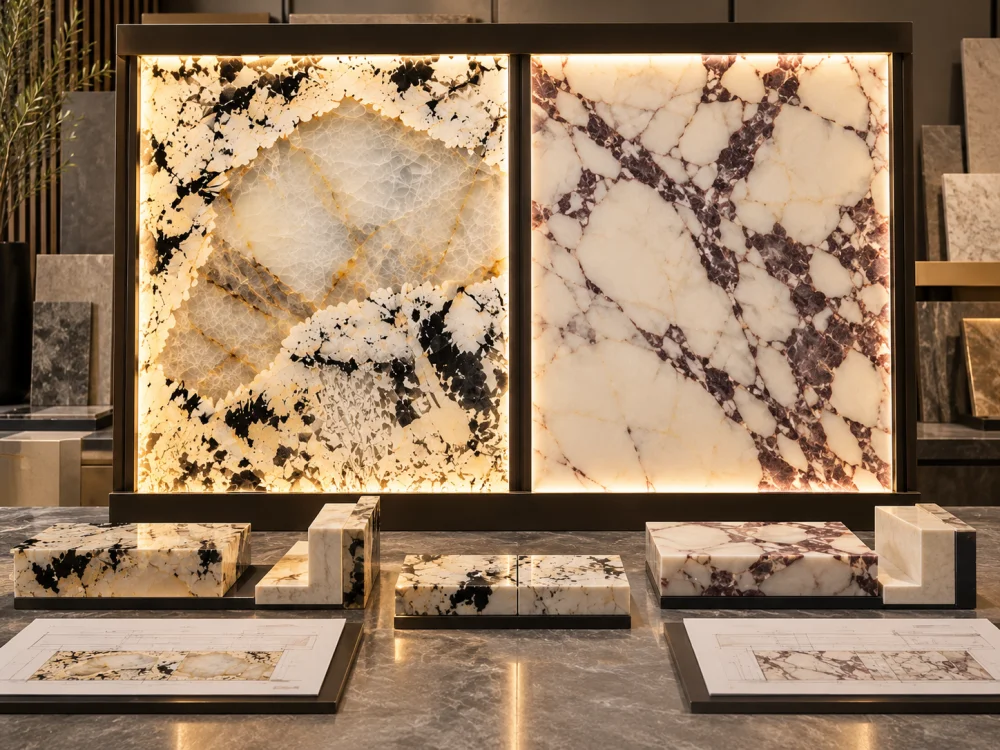
“Please make a backlit sample” is too broad.
A better request might be:
Compare the identified Quartzite and Marble under the proposed lighting arrangement to evaluate transmitted-light distribution, visible face appearance, one representative seam, and the proposed mitred return from the normal lobby viewing distance.
Now the mock-up has a measurable scope of review without pretending to be a universal laboratory test.
Depending on the project, useful elements can include:
The purpose is not to build an entire reception desk before approval.
It is to reproduce the variables that could change the material decision.
Place the samples in equivalent conditions where practical.
If the Quartzite is tested with one light source and the Marble is photographed on another day using different lighting, the comparison becomes difficult to interpret.
Likewise, do not compare one polished sample with another honed sample and then attribute the complete visual difference to the stone category.
Record meaningful differences in finish, thickness, orientation, backing, or lighting instead of hiding them.
A mock-up should answer a defined question. If material, thickness, finish, panel scale, light source, spacing, diffusion, edge detail, or seam arrangement changes materially, decide whether the affected condition needs to be reviewed again.
A successful sample comparison does not finish the selection process for a naturally variable material.
Once a Natural Quartzite option is preferred, connect the decision to the actual proposed slabs where available.
A small sample may show that one mineral zone transmits light attractively. The complete slab may contain a mixture of brighter crystalline areas and denser areas.
Those differences can become part of the design rather than a problem—but only if the layout recognizes them.
Overlay the finished reception-front panels onto the actual slab photographs or current material layout.

Identify:
Then review the composition in both the illuminated and non-illuminated condition.
This prevents a strong translucent feature from being approved on the slab and then unintentionally removed by a joint, service opening, or panel subdivision.
The design intent may not require uniform illumination.
Some projects deliberately use brighter and darker natural areas to create depth. Others require a quieter, more evenly distributed luminous field.
The project should define which result is preferred rather than treating natural variation itself as an automatic defect.
If the desired appearance depends on a very specific luminous distribution, actual panel or slab review becomes more important.
The stone supplier can provide material evidence, panel information, samples, and fabrication-related documentation within the confirmed scope. The lighting system remains another part of the assembly and must be coordinated by the responsible project team.
Several interfaces can materially affect the visual result:
This is why a beautiful slab photograph cannot approve a complete backlit assembly.
For example, a support member located directly behind a highly translucent area may become visible as a darker band when the light is switched on.
Similarly, insufficiently coordinated light spacing may produce individual bright zones rather than the intended broad illumination.
These are assembly questions rather than reasons to label one natural stone category universally superior.
The final selection should describe why one specific option was chosen for the project rather than announcing that Quartzite or Marble is generally the better backlit material.
A simple decision matrix can help.
| Decision Area | Natural Quartzite Review | Marble Review | Approval Evidence |
| Lights-on appearance | Review actual proposed material | Review actual proposed material | Controlled mock-up |
| Lights-off appearance | Color, pattern, finish, slab variation | Color, pattern, finish, selected-product variation | Physical samples / actual material |
| Pattern direction | Coordinate with actual slab layout | Coordinate with actual selected material | Current panel layout |
| 노출된 가장자리 | Review worked edge where required | Review worked edge where required | Edge sample / detail |
| Seams and returns | Review light response across actual layout | Review light response across actual layout | Mock-up + shop drawing |
| Final release | Defined project scope only | Defined project scope only | Written approval + current revision |
The project does not need to force both materials into identical behavior. It needs enough evidence to understand the differences that matter to this reception front.
Where several designers, procurement representatives, fabricators, and owners are reviewing the same samples, the Quartzite Slab Selection with Multiple Decision Makers guide can help separate visual preference, technical review, commercial confirmation, and final release.
A controlled project can use the following sequence:
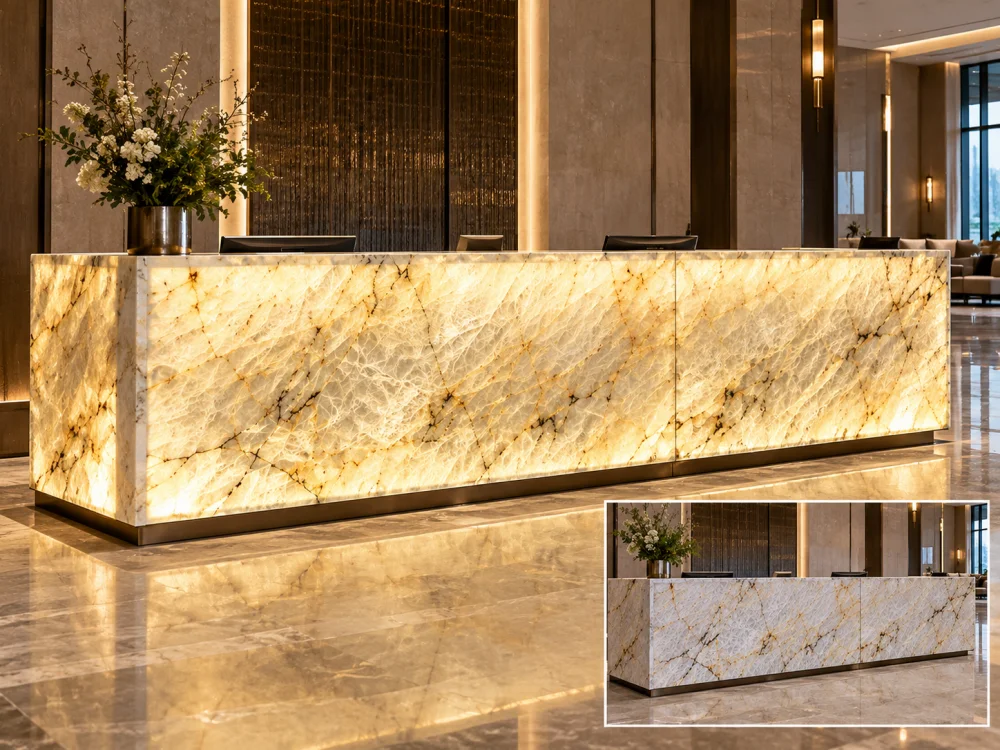
This sequence keeps the material decision useful without pretending that an early sample resolves every later fabrication and installation question.
No. Do not assume that every Natural Quartzite slab or every area within one slab transmits light sufficiently for a backlit application. Review the actual proposed material with transmitted light and connect the result to the intended panel layout.
No category-wide conclusion should be made from the material names alone. Compare the identified Quartzite and Marble samples or slabs under equivalent project lighting conditions. The decision should be based on the actual proposed materials.
Yes, where the design will be visible with the lighting off. Review both illuminated and non-illuminated conditions because the natural color, slab variation, seams, and surface finish may read differently without transmitted light.
Use identified material, the intended finish and orientation, representative lighting, relevant spacing or diffusion where available, and any seam, edge, or return that materially affects the design. Review it from the intended viewing distance and record exactly what the mock-up is intended to approve.
No. A sample can establish a defined design, finish, or lighting direction. Actual slab allocation, natural variation, panel layout, seams, fabrication details, and other project-specific conditions may still require separate review.
There is no universal rule. Review the actual material layout and lighting response. The best seam position depends on the panel geometry, natural pattern, light distribution, architectural breaks, fabrication requirements, and intended visual priority.
Send Josh the proposed Natural Quartzite material, dimensions, quantities, current drawings, required finish, panel and edge details, available lighting information, comparison material, intended mock-up scope, visible-face priorities, and delivery destination. Identify the exact decision that the sample or mock-up needs to support.
For project-based Natural Quartzite fabrication, HRST STONE can coordinate available slab references, finish samples, backlight review photographs, CAD/shop drawings, panel layouts, fabricated edge samples, visual QC records, packing, and export documentation according to the confirmed stone scope. Send Josh the current material information, drawings, panel dimensions, finish, lighting information, quantities, and delivery destination for review.