
빠른 요약
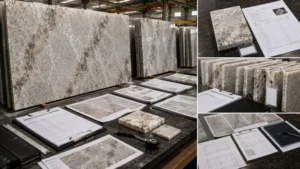
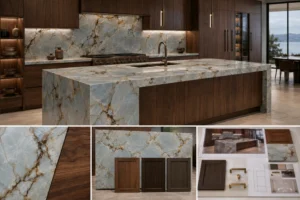
Cristallo Quartzite and Statuario Marble can both create a light-colored luxury feature wall, but they produce very different architectural effects. Cristallo is typically selected for crystalline depth, irregular translucent zones, and the possibility of backlighting. Statuario is typically selected for its white marble background, expressive grey veining, and strong graphic composition across panels. For a real project, compare the actual full slabs, intended lighting, panel layout, seams, surface finish, and maintenance requirements before choosing between them.
A white natural-stone feature wall can appear quiet and luminous, bold and graphic, or somewhere between the two. That is why choosing between Cristallo Quartzite and Statuario Marble should not begin with the question, “Which stone is whiter?”
A more useful question is:
What visual effect should the completed wall create?
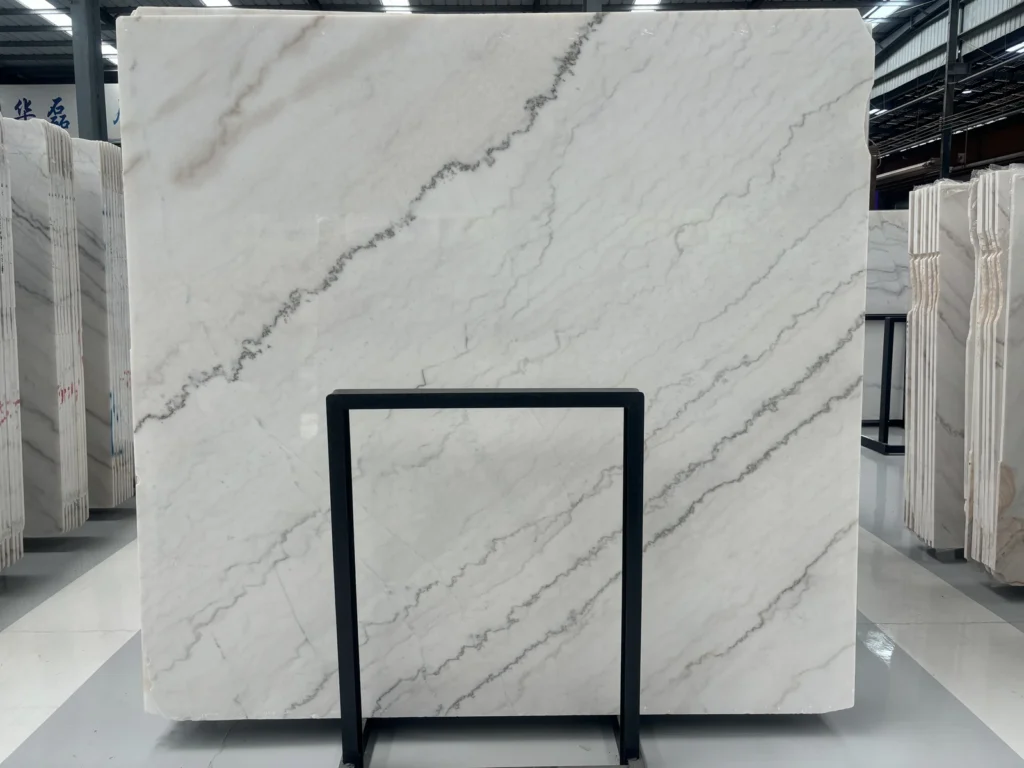
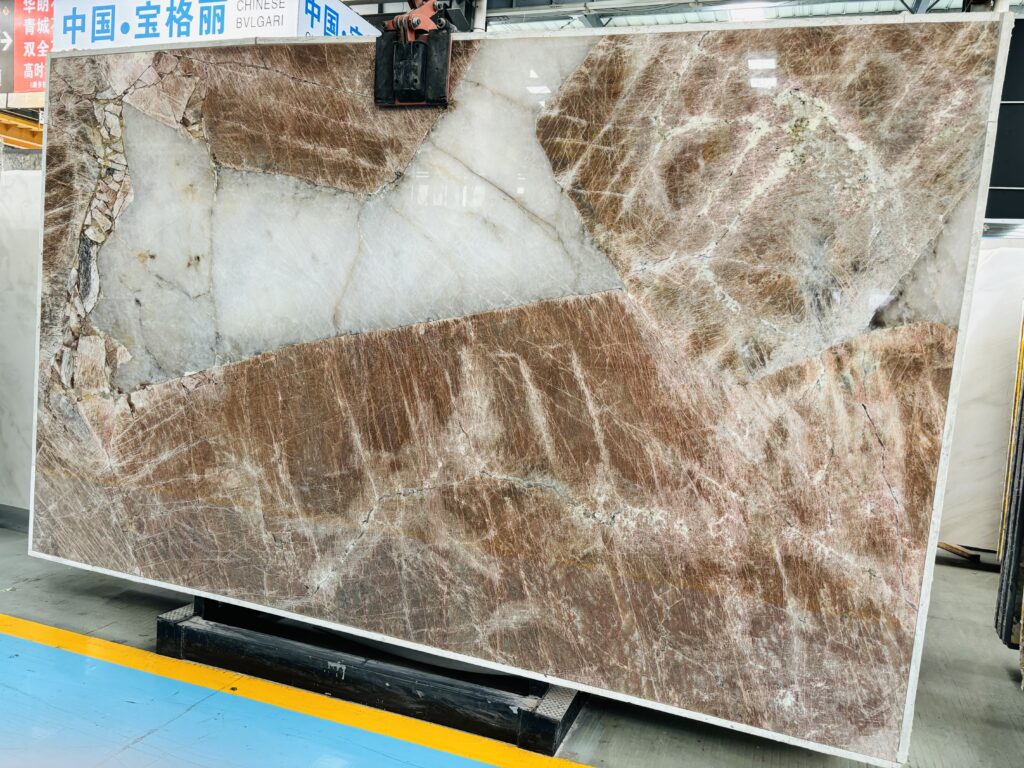
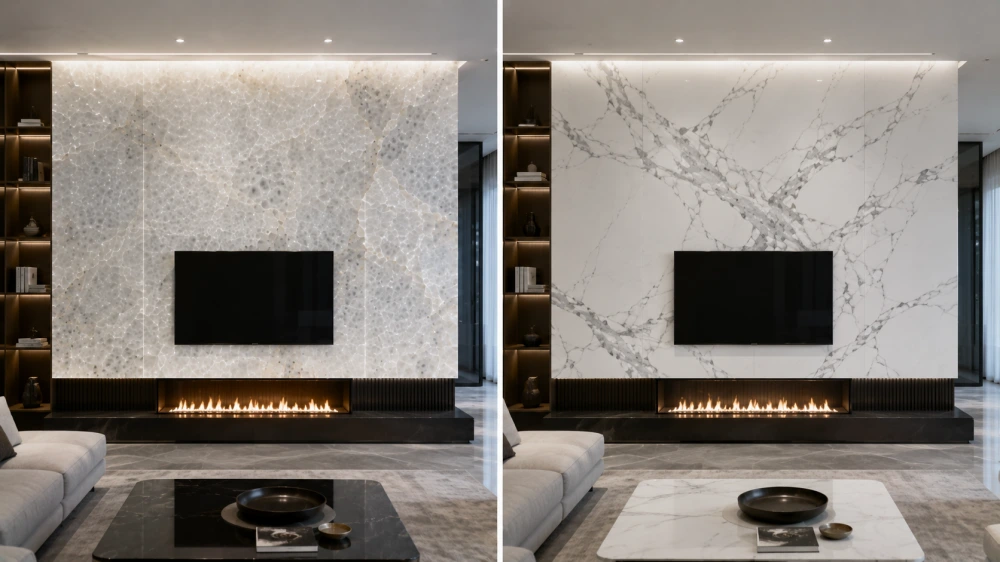
Cristallo Quartzite is known for a crystalline appearance that can include milky white to pale grey areas, internal mineral depth, cloudy crystalline movement, and zones with varying translucency. Statuario Marble is known for a white to soft-white marble field crossed by distinctive grey veining that can become the main graphic element of a wall.
For a feature wall, this creates two different design directions:
Cristallo Quartzite → Crystalline Depth → Potential Translucency → Light Interaction
Statuario Marble → White Ground → Grey Veining → Graphic Composition
Neither direction is universally better. The correct choice depends on what the wall is supposed to do visually, how it will be illuminated, and how the actual slabs work across the elevation.
Cristallo Quartzite vs Statuario Marble: Quick Comparison
| 비교 | 크리스탈로 석영암 | 조각상 대리석 |
| 재료 카테고리 | 천연 쿼츠라이트 | 천연 대리석 |
| Typical Visual Character | Crystalline, cloudy, layered and potentially translucent | White or soft-white field with expressive grey veining |
| Main Visual Feature | Crystal structure, mineral depth and translucent-to-opaque variation | Vein direction, contrast and white-ground composition |
| Backlighting | Can be an important design option where the selected slabs transmit light effectively | Usually not the primary reason for selecting the material; evaluate the actual stone if a lighting concept is proposed |
| Primary Lighting Interaction | Reflected light plus potential transmitted light | Primarily reflected light |
| 북매칭 | Possible where slab sequence and mineral movement support the intended composition | Often used as a strong design strategy when suitable consecutive slabs are available |
| Layout Priority | Balance crystalline fields, translucent zones, opaque areas and mineral movement | Control vein direction, intersections, seam interruptions and panel composition |
| Typical Feature-Wall Effect | Luminous, atmospheric and mineral-rich | Graphic, elegant and recognizably marble |
| Approval Priority | Actual slab + translucency + lighting + layout | Actual slab + vein composition + background tone + layout |
What Is the Main Visual Difference Between Cristallo Quartzite and Statuario Marble?
The most important difference is not simply Quartzite versus Marble. It is the way each material creates visual movement across a large wall.
Cristallo Quartzite tends to create depth through crystalline mineral structure. Large areas may appear milky white, pale grey, cloudy or semi-translucent, while other areas may contain denser or more opaque mineral structures. Under suitable backlighting, some of those internal differences become more visible because light is transmitted through the stone.
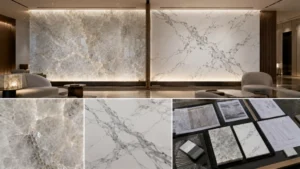
Statuario Marble tends to create movement through veins. Its white or soft-white background acts as the visual field, while grey veins create direction, contrast and large-scale graphic relationships between panels.
From normal viewing distance, the distinction can be summarized as:
Cristallo → Read the Crystal Fields
Statuario → Read the Vein Composition
What Does Cristallo Quartzite Look Like on a White Feature Wall?
Cristallo Quartzite can create a softer and more atmospheric white wall than a strongly veined marble.
Depending on the actual slabs, its surface may contain:
- Milky white to pale cool-grey crystalline fields
- Dense intersecting crystal or mineral lines
- Broad cloudy or feathered crystalline areas
- Subtle ivory or warm mineral undertones
- Localized opaque mineral zones
- Restrained darker natural mineral marks
- Different levels of light transmission across the same slab
These characteristics mean the wall should be evaluated as a composition of mineral fields rather than as a perfectly uniform white surface.
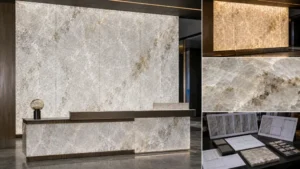
When backlighting is included, the material can develop a second architectural identity: the same wall may read as a natural crystalline stone surface during the day and as a luminous feature when illuminated from behind.
That day-to-evening transformation is one of the strongest reasons a designer may prefer Cristallo for a feature wall.
What Does Statuario Marble Look Like on a White Feature Wall?
Statuario Marble produces a different visual language.
The white to soft-white marble background is typically interrupted by grey natural veining. Depending on the selected slabs, those veins may be fine and branching, broad and directional, or concentrated into larger areas of movement.
On a multi-panel wall, the most important visual decisions often include:
- Where the strongest veins appear
- Whether veins continue or break at panel joints
- Whether consecutive slabs support bookmatching
- How the white background varies from slab to slab
- Whether the vein scale works with the wall dimensions
- How the stone reads from the primary viewing distance
A successful Statuario feature wall therefore depends heavily on graphic slab composition.
The wall is not simply “white marble.” The veins become architectural lines.
Which Looks Whiter: Cristallo Quartzite or Statuario Marble?
There is no reliable universal winner based only on the material names.
Actual slabs can vary.
Cristallo may read as milky white, icy white, pale grey-white or slightly ivory depending on its crystalline structure and the lighting condition. Statuario may have a bright white or softer white ground, while its grey veins can make the overall wall appear more contrast-driven.
The perceived whiteness of either wall also depends on:
- Daylight
- LED color temperature
- Adjacent wall and joinery colors
- 바닥
- 표면 마감 상태
- Vein or mineral density
- Camera and screen reproduction when slabs are reviewed remotely
For a project where the exact white tone matters, approve the actual slabs beside the relevant adjacent finishes rather than selecting from an online material name.
Which Is Better for a Backlit Feature Wall?
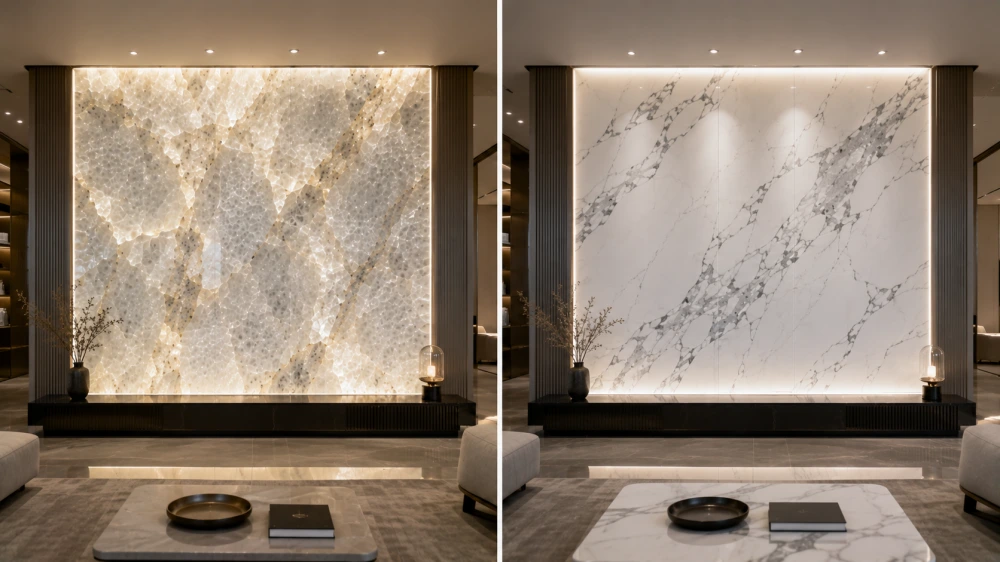
Cristallo Quartzite is generally the more relevant option when backlighting and natural translucency are central to the design concept.
The reason is not simply that Cristallo is light-colored. Selected Cristallo slabs can contain crystalline areas that transmit light, allowing a concealed lighting system to reveal internal mineral structure.
However, translucency is not necessarily uniform across a slab.
A Cristallo panel can contain:
More Translucent Zones → Greater Light Transmission
More Opaque Zones → Reduced Light Transmission
Therefore, a backlit wall should be reviewed using the actual or representative material, intended stone thickness, lighting system, cavity depth, LED arrangement, diffuser strategy and brightness.
Statuario Marble is normally selected primarily for its reflected-light appearance and grey vein composition rather than for a translucent architectural effect. If a project proposes transmitting light through any specific Statuario material, the actual slab and assembly should be tested rather than assuming behavior from the material name.
Transmitted Light vs Reflected Light: Why Does It Matter?
This distinction explains one of the biggest differences between the two feature-wall concepts.
| Lighting Principle | 크리스탈로 석영암 | 조각상 대리석 |
| Reflected Light | Reveals natural surface color, crystalline structure, opaque zones and mineral movement | Reveals white background, grey veins, surface finish and overall graphic composition |
| Transmitted Light | Can reveal internal crystalline depth where the selected material transmits light | Normally not the primary design basis; test the actual material if proposed |
| Primary Design Review | Daytime stone appearance plus any intended backlit condition | Surface appearance, vein composition and architectural lighting |
This leads to a useful design distinction:
Cristallo Feature Wall → Stone + Potential Light-Transmission System
Statuario Feature Wall → Stone + Vein Composition + Surface Lighting
Which Is Better for a Bookmatched Feature Wall?
Statuario Marble is often the more intuitive choice when dramatic bookmatched veining is the primary design objective.
Suitable consecutive marble slabs can create mirrored grey vein compositions that become the centerpiece of a lobby, reception wall, living room, fireplace surround or luxury bathroom.
Cristallo Quartzite can also be arranged in matched sequences when the actual slabs support the concept, but its visual logic can be different.
Instead of concentrating only on mirrored veins, a Cristallo layout may need to balance:
- Large translucent crystal zones
- Cloudy mineral areas
- Opaque sections
- Pale grey and ivory movement
- 자연 발생 균열 패턴
- Distribution of darker mineral marks
따라서:
Statuario Bookmatch → Vein Symmetry
Cristallo Matching → Crystal-Field and Mineral Balance
The actual slab sequence should determine what matching strategy is realistic.
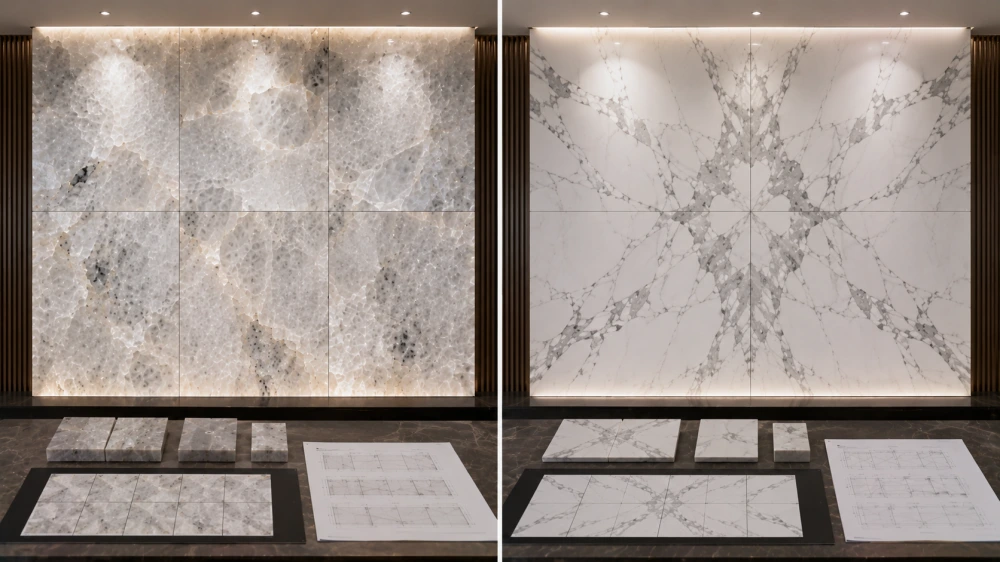
How Do Slab Layout and Seams Differ?
Feature-wall seams should be planned as part of the visual composition, not treated only as fabrication joints.
Cristallo Quartzite Layout
Review whether seams interrupt major crystalline areas, translucent zones, cloudy movement or visually concentrated mineral features. If backlighting is used, also consider whether seams, supports, backing materials or lighting transitions affect the illuminated appearance.
Statuario Marble Layout
Review where veins meet the seams. A poorly positioned joint can abruptly interrupt a major grey vein or weaken a bookmatched composition.
For both materials, prepare the wall elevation against the actual slab dimensions before cutting.
Actual Slabs → Panel Cutting Layout → Seam Review → Final Elevation Approval → Fabrication
Does Viewing Distance Matter for a White Stone Feature Wall?
Yes. A stone pattern that appears dramatic at arm’s length may read very differently across a hotel lobby or large living room.
At close range, Cristallo may emphasize individual crystal structures, mineral boundaries and subtle color variation. From farther away, those details may merge into larger cloudy fields.
Statuario behaves differently. Fine mineral details may become less important at distance while the larger grey veins continue to define the wall composition.
For a large feature wall, review both:
Close View → Surface and Mineral Detail
Primary Room View → Overall Wall Composition
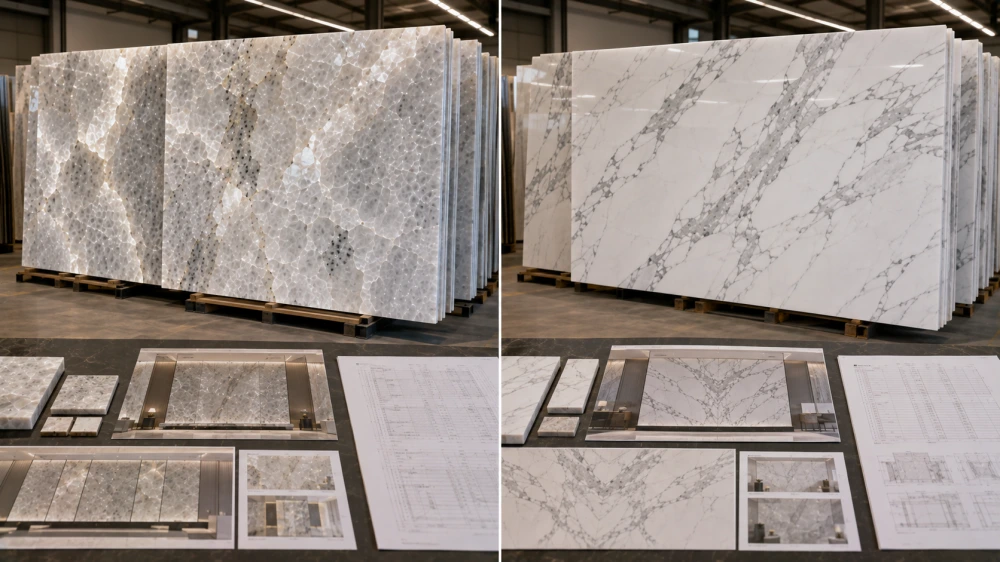
Does Surface Finish Change the Comparison?
Yes. Surface finish affects reflection, contrast, tactile appearance and how the mineral pattern is perceived.
A polished surface generally produces stronger reflections and can increase perceived contrast and depth. A honed or lower-sheen surface can create a softer appearance.
For Cristallo, the selected finish should also be reviewed together with any intended backlighting because the complete assembly determines the final visual effect.
For Statuario, finish can influence how strongly the white background and grey veins read under architectural lighting.
Do not assume that changing the finish will remove natural variation or make unrelated slabs appear identical.
What About Maintenance and Material Behavior?
Cristallo Quartzite and Statuario Marble are different natural-stone categories, so they should not be treated as technically interchangeable.
Marble is carbonate-based and requires particular attention to acidic exposure because acid-sensitive surfaces can etch. Even on an interior feature wall, cleaning products and maintenance procedures should therefore be appropriate for natural marble.
Natural Quartzite is a different geological material, but the word “Quartzite” should not be used as a blanket guarantee of every performance characteristic. Relevant physical properties, mineralogical information, finish behavior and project requirements should be reviewed for the actual material when technical performance matters.
A useful rule is:
Material Category Helps Define the Questions → Actual Material Evidence Supports the Decision
How Should Cristallo Quartzite Be Approved for a Feature Wall?
If Cristallo is selected, the approval should reflect the way the completed wall will actually be experienced.
For a non-backlit wall, focus on:
- Actual slab color
- 결정 구조
- Opaque mineral zones
- Slab-to-slab variation
- Panel sequence
- Seams
- 표면 마감 상태
- Primary viewing distance
For a backlit Cristallo wall, add separate lighting reviews:
Backlight OFF — Daytime → Natural Stone Appearance
Backlight ON — Daytime → Stone + Backlight Under Ambient Light
Backlight ON — Evening / Low Ambient → Maximum Luminous Effect
Approving only the strongest backlit condition does not automatically approve how the wall looks when the lighting system is off.
How Should Statuario Marble Be Approved for a Feature Wall?
For Statuario, the approval process should focus strongly on the actual slab composition.
Review:
- White background tone
- Grey vein scale
- Vein direction
- Concentrated dark areas
- 슬래브 순서
- Bookmatch or slip-match intent where applicable
- Panel joints
- Returns and visible edges
- 표면 마감 상태
- Daylight and architectural lighting
A small sample can confirm general color and finish direction, but it cannot show the complete vein composition of a multi-panel wall.
Small Sample → Full Slabs → Elevation Layout → Joint Review → Final Approval
Worked Example: Luxury Lobby White Feature Wall
Consider a hypothetical luxury hotel lobby requiring a large multi-panel white stone feature wall.
The interior receives strong daylight during the day and softer architectural lighting in the evening. The design team wants the wall to remain visually important under both conditions.
Option A — Cristallo Quartzite
The design team prioritizes crystalline depth and wants the wall to develop a luminous character after dark.
The approval priorities become:
- Actual slab translucency
- Distribution of translucent and opaque areas
- Crystalline field balance
- Daytime lights-off appearance
- Backlighting uniformity
- LED and diffusion mock-up
- Panel seams and support shadows
The wall becomes both a stone surface and a lighting feature.
Option B — Statuario Marble
The design team instead wants strong grey movement across a bright white wall with a recognizable marble character.
The approval priorities become:
- Actual vein direction
- Bookmatch opportunity
- White background consistency
- Major vein positions
- Seam interruption
- Primary viewing distance
- Surface-lighting interaction
The wall becomes a large-scale graphic stone composition.
The application is the same, but the approval logic is different:
Cristallo → Light + Crystal Structure + Slab Layout
Statuario → Vein Composition + White Ground + Slab Layout
Which Should You Choose for a White Feature Wall?
| Design Priority | Material Direction to Review First | 왜 그런가요? |
| Luminous crystalline appearance | 크리스탈로 석영암 | Crystalline mineral structure can create greater internal visual depth |
| Backlit feature wall | 크리스탈로 석영암 | Selected slabs may provide useful natural light transmission |
| Strong grey-on-white graphic movement | 조각상 대리석 | Grey veining becomes the dominant architectural pattern |
| Dramatic traditional bookmatch | 조각상 대리석 | Suitable consecutive slabs can create strong mirrored vein compositions |
| Day-to-night visual transformation | 크리스탈로 석영암 | A backlighting concept can create a second nighttime visual condition |
| Classic white marble identity | 조각상 대리석 | White ground and grey veining provide a recognizable marble aesthetic |
The table is a design-direction guide, not a substitute for reviewing the actual slabs.
The final material should be selected from the stone that best achieves the intended composition in the real project lighting and layout.
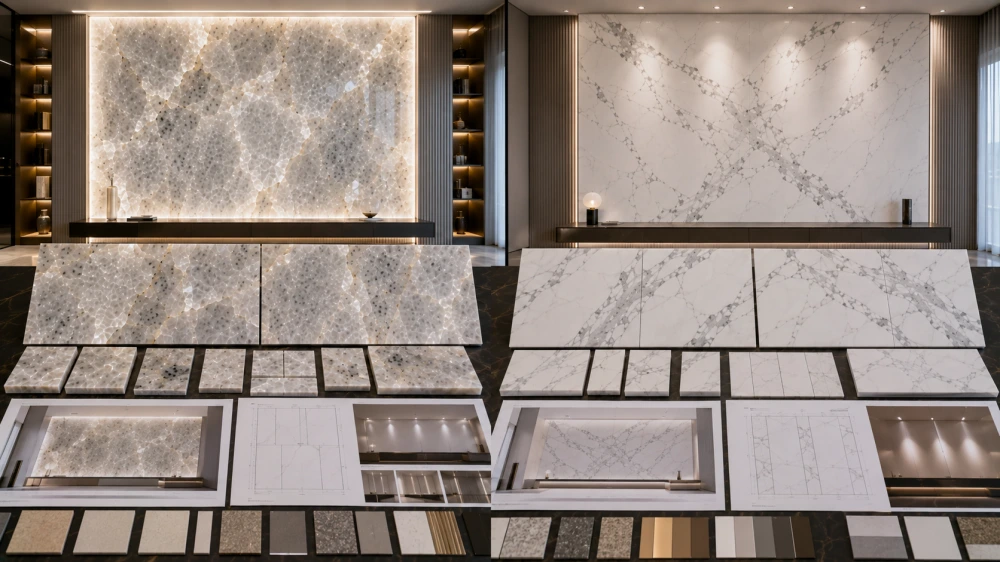
White Feature Wall Buyer Checklist
Before approving either material, confirm:
- Actual Slabs: Have the current full slabs been reviewed?
- Background Tone: Does the actual white, grey-white or ivory direction suit adjacent finishes?
- Pattern Scale: Does the crystal or vein movement work at full wall scale?
- Primary View: Has the wall been considered from its main viewing distance?
- Panel Layout: Are actual slab dimensions mapped to the elevation?
- Seams: Do joints interrupt important veins or mineral fields?
- Bookmatching: Is the proposed match supported by the actual slab sequence?
- Lighting: Has the stone been reviewed under the intended architectural lighting?
- Backlighting: If Cristallo is backlit, has the actual assembly been tested?
- Surface Finish: Has the selected finish been reviewed on representative material?
- Edges and Returns: Are visible edge conditions included in the drawings?
- 유지: Are cleaning and maintenance requirements appropriate for the selected natural stone?
- Final Approval: Is the approved slab/layout revision clearly recorded before fabrication?
구매자 FAQ
1. Is Cristallo Quartzite the same material as Statuario Marble?
No. Cristallo Quartzite and Statuario Marble are different natural-stone materials. They should not be treated as interchangeable based only on their light color. Review the actual slabs, visual structure, intended lighting, technical information and project requirements separately.
2. Is Cristallo Quartzite whiter than Statuario Marble?
Not necessarily. Cristallo can range from milky white and pale grey-white to areas with subtle ivory undertones, while Statuario can have a bright or soft white marble ground with grey veining. Actual slabs and project lighting determine the perceived white tone.
3. Can Cristallo Quartzite be backlit?
Selected Cristallo Quartzite slabs can contain translucent crystalline areas that make backlighting an important design option. Light transmission can vary across the slab, so the actual stone and proposed lighting assembly should be tested before approval.
4. Can Statuario Marble be backlit?
Statuario Marble is normally selected for its reflected-light appearance, white background and grey veining rather than as a backlighting material. If a project proposes transmitted lighting through a particular slab, test the actual material and assembly rather than assuming performance from the trade name.
5. Which is better for a bookmatched feature wall?
Statuario Marble is often the more intuitive option when dramatic mirrored grey veining is the main objective. Cristallo can also be arranged in matched layouts, but its composition may depend more on crystalline fields, translucent zones and mineral balance than on traditional vein symmetry.
6. Which material has stronger visible veining?
Statuario Marble is generally selected specifically for visible grey veining against a white background. Cristallo Quartzite more often reads through crystalline, cloudy and translucent mineral structures, although actual slabs vary.
7. Should full slabs be approved before fabricating a feature wall?
Yes. A small sample cannot show the complete pattern, vein direction, crystalline structure, variation or usable layout of a large multi-panel wall. Review the actual full slabs and proposed cutting layout before fabrication.
8. Which is easier to maintain on an interior feature wall?
Maintenance depends on the actual stone, finish, location and cleaning system. Marble requires particular attention to acid-sensitive cleaning because acidic substances can etch carbonate stone. Natural Quartzite is a different material category, but its maintenance and technical characteristics should still be confirmed for the actual stone rather than assumed from the name alone.
마지막 메모
Cristallo Quartzite and Statuario Marble can both create exceptional white feature walls, but they achieve that result through different visual systems. Choose Cristallo when crystalline depth, potential translucency and day-to-night lighting effects are central to the design. Choose Statuario when a white marble ground, expressive grey veining and strong bookmatched or directional composition are the priorities. In both cases, make the final decision from the actual slabs, project lighting, elevation layout, seams, finish and viewing conditions rather than from a trade name or small sample alone.
Discuss Your White Feature Wall with HRST STONE
For a project-specific comparison, contact Josh at HRST STONE with the material direction under consideration, current slab or sample references, feature-wall elevation, panel dimensions, quantities, required surface finish, lighting concept, visible edge details and delivery destination. These inputs make it possible to review Cristallo Quartzite or other Natural Quartzite options against the actual design and fabrication scope.
저작권 (c) HRST STONE / XIAMEN HRST STONE CO., LTD. 모든 권리 보유.